









MODULE 3 — WHAT IS AN ESD MAT?
ESD MAT BASICS
What Is an ESD Mat?
Short Answer
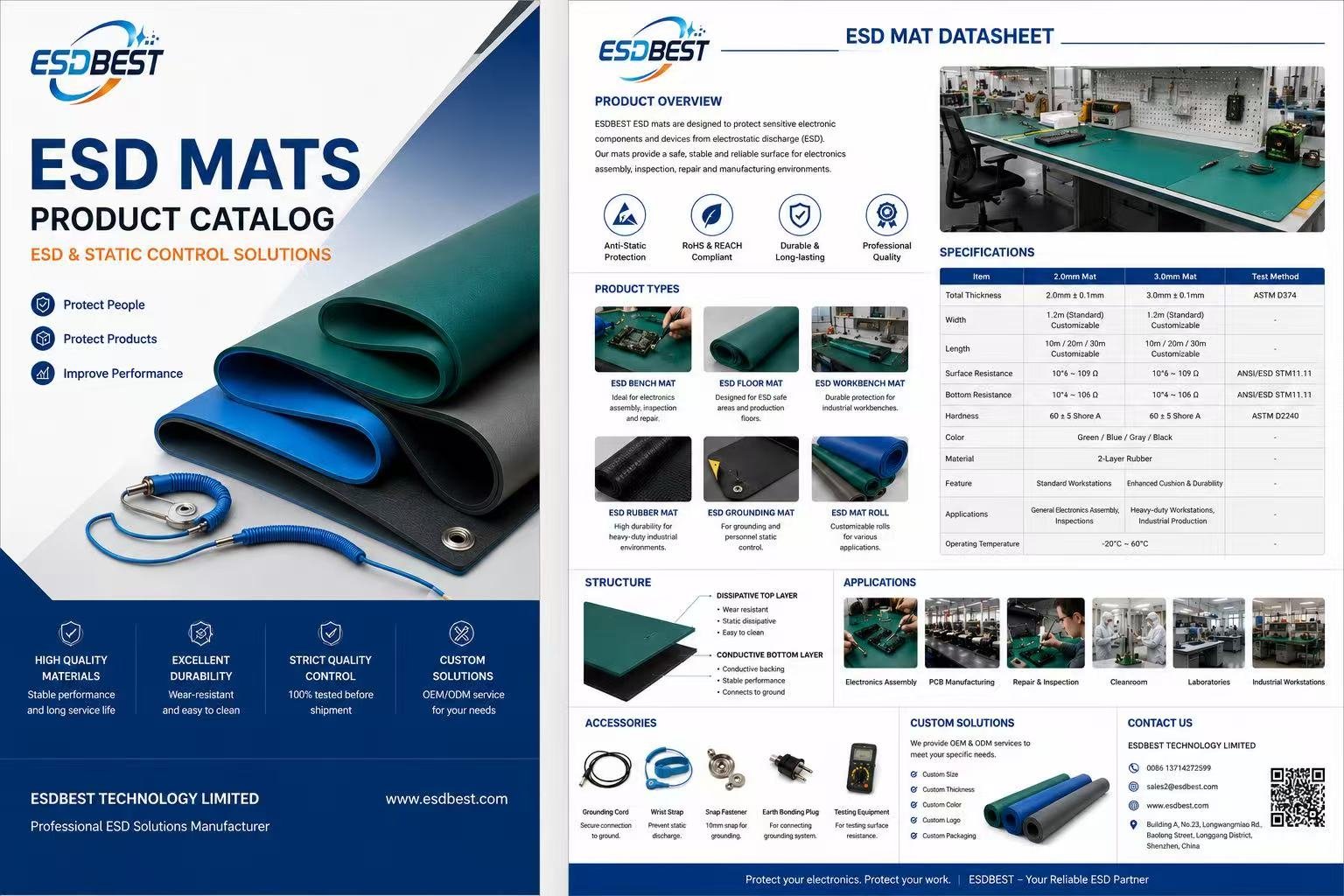
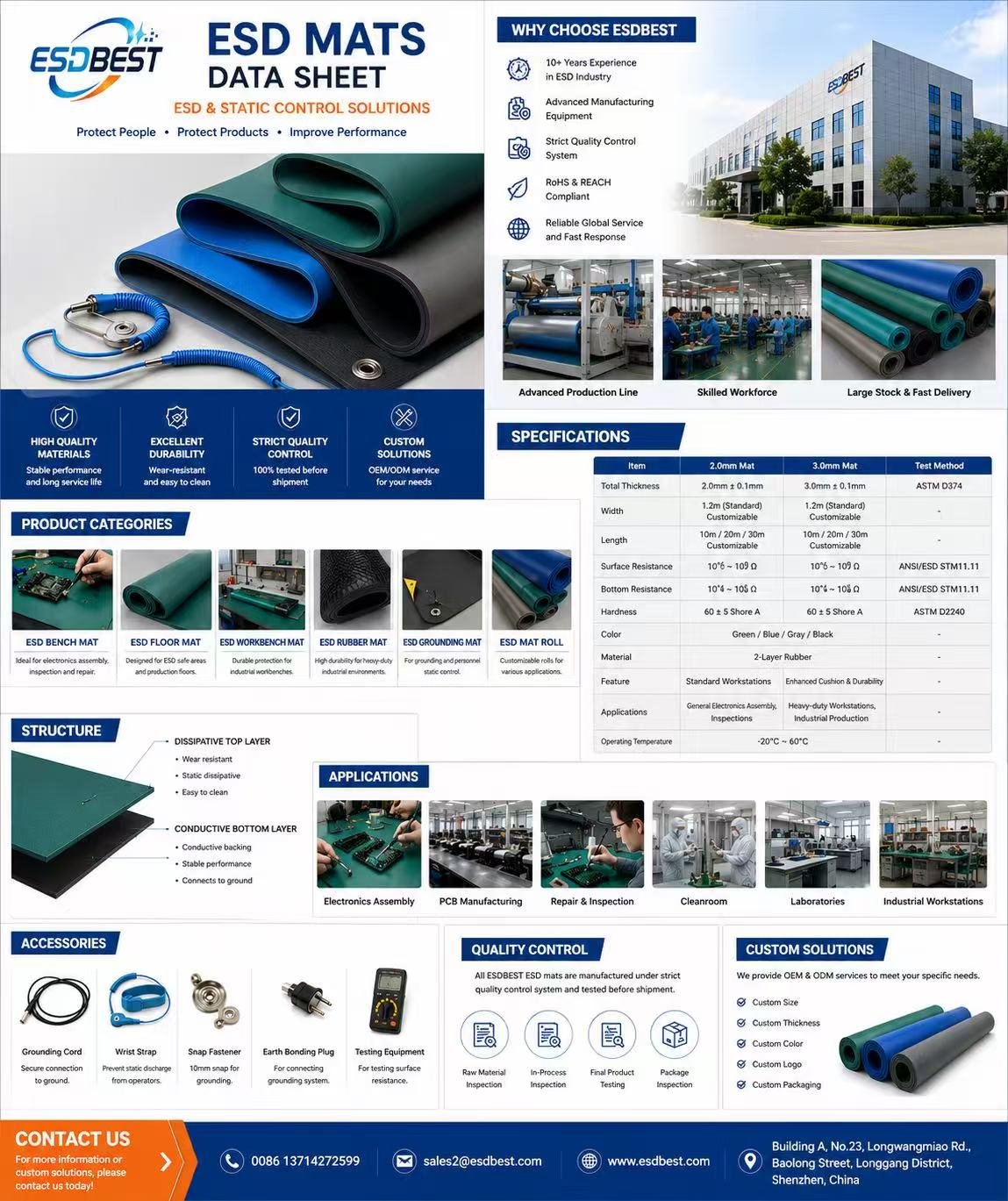
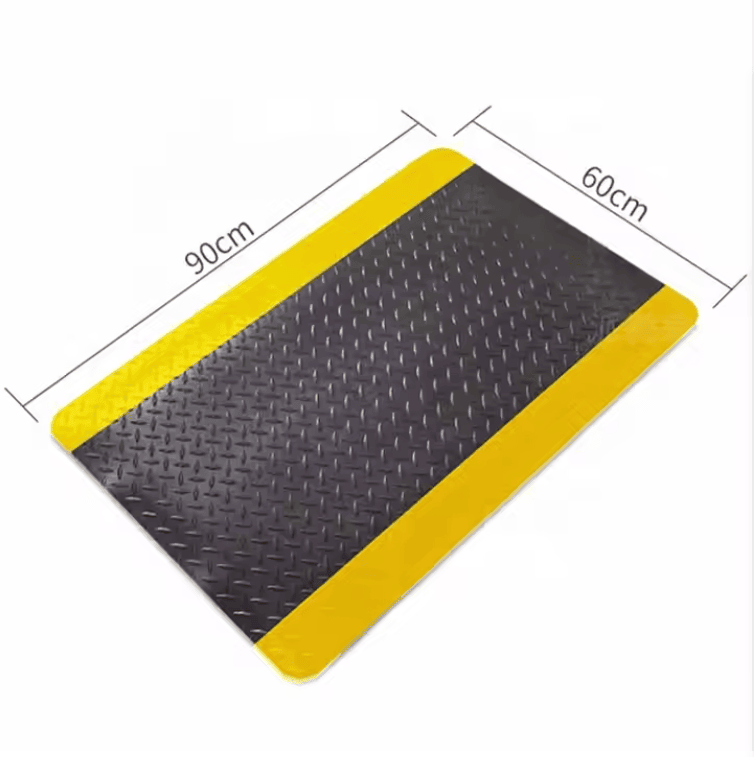
An ESD mat is a specially engineered work-surface or floor material designed to control electrostatic charge in areas where sensitive electronic components are handled.
Unlike an ordinary rubber, vinyl or plastic mat, a properly selected ESD mat provides a controlled electrical path that allows accumulated static charge to move safely toward ground.
ESD mats are commonly installed on electronics workbenches, PCB assembly stations, SMT production lines, repair benches, laboratories, cleanrooms and factory floors.
They are usually used together with grounding cords, common-point grounds, wrist straps, ESD footwear and other static-control equipment.
MAIN EXPLANATION
An ESD Mat Is a Controlled Static-Dissipation Surface
Static electricity can build up when two materials contact, separate or move against each other.
Common examples include:
An operator moving on a chair
Shoes contacting a floor
Plastic packaging being opened
Components moving across a work surface
Tools, trays or containers contacting a bench
Protective films being removed
Clothing rubbing against the body
PCBs being placed on an unsuitable surface
In an uncontrolled environment, this electrical charge may remain on a person, object or work surface.
When the charged object contacts a component, tool or grounded conductor, the charge may discharge suddenly.
This event is known as electrostatic discharge.
An ESD mat helps reduce this risk by creating a defined surface through which charge can be controlled and, when properly grounded, directed away from the work area.
The purpose is not simply to make the surface “anti-static.”
The purpose is to create a predictable and controlled electrical path.
Why Ordinary Mats Are Not Suitable for Sensitive Electronics
An ordinary desk mat or rubber sheet may look similar to an ESD mat, but appearance alone does not indicate electrical performance.
Some ordinary materials are highly insulating.
Instead of allowing charge to dissipate, they may hold static electricity on the surface.
Other materials may be too conductive for the intended application and allow charge to move too quickly.
For sensitive electronics handling, both extremes can create problems.
A professional ESD mat should therefore be selected according to measurable electrical properties rather than:
Color
Surface texture
Thickness alone
Marketing labels
Price alone
Visual appearance
The word “rubber”
The word “anti-static”
The correct mat should have a documented resistance range that matches the intended ESD-control application.
HOW AN ESD MAT WORKS
How Does an ESD Mat Control Static Electricity?
An ESD mat works by controlling how electrical charge moves across and through the mat material.
In a typical grounded workstation, charge follows a controlled path:
Operator or object → ESD mat → grounding cord → common-point ground → verified earth ground
The exact route depends on the workstation design, but the principle remains the same.
Charge should not remain trapped on the work surface, and it should not discharge unpredictably through sensitive electronic components.
THE FOUR-STAGE STATIC-CONTROL PROCESS
Display as four connected horizontal steps on desktop and a vertical timeline on mobile.
STEP 1 — STATIC CHARGE IS GENERATED
Static charge may develop through movement, friction, separation or contact between materials.
Examples include:
An operator reaching across a bench
A PCB sliding on a surface
Packaging being removed
A chair moving
A component tray being handled
STEP 2 — THE CHARGE CONTACTS THE MAT
The operator, PCB, tool, tray or component is placed on or connected to the ESD-protected work surface.
The ESD mat provides a surface with controlled electrical resistance.
STEP 3 — THE CHARGE MOVES TOWARD GROUND
The charge moves through the mat and grounding connection at a controlled rate.
This reduces the possibility of a sudden high-energy discharge.
STEP 4 — THE CHARGE IS SAFELY DISSIPATED
The grounding system carries the charge away from the protected work area.
The workstation is returned toward a more stable electrical condition.
SIMPLE WORKSTATION DIAGRAM
How a Grounded ESD Mat Works
Diagram Labels
Operator wearing an ESD wrist strap
Sensitive PCB on ESD mat
Static-dissipative top surface
Mat grounding snap
Grounding cord
Common-point ground
Verified earth ground
Optional ESD floor mat
ESD footwear or heel grounder
Diagram Flow
Operator + PCB + Tools
↓
ESD Work Surface
↓
Grounding Cord
↓
Common-Point Ground
↓
Earth Ground
Suggested Diagram Caption
A complete ESD workstation controls charge on the operator, work surface and handled devices through a coordinated grounding system.

Diagram showing an ESD mat connected through a grounding cord and common-point ground to earth
WHAT IS AN ESD MAT MADE OF?
Common ESD Mat Materials and Construction
ESD mats can be manufactured from several materials and structures.
The correct choice depends on the application, expected service life, heat exposure, chemical exposure, cleaning method, resistance requirement and budget.
1. TWO-LAYER ESD RUBBER MAT
A two-layer ESD rubber mat is one of the most common choices for electronics workbenches.
It normally includes:
A static-dissipative working surface
A conductive or lower-resistance bottom layer
The upper layer helps control charge around sensitive components, while the lower layer supports movement toward the grounding point.
Common Applications
PCB assembly
SMT inspection
Electronics repair
Soldering stations
Testing benches
Quality-control workstations
Main Advantages
Durable surface
Good abrasion resistance
Suitable for frequent use
Commonly available in rolls
Easy to custom cut
Compatible with grounding hardware
Suitable for professional ESD workstations
2. SINGLE-LAYER ESD MAT
A single-layer mat is manufactured from one homogeneous material.
Its electrical characteristics are intended to remain consistent through the material rather than being divided into separate top and bottom layers.
Common Applications
General assembly
Temporary workstations
Light-duty production
Custom-cut projects
Selected bench or floor uses
Main Advantages
Simple construction
Flexible sizing
Easy installation
Lower material complexity
Suitable for selected cost-sensitive applications
Important Consideration
A single-layer mat should still be evaluated based on resistance, grounding requirements and actual application.
Single-layer does not automatically mean lower quality, and two-layer does not automatically mean suitable for every environment.
3. ESD PVC OR VINYL MAT
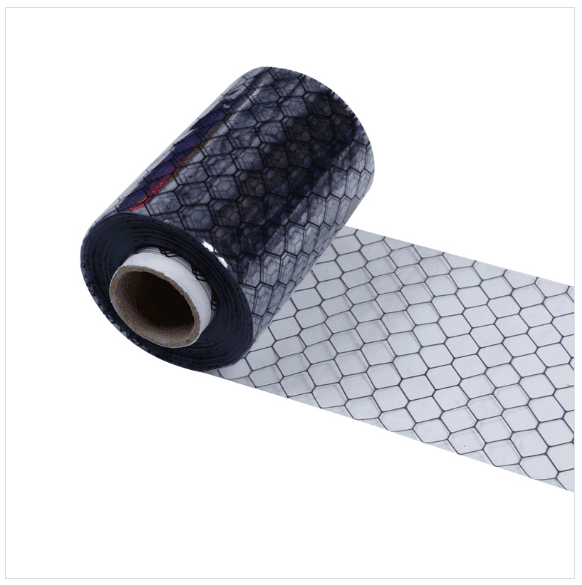
ESD PVC and vinyl mats are flexible materials used in selected bench, packing and floor applications.
Common Applications
Light-duty assembly
Packing areas
Temporary workstations
Indoor production areas
Selected clean environments
Work surfaces requiring easy cutting
Main Advantages
Flexible
Lightweight
Smooth surface
Easy to clean
Available in multiple colors
Suitable for roll supply
Important Consideration
PVC and vinyl materials may respond differently to heat, chemicals, abrasion and long-term environmental exposure compared with rubber mats.
The material should be selected based on the actual operating conditions.
4. ESD FLOOR MATTING
ESD floor mats are designed for operators who stand or move within static-controlled areas.
They may be made from rubber, vinyl or other engineered materials.
Some products also provide anti-fatigue properties.
Common Applications
Standing workstations
Assembly lines
Equipment zones
Production cells
Inspection areas
Repair areas
Important Consideration
A floor mat is only one part of the operator-grounding system.
Its effectiveness may depend on:
Grounding method
ESD footwear
Heel grounders
Floor condition
Operator movement
Cleaning and contamination
Resistance verification
ESD MAT RESISTANCE EXPLAINED
Why Electrical Resistance Matters
Electrical resistance determines how easily charge can move through or across the mat.
A mat with very high resistance may hold charge for too long.
A mat with very low resistance may allow charge to move too quickly for some applications.
For this reason, ESD mat selection should focus on controlled dissipation rather than simply choosing the lowest possible resistance.
THREE COMMON RESISTANCE CATEGORIES
Display as three comparison cards.
CARD 1 — INSULATIVE MATERIAL
General Description
An insulative material strongly restricts the movement of electrical charge.
Common Examples
Ordinary plastic
Acrylic
Untreated packaging films
Some conventional rubber materials
Glass
Dry synthetic surfaces
Risk in Electronics Areas
Charge may remain on the material and discharge unexpectedly when a conductive path becomes available.
Recommendation
Insulative materials should be controlled, removed or managed carefully within ESD-sensitive work areas.
CARD 2 — STATIC-DISSIPATIVE MATERIAL
General Description
A static-dissipative material allows charge to move in a controlled manner.
Common Use
This is often the preferred category for electronics work surfaces because it balances charge movement with controlled discharge.
Typical Applications
ESD bench mats
PCB handling surfaces
Electronics repair stations
SMT inspection benches
Component testing areas
Main Benefit
Charge is reduced gradually rather than remaining trapped or discharging suddenly.
CARD 3 — CONDUCTIVE MATERIAL
General Description
A conductive material allows charge to move relatively easily.
Common Use
Conductive materials may be used in specialized mat layers, flooring systems, grounding components or applications with defined low-resistance requirements.
Important Warning
Conductive does not automatically mean safer or better.
The suitability depends on the full ESD-control design, grounding system and risk assessment.
Expert Note
The terms “anti-static,” “static-dissipative” and “conductive” are often used loosely in product listings.
Buyers should request measurable electrical specifications and test conditions rather than relying only on product names.
Internal Link
Learn more about the differences between conductive and static-dissipative mats.
ESD MAT VS ANTI-STATIC MAT
Is an ESD Mat the Same as an Anti-Static Mat?
Not always.
The terms are often used interchangeably in the market, but they can describe different levels of performance.
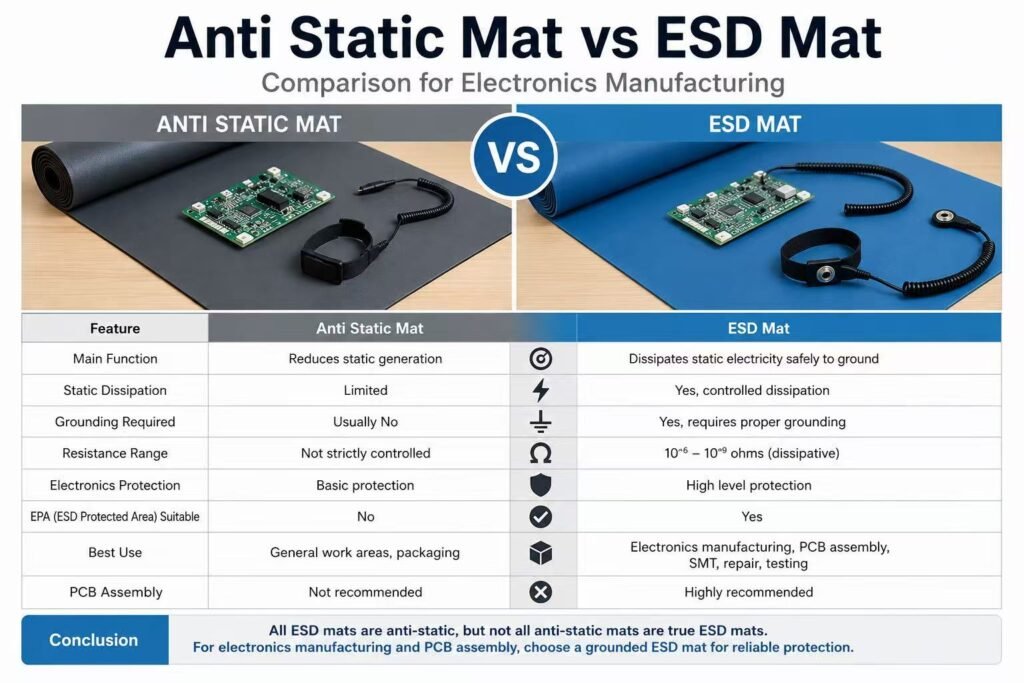
An anti-static mat may be designed mainly to reduce charge generation.
An ESD mat used in electronics manufacturing is normally expected to provide measurable and controlled electrical performance as part of a grounded workstation.
The key difference is not the label.
The key difference is whether the material:
Has a defined resistance range
Can be tested
Can be connected to ground
Supports the required ESD-control process
Is suitable for the intended application
Maintains performance during normal use
QUICK COMPARISON TABLE
| Feature | Ordinary Mat | Anti-Static Mat | Professional ESD Mat |
|---|---|---|---|
| Designed for electronics protection | No | Sometimes | Yes |
| Defined resistance range | Usually no | May be limited | Should be specified |
| Grounding connection | Usually no | Optional | Commonly required |
| Suitable for PCB handling | Not recommended | Depends on specification | Yes, when correctly selected |
| Resistance testing | Usually unavailable | Sometimes available | Recommended |
| Part of complete ESD workstation | No | Sometimes | Yes |
| Suitable for controlled production | No | Application-dependent | Yes |
WHERE ARE ESD MATS USED?
Common ESD Mat Applications
ESD mats are used wherever static-sensitive devices, assemblies or components may be exposed to electrostatic discharge.
APPLICATION CARD 1
PCB Assembly
ESD mats provide a controlled work surface for placing, assembling, inspecting and repairing printed circuit boards.
Typical Activities
Component placement
Manual assembly
Soldering
Inspection
Testing
Rework
APPLICATION CARD 2
SMT Production
ESD mats are used at inspection, repair, feeder preparation, quality-control and manual handling stations around SMT production lines.
Typical Activities
Reel handling
Feeder preparation
PCB inspection
Rework
Defect analysis
Component handling
APPLICATION CARD 3
Electronics Repair
Repair benches often involve exposed circuit boards, replacement components, soldering tools and repeated operator contact.
A grounded ESD work surface helps create a more controlled repair environment.
Typical Activities
Mobile device repair
Computer repair
Industrial control repair
Power-supply repair
Instrument repair
Consumer electronics service
APPLICATION CARD 4
Laboratories
Laboratories use ESD mats when testing, prototyping or analyzing electronic devices and assemblies.
Typical Activities
Research and development
Prototype assembly
Electrical testing
Failure analysis
Measurement
Product validation
APPLICATION CARD 5
Cleanrooms
Selected ESD mats may be used in clean environments where particle control, cleaning compatibility and static control are both important.
Selection Factors
Material shedding
Chemical resistance
Cleaning method
Surface finish
Resistance stability
Contamination control
APPLICATION CARD 6
Electronics Warehouses and Packing Areas
ESD-controlled surfaces may be used when unpacking, storing, sorting or repacking static-sensitive components.
Typical Activities
Component receiving
Inventory handling
Kitting
ESD packaging
Order preparation
Quality inspection
APPLICATION CARD 7
Factory Floors
ESD floor mats are installed where operators stand, move or work around static-sensitive equipment.
Typical Activities
Assembly
Inspection
Testing
Machine operation
Repair
Material transfer
Suggested Link
/esd-floor-mat/
APPLICATION CARD 8
Training and Education
Electronics training centers and technical schools may use ESD mats to teach correct PCB handling and workstation grounding practices.
Typical Activities
Soldering training
Electronics courses
PCB design laboratories
Repair instruction
ESD awareness training
WHAT DOES AN ESD MAT PROTECT?
Devices and Components Commonly Protected by ESD Mats
ESD mats may help protect a wide range of static-sensitive items, including:
Integrated circuits
Microprocessors
Memory devices
MOSFETs
Sensors
LEDs
Printed circuit boards
Surface-mount components
Semiconductor devices
Control modules
Communication modules
Medical electronics
Automotive electronic assemblies
Aerospace electronic assemblies
Measurement instruments
Some ESD damage causes an immediate failure.
Other damage may weaken a device without causing an obvious defect during initial testing.
This is one reason static control must be treated as a process rather than only as a visible safety measure.
TYPES OF ESD MATS
Main Types of ESD Mats
1. ESD BENCH MAT
Installed on top of a workbench or table.
Best For
PCB handling
Soldering
Assembly
Inspection
Testing
Repair
2. ESD WORKBENCH MAT
A workbench mat is often supplied as part of a complete workstation configuration.
Typical System Includes
ESD mat
Grounding cord
Common-point ground
Wrist strap connection
Ground plug
Optional monitor or tester
3. ESD FLOOR MAT
Installed below or around standing workstations.
Best For
Standing operators
Production cells
Assembly lines
Repair zones
Equipment areas
4. ESD GROUNDING MAT
A groundable mat designed to provide a controlled electrical path when connected to an approved grounding point.
Best For
Electronics benches
Temporary ESD workstations
Service areas
Laboratories
Field repair setups
5. ANTI-FATIGUE ESD MAT
A floor mat designed to combine static control with operator comfort.
Best For
Long standing periods
Assembly stations
Inspection stations
Production lines
Machine-operation areas
Important Consideration
Comfort performance should not replace electrical performance verification.
Both functions should be evaluated separately.
6. CUSTOM-CUT ESD MAT
Manufactured or cut to match specific bench dimensions, equipment layouts or production requirements.
Custom Options May Include
Length
Width
Thickness
Color
Resistance range
Surface texture
Grounding snap location
Logo
Packaging
Roll or sheet format
WHY DOES AN ESD MAT NEED GROUNDING?
An ESD Mat Without Grounding Is an Incomplete System
An ESD mat may have the correct electrical properties, but charge still needs a defined route away from the work surface.
Without a proper grounding connection, charge may remain on the mat or dissipate inconsistently.
A typical grounding system includes:
Grounding snap
Mat grounding cord
Common-point ground
Approved grounding point
Wrist-strap connection
Verified earth ground
The grounding connection should be inspected and tested as part of routine workstation maintenance.
Internal Links
How to ground an ESD mat:
/how-to-ground-esd-mat/Why ESD mats need grounding:
/why-esd-mats-need-grounding/
GROUNDING WARNING BOX
Important
Do not connect an ESD mat to an unknown metal object, unverified pipe, painted surface or improvised grounding point.
The workstation ground should be approved and verified according to the facility’s electrical and ESD-control procedures.
ESD MAT AND WRIST STRAP
Why a Mat and Wrist Strap Are Often Used Together
An ESD mat controls charge on the work surface and objects placed on it.
A wrist strap controls charge on the operator.
These are different functions.
A bench mat cannot always replace operator grounding, and a wrist strap cannot replace a controlled work surface.
A complete seated workstation commonly includes:
ESD bench mat
Mat grounding cord
Common-point ground
Wrist strap
Wrist-strap cord
Verified grounding point
Routine continuity testing
This coordinated system helps place the operator, work surface and handled devices within a more controlled electrical environment.
HOW TO IDENTIFY A REAL ESD MAT
Do Not Rely on Color or Product Labels
A blue, green, gray or black mat is not automatically an ESD mat.
A product should be evaluated through documentation and testing.
BUYER VERIFICATION CHECKLIST
Before purchasing, ask the supplier for:
1. Resistance Specification
Request the stated surface resistance, point-to-point resistance or resistance-to-ground range.
2. Test Method
Confirm how the material was tested and under what conditions.
3. Mat Construction
Ask whether the product is single-layer, two-layer, rubber, PVC, vinyl or another material.
4. Grounding Compatibility
Confirm whether grounding snaps, cords and common-point-ground accessories are available.
5. Thickness and Tolerance
Check the nominal thickness and acceptable manufacturing tolerance.
6. Material Performance
Ask about resistance to heat, chemicals, abrasion, curling and wear.
7. Available Documentation
Request relevant technical data, test reports or product specifications.
8. Application Recommendation
Confirm that the mat is suitable for your exact use, not merely marketed as “anti-static.”
HOW TO TEST AN ESD MAT
Electrical Performance Should Be Verified
Testing helps determine whether the mat and grounding system are performing as expected.
Common checks may include:
Surface resistance
Point-to-point resistance
Resistance to ground
Grounding-cord continuity
Grounding-snap condition
Workstation ground verification
Visual inspection
Cleaning-condition review
Testing frequency depends on the facility’s ESD-control program, risk level, usage and internal procedures.
ESD Mat Resistance Explained
TESTING PROCESS — 5 STEPS
Display as five numbered icons.
STEP 1
Clean and condition the mat according to the approved procedure.
STEP 2
Inspect the surface, grounding snap and cord for visible damage.
STEP 3
Position the resistance meter and electrodes according to the selected test method.
STEP 4
Record surface, point-to-point or ground-resistance readings.
STEP 5
Compare results with the product specification and facility requirements.
WHAT HAPPENS WITHOUT AN ESD MAT?
Risks of Using an Uncontrolled Work Surface
Without a suitable ESD work surface, static charge may accumulate on:
Operators
Plastic trays
Tools
Packaging
Chairs
Ordinary tabletops
Component containers
Workbench accessories
Potential consequences include:
Immediate component failure
Hidden or latent damage
Unstable product performance
Increased rework
Intermittent failures
Inspection escapes
Warranty claims
Customer returns
Difficult fault diagnosis
Reduced process reliability
An ESD mat does not eliminate every electrostatic risk by itself.
It is one part of a complete ESD-control system.
LIMITATIONS OF AN ESD MAT
What an ESD Mat Cannot Do Alone
An ESD mat is important, but it cannot compensate for weaknesses in the rest of the ESD-control program.
A mat cannot by itself:
Ground an operator who is not connected
Neutralize charge on isolated insulators
Replace an ionizer where ionization is required
Verify that the earth connection is correct
Prevent charge from unsuitable clothing
Correct poor PCB-handling practices
Replace ESD packaging
Replace resistance testing
Replace employee training
Maintain performance when heavily contaminated
Effective static control requires coordinated products, procedures, testing and training.
COMPLETE ESD WORKSTATION COMPONENTS
What Should Be Used With an ESD Mat?
Display as eight icon cards.
1. Wrist Strap
Controls charge on a seated operator.
2. Common-Point Ground
Provides a shared grounding location for the mat and operator.
3. Grounding Cord
Connects the mat to the grounding system.
4. ESD Footwear
Supports operator grounding in standing or walking applications.
5. ESD Floor Mat
Controls floor-level charge in selected work areas.
6. Ionizer
Helps neutralize charge on insulating materials and isolated objects.
7. ESD-Safe Tools and Containers
Reduce charge generation and uncontrolled contact around sensitive devices.
8. Resistance Tester
Verifies electrical performance and grounding continuity.
ESD MAT SELECTION FACTORS
How to Choose the Correct ESD Mat
Before selecting a mat, identify the following:
Application
Will it be used on a bench, floor, production line, packing table or laboratory surface?
Device Sensitivity
What types of components or assemblies will be handled?
Resistance Requirement
Does the facility require static-dissipative, conductive or another defined range?
Mat Construction
Is rubber, PVC, vinyl, single-layer or two-layer material more suitable?
Thickness
Is the priority flexibility, durability, cushioning or easy handling?
Grounding Method
How will the mat connect to the workstation ground?
Environment
Will it be exposed to heat, solder, oils, chemicals, humidity, abrasion or frequent cleaning?
Size
Is a custom-cut sheet, full bench covering or roll material required?
Quantity
Is the requirement for one workstation, multiple production lines or distributor stock?
Documentation
Are technical data, resistance records, inspection reports or custom labeling required?
ESD MAT CLEANING AND MAINTENANCE
Contamination Can Affect Performance
Dust, oil, flux, adhesive residue, cleaning chemicals and general factory contamination may influence surface condition and electrical performance.
A maintenance procedure should include:
Approved cleaning materials
Defined cleaning frequency
Visual inspection
Grounding-cord inspection
Snap inspection
Resistance testing
Damage recording
Replacement criteria
Avoid using unapproved waxes, polishes, silicone cleaners or residue-forming products.
Cleaning chemicals should be compatible with the mat material and the facility’s ESD-control procedure.
WHEN SHOULD AN ESD MAT BE REPLACED?
Replace Based on Condition and Performance, Not Age Alone
An ESD mat may require replacement when:
Resistance readings are outside the required range
The mat is cracked
The surface is deeply cut
Layers are separating
Edges are curling
Grounding snaps are loose or damaged
Chemical exposure has changed the surface
The mat cannot be properly cleaned
Permanent contamination is present
Heat damage is visible
The working surface is excessively worn
A mat that still looks acceptable may fail electrically.
A mat that shows cosmetic wear may still perform correctly.
Testing should guide the replacement decision.
How Long Do ESD Mats Last?
COMMON ESD MAT MISTAKES
Eight Mistakes to Avoid
Mistake 1
Buying a mat based only on the words “anti-static.”
Mistake 2
Assuming every rubber mat is ESD-safe.
Mistake 3
Using the mat without grounding it.
Mistake 4
Connecting the mat to an unverified ground.
Mistake 5
Placing plastic sheets, paper or insulating materials over the mat.
Mistake 6
Using household cleaners that leave a residue.
Mistake 7
Never testing resistance after installation.
Mistake 8
Assuming a mat replaces wrist straps, footwear or operator training.
MYTH VS FACT
Display as four two-column cards.
MYTH 1
Myth
Any rubber mat can protect a PCB.
Fact
Ordinary rubber may be insulating and may hold charge. Electrical properties must be verified.
MYTH 2
Myth
The lowest-resistance mat is always the best.
Fact
The correct mat provides controlled performance suitable for the application.
MYTH 3
Myth
A grounded mat protects the operator automatically.
Fact
Operator grounding normally requires a wrist strap, footwear or another approved method.
MYTH 4
Myth
An ESD mat never needs testing.
Fact
Wear, contamination, damage and grounding faults may affect performance over time.
QUICK ANSWER BOX
What Is an ESD Mat in One Sentence?
An ESD mat is a tested, groundable work-surface or floor material that helps control electrostatic charge around sensitive electronic devices.
ESD MAT FAQ
1. What does ESD mat mean?
ESD mat means electrostatic-discharge-control mat. It is designed to reduce and control static charge in electronics work areas.
2. Does an ESD mat stop static electricity?
It helps control and dissipate charge, but it does not eliminate all static sources. A complete system may also require grounding, wrist straps, footwear, ionizers and controlled handling procedures.
3. Does an ESD mat need to be grounded?
In most professional electronics workstations, yes. Grounding provides a defined path for charge to leave the mat.
4. Can I use an ESD mat without a wrist strap?
The mat controls the work surface, while the wrist strap controls the operator. A seated operator handling sensitive components commonly needs both.
5. Is an anti-static mat the same as an ESD mat?
Not necessarily. “Anti-static” may describe charge-reducing behavior, while a professional ESD mat should have measurable electrical properties suitable for a grounded workstation.
6. What color is an ESD mat?
ESD mats may be blue, green, gray, black or other colors. Color does not confirm electrical performance.
7. What is the best ESD mat for PCB assembly?
A static-dissipative, groundable workbench mat with suitable resistance, durable construction and compatible grounding accessories is commonly selected for PCB assembly.
8. Can an ESD mat be cut to size?
Many ESD mats can be supplied as rolls or custom-cut sheets. Care should be taken not to damage layered construction or grounding points.
9. How thick should an ESD mat be?
The correct thickness depends on durability, comfort, flexibility and application. Professional bench mats are commonly selected in a moderate thickness that balances handling and durability.
10. How do I know whether an ESD mat is working?
Test surface resistance, point-to-point resistance, resistance to ground and grounding-cord continuity using suitable equipment and procedures.
11. Can I solder directly on an ESD mat?
This depends on the mat’s heat resistance. Hot soldering tips should not be intentionally placed on the mat, and a suitable soldering-iron holder should always be used.
12. Can an ESD floor mat replace ESD shoes?
Not automatically. Floor-level operator grounding usually depends on the combination of the floor surface, footwear and verified system resistance.
SIDEBAR CONTENT
SIDEBAR CARD 1 — QUICK DEFINITION
What Is an ESD Mat?
A groundable surface that helps move static charge away from sensitive electronics at a controlled rate.
SIDEBAR CARD 2 — BEST USED FOR
PCB assembly
SMT inspection
Electronics repair
Laboratories
Cleanrooms
Factory workbenches
Standing production areas
SIDEBAR CARD 3 — REQUIRED COMPONENTS
ESD mat
Grounding cord
Common-point ground
Verified earth
Operator grounding
Routine testing
SIDEBAR CARD 4 — RELATED GUIDES
ESD Bench Mats
ESD Floor Mats
How to Ground an ESD Mat
How to Test an ESD Mat
Conductive vs Dissipative Mats
ESD Mat Resistance Explained
SIDEBAR CARD 5 — EXPERT CTA
Need Help Selecting an ESD Mat?
Send your application, dimensions, thickness, resistance requirement and quantity.
Button: Ask an ESD Specialist
Link: /contact-us/
Need an ESD Mat for a Workbench, Production Line or Factory Floor?
Tell ESDBEST where the mat will be installed, what products will be handled and what resistance, size, thickness and quantity you require.
Our team can recommend a suitable mat construction, grounding method and accessory configuration.
Scene
A real electronics workstation showing:
ESD bench mat
PCB
Wrist strap
Grounding cord
Common-point ground
Soldering tools
Organized production environment

IMAGE 2 — ESD MAT CROSS-SECTION
Scene
A technical cross-section comparing:
Static-dissipative top layer
Conductive bottom layer
Grounding snap
Grounding cord
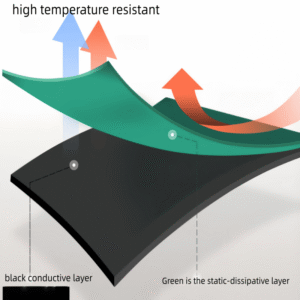
IMAGE 3 — STATIC CHARGE FLOW
Scene
A clear process illustration showing:
Operator → Mat → Grounding Cord → Common Point → Earth
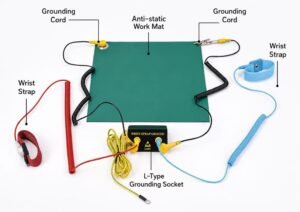
IMAGE 4 — ORDINARY MAT VS ESD MAT
Scene
Side-by-side comparison:
Left: ordinary plastic or rubber surface holding static charge
Right: grounded ESD mat dissipating charge safely
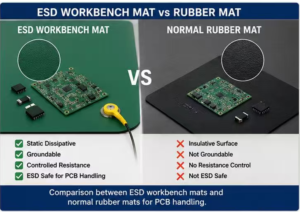
IMAGE 5 — RESISTANCE TEST
Scene
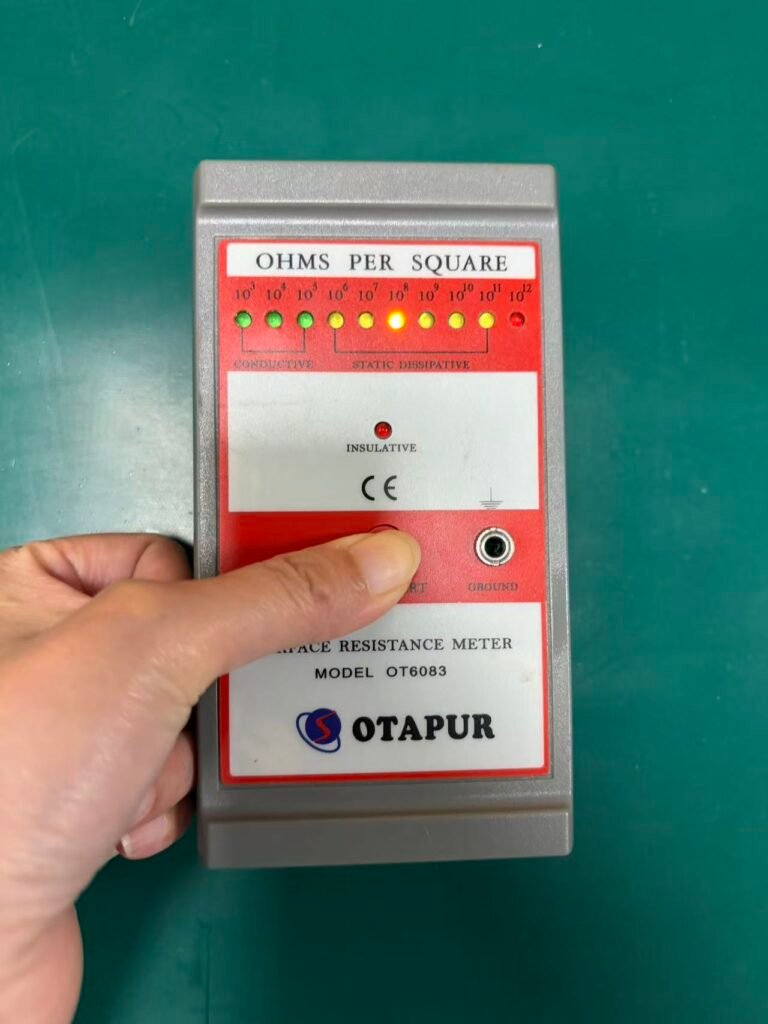
ACL800 or suitable surface-resistance tester with two electrodes positioned on an ESD mat.

Module 4
Types of ESD Mats
Types of ESD Mats for Different Applications
Selecting the right ESD mat depends on your working environment, production process, and electrostatic protection requirements. Although all ESD mats are designed to safely dissipate static electricity, different applications require different structures, sizes, and resistance characteristics.
Choosing the appropriate mat helps improve product reliability, operator safety, and compliance with ANSI/ESD S20.20 and IEC 61340 standards.
Bench ESD Mats



Bench mats are the most commonly used static control mats in electronics manufacturing.
They are installed directly on workbenches where sensitive electronic components are assembled, repaired, inspected, or tested.
Typical applications include:
- PCB assembly
- SMT production
- Electronic repair
- Semiconductor laboratories
- Quality inspection stations
Typical Features
✓ Two-layer construction
✓ Grounding snap
✓ Heat resistant
✓ Chemical resistant
✓ Easy to clean
Recommended Surface Resistance
10⁶–10⁹ Ω
Learn More →
https://esdbest.com/esd-bench-mat/
ESD Floor Mats
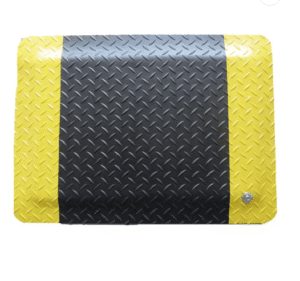
Floor mats protect operators from electrostatic charge generated while walking. When connected to earth ground and combined with ESD footwear, floor mats create a complete personnel grounding system. Common Industries
• Electronics factories
• Medical device production
• Aerospace
• Automotive electronics
• Cleanrooms Recommended Resistance 10⁶–10⁹ Ω
Learn More →
esd-floor-mat
ESD Workbench Mats
Workbench mats combine large working areas with excellent static dissipation.
They are ideal for:
- Assembly lines
- Testing stations
- R&D laboratories
- Electronic maintenance centers
Most manufacturers choose custom-cut sizes for production lines.
Portable ESD Mats
Portable mats are lightweight and designed for field engineers.
Ideal for
- On-site repairs
- Customer service
- Mobile laboratories
- Electronics maintenance
Module 5
ESD Mat Materials
What Materials Are ESD Mats Made From?
The performance of an ESD mat depends largely on its material composition.
Different materials offer varying levels of durability, flexibility, chemical resistance, and static dissipation.
Rubber ESD Mats
Rubber is the most widely used material in industrial ESD environments.
Advantages
- Excellent durability
- Heat resistant
- Long service life
- Stable resistance
- Chemical resistant
Best For
- Electronics manufacturing
- SMT factories
- PCB assembly
PVC ESD Mats
PVC mats are economical and suitable for light-duty workstations.
Advantages
- Lower cost
- Easy installation
- Lightweight
Disadvantages
- Shorter lifespan
- Lower heat resistance
Best For
- Offices
- Light assembly
- Educational labs
Vinyl ESD Mats
Vinyl offers a balance between flexibility and cost.
Suitable for
- Temporary workstations
- Laboratories
- Maintenance benches
Two-Layer Rubber Construction
Most professional ESD mats use two layers.
Top Layer
Static dissipative
Bottom Layer
Conductive
This design allows static electricity to flow safely through the grounding system without damaging electronic components.
| Material | Durability | Heat Resistance | Price | Recommended |
|---|---|---|---|---|
| Rubber | ★★★★★ | ★★★★★ | $$$ | Electronics Factory |
| PVC | ★★★ | ★★★ | $ | Office |
| Vinyl | ★★★★ | ★★★ | $$ | Laboratory |
Module 6
Conductive vs Dissipative
Conductive vs Dissipative ESD Mats: What’s the Difference?
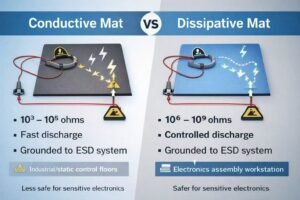
One of the biggest misunderstandings in static control is assuming all ESD mats perform the same.
Professional ESD mats are generally divided into two categories:
- Conductive
- Static Dissipative
Both are important, but they serve different purposes.
Conductive Mats
Surface Resistance
10³–10⁵ Ω
Characteristics
- Very fast charge transfer
- Excellent grounding
- Used in special industrial environments
Advantages
✓ Fast discharge
✓ Low resistance
Disadvantages
May discharge too quickly for some sensitive electronic devices.
Static Dissipative Mats
Surface Resistance
10⁶–10⁹ Ω
Characteristics
- Controlled discharge
- Protects electronic components
- Most common industrial choice
Advantages
✓ Safe charge dissipation
✓ Excellent component protection
✓ ANSI/ESD compliant
Side-by-Side Comparison
| Feature | Conductive | Dissipative |
|---|---|---|
| Resistance | 10³–10⁵ Ω | 10⁶–10⁹ Ω |
| Discharge Speed | Very Fast | Controlled |
| Component Safety | Medium | Excellent |
| Recommended for PCB | ❌ | ✅ |
| Most Popular | No | Yes |
Which One Should You Choose?
For most electronics manufacturers—including PCB assembly, SMT production, semiconductor packaging, and electronics repair—a static dissipative ESD mat (10⁶–10⁹ Ω) is the preferred choice because it provides controlled discharge while protecting sensitive electronic components.
Conductive mats are better suited to specialized industrial applications where rapid grounding is required.
Expert Recommendation
At ESDBEST, the majority of our industrial customers choose two-layer dissipative rubber ESD mats because they combine:
- Stable electrical performance
- Long service life
- Excellent chemical resistance
- Compliance with ANSI/ESD S20.20 and IEC 61340
- Reliable protection for sensitive electronic assemblies
Not sure which resistance range is right for your facility?
Module 7
ESD Mat Resistance
Surface resistance is the most important indicator of an ESD mat’s performance. It determines how quickly electrostatic charges are safely transferred to ground while preventing sudden electrical discharge that may damage sensitive electronic components.
A high-quality ESD mat should provide controlled static dissipation, not simply conduct electricity as fast as possible.
Professional ESD mats are designed to meet the resistance requirements defined by ANSI/ESD S20.20 and IEC 61340, ensuring reliable protection for PCB assembly, semiconductor manufacturing, cleanrooms, and electronic repair environments.
Why Surface Resistance Matters
An ESD mat with the correct resistance helps to:
- Safely dissipate static electricity
- Prevent Electrostatic Discharge (ESD)
- Protect sensitive electronic components
- Reduce hidden PCB failures
- Improve production quality
- Meet international ESD compliance requirements
If resistance is too low, static charges may discharge too rapidly and damage components.
If resistance is too high, static electricity cannot flow effectively to ground, allowing charges to accumulate.
The correct resistance provides a controlled discharge path.
Standard Resistance Classifications
| Surface Resistance | Classification | Typical Application |
|---|---|---|
| Below 10⁵ Ω | Conductive | Special industrial grounding |
| 10⁶–10⁹ Ω | Static Dissipative | Electronics Manufacturing |
| Above 10¹⁰ Ω | Insulative | Not suitable for ESD protection |
For most electronics manufacturers, the recommended resistance range is:
10⁶–10⁹ Ω (Static Dissipative)
This range provides the safest balance between charge dissipation speed and electronic component protection.
How Resistance Is Tested

Professional testing follows internationally accepted procedures.
Typical equipment includes:
- ACL 800 Surface Resistance Meter
- Two 5 lb electrodes
- Grounding cord
- Calibrated test environment
Basic testing process:
Step 1
Place the mat on a clean, dry surface.
Step 2
Position two electrodes at the specified distance.
Step 3
Connect the resistance meter.
Step 4
Measure surface resistance.
Step 5
Record and verify the reading.
Routine testing helps ensure the mat continues to meet ESD protection requirements throughout its service life.
Typical Test Results
| Mat Quality | Typical Reading |
|---|---|
| High-quality Rubber Mat | 10⁶–10⁸ Ω |
| Industrial Dissipative Mat | 10⁷–10⁹ Ω |
| Low-quality Rubber Mat | Highly unstable |
| Ordinary Rubber Mat | Not ESD compliant |
Factors That Affect Resistance
Several environmental factors influence resistance measurements.
- Humidity
- Temperature
- Surface contamination
- Cleaning chemicals
- Wear and aging
- Grounding quality
For this reason, periodic testing is recommended rather than relying solely on factory specifications.
Expert Recommendation
For PCB assembly, SMT production, semiconductor packaging, and electronics repair, ESDBEST recommends using two-layer rubber static dissipative mats with a resistance range between 10⁶ and 10⁹ Ω, verified through regular resistance testing.
Need certified ESD mats with verified resistance?
Module 8
ESD Standards
International ESD Standards Every Factory Should Know

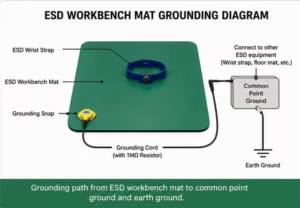

An ESD mat alone cannot protect electronic products unless it is used as part of a complete electrostatic control system.
International standards define how ESD products should be selected, tested, installed, and maintained.
Following these standards helps manufacturers improve product quality, reduce failures, and meet customer audit requirements.
ANSI/ESD S20.20
ANSI/ESD S20.20 is the most widely adopted ESD control standard in North America.
It specifies requirements for:
- ESD protected areas (EPA)
- Grounding systems
- Personnel grounding
- ESD flooring
- Work surfaces
- Packaging
- Compliance verification
- Periodic testing
Factories supplying global electronics brands commonly implement this standard.
IEC 61340-5-1
IEC 61340 is the internationally recognized electrostatic protection standard used throughout Europe and many Asian countries.
It covers:
- Electrostatic control systems
- Resistance requirements
- Testing procedures
- Equipment qualification
- Personnel protection
- Manufacturing environments
Many multinational electronics companies require compliance with IEC 61340.
What Standards Require for ESD Mats
A compliant ESD workstation generally includes:
✓ Static dissipative work surface
✓ Grounding cord
✓ Common point ground
✓ Wrist strap
✓ Earth grounding
✓ Routine resistance testing
An ESD mat should never be used as a standalone product without proper grounding.
Industries That Require ESD Compliance
- PCB Manufacturing
- SMT Assembly
- Semiconductor Production
- Medical Electronics
- Aerospace Electronics
- Automotive Electronics
- Military Electronics
- Telecommunications Equipment
Benefits of Compliance
Factories implementing recognized ESD standards often experience:
- Lower defect rates
- Higher production yields
- Better product reliability
- Easier customer audits
- Improved product consistency
- Reduced warranty claims
ESDBEST Commitment
ESDBEST manufactures ESD products designed to support facilities implementing internationally recognized electrostatic control programs, including ANSI/ESD S20.20 and IEC 61340 requirements.
Need help building a compliant ESD workstation?
Module 9
Grounding an ESD Mat
How to Properly Ground an ESD Mat
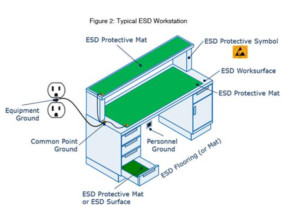
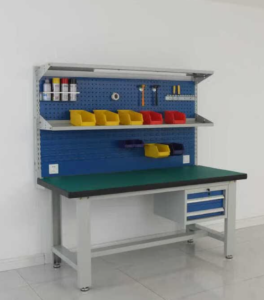

Even the highest-quality ESD mat cannot protect electronic components unless it is correctly grounded.
Grounding provides a safe path for static electricity to flow from the work surface to earth, preventing charge accumulation that could damage sensitive devices.
Proper grounding is one of the most important requirements of any ESD protected workstation.
Complete Grounding System
A standard ESD workstation includes:
- Static dissipative ESD mat
- Grounding cord
- Common Point Ground (CPG)
- Wrist strap
- Earth ground connection
Each component works together to create a continuous path for static electricity.
Step-by-Step Grounding Procedure
Step 1
Install the grounding snap on the mat.
Step 2
Connect the grounding cord to the snap.
Step 3
Attach the grounding cord to the Common Point Ground.
Step 4
Connect the Common Point Ground to earth ground.
Step 5
Connect the operator’s wrist strap to the Common Point Ground.
Step 6
Verify the resistance using an ACL 800 tester or equivalent equipment.
Common Grounding Mistakes
❌ Using an ordinary rubber mat
❌ Connecting the mat to an unverified ground
❌ Forgetting to wear a wrist strap
❌ Damaged grounding cord
❌ Loose grounding snap
❌ Never testing resistance
These mistakes can eliminate the effectiveness of an otherwise compliant ESD workstation.
Grounding Checklist
| Item | Status |
|---|---|
| ESD Mat Installed | ✓ |
| Grounding Cord Connected | ✓ |
| Common Point Ground Installed | ✓ |
| Earth Ground Verified | ✓ |
| Wrist Strap Connected | ✓ |
| Resistance Tested | ✓ |
Why Grounding Is Essential
Without grounding:
- Static charges accumulate on the work surface.
- Operators continuously generate electrostatic charge.
- Sensitive components remain exposed to ESD events.
- Product failures become more likely.
- Compliance with ANSI/ESD S20.20 cannot be achieved.
A correctly grounded ESD mat provides controlled charge dissipation and forms the foundation of a reliable electrostatic protection system.
ESDBEST Recommendation
For maximum protection, use a complete grounding kit that includes:
- Two-layer rubber ESD mat
- Grounding cord
- Common Point Ground
- Wrist strap
- Regular resistance verification
This complete system delivers the highest level of protection for PCB assembly, SMT production, electronics repair, and semiconductor manufacturing.
Module 10
How to Test an ESD Mat
How to Test an ESD Mat Correctly
Testing is the only reliable way to verify that an ESD mat continues to provide effective electrostatic protection. Even a high-quality mat can lose performance over time due to wear, contamination, improper cleaning, or damaged grounding components.
Regular resistance testing helps ensure your workstation remains compliant with ANSI/ESD S20.20 and IEC 61340 requirements.
Why Regular Testing Is Important
Routine testing helps you:
- Verify the mat is still within the specified resistance range
- Detect damage before product failures occur
- Maintain ESD compliance
- Reduce hidden PCB defects
- Improve product reliability
- Prepare for customer or third-party audits
Equipment Required
A standard ESD mat resistance test requires:
- Surface Resistance Meter (such as ACL 800)
- Two 5 lb electrodes
- Grounding cord
- Clean ESD mat
- Stable temperature and humidity
Step-by-Step Testing Procedure
Step 1 – Clean the Mat
Remove dust, oil, and debris using an approved ESD mat cleaner. Avoid alcohols or harsh solvents unless recommended by the manufacturer.
Step 2 – Inspect the Grounding System
Check that the grounding snap, grounding cord, and Common Point Ground are securely connected and free from damage.
Step 3 – Position the Electrodes
Place the two electrodes on the mat according to the instrument manufacturer’s recommended spacing.
Step 4 – Measure Surface Resistance
Connect the resistance meter and record the reading after it stabilizes.
Step 5 – Compare the Results
For most electronics manufacturing environments, the expected resistance range is:
10⁶–10⁹ Ω
If readings fall outside this range, inspect the mat and grounding system before returning it to service.
Common Testing Mistakes
❌ Testing on a dirty surface
❌ Ignoring humidity effects
❌ Using damaged electrodes
❌ Measuring without proper grounding
❌ Testing immediately after cleaning before the surface dries
❌ Skipping routine inspections
Recommended Testing Frequency
| Environment | Recommended Frequency |
|---|---|
| SMT Production | Monthly |
| PCB Assembly | Monthly |
| Electronics Repair | Every 3 Months |
| Laboratory | Every 3–6 Months |
| Cleanroom | Monthly or per internal ESD program |
Signs Your ESD Mat Should Be Replaced
Replace the mat if you observe:
- Resistance consistently outside specification
- Cracks or deep cuts
- Delamination between layers
- Damaged grounding snap
- Severe chemical damage
- Permanent surface contamination
Expert Tip
Resistance testing should be part of every preventive maintenance program. Keeping records of test results provides valuable evidence during quality audits and helps identify long-term performance trends.
Need a certified ESD testing solution?
Module 11
ESD Mats for PCB Assembly
H2
Why PCB Assembly Requires ESD Mats
Printed Circuit Boards (PCBs) contain highly sensitive electronic components that can be permanently damaged by electrostatic discharge. In many cases, ESD damage is invisible, leading to intermittent failures that are difficult to diagnose.
A properly grounded ESD mat creates a controlled work surface that safely dissipates static electricity before it reaches sensitive devices.
Common PCB Components Vulnerable to ESD
Electrostatic discharge can damage:
- Integrated Circuits (ICs)
- MOSFETs
- Microcontrollers
- Memory Chips
- CPUs
- FPGAs
- Sensors
- Communication Modules
Many of these components may continue to function after an ESD event but experience reduced lifespan or unpredictable performance.
Typical PCB Assembly Workstation
A compliant PCB assembly workstation usually includes:
✓ ESD bench mat
✓ Wrist strap
✓ Grounding cord
✓ Common Point Ground
✓ ESD chair
✓ Ionizer (when required)
✓ Conductive storage bins
✓ ESD footwear
Together, these elements create a complete ESD Protected Area (EPA).
Benefits of Using ESD Mats During PCB Assembly
Using an ESD mat helps manufacturers:
- Protect sensitive electronic components
- Reduce latent ESD damage
- Improve first-pass yield
- Reduce costly rework
- Increase long-term product reliability
- Support compliance with customer quality requirements
PCB Manufacturing Process Where ESD Mats Are Used
| Manufacturing Stage | ESD Mat Required |
|---|---|
| Incoming Inspection | ✓ |
| PCB Assembly | ✓ |
| SMT Placement | ✓ |
| Manual Soldering | ✓ |
| Functional Testing | ✓ |
| Rework & Repair | ✓ |
| Final Inspection | ✓ |
| Packaging | ✓ |
Why Latent ESD Damage Is Dangerous
Unlike catastrophic failures, latent ESD damage may not be immediately detected.
The product may:
- Pass functional testing
- Ship to the customer
- Fail weeks or months later
This hidden failure can increase warranty claims, customer complaints, and maintenance costs.
Preventing ESD at the workstation is significantly less expensive than addressing failures after shipment.
ESDBEST Recommendation
For PCB manufacturing, ESDBEST recommends:
- Two-layer rubber static dissipative ESD bench mats
- Resistance range of 10⁶–10⁹ Ω
- Proper grounding system
- Regular resistance testing
- Routine operator ESD training
Looking for professional PCB assembly ESD solutions?
Module 12
Industry Applications
Industries That Use ESD Mats

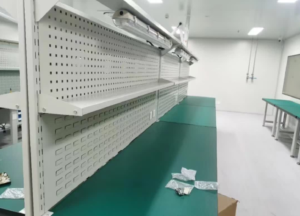
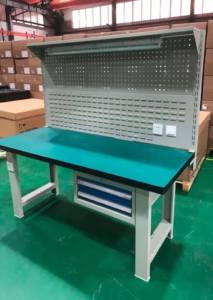
Electrostatic discharge affects nearly every industry that manufactures, assembles, tests, or repairs electronic products. As electronic components become smaller and more sensitive, effective static control has become a critical part of modern manufacturing.
ESD mats provide a safe working surface across a wide range of industries.
Electronics Manufacturing
The electronics industry is the largest user of ESD mats.
Typical applications include:
- PCB assembly
- SMT production
- Electronic testing
- Product inspection
- Final assembly
Semiconductor Manufacturing
Semiconductor devices are among the most ESD-sensitive products in the world.
ESD mats are used during:
- Wafer processing
- IC packaging
- Chip testing
- Failure analysis
- Research laboratories
Medical Device Manufacturing
Medical electronics require exceptionally high levels of reliability.
ESD mats help protect:
- Diagnostic equipment
- Patient monitoring systems
- Surgical electronics
- Imaging equipment
- Portable medical devices
Automotive Electronics
Modern vehicles contain hundreds of electronic control units.
ESD protection is widely used in the production of:
- Engine control modules
- ADAS systems
- Battery management systems
- Infotainment systems
- Electric vehicle electronics
Aerospace and Defense
Mission-critical electronics demand strict ESD control.
Applications include:
- Navigation systems
- Radar equipment
- Satellite electronics
- Flight control systems
- Military communication equipment
Research Laboratories
Universities and R&D centers frequently install ESD workstations for:
- Prototype development
- Circuit design
- Component testing
- Failure analysis
- Product verification
Telecommunications
Telecommunications manufacturers use ESD mats during the production of:
- Network switches
- Servers
- Fiber optic equipment
- Base stations
- Communication modules
Industry Comparison
| Industry | ESD Protection Required | Typical Workstation |
|---|---|---|
| Electronics | ★★★★★ | Bench Mat |
| Semiconductor | ★★★★★ | Cleanroom Bench Mat |
| Medical Devices | ★★★★★ | Laboratory Bench Mat |
| Automotive Electronics | ★★★★★ | Production Bench Mat |
| Aerospace | ★★★★★ | Certified ESD Workstation |
| Telecommunications | ★★★★★ | ESD Assembly Station |
Why ESD Protection Matters Across Industries
Regardless of industry, effective ESD control helps organizations:
- Reduce product defects
- Improve manufacturing yield
- Increase product reliability
- Lower warranty costs
- Meet customer quality requirements
- Support international ESD compliance
ESDBEST Solutions for Every Industry
ESDBEST supplies ESD mats and complete static control solutions for manufacturers, laboratories, repair centers, and cleanrooms worldwide. Whether you need standard bench mats, heavy-duty floor mats, or custom-sized work surfaces, our products are designed to deliver reliable static protection in demanding industrial environments.
ESD Mat Buying Guide
H2
How to Choose the Right ESD Mat
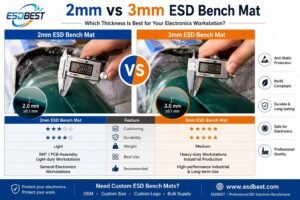


Choosing the right ESD mat is about more than price. The correct mat should match your production environment, provide reliable electrostatic protection, and deliver long-term durability.
Whether you’re building a new ESD workstation or upgrading an existing production line, selecting the appropriate material, resistance range, and accessories will significantly improve static control performance.
Step 1 – Identify Your Application
Different workplaces require different ESD mats.
| Application | Recommended Product |
|---|---|
| PCB Assembly | Two-Layer Rubber Bench Mat |
| SMT Production | Heavy-Duty Bench Mat |
| Electronics Repair | Bench Mat Kit |
| Cleanroom | Low-Outgassing Rubber Mat |
| Laboratory | Static Dissipative Bench Mat |
| Factory Walkways | ESD Floor Mat |
Step 2 – Choose the Correct Material
For industrial manufacturing, rubber is the preferred material because it provides:
- Excellent durability
- Stable electrical performance
- Heat resistance
- Chemical resistance
- Long service life
PVC and vinyl mats are suitable for lighter-duty environments but generally have a shorter lifespan.
Step 3 – Select the Right Resistance
For most electronics manufacturing:
Recommended Surface Resistance
10⁶–10⁹ Ω
This resistance range provides controlled static dissipation while protecting sensitive electronic components.
Step 4 – Check Product Quality
Before purchasing, verify that the ESD mat includes:
✓ Two-layer construction
✓ Durable rubber surface
✓ Grounding snap installed
✓ Stable resistance values
✓ Quality inspection before shipment
Step 5 – Consider Accessories
A complete ESD workstation typically includes:
- Grounding cord
- Common Point Ground (CPG)
- Wrist strap
- ESD cleaner
- Resistance tester
- ESD footwear (for floor systems)
Step 6 – Evaluate the Supplier
Choose a supplier that can provide:
- Consistent product quality
- Technical support
- OEM & custom manufacturing
- Factory testing
- Stable delivery times
- Export experience
Buyer Checklist
| Item | Check |
|---|---|
| Correct Material | ✓ |
| Correct Resistance | ✓ |
| Grounding Accessories | ✓ |
| Quality Inspection | ✓ |
| OEM Available | ✓ |
| Technical Support | ✓ |
Why Buyers Choose ESDBEST
Customers worldwide choose ESDBEST because we provide:
- Industrial-grade rubber ESD mats
- Consistent quality control
- Custom manufacturing
- Competitive factory pricing
- Global export experience
- Responsive engineering support
Module 14
OEM & Custom Manufacturing
OEM & Custom ESD Mat Manufacturing



Every production facility has different workstation sizes, layouts, and electrostatic protection requirements. For this reason, many manufacturers choose OEM or custom-made ESD mats instead of standard products.
ESDBEST provides flexible manufacturing solutions for distributors, industrial suppliers, system integrators, and electronics manufacturers worldwide.
Custom Sizes
We manufacture ESD mats in virtually any size, including:
- Standard bench sizes
- Large production workstations
- Continuous roll materials
- Custom-cut dimensions
- Oversized assembly tables
Color Options
Available colors include:
- Green
- Blue
- Gray
- Black
Additional colors may be available for large-volume OEM orders.
Logo Printing
Enhance your brand with custom printing:
- Company logo
- Product identification
- Safety warnings
- Anti-static symbols
- Custom graphics
High-quality printing maintains a professional appearance while supporting workplace organization.
Custom Packaging
Packaging options include:
- Individual cartons
- Retail packaging
- Distributor labeling
- Private label branding
- Export cartons
- Palletized shipments
Grounding Options
Customers can specify:
- Grounding snap position
- Snap quantity
- Grounding cord type
- Common Point Ground configuration
- Complete workstation kits
OEM Manufacturing Process
| Step | Description |
|---|---|
| 1 | Requirement Confirmation |
| 2 | Material Selection |
| 3 | Sample Production |
| 4 | Customer Approval |
| 5 | Mass Production |
| 6 | Quality Inspection |
| 7 | Export Packaging |
| 8 | Worldwide Shipping |
Industries We Serve
Our OEM ESD mats are supplied to:
- Electronics manufacturers
- Semiconductor companies
- Medical device manufacturers
- Automotive suppliers
- Industrial distributors
- ESD solution providers
- Laboratories
- Government projects
Why Work with ESDBEST
We provide:
- OEM & ODM manufacturing
- Low minimum order quantities
- Stable production capacity
- Fast sample development
- Strict quality control
- International shipping support
Module 15
ESDBEST Factory & Quality Assurance
Why Choose ESDBEST as Your ESD Mat Manufacturer
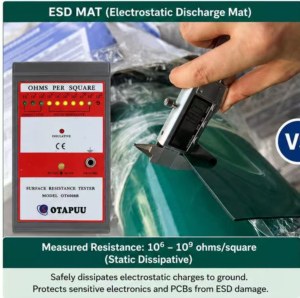


Selecting the right supplier is just as important as selecting the right ESD mat. A reliable manufacturing partner ensures consistent quality, dependable delivery, and long-term technical support.
At ESDBEST, we focus on delivering industrial ESD solutions that help customers improve product quality, reduce electrostatic failures, and build compliant ESD workstations.
Manufacturing Capabilities
Our production capabilities include:
- Industrial rubber ESD mats
- Bench mats
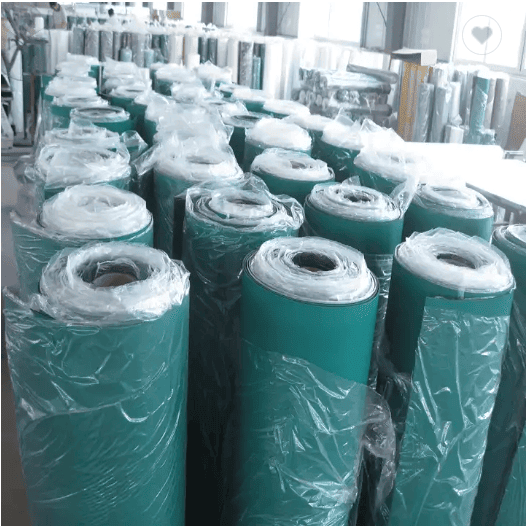
- Floor mats
- Roll materials
- Custom-cut products
- Complete workstation accessories
We support both standard products and customized OEM manufacturing.
Quality Control
Every production batch undergoes strict quality inspection, including:
✓ Appearance inspection
✓ Dimensional verification
✓ Surface resistance testing
✓ Grounding component inspection
✓ Packaging inspection
Quality verification helps ensure consistent performance before shipment.
Export Experience
ESDBEST supplies customers across:
- North America
- Europe
- Southeast Asia
- Middle East
- South America
- Australia
Our team supports international shipping, export documentation, and responsive customer service.
Complete ESD Solutions
In addition to ESD mats, we also provide:
- Wrist Straps
- Heel Grounders
- ESD Shoes
- ESD Gloves
- Ionizers
- ESD Chairs
- ESD Workbenches
- Grounding Accessories
- ESD Packaging
This allows customers to source complete static control solutions from a single supplier.
Why Global Customers Choose ESDBEST
| Advantage | Benefit |
|---|---|
| Factory Direct Supply | Competitive Pricing |
| OEM & ODM | Flexible Manufacturing |
| Stable Production | Reliable Delivery |
| Technical Support | Professional Recommendations |
| Strict Quality Control | Consistent Performance |
| Export Experience | Efficient Global Shipping |
Our Commitment
Our goal is to provide reliable ESD products that support modern electronics manufacturing and help customers establish effective electrostatic control programs.
Whether you are purchasing a single workstation solution or sourcing products for large-scale production, ESDBEST is committed to delivering quality, consistency, and long-term partnership.
Ready to Build Your ESD-Protected Workspace?
Our engineering team can help you select the right products based on your application, production process, and compliance requirements.

Module 16
Downloads & Technical Resources
Free ESD Resources & Downloads
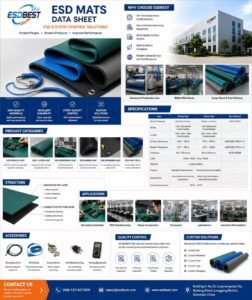
Building an effective ESD Protected Area (EPA) requires more than choosing the right products. Technical documentation, inspection records, and maintenance procedures help ensure long-term compliance and consistent electrostatic protection.
To support engineers, purchasing managers, and quality teams, ESDBEST provides a range of free technical resources.
Free Downloads
ESD Mat Product Catalog
Includes:
- Product specifications
- Standard sizes
- Material options
- Color selection
- Accessories
- Ordering information
Download PDF
ESD Mat Technical Data Sheet
Contains:
- Surface resistance
- Material composition
- Thickness
- Heat resistance
- Chemical resistance
- Operating environment
Download PDF
ESD Workstation Checklist
Use this checklist before production starts.
Includes inspection of:
- ESD mat
- Grounding cord
- Wrist strap
- Common Point Ground
- Ionizer
- ESD chair
- Footwear
- Tester
Download Checklist
ESD Compliance Guide
A practical guide covering:
- ANSI/ESD S20.20
- IEC 61340
- Grounding methods
- Testing procedures
- Maintenance recommendations
Download Guide
Resistance Testing Record Form
Keep documented inspection records for:
- Test date
- Equipment used
- Resistance value
- Inspector
- Corrective actions
Suitable for ISO quality systems and factory audits.
Download Excel Template
Factory Audit Checklist
Designed for:
- Electronics factories
- PCB manufacturers
- SMT production
- Medical device assembly
- Semiconductor plants
Includes over 50 inspection items covering EPA setup, personnel grounding, workstation verification, and routine maintenance.
Download Audit Checklist
Why Download These Resources?
These documents help you:
- Build compliant ESD workstations
- Improve audit readiness
- Standardize inspection procedures
- Reduce production defects
- Train operators more effectively
- Extend ESD mat service life
Resource Center
| Resource | Format |
|---|---|
| Product Catalog | |
| Technical Data Sheet | |
| ESD Compliance Guide | |
| Workstation Checklist | |
| Resistance Test Record | Excel |
| Factory Audit Checklist |
CTA
Need additional technical documentation?
Primary Button
Download All Resources
Secondary Button
Contact Our Engineering Team
Module 17
Videos & Knowledge Center
Learn ESD Through Real Factory Demonstrations

Understanding ESD protection is easier when you can see it in action.
The ESDBEST Knowledge Center features practical demonstrations, laboratory testing, and real manufacturing applications to help engineers and purchasing teams make informed decisions.
Our educational content is designed to answer the most common questions about static control while demonstrating industry best practices.
Featured Video Topics
ESD Mat Resistance Test
Learn how to verify surface resistance using an ACL 800 Surface Resistance Meter.
Conductive vs Static Dissipative Mats
Understand the differences between resistance ranges and learn which type is best for PCB assembly.
What Happens Without Grounding?
Watch how static electricity accumulates on an ungrounded workstation and why grounding is essential.
Complete ESD Workstation Setup
A step-by-step demonstration covering:
- ESD mat
- Wrist strap
- Grounding cord
- Common Point Ground
- Earth connection
PCB ESD Damage Demonstration
See how electrostatic discharge can damage sensitive electronic components—even when no visible damage is present.
Factory ESD Inspection
Learn how quality engineers inspect ESD workstations and maintain compliance with international standards.
Knowledge Articles
Our technical resource center also includes expert articles covering:
- What Is an ESD Mat?
- How to Ground an ESD Mat
- How to Test an ESD Mat
- ESD Standards Explained
- PCB Static Protection
- Conductive vs Dissipative Materials
- ESD Workstation Design
- Cleanroom Static Control
Why Learn from ESDBEST?
Our educational content is based on real manufacturing environments and focuses on practical solutions rather than theory alone.
Each guide is designed to help readers:
- Reduce ESD failures
- Improve production quality
- Build compliant workstations
- Understand international standards
- Select the right products
Explore More
Visit our Knowledge Center for:
✓ Technical Articles
✓ Product Guides
✓ Case Studies
✓ Factory Demonstrations
✓ Video Tutorials
✓ Industry News
CTA
Want More ESD Training Resources?
Primary Button
Visit the Knowledge Center
Secondary Button
Watch All Videos
Module 18
Request a Quote
Get a Fast Quote from ESDBEST
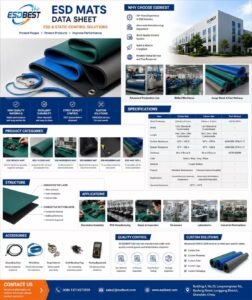
Whether you need a single ESD workstation or a large-scale OEM manufacturing project, our team is ready to provide professional recommendations, competitive pricing, and fast quotations.
Simply tell us about your application, and we’ll recommend the most suitable ESD solution.
We Can Help You With
- Standard ESD Bench Mats
- ESD Floor Mats
- Custom Sizes
- Roll Materials
- OEM & Private Label Manufacturing
- Complete ESD Workstation Kits
- Grounding Accessories
- Factory Static Control Solutions
Why Customers Contact ESDBEST
✔ Factory Direct Pricing
✔ Fast Sample Production
✔ OEM & ODM Support
✔ Worldwide Shipping
✔ Technical Engineering Assistance
✔ Stable Product Quality
✔ Professional Export Service
Information to Prepare
To receive an accurate quotation, please provide:
| Information | Example |
|---|---|
| Product Type | Bench Mat / Floor Mat |
| Size | 600 × 900 mm |
| Thickness | 2 mm / 3 mm |
| Color | Green / Blue |
| Quantity | 500 pcs |
| Custom Logo | Yes / No |
| Shipping Country | USA / Germany / Thailand |
The more details you provide, the faster we can prepare an accurate proposal.
Our Response Process
Step 1
Submit your inquiry.
↓
Step 2
Our engineers review your requirements.
↓
Step 3
Receive product recommendations and pricing.
↓
Step 4
Sample confirmation (if required).
↓
Step 5
Mass production.
↓
Step 6
Quality inspection.
↓
Step 7
Worldwide delivery.
Contact Information
Sales Team
Reply within 24 hours
Technical Support
Professional product recommendations
OEM Department
Custom manufacturing assistance