ESD Floor Mat: Complete Guide to Static Control Floor Mats for Electronics Manufacturing
Static electricity can silently damage sensitive electronic components long before defects become visible. In electronics manufacturing environments, ESD floor mats are one of the most important tools for controlling electrostatic discharge and maintaining a compliant ESD Protected Area (EPA).
This guide explains what ESD floor mats are, how they work, resistance requirements, grounding methods, testing procedures, installation best practices, and how to choose the right floor mat for your facility.



Product name | ESD Floor Mat | |||
Wear layer thickness | Complete layer as wear layer | |||
Backing | Conductive Backing with Carbon granules | |||
Features | 1. Durable 2. Water resistant 3. Abrasion proof 4. Anti-bacterial 5. Fireproof 6. Recyclable 7. Anti-slip | |||
Service | 1.Strict quality control system 2.Perfect after-sales service | |||
What Is An ESD Floor Mat?
An ESD floor mat is a static-dissipative or conductive flooring material designed to safely drain static electricity from personnel, carts, and equipment to ground. ESD floor mats help prevent electrostatic discharge events that can damage sensitive electronic devices during manufacturing, assembly, testing, and repair.
Why Are ESD Floor Mats Important?
Electrostatic discharge is often invisible.
Humans typically cannot feel static discharge until approximately:
3000 V3000\ V3000 V
However, many semiconductor devices can be damaged at:
100 V100\ V100 V
This means operators may unknowingly damage products while believing no static event occurred.
Common consequences include:
- PCB failures
- Semiconductor damage
- Reduced product reliability
- Latent defects
- Customer returns
- Production downtime
ESD floor mats significantly reduce these risks by creating a controlled path to ground.
How Does An ESD Floor Mat Work?
Static Control Process
- Operator walks on floor
- Static charge accumulates
- ESD footwear contacts floor mat
- Charge transfers through mat
- Ground cord directs charge safely to earth
Result:
Static is dissipated gradually instead of discharging suddenly into electronics.
ESD Floor Mat vs Anti-Static Floor Mat
| Feature | ESD Floor Mat | Anti-Static Floor Mat |
|---|---|---|
| Groundable | Yes | Usually No |
| Static Dissipation | Controlled | Limited |
| Electronics Manufacturing | Excellent | Limited |
| ANSI/ESD S20.20 Compliance | Yes | Usually No |
| PCB Assembly | Recommended | Not Recommended |
| Semiconductor Use | Recommended | Not Recommended |
Bottom Line
Anti-static mats reduce charge generation.
ESD floor mats actively dissipate charge to ground.
For electronics manufacturing, ESD floor mats are generally the preferred solution.
Conductive vs Dissipative ESD Floor Mats
Conductive Mats
Resistance:
103 Ω∼105 Ω10^3\ \Omega\sim10^5\ \Omega103 Ω∼105 Ω
Characteristics:
- Fast charge transfer
- Specialized applications
- Requires careful grounding
Dissipative Mats
Resistance:
106 Ω∼109 Ω10^6\ \Omega\sim10^9\ \Omega106 Ω∼109 Ω
Characteristics:
- Controlled discharge
- Most common EPA solution
- Safer for sensitive electronics
ESD Floor Mat Resistance Explained
Resistance is one of the most important specifications.
Most electronics manufacturers prefer mats within:
106 Ω∼109 Ω10^6\ \Omega\sim10^9\ \Omega106 Ω∼109 Ω
Why?
Too low:
- Discharge may occur too rapidly
Too high:
- Static cannot dissipate effectively
The correct range balances safety and static control.
ANSI/ESD S20.20 Requirements
An effective ESD control program often references:
- ANSI/ESD S20.20
- IEC 61340-5-1
Key requirements include:
- Grounding system
- Personnel grounding
- Flooring systems
- Work surfaces
- ESD audits
- Verification testing
ESD floor mats play an essential role within a compliant EPA.
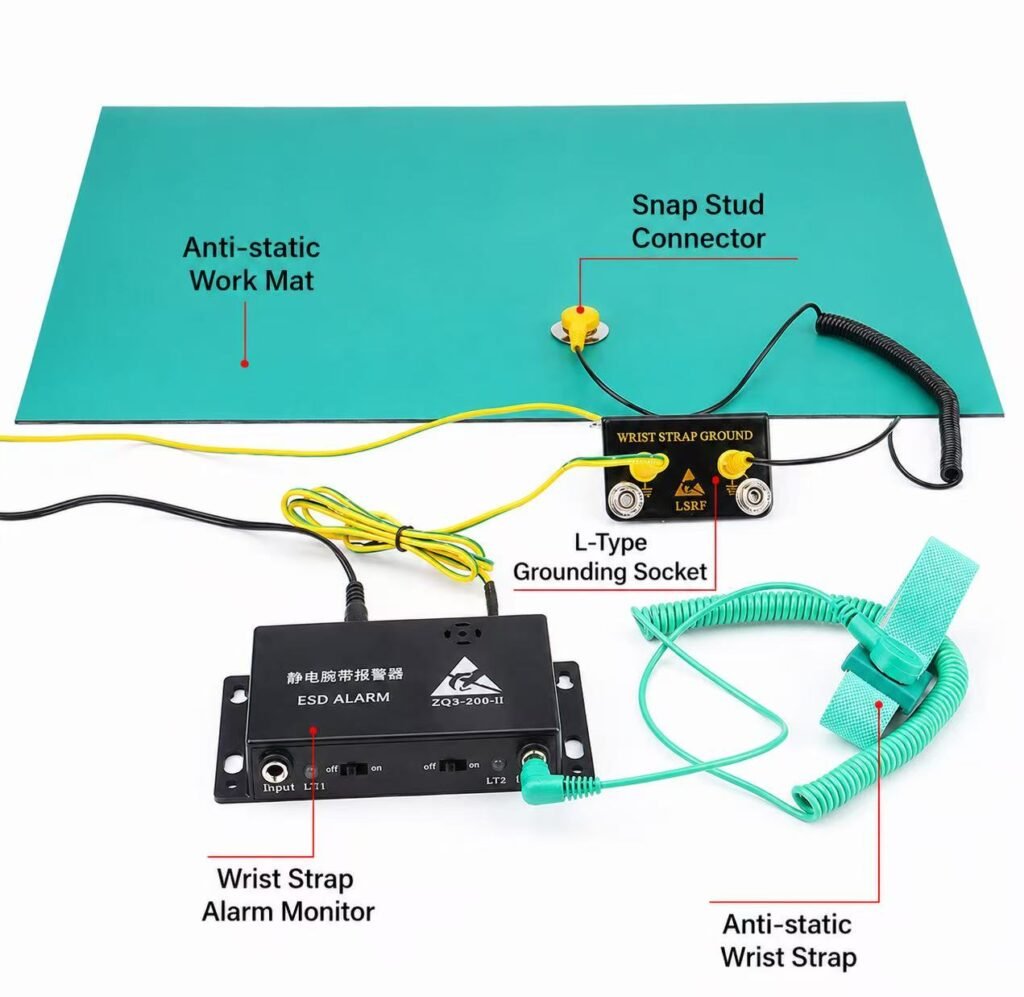
How To Ground An ESD Floor Mat
Step 1
Install snap connector.
Step 2
Connect grounding cord.
Step 3
Attach common point ground.
Step 4
Connect to verified earth ground.
Step 5
Verify resistance.
How To Test An ESD Floor Mat
Testing should be performed regularly.
Equipment:
- Surface resistance meter
- Megohmmeter
- ESD tester
Procedure:
- Clean mat
- Place electrodes
- Measure resistance
- Record results
- Compare against specifications
Applications Of ESD Floor Mats
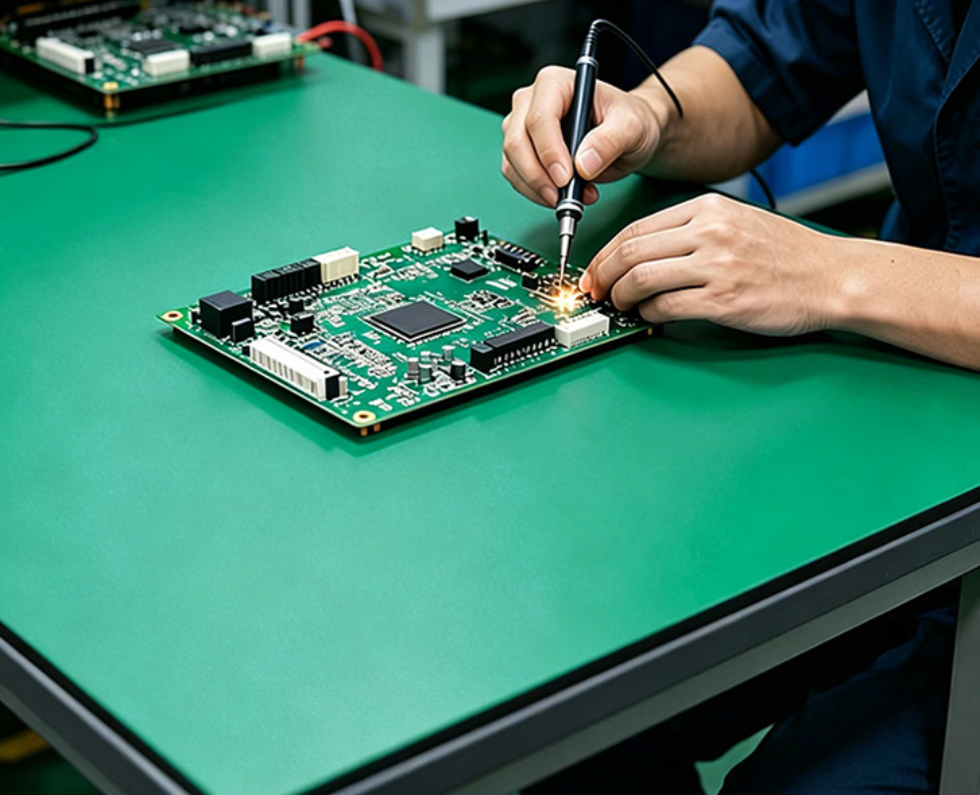
PCB Assembly
Protects:
- Printed circuit boards
- SMT components
- IC devices
Semiconductor Manufacturing
Used in:
- Wafer production
- Chip packaging
- Testing facilities
Electronics Repair
Ideal for:
- Service centers
- Maintenance areas
- Repair benches
Cleanrooms
Supports:
- Controlled environments
- Static-sensitive operations
Logistics And Warehousing
Protects:
- Electronic inventory
- Finished products
- Shipping operations
How Long Do ESD Floor Mats Last?
Typical lifespan:
| Environment | Typical Life |
|---|---|
| Light Duty | 5-8 Years |
| Medium Duty | 3-5 Years |
| Heavy Manufacturing | 2-4 Years |
Factors affecting lifespan:
- Traffic volume
- Cleaning methods
- Chemical exposure
- Mechanical wear
Common ESD Floor Mat Mistakes
No Ground Connection
Most common issue.
Using Standard Rubber Mats
Rubber alone does not provide effective ESD control.
Ignoring Testing
Resistance values can change over time.
Poor Cleaning Practices
Contamination affects performance.
How To Choose The Best ESD Floor Mat
Consider:
Application
- Assembly
- Testing
- Packaging
- Warehousing
Material
- Rubber
- Vinyl
- PVC
Thickness
- Comfort
- Durability
- Traffic levels
Resistance Range
Preferred:
106 Ω∼109 Ω10^6\ \Omega\sim10^9\ \Omega106 Ω∼109 Ω
Compliance
Look for:
- ANSI/ESD S20.20 support
- IEC 61340 compliance
Why Electronics Manufacturers Choose ESDBEST ESD Floor Mats
Benefits include:
✅ Static dissipative construction
✅ Consistent resistance performance
✅ Durable rubber materials
✅ Custom sizes available
✅ Bulk factory supply
✅ Export support worldwide
ESD Floor Mat
1.Flexible vinyl flooring for conductive vinyl flooring. | |||
2.Excellent performance of iodine. | |||
3.Anti-bacterial and anti-fungal treatment. | |||
4.Densely compacted homogeneous floor covering for improved wear and ease of maintenance. | |||
Usage | Hospital,Office,Transport,Shops,Hotel | ||
Color | Various color for choice | ||
Surface | PUR Protect ,Directional,Non-directional,Antistatic | ||
Backing | compact sheet,without foam backing. | ||
OEM/ODM | Yes, we accept. | ||
HS Code | 3918109000 | ||
Certification | CE/ISO14001/ISO9001/SGS/OHSAS18001,96-certified factory | ||
Warranty | 8-Yearunder the premise of normal installation and maintenance | ||
📞 Contact Us Today
For bulk orders, quotes, or product guidance, get in touch with our expert team:
Email: sales2@esdbest.com
Phone: +86 137 1427 2599
FAQ
What resistance should an ESD floor mat have?
Most ESD floor mats used in electronics manufacturing fall within the dissipative range of 10⁶ to 10⁹ ohms.
How do you ground an ESD floor mat?
Using a grounding cord connected to a verified earth ground or common point ground.
Are anti-static mats the same as ESD mats?
No. Anti-static mats reduce static generation, while ESD mats dissipate static charge safely to ground.
How often should ESD floor mats be tested?
Most facilities test regularly according to their ESD control program and audit schedule.
Do ESD floor mats wear out?
Yes. Traffic, contamination, and environmental conditions can affect performance over time.
Can ESD floor mats protect PCBs?
Yes. Properly grounded ESD floor mats help reduce the risk of electrostatic discharge damage.
这是示例文本,单击 “编辑” 按钮更改此文本。