Top Fit ESD Gloves — Carbon Fibre with PU Fingertip Coating
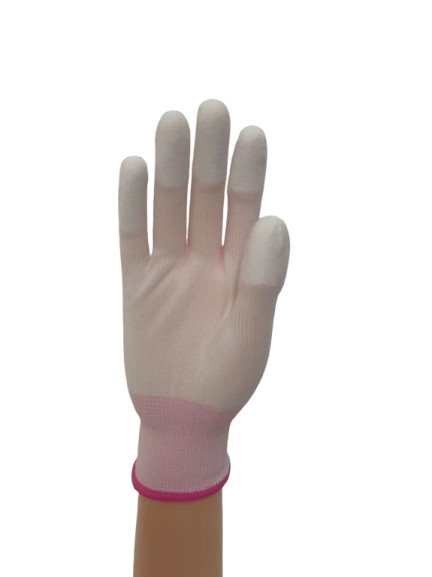
Top Fit is our carbon fibre knitted glove with polyurethane coating on the fingertips only. It is the specification most of our customers wear for a full shift: enough coating for grip and component handling, enough open knit for the hand to breathe.
Here is what it measured.
Measured Surface Resistance
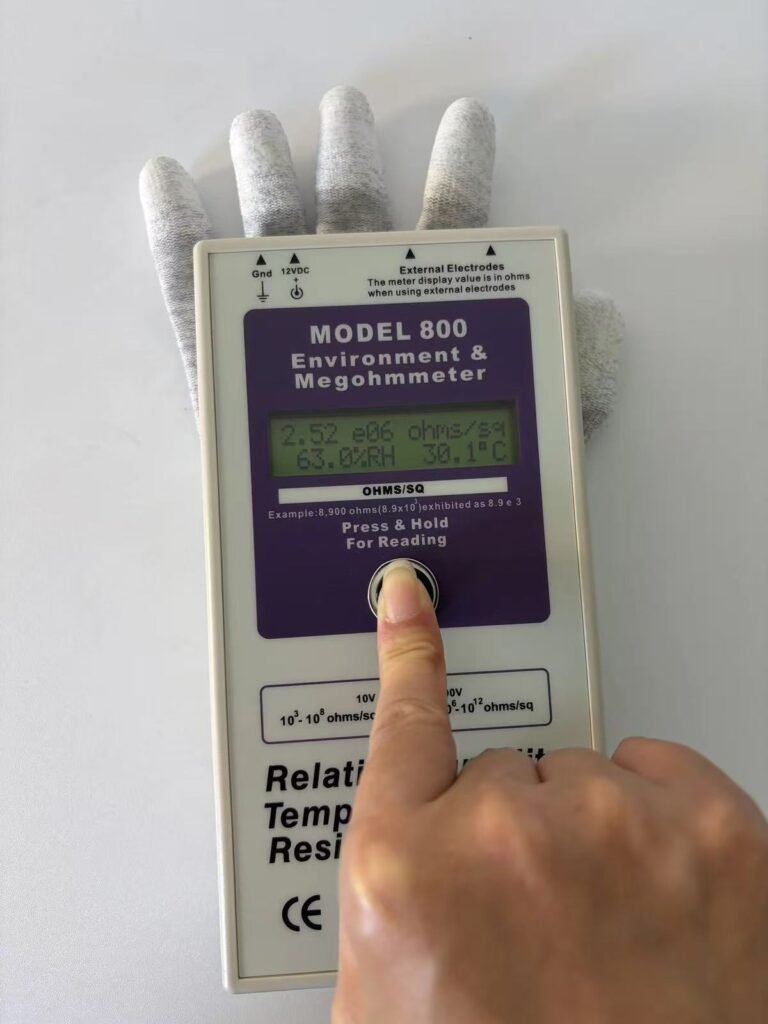
We measured six locations on a production sample with a calibrated ACL Staticide Model 800 megohmmeter, recording temperature and humidity for every reading.
| # | Surface resistance | RH | Temperature |
|---|---|---|---|
| A-01 | 2.52 × 10⁶ Ω/sq | 63.0% | 30.1 °C |
| A-02 | 4.24 × 10⁶ Ω/sq | 61.9% | 30.2 °C |
| A-03 | 5.60 × 10⁶ Ω/sq | 64.7% | 30.1 °C |
| A-04 | 7.87 × 10⁶ Ω/sq | 61.9% | 30.2 °C |
| A-05 | 9.23 × 10⁶ Ω/sq | 61.7% | 30.3 °C |
| A-06 | 2.01 × 10⁷ Ω/sq | 64.8% | 30.1 °C |
Range: 2.52 × 10⁶ – 2.01 × 10⁷ Ω/sq. Six of six inside the static-dissipative range of 1 × 10⁶ to 1 × 10⁹ Ω.
Test voltage 10 V. Instrument serial R01172234, calibrated 19 August 2026, next due 18 August 2027, all ranges PASS within ±10% MPE.
The spread across six locations is under one order of magnitude, which is what you want to see: the conductive path is distributed through the knit, not concentrated in one area.
Download the full comparative test report (PDF)Why Carbon Fibre
The conductive path in these gloves is carbon fibre spun into the yarn. It is part of the structure, not a surface treatment, so it does not wash off and does not wear away with the coating.
To show what that actually contributes, we tested a plain knitted glove of the same construction and the same white PU fingertip coating, with no carbon fibre in the yarn.
| Carbon fibre glove | Plain knitted glove | |
|---|---|---|
| Measured range | 2.52 × 10⁶ – 2.01 × 10⁷ Ω/sq | 6.47 × 10¹⁰ – 8.16 × 10¹⁰ Ω/sq |
| Order of magnitude | 106–107 | 1010 |
| Conductive path | Carbon fibre in yarn | None |
The difference is about four orders of magnitude — roughly 10,000 times.
Put the two gloves side by side and you cannot tell them apart. Same knit, same coating, same weight. Only measurement distinguishes them.
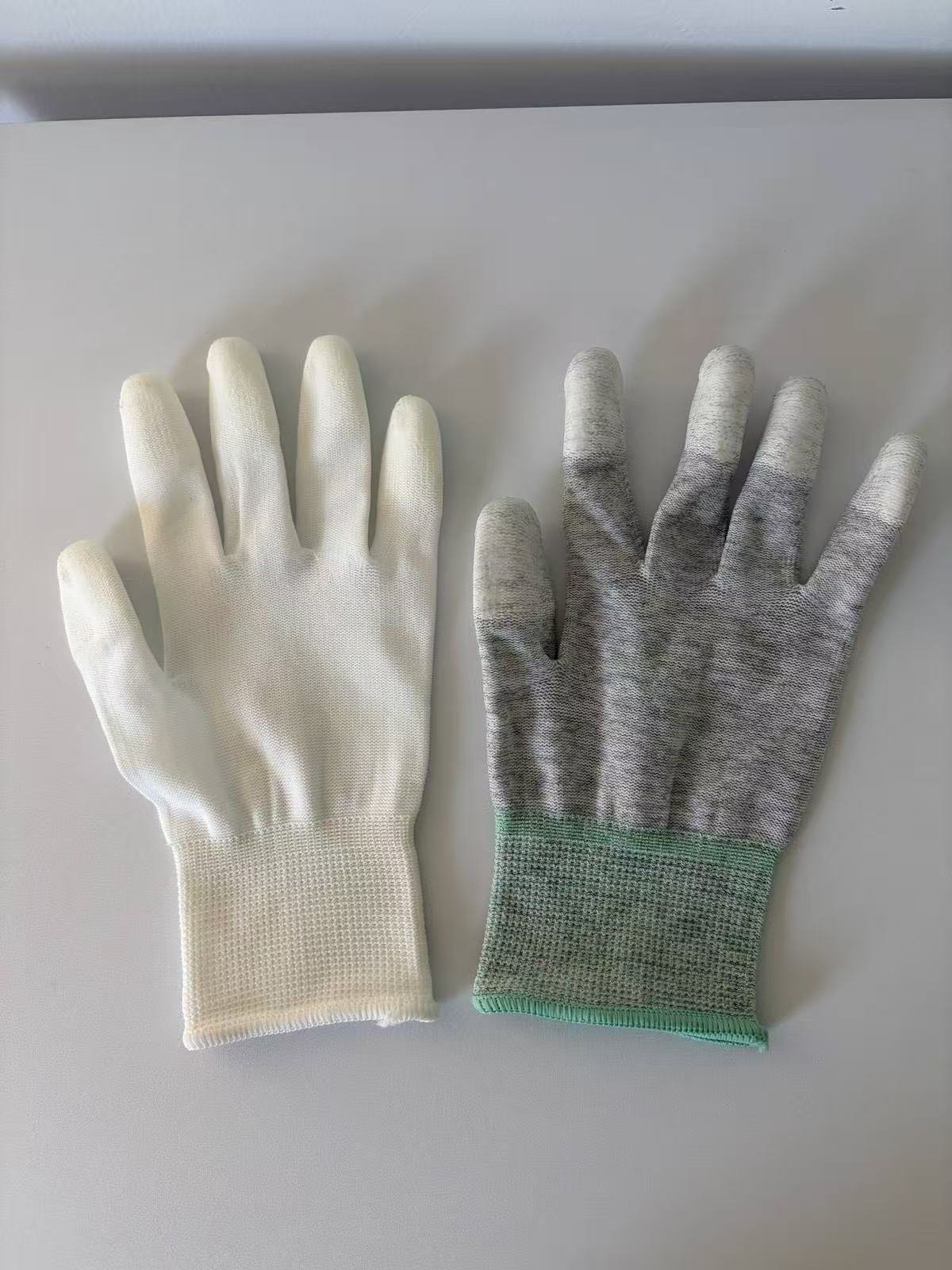
This is why we publish the number, the conditions and the instrument. A product description cannot tell you which glove you are holding.
Coating Options
All three coating versions use the same carbon fibre knitted base. The coating changes grip and durability, not the electrical performance — the conductive path is in the yarn, not in the coating.
Top Fit — PU coating on the fingertips only. Maximum breathability. For light handling, inspection, QC and long-shift assembly work where comfort matters most. This is the version measured above.
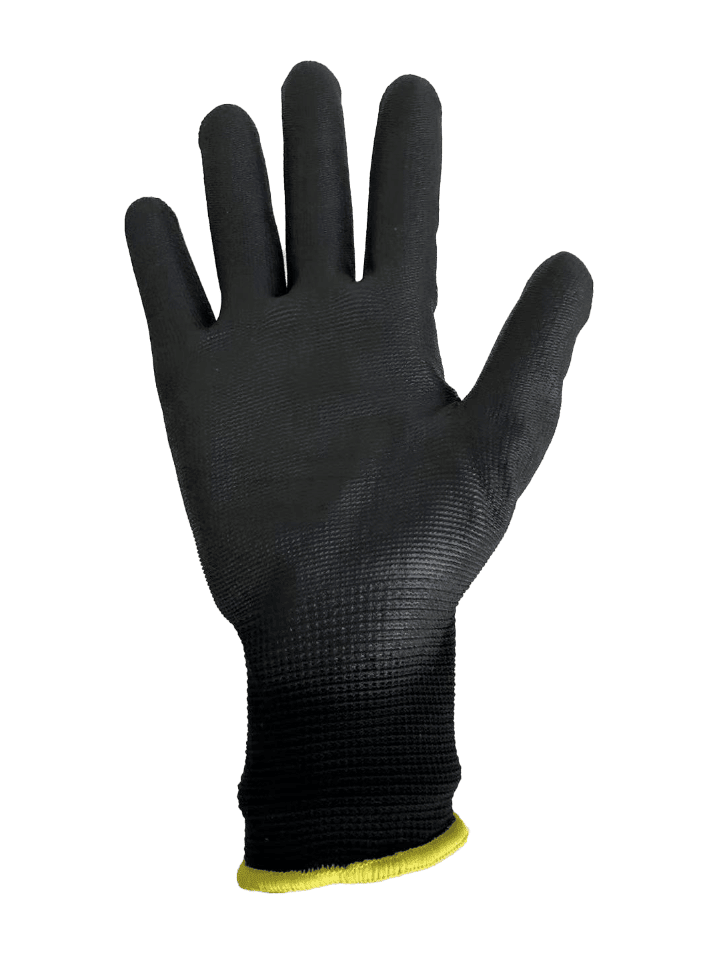
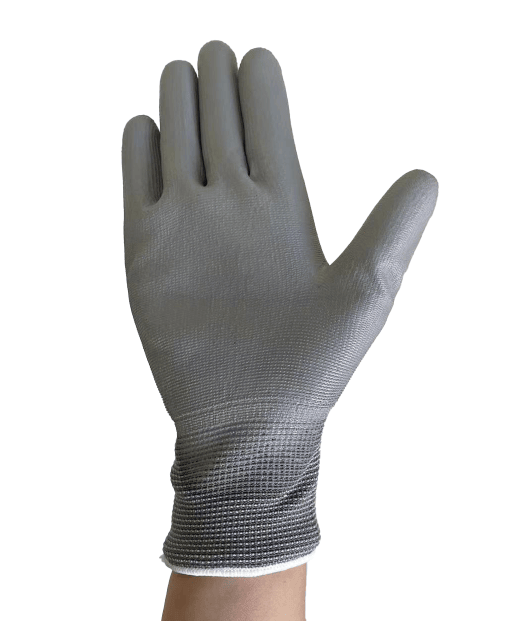
Palm Fit — PU coating across the palm and fingers. More grip and abrasion resistance, for handling heavier assemblies, enclosures and sharp-edged parts. See Palm Fit gloves.
Dotted — PVC dots on the palm. Additional grip where components are smooth, polished or slippery, and where a textured surface helps with small-part handling.
| Top Fit | Palm Fit | Dotted | |
|---|---|---|---|
| Coverage | Fingertips | Palm + fingers | Palm dots |
| Breathability | Highest | Moderate | High |
| Grip | Good | Best | Best on smooth parts |
| Abrasion resistance | Moderate | Highest | Moderate |
| Electrical performance | Same — determined by the yarn, not the coating | ||
Where Top Fit Is Used
| Application | Why Top Fit |
|---|---|
| PCB and PCBA assembly | Fingertip grip without losing tactile feel |
| SMT line operation | All-shift comfort, breathable back of hand |
| Inspection and QC | Light handling, high dexterity |
| Electronics rework and repair | Precise fingertip control around small components |
| Semiconductor device handling | Dissipative range with no powder or residue |
| Warehouse and kitting in an EPA | Reusable, low cost per shift |
For work with flux, solvents or adhesives, a disposable barrier is the better choice — see ESD nitrile gloves.
Washing and Care
Carbon fibre gloves are washable and retain their dissipative performance, because the conductive path is in the yarn rather than on the surface.
- Machine washable at 40 °C
- Do not use fabric softener — it coats the fibre
- Air dry; do not tumble dry at high heat
- Replace when the coating is worn through or the glove is visibly contaminated
Contamination and physical damage are the usual reasons for replacement, not electrical degradation. If you want to confirm, spot-check a washed glove with a surface resistance meter.
Specifications
| Parameter | Specification |
|---|---|
| Base material | Carbon fibre / polyester knitted yarn |
| Coating | PU fingertip (Top Fit), PU palm (Palm Fit), PVC dots |
| Measured surface resistance | 2.52 × 10⁶ – 2.01 × 10⁷ Ω/sq at 62–65% RH |
| Gauge | 13G |
| Sizes | S / M / L / XL |
| Colours | Grey/white body with coloured cuff band |
| Washable | Yes — retains dissipative performance |
| Standards | Conforms to the dissipative range in ANSI/ESD S20.20 and IEC 61340-5-1 under the stated test conditions |
| Documentation | SGS RoHS and REACH on request |
How We Test
Every batch is checked in our own laboratory in Shenzhen.
- The glove is laid flat on an insulating white work surface.
- Surface resistance is measured with the ACL Staticide Model 800 at 10 V.
- The reading is allowed to stabilise before recording.
- Temperature and relative humidity are recorded alongside every reading.
- Multiple locations on the glove are measured, not just one.
The instrument carries a current calibration certificate: serial R01172234, calibrated 19 August 2026, next due 18 August 2027.
Original test photographs and the full measurement record are available to customers on request.
Supply
HORBEST Tech Co., Ltd, trading as ESDBEST, has manufactured ESD control products in Shenzhen, China since 1996, across nine production lines. Samples, the test report and the instrument calibration certificate are available on request.
For volume pricing, MOQ, custom colours and private label, see bulk and OEM supply.
Request a QuoteFAQ
What is a Top Fit glove?
A knitted glove with polyurethane coating on the fingertips only, leaving the rest of the knit open for breathability. The name describes the coating pattern, not the electrical performance.
What resistance did the Top Fit glove measure?
2.52 × 10⁶ to 2.01 × 10⁷ Ω/sq across six locations, at 62–65% RH and 30 °C, on a calibrated ACL Staticide 800.
Does the coating affect the ESD performance?
No. The conductive path is carbon fibre spun into the yarn. Top Fit, Palm Fit and dotted versions share the same electrical classification.
Can carbon fibre gloves be washed?
Yes. They retain their dissipative performance through washing because the carbon fibre is part of the yarn. Do not use fabric softener.
How is a carbon fibre glove different from an ordinary knitted glove?
By measurement, not by appearance. We tested a plain glove of the same knit and the same PU fingertip coating: it measured 6.47 – 8.16 × 10¹⁰ Ω/sq, roughly 10,000 times higher.
Do these gloves ground the operator?
No. Gloves limit charge transfer at the point of contact. Personnel grounding still requires a wrist strap connected to a common point ground, or ESD footwear on a dissipative floor.
Related
- ESD gloves overview — the full range and how to verify a glove
- ESD nitrile gloves — disposable, for contamination control
- Palm Fit gloves — full palm coating for heavier handling
- Which glove type to choose
- Bulk and OEM supply