Protect Personnel and Electronics with Professional ESD Floor Mats
Industrial ESD Floor Mats for Electronics Manufacturing
Professional ESD floor mats provide a safe path for electrostatic charges generated by walking personnel, helping prevent Electrostatic Discharge (ESD) that can damage sensitive electronic components. Widely used in PCB assembly, SMT production, semiconductor manufacturing, cleanrooms, laboratories, and industrial workstations, ESD floor mats create a safer and more reliable Electrostatic Protected Area (EPA).
At ESDBEST, we manufacture high-performance anti-static floor mats engineered to meet international ANSI/ESD S20.20 and IEC 61340 requirements. Our floor mats combine excellent durability, controlled electrical resistance, and long service life, making them the preferred choice for electronics manufacturers worldwide.
Whether you need standard floor mats, custom sizes, OEM branding, or complete ESD flooring solutions, ESDBEST delivers factory-direct quality backed by over 29 years of manufacturing experience.
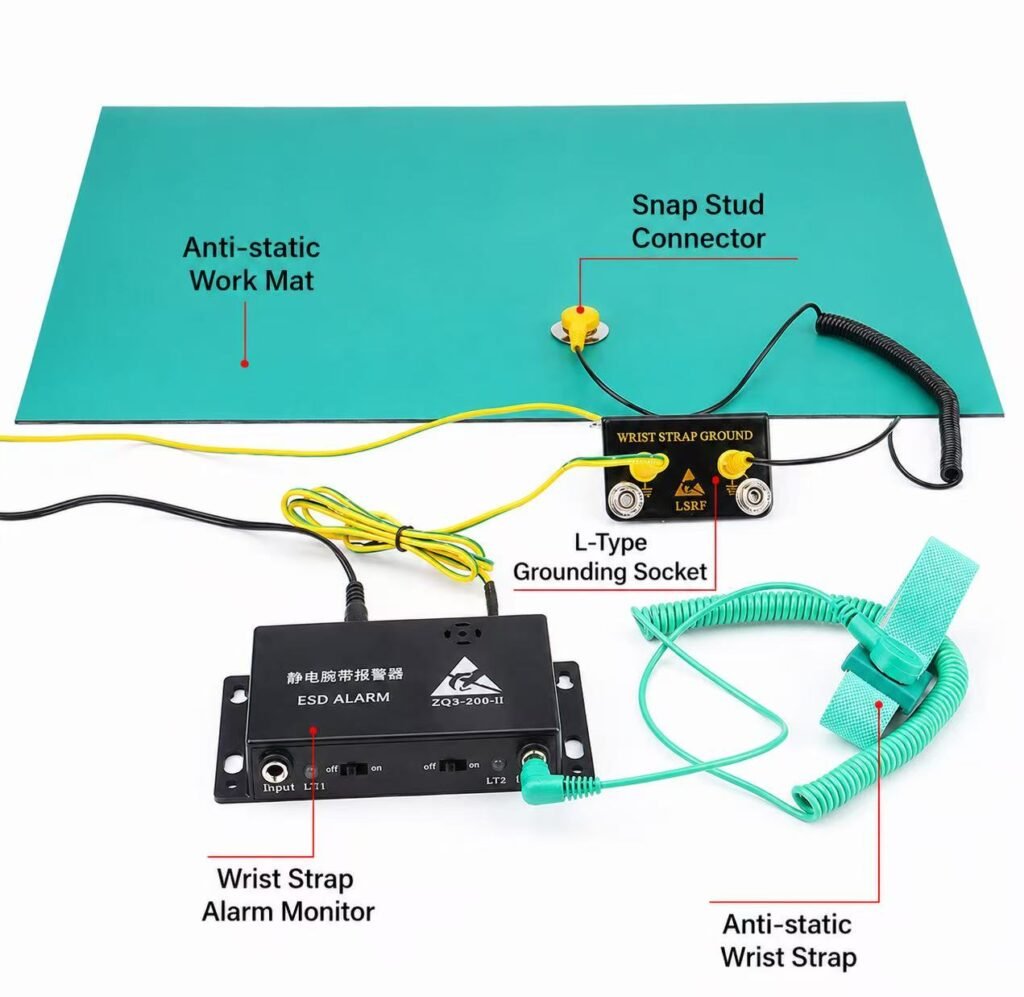

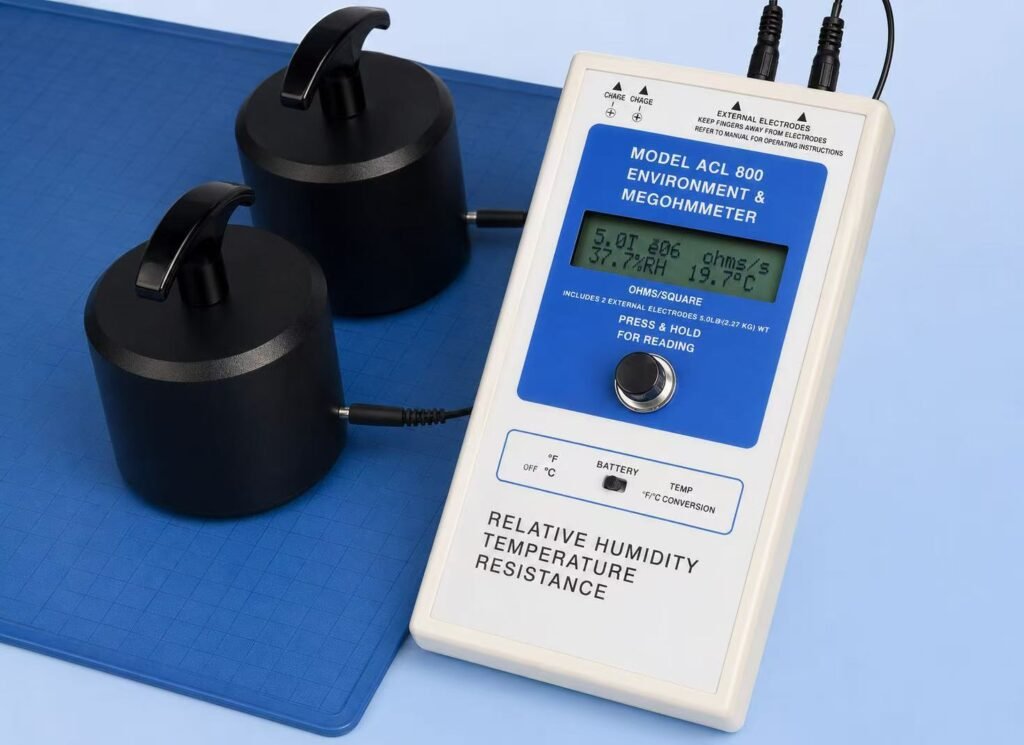
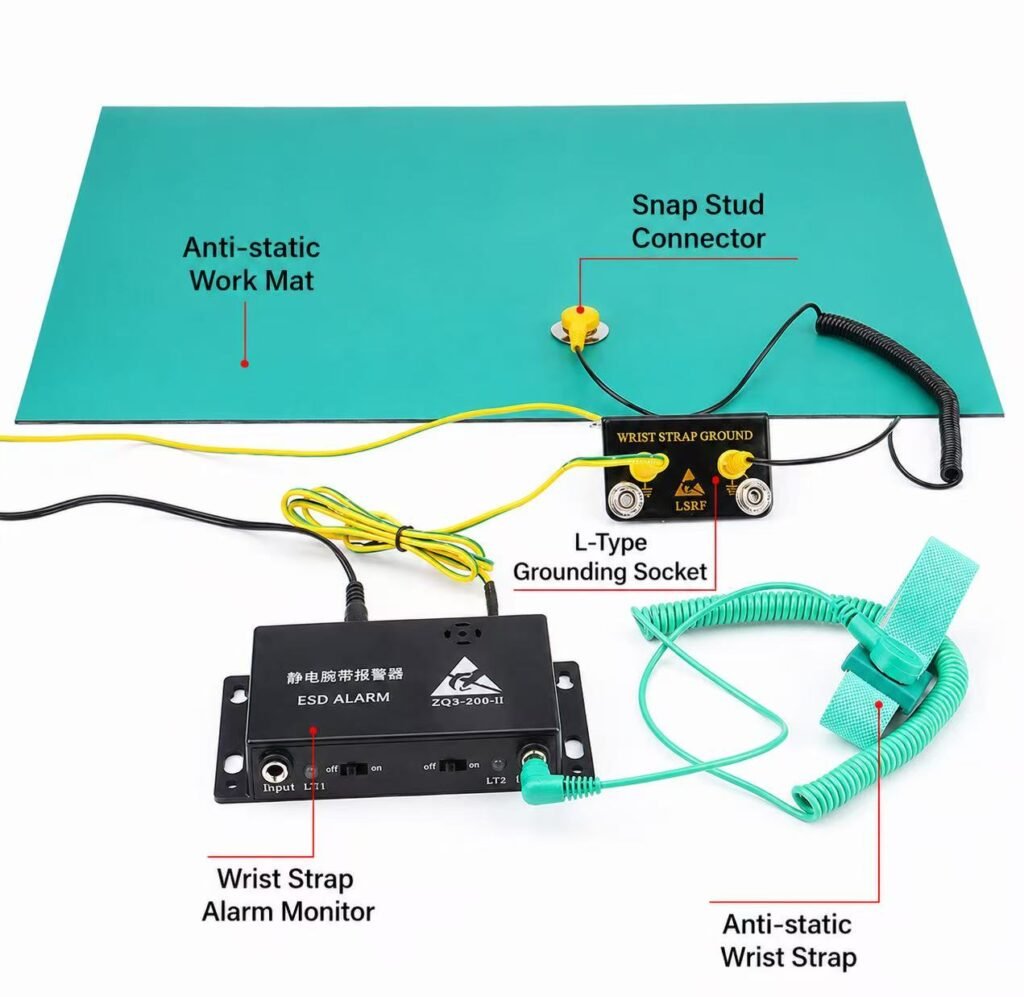

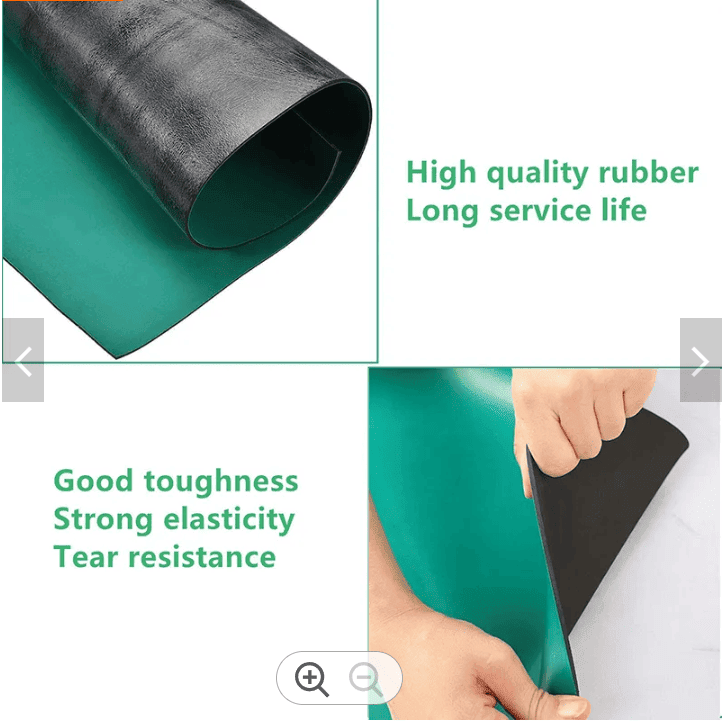
Product name | ESD Floor Mat | |||
Wear layer thickness | Complete layer as wear layer | |||
Backing | Conductive Backing with Carbon granules | |||
Features | 1. Durable 2. Water resistant 3. Abrasion proof 4. Anti-bacterial 5. Fireproof 6. Recyclable 7. Anti-slip | |||
Service | 1.Strict quality control system 2.Perfect after-sales service | |||
Need the Right ESD Floor Mat for Your Factory?
✔ IEC 61340 Compliant
✔ ANSI/ESD S20.20 Ready
✔ OEM & Custom Sizes
✔ Fast Worldwide Delivery
Why Choose ESDBEST ESD Floor Mats?
✔ Surface Resistance: 10⁶–10⁹ Ω
✔ ANSI/ESD S20.20 Compliant
✔ IEC 61340 Compliant
✔ Excellent Wear Resistance
✔ Easy to Clean & Maintain
✔ Suitable for Heavy Traffic Areas
✔ Custom Sizes Available
✔ OEM & ODM Manufacturing
✔ Factory Direct Pricing
✔ Worldwide Shipping
Need help selecting the right ESD floor mat?
Our engineers can recommend the best solution based on your factory layout, production process, and compliance requirements.
Contact an ESD Specialist →
Quick Navigation
In This Guide
Basics
- What Is an ESD Floor Mat?
- How Does an ESD Floor Mat Work?
- Why Are ESD Floor Mats Important?
Types
- Rubber ESD Floor Mats
- Vinyl ESD Floor Mats
- Conductive Floor Mats
- Static Dissipative Floor Mats
- Modular ESD Flooring
Applications
- PCB Manufacturing
- SMT Assembly
- Semiconductor Production
- Electronics Manufacturing
- Cleanrooms
- Laboratories
- Warehouses
- Repair Centers
Installation & Testing
- How to Install an ESD Floor Mat
- How to Ground an ESD Floor Mat
- Surface Resistance Testing
- Daily Maintenance
Standards
- ANSI/ESD S20.20
- IEC 61340
- EPA Requirements
Buying Guide
- How to Choose an ESD Floor Mat
- Common Mistakes
- Frequently Asked Questions
Why Electronics Factories Choose ESD Floor Mats
Walking across ordinary floors can generate thousands of volts of static electricity. Although invisible, these charges can instantly damage integrated circuits, semiconductors, and other static-sensitive devices.
A professionally grounded ESD floor mat continuously dissipates static charges through a controlled resistance path, helping maintain a safe Electrostatic Protected Area (EPA) and reducing the risk of costly ESD failures.
Combined with ESD workbenches, wrist straps, conductive footwear, and ionizers, ESD floor mats form the foundation of a complete static control system.
Trusted by Industries Worldwide
Our ESD floor mats are widely used in:
- PCB Assembly
- SMT Production
- Electronics Manufacturing
- Semiconductor Industry
- Aerospace
- Medical Device Manufacturing
- Automotive Electronics
- Telecommunications
- Precision Instrument Assembly
- Cleanrooms
- Laboratories
- Industrial Maintenance
Ready to Protect Your Facility?
Whether you’re building a new ESD workstation or upgrading an existing production line, ESDBEST provides high-quality ESD floor mats designed for long-term performance and international compliance.

What Is an ESD Floor Mat?
An ESD floor mat (Electrostatic Discharge Floor Mat) is a specially engineered static control flooring solution designed to safely dissipate electrostatic charges generated by people walking or moving within an Electrostatic Protected Area (EPA). Unlike ordinary rubber mats or PVC flooring, an ESD floor mat has controlled electrical resistance that continuously directs static electricity to ground, significantly reducing the risk of Electrostatic Discharge (ESD) events that can damage sensitive electronic components.
In electronics manufacturing, even a small electrostatic discharge that is invisible to the human eye can permanently damage integrated circuits (ICs), semiconductors, printed circuit boards (PCBs), sensors, and other static-sensitive devices. Because many ESD failures are latent rather than immediate, manufacturers may not detect the damage until final testing or after the product has been delivered to customers. This makes effective static control one of the most important quality management practices in modern electronics production.
An ESD floor mat forms the foundation of a complete static control system by providing a controlled path for electrical charges to flow safely to earth ground. When personnel wear ESD shoes or heel grounders, any static electricity generated while walking is transferred through the footwear into the ESD floor mat and then safely discharged through the grounding system. This continuous dissipation helps maintain a stable electrostatic environment throughout the production area.
Unlike standard insulating flooring, professional ESD floor mats are manufactured with conductive or static dissipative materials that maintain stable electrical performance over long periods of use. Depending on the application, the surface resistance typically falls within the range specified by international ESD standards, providing reliable protection without creating electrical safety hazards for personnel.
For this reason, ESD floor mats are widely installed in:
- PCB Assembly Lines
- SMT Production Facilities
- Semiconductor Manufacturing Plants
- Electronics Assembly Workshops
- Cleanrooms
- Medical Device Manufacturing
- Aerospace Electronics
- Automotive Electronics Production
- Testing Laboratories
- Electronic Repair Centers
In these environments, ESD floor mats are not used alone. They work together with other static control products—including ESD workbenches, ESD wrist straps, ionizers, ESD garments, and grounding systems—to create a complete Electrostatic Protected Area (EPA) that complies with internationally recognized standards.
Why Is an ESD Floor Mat Important?
Walking across ordinary concrete, vinyl, epoxy, or carpet flooring can generate thousands of volts of static electricity through friction. Even though people usually cannot feel electrostatic charges below approximately 3,000 volts, many modern electronic components can be damaged by discharges as low as 30–100 volts.
This means electronic products may already be damaged long before an operator notices any static shock.
A professionally installed ESD floor mat minimizes this risk by continuously controlling charge generation and safely dissipating accumulated static electricity before it reaches sensitive electronic devices.
The result is:
- Reduced ESD failures
- Improved production yield
- Better product reliability
- Lower warranty costs
- Higher customer satisfaction
- Compliance with international ESD standards
For manufacturers producing high-value electronic products, investing in professional ESD flooring is far less expensive than dealing with product failures, production downtime, or customer returns caused by electrostatic damage.
How Is an ESD Floor Mat Different from a Regular Floor Mat?
Many people assume that any rubber mat can prevent static electricity, but this is a common misconception.
A standard rubber floor mat is designed primarily for comfort, slip resistance, or floor protection. Because rubber is generally an electrical insulator, ordinary rubber mats may actually allow static charges to accumulate rather than dissipate them.
An ESD floor mat is specifically engineered to control electrostatic discharge through carefully designed conductive or static dissipative layers. Instead of trapping electrical charges, it safely channels them through the grounding system at a controlled rate.
The major differences include:
| Standard Floor Mat | Professional ESD Floor Mat |
|---|---|
| General rubber or PVC | Conductive or static dissipative materials |
| No controlled electrical resistance | Controlled resistance for safe charge dissipation |
| Cannot protect electronics | Designed for static-sensitive environments |
| No grounding system | Connected to earth ground |
| Used for comfort or safety | Used for ESD protection and compliance |
Because of these differences, electronics manufacturers should never substitute ordinary rubber mats for certified ESD floor mats in Electrostatic Protected Areas.
Where Are ESD Floor Mats Used?
Professional ESD floor mats are commonly installed in areas where people frequently walk while handling electronic components.
Typical applications include:
- PCB Manufacturing
- SMT Assembly Lines
- Semiconductor Fabrication
- Electronics Repair Centers
- Medical Electronics
- Aerospace Manufacturing
- Automotive Electronics
- Telecommunication Equipment Production
- Industrial Control Panel Assembly
- Cleanrooms
- Electronic Warehouses
- Quality Inspection Areas
In these facilities, ESD floor mats help maintain continuous static control and support compliance with ANSI/ESD S20.20 and IEC 61340 requirements.
How Does an ESD Floor Mat Work?
An ESD floor mat works by providing a controlled path for electrostatic charges to safely flow from personnel to earth ground. Instead of allowing static electricity to accumulate on the human body or nearby equipment, the mat continuously dissipates electrical charges through its engineered conductive or static dissipative layers.
Unlike ordinary flooring materials such as rubber, vinyl, wood, or concrete, professional ESD floor mats are specifically designed with controlled electrical resistance. This allows static electricity to discharge gradually and safely rather than creating sudden Electrostatic Discharge (ESD) events that can damage sensitive electronic components.
When correctly installed and connected to an approved grounding system, an ESD floor mat becomes part of a complete Electrostatic Protected Area (EPA), helping maintain a stable electrostatic environment throughout the production facility.
The Science Behind Static Electricity
Static electricity is generated whenever two different materials come into contact and then separate. This process, known as the triboelectric effect, causes electrons to transfer between surfaces.
Common factory activities that generate static electricity include:
- Walking across the floor
- Moving plastic containers
- Sliding packaging materials
- Handling PCB trays
- Removing protective films
- Rolling carts across production areas
- Wearing synthetic clothing
- Opening plastic bags
Even simple walking can generate surprisingly high voltages depending on humidity and flooring materials.
Typical static voltage generated while walking:
| Walking Surface | Typical Static Voltage |
|---|---|
| Carpet | Up to 35,000 V |
| Vinyl Floor | Up to 12,000 V |
| Waxed Floor | Up to 10,000 V |
| Ordinary Concrete | Several thousand volts |
| Properly Grounded ESD Floor Mat | Typically below 100 V |
Because many electronic components can be damaged by discharges of only 30–100 volts, controlling static electricity at floor level is critical for product quality.
The Static Dissipation Process
An ESD floor mat works through a continuous four-step process.
Step 1 – Static Charge Generation
As operators walk around the production area, friction between footwear and the floor naturally generates electrostatic charges.
Without ESD protection, these charges accumulate on the human body.
Step 2 – Charge Transfer
When operators wear ESD shoes or heel grounders, static electricity is transferred from the body into the conductive footwear.
Instead of remaining on the operator, the charge immediately begins flowing toward the floor mat.
Step 3 – Controlled Dissipation
The ESD floor mat receives the electrical charge and spreads it across its conductive or static dissipative layer.
Unlike a direct electrical conductor, the mat controls the discharge speed using carefully engineered electrical resistance.
This controlled dissipation prevents sudden electrical discharge while continuously reducing accumulated static electricity.
Step 4 – Safe Grounding
Finally, the charge flows through:
- Grounding Cord
- Common Point Ground (CPG)
- Earth Ground
The electrical energy is safely discharged into the building grounding system.
The entire process occurs continuously without interrupting production.
Why Controlled Resistance Is Important
Many people assume that maximum conductivity provides the best ESD protection.
In reality, this is incorrect.
An ESD floor mat should not behave like bare metal.
Instead, it should provide controlled resistance, allowing static electricity to dissipate gradually.
If resistance is too low:
- Electrical safety may be reduced.
- Static may discharge too quickly.
- Sensitive devices may experience sudden discharge.
If resistance is too high:
- Static electricity accumulates.
- Charges cannot dissipate efficiently.
- ESD protection becomes ineffective.
Professional ESD floor mats are engineered to balance safety and performance by maintaining stable resistance within internationally accepted ranges.
How ESD Shoes Work with Floor Mats
An ESD floor mat alone cannot remove static electricity from personnel.
To create an effective grounding path, operators should also wear:
- ESD Shoes
- Heel Grounders
- Conductive Footwear
These products create electrical continuity between the operator and the grounded floor mat.
Without conductive footwear, personnel remain electrically isolated, reducing the effectiveness of the floor mat.
For this reason, electronics manufacturers often specify both ESD flooring and ESD footwear as part of their static control program.
ESD Floor Mats in an Electrostatic Protected Area (EPA)
Professional ESD floor mats are one element of a complete Electrostatic Protected Area (EPA).
A typical EPA includes:
- ESD Floor Mat
- ESD Workbench
- ESD Bench Mat
- ESD Wrist Strap
- Ionizer
- Common Point Ground
- Grounding Cord
- ESD Chairs
- ESD Storage Containers
- Conductive Footwear
Each component plays a specific role in controlling electrostatic discharge.
Together, they create a comprehensive ESD protection system that reduces product failures and improves manufacturing reliability.
International Standards
To ensure reliable performance, professional ESD floor mats should comply with internationally recognized standards, including:
- ANSI/ESD S20.20
- IEC 61340 Series
These standards define requirements for:
- Electrical resistance
- Grounding methods
- Personnel grounding
- Flooring systems
- Electrostatic Protected Areas
- Compliance verification
Following these standards helps manufacturers establish consistent ESD control programs across production facilities.
Why Proper Grounding Matters
An ESD floor mat that is not connected to earth ground cannot effectively dissipate static electricity.
Although it may look identical to a grounded mat, its ability to control electrostatic charges is greatly reduced.
Correct installation includes:
- Approved grounding cord
- Secure Common Point Ground (CPG)
- Reliable earth ground connection
- Periodic resistance testing
Routine inspection helps ensure long-term ESD performance and compliance.
Key Features & Benefits of ESD Floor Mats
A professional ESD floor mat is much more than a simple floor covering. It is a critical component of an Electrostatic Protected Area (EPA) that helps control static electricity, improve product quality, and ensure compliance with international ESD standards.
Unlike ordinary rubber or PVC flooring, ESD floor mats are specifically engineered with conductive or static dissipative materials that provide controlled electrical resistance. This allows electrostatic charges to dissipate safely and continuously, protecting sensitive electronic components throughout the manufacturing process.
Whether used in PCB assembly, SMT production, semiconductor fabrication, cleanrooms, laboratories, or electronics repair centers, high-quality ESD floor mats deliver long-term performance, safety, and reliability.
1. Continuous Static Charge Dissipation
The primary function of an ESD floor mat is to continuously dissipate electrostatic charges before they can damage sensitive electronic devices.
As personnel walk across the floor, friction naturally generates static electricity. Without proper flooring, these charges accumulate on the body and can discharge unexpectedly when touching a PCB, IC, sensor, or other electronic component.
When installed with a proper grounding system and used together with ESD shoes or heel grounders, an ESD floor mat safely channels static electricity to earth ground, significantly reducing the risk of Electrostatic Discharge (ESD).
Benefits
- Reduces static charge accumulation
- Protects sensitive electronic components
- Minimizes unexpected ESD events
- Improves production consistency
2. Controlled Electrical Resistance
One of the defining characteristics of an ESD floor mat is its carefully engineered electrical resistance.
Instead of acting as a direct electrical conductor, the mat allows electrostatic charges to dissipate at a controlled rate. This balance helps protect both electronic devices and personnel.
Professional ESD floor mats are manufactured to provide stable electrical performance throughout their service life, even in demanding industrial environments.
Benefits
- Safe charge dissipation
- Stable resistance performance
- Reliable ESD protection
- Long-term compliance
3. Compliance with International Standards
Electronics manufacturers must comply with recognized ESD standards to maintain product quality and meet customer requirements.
Professional ESD floor mats are designed to support compliance with:
- ANSI/ESD S20.20
- IEC 61340 Series
- Electrostatic Protected Area (EPA) requirements
Using certified ESD flooring helps establish standardized static control procedures across production facilities and simplifies ESD audits.
Benefits
- Supports ESD compliance programs
- Improves audit readiness
- Meets customer quality requirements
- Reduces manufacturing risks
4. Improved Product Quality
Electrostatic discharge is one of the leading causes of hidden electronic failures.
Many ESD events do not produce visible damage but create latent defects that reduce product reliability and shorten service life.
By reducing electrostatic discharge, ESD floor mats help manufacturers:
- Improve first-pass yield
- Reduce product failures
- Minimize customer returns
- Increase long-term reliability
For high-value electronics, preventing a single ESD-related defect can save far more than the cost of installing professional static control flooring.
5. Enhanced Workplace Safety
Although ESD floor mats are primarily designed to protect electronic products, they also contribute to a safer working environment.
Their anti-slip surface helps reduce the risk of slips and falls, while their controlled electrical resistance minimizes the possibility of sudden electrostatic shocks to operators.
Many industrial ESD floor mats also feature durable textured surfaces that improve traction in busy production areas.
Benefits
- Improved operator safety
- Reduced slipping hazards
- Comfortable walking surface
- Better workplace ergonomics
6. Excellent Wear Resistance
Industrial production environments involve constant foot traffic, equipment movement, and daily cleaning.
Professional ESD floor mats are designed to withstand:
- Continuous walking
- Rolling carts
- Production equipment
- Cleaning chemicals
- Daily maintenance
- Long operating hours
High-quality materials ensure stable electrical performance even after years of industrial use.
Benefits
- Longer service life
- Lower replacement costs
- Stable ESD performance
- Excellent durability
7. Easy Installation and Maintenance
Most ESD floor mats can be installed quickly without major modifications to existing production areas.
Routine maintenance usually requires only:
- Regular cleaning
- Visual inspection
- Periodic resistance testing
- Grounding verification
Proper maintenance helps ensure the mat continues to provide effective ESD protection throughout its service life.
Benefits
- Fast installation
- Easy maintenance
- Low operating costs
- Reliable long-term performance
8. Flexible Applications
Professional ESD floor mats are suitable for a wide range of industries.
Typical applications include:
- PCB Manufacturing
- SMT Assembly
- Semiconductor Production
- Electronics Manufacturing
- Aerospace Electronics
- Medical Devices
- Automotive Electronics
- Telecommunications
- Laboratories
- Cleanrooms
- Electronic Warehouses
- Repair Centers
Their versatility makes them one of the most widely used static control products in modern manufacturing.
9. Compatible with Complete ESD Systems
An ESD floor mat delivers the best performance when integrated into a complete Electrostatic Protected Area.
It works together with:
- ESD Workbench
- ESD Bench Mat
- ESD Wrist Strap
- ESD Shoes
- Heel Grounders
- Ionizer
- Common Point Ground (CPG)
- Grounding Cord
This integrated approach provides comprehensive protection against electrostatic discharge throughout the production process.
10. Cost-Effective Investment
Compared with the financial impact of ESD-related failures, professional ESD floor mats represent a highly cost-effective investment.
Benefits include:
- Fewer defective products
- Lower warranty costs
- Reduced production downtime
- Higher manufacturing efficiency
- Better customer satisfaction
- Longer equipment life
For electronics manufacturers, effective static control is not simply an expense—it is an investment in product quality and operational reliability.
Why Choose ESDBEST ESD Floor Mats?
ESDBEST provides high-performance ESD floor mats trusted by electronics manufacturers worldwide.
Our Advantages
- 29+ Years of Manufacturing Experience
- Factory Direct Supply
- OEM & ODM Services
- Custom Sizes Available
- Stable Electrical Performance
- Durable Industrial Construction
- Worldwide Shipping
- Professional Technical Support
- Competitive Factory Pricing
Whether you need ESD flooring for a PCB assembly line, semiconductor plant, cleanroom, or industrial workstation, ESDBEST can provide the right solution tailored to your application.
Continue Reading
To build a complete understanding of ESD protection, explore these related guides:
- Conductive vs. Dissipative ESD Mats
- How to Ground an ESD Mat
- How to Test an ESD Mat
- ESD Workbench
- ESD Wrist Strap
- ESD Shoes
- ANSI/ESD S20.20 Guide
- IEC 61340 Standard
- PCB Static Protection
2-Layer Rubber ESD Floor Mat Construction
Unlike ordinary anti-static flooring, ESDBEST 2-Layer Rubber ESD Floor Mats are specifically engineered for professional Electrostatic Protected Areas (EPA). Their dual-layer construction combines controlled static dissipation, reliable grounding performance, and outstanding mechanical durability, making them ideal for demanding electronics manufacturing environments.
Each layer performs a dedicated function to ensure stable electrical performance and long service life.
Top Layer – Static Dissipative Rubber
The upper layer is manufactured from premium static dissipative rubber designed to safely control the rate of electrostatic charge transfer.
Instead of allowing sudden electrical discharge, the surface gradually dissipates accumulated static electricity, helping protect sensitive electronic devices while maintaining operator safety.
Key Features
- Static dissipative surface
- Comfortable walking experience
- Excellent wear resistance
- Slip-resistant texture
- Easy to clean
- Resistant to daily industrial use
Typical Surface Resistance
10⁶–10⁹ Ω
This controlled resistance range is widely used in electronics manufacturing and supports ESD control programs when properly installed and grounded.
Bottom Layer – Conductive Rubber
The bottom layer is manufactured from highly conductive rubber.
Its primary purpose is to collect electrical charges from the dissipative top layer and transfer them efficiently to the grounding system.
Unlike single-layer mats, the conductive backing provides a more reliable and consistent grounding path across the entire floor surface.
Key Features
- Conductive rubber construction
- Stable grounding performance
- Uniform charge distribution
- Long-term resistance stability
- Improved grounding reliability
Typical Bottom Layer Resistance
10³–10⁵ Ω
The conductive backing works together with grounding cords and earth ground to complete the static dissipation path.
How the Dual-Layer Structure Works
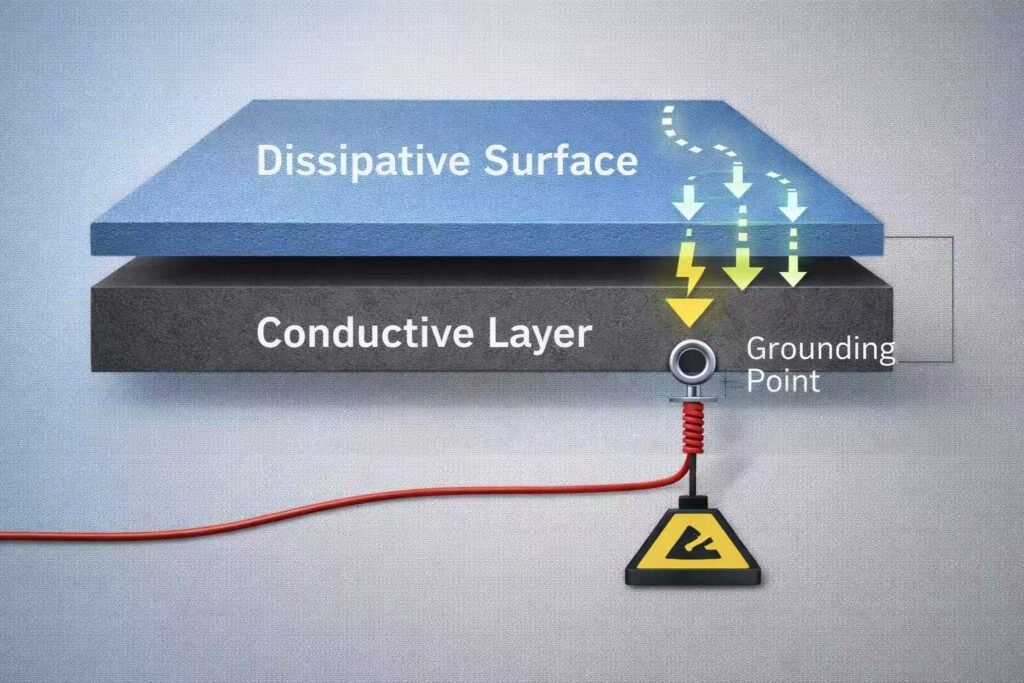
The two-layer design creates a controlled discharge path:
Step 1
Personnel walking across the floor generate static electricity.
↓
Step 2
Static charges enter the static dissipative top layer.
↓
Step 3
The conductive bottom layer collects and distributes the electrical charge.
↓
Step 4
The grounding cord transfers the charge to the Common Point Ground (CPG).
↓
Step 5
The charge is safely discharged into earth ground.
This controlled process helps maintain a stable Electrostatic Protected Area (EPA) while protecting sensitive electronic components from Electrostatic Discharge (ESD).
Why Two Layers Are Better Than One
Compared with traditional single-layer floor mats, a dual-layer rubber construction provides significant advantages.
| Feature | 2-Layer Rubber ESD Floor Mat | Single-Layer Mat |
|---|---|---|
| Static Dissipation | Excellent | Moderate |
| Grounding Performance | Excellent | Limited |
| Electrical Stability | Excellent | Moderate |
| Wear Resistance | Excellent | Lower |
| Service Life | Long | Shorter |
| EPA Suitability | Ideal | Limited |
Because each layer performs a dedicated function, dual-layer construction delivers more stable electrical performance and longer service life under continuous industrial use.
Industrial-Grade Rubber Material
ESDBEST uses high-quality industrial rubber designed for continuous operation in electronics manufacturing facilities.
Our rubber formulation provides:
- Excellent abrasion resistance
- High tensile strength
- Outstanding flexibility
- Low deformation after long-term use
- Consistent electrical properties
- Excellent aging resistance
These characteristics make our floor mats suitable for high-traffic production areas where durability and static control are equally important.
Surface Texture
The textured rubber surface improves both safety and usability.
Benefits include:
- Better traction
- Reduced slipping
- Comfortable standing
- Easy maintenance
- Professional industrial appearance
The textured finish also helps reduce visible wear while maintaining stable ESD performance.
Available Thickness
ESDBEST offers multiple thickness options to meet different industrial requirements.
2 mm
Suitable for:
- Electronics assembly
- PCB production
- Laboratories
3 mm
Recommended for:
- SMT production
- Semiconductor manufacturing
- Heavy-duty industrial environments
- High-traffic production areas
Custom thicknesses are also available for OEM projects.
Available Colors
Standard colors include:
- Green
- Blue
- Gray
- Black
Custom colors are available for OEM orders.
Custom Manufacturing
As a professional ESD manufacturer, ESDBEST provides complete OEM and ODM services.
Available customization includes:
- Custom sizes
- Custom roll lengths
- Custom colors
- Logo printing
- Special packaging
- Private labeling
- Customized resistance requirements
Why Choose ESDBEST 2-Layer Rubber ESD Floor Mats?
✔ Dual-layer industrial rubber construction
✔ Static dissipative top layer
✔ Conductive rubber bottom layer
✔ Stable resistance performance
✔ Excellent wear resistance
✔ ANSI/ESD S20.20 Compatible
✔ IEC 61340 Compatible
✔ OEM & ODM Manufacturing
✔ Factory Direct Pricing
✔ Worldwide Shipping
Why Electronics Factories Need ESD Floor Mats
In modern electronics manufacturing, static electricity is one of the most underestimated causes of product defects. Although electrostatic discharge (ESD) is invisible and often goes unnoticed by operators, it can permanently damage integrated circuits, semiconductors, printed circuit boards (PCBs), sensors, and other static-sensitive components.
As electronic devices become smaller, faster, and more densely integrated, their tolerance to electrostatic discharge continues to decrease. Today, many semiconductor devices can be damaged by static voltages far below the level that humans can feel.
For this reason, ESD floor mats have become an essential part of Electrostatic Protected Areas (EPAs) in factories worldwide. They help control static electricity at floor level, reduce the risk of ESD events, and support consistent product quality throughout the manufacturing process.
The Hidden Cost of Static Electricity
Unlike visible manufacturing defects, ESD damage often leaves no obvious signs.
There are two common types of ESD failures:
Catastrophic Failure
A high-energy electrostatic discharge immediately destroys the electronic component.
Typical results include:
- Device failure during production testing
- Immediate functional defects
- Production scrap
- Rework costs
These failures are usually detected before products leave the factory.
Latent Failure
More dangerous are latent defects.
A relatively small electrostatic discharge may partially damage an integrated circuit without causing immediate failure.
The product appears to pass inspection and quality testing, but its long-term reliability has already been reduced.
Weeks or months later, the product may fail in the customer’s equipment.
This leads to:
- Warranty claims
- Product recalls
- Customer complaints
- Brand reputation damage
- Increased service costs
Because latent failures are difficult to trace back to their original cause, many manufacturers underestimate the true cost of inadequate ESD protection.
Where Static Electricity Is Generated
Static electricity is created whenever two materials come into contact and then separate.
Inside an electronics factory, this happens continuously.
Common sources include:
- Personnel walking
- Plastic packaging
- PCB trays
- Component reels
- Conveyor belts
- Moving carts
- Plastic chairs
- Protective clothing
- Packaging films
Without proper ESD flooring, static charges accumulate rapidly on personnel and equipment.
Walking Is One of the Biggest Sources of Static
Many people are surprised to learn that simply walking across an ordinary floor can generate several thousand volts of static electricity.
The amount depends on:
- Floor material
- Shoe material
- Humidity
- Walking speed
- Environmental conditions
In dry environments, walking on standard flooring can easily generate more than 10,000 volts.
Although people usually do not feel static electricity below approximately 3,000 volts, many electronic components can be damaged by discharges as low as 30–100 volts.
This means invisible ESD events may occur hundreds or even thousands of times every day.
How ESD Floor Mats Solve the Problem
Professional 2-layer rubber ESD floor mats provide a controlled discharge path that continuously removes electrostatic charges generated during normal factory operations.
When operators wear ESD shoes or heel grounders, the process is simple:
- Static electricity is generated while walking.
- Conductive footwear transfers the charge to the ESD floor mat.
- The static dissipative top layer controls the discharge rate.
- The conductive bottom layer directs the charge to the grounding system.
- The grounding cord and Common Point Ground (CPG) safely discharge the electricity to earth ground.
Instead of allowing charges to build up on personnel, the system continuously dissipates them before they can reach sensitive electronic products.
Supporting ANSI/ESD S20.20 Compliance
Most international electronics manufacturers implement ANSI/ESD S20.20 as the foundation of their ESD control program.
This standard requires organizations to identify electrostatic hazards and implement appropriate grounding, flooring, personnel grounding, and verification procedures.
Properly installed ESD floor mats help support these requirements by:
- Controlling charge generation
- Providing a reliable grounding path
- Supporting personnel grounding systems
- Maintaining a compliant Electrostatic Protected Area (EPA)
Regular testing and maintenance ensure the flooring continues to perform as required.
Improving Manufacturing Quality
Implementing professional ESD flooring delivers measurable production benefits.
Manufacturers often experience:
- Reduced ESD-related defects
- Higher first-pass yield
- Lower rework rates
- Improved production efficiency
- Better product consistency
- Reduced customer returns
- Increased long-term reliability
For facilities producing high-value electronics, even a small reduction in ESD failures can generate significant cost savings.
Industries That Require ESD Floor Mats
Professional ESD floor mats are widely used in industries where electrostatic discharge presents a significant risk.
Typical applications include:
PCB Manufacturing
Protects bare circuit boards during assembly, inspection, and testing.
SMT Production
Controls static electricity generated during automated placement and manual handling.
Semiconductor Manufacturing
Provides continuous personnel grounding for highly sensitive semiconductor devices.
Electronics Assembly
Maintains a stable Electrostatic Protected Area for assembly operations.
Cleanrooms
Supports static control while maintaining a clean and safe production environment.
Medical Device Manufacturing
Protects sensitive electronic medical equipment throughout production.
Automotive Electronics
Reduces electrostatic damage during assembly of electronic control systems and sensors.
Aerospace Electronics
Supports high-reliability manufacturing where product failure is unacceptable.
Why Choose ESDBEST ESD Floor Mats?
ESDBEST has more than 29 years of manufacturing experience in electrostatic protection products.
Our 2-layer rubber ESD floor mats are designed specifically for demanding industrial environments and provide:
- Static dissipative top layer
- Conductive rubber backing
- Stable electrical resistance
- Excellent wear resistance
- Long service life
- ANSI/ESD S20.20 compatibility
- IEC 61340 compatibility
- OEM & ODM manufacturing
- Custom sizes and colors
- Factory-direct pricing
- Worldwide shipping
Whether you are building a new electronics factory or upgrading an existing Electrostatic Protected Area, ESDBEST can provide a reliable flooring solution tailored to your production requirements.
Build a Complete Electrostatic Protected Area (EPA)
An ESD floor mat performs best when used as part of a complete static control system.
For maximum protection, combine it with:
- ESD Workbench
- ESD Bench Mat
- ESD Wrist Strap
- ESD Shoes
- Ionizer
- Common Point Ground (CPG)
- Grounding Cord
- ESD Chairs
- ESD Storage Containers
Together, these products create a comprehensive ESD protection system that helps safeguard personnel, equipment, and electronic components.
Complete Buying Guide for Industrial Static Control Flooring
Choosing the right ESD floor mat is essential for maintaining an effective Electrostatic Protected Area (EPA). Different production environments require different materials, sizes, thicknesses, and electrical characteristics. Selecting the wrong mat can reduce static control performance, increase maintenance costs, and shorten product life.
This guide explains the most common types of ESD floor mats and helps you determine the best solution for your electronics manufacturing facility.
1. 2-Layer Rubber ESD Floor Mats (Recommended)
A 2-layer rubber ESD floor mat is the most widely used flooring solution in electronics manufacturing. It consists of a static dissipative top layer bonded to a conductive bottom layer, creating a controlled path for electrostatic charges to flow safely to ground.
This dual-layer construction provides stable electrical performance, excellent durability, and long service life, making it the preferred choice for factories with continuous production.
Advantages
- Static dissipative surface
- Conductive backing
- Stable resistance performance
- Excellent wear resistance
- Long service life
- Easy maintenance
- Suitable for heavy-duty industrial use
Best Applications
- PCB Assembly
- SMT Production
- Semiconductor Manufacturing
- Electronics Assembly
- Industrial Workstations
- Laboratories
Recommended for: Most electronics factories.
2. ESD Floor Mat Rolls
ESD floor mat rolls are supplied in continuous lengths, allowing users to cut the material according to their workspace.
They are ideal for covering long production lines, assembly areas, and large workshops.
Advantages
- Flexible installation
- Easy to cut to size
- Cost-effective for large areas
- Reduced installation joints
- Suitable for OEM projects
Best Applications
- Production Lines
- Assembly Workshops
- Electronics Factories
- Warehouses
3. Pre-Cut ESD Floor Mats
Pre-cut mats are manufactured in standard dimensions and are ready to install immediately.
They are commonly used at individual workstations, inspection stations, and equipment operating areas.
Advantages
- Ready to use
- Fast installation
- Neat appearance
- Easy replacement
Best Applications
- Individual Workstations
- Inspection Areas
- Laboratory Entrances
- Equipment Operating Positions
4. Smooth Surface ESD Floor Mats
Smooth surface mats provide a clean, professional appearance and are easy to maintain.
They are particularly suitable for clean environments where dust control is important.
Advantages
- Easy cleaning
- Low dust accumulation
- Professional appearance
- Comfortable walking
Best Applications
- Cleanrooms
- Laboratories
- Medical Electronics
- Precision Manufacturing
5. Textured Surface ESD Floor Mats
Textured surfaces improve traction and reduce slipping, making them ideal for busy industrial environments.
Advantages
- Better grip
- Improved operator safety
- Excellent wear resistance
- Durable surface
Best Applications
- SMT Production
- PCB Assembly
- Industrial Workshops
- High-Traffic Areas
6. Standard Thickness Options
Choosing the correct thickness depends on traffic levels and application requirements.
| Thickness | Recommended Application |
|---|---|
| 2 mm | Laboratories, inspection stations, light-duty electronics assembly |
| 3 mm | PCB assembly, SMT production, electronics manufacturing |
| Custom | Heavy-duty industrial environments or special OEM requirements |
For most electronics factories, 3 mm 2-layer rubber ESD floor mats provide the best balance of durability and comfort.
7. Standard Sizes
ESDBEST supports both standard and customized dimensions.
Common widths include:
- 0.6 m
- 0.8 m
- 1.0 m
- 1.2 m
Roll lengths can be customized according to customer requirements.
Custom cutting services are also available for OEM projects.
8. Custom OEM ESD Floor Mats
Every production facility has different layout requirements.
ESDBEST offers complete OEM and ODM manufacturing services, including:
- Custom dimensions
- Custom roll lengths
- Custom colors
- Logo printing
- Private labeling
- Special packaging
- Bulk production
Our engineering team can recommend the most suitable solution based on your production environment and ESD control requirements.
How to Choose the Right ESD Floor Mat
When selecting an ESD floor mat, consider the following factors:
Choose a 2-Layer Rubber ESD Floor Mat if you need:
- Long service life
- Stable ESD performance
- Heavy-duty industrial use
- Reliable grounding
- Compliance with ANSI/ESD S20.20 and IEC 61340
Choose a Roll if you need:
- Long production lines
- Large floor coverage
- Flexible installation
- Custom lengths
Choose a Pre-Cut Mat if you need:
- Individual workstations
- Quick installation
- Standard work areas
Why Choose ESDBEST?
ESDBEST manufactures industrial-grade 2-layer rubber ESD floor mats trusted by electronics manufacturers worldwide.
Our Advantages
- 29+ Years of Manufacturing Experience
- 2-Layer Rubber Construction
- Static Dissipative Top Layer
- Conductive Bottom Layer
- Stable Surface Resistance
- OEM & ODM Services
- Custom Sizes Available
- Factory Direct Pricing
- Fast Worldwide Shipping
- Professional Technical Support
Where Are ESD Floor Mats Used?
Modern electronic products are becoming increasingly smaller, faster, and more sensitive to electrostatic discharge (ESD). As a result, ESD floor mats have become an essential part of Electrostatic Protected Areas (EPAs) across a wide range of industries.
A professionally grounded 2-layer rubber ESD floor mat helps dissipate static electricity generated by personnel movement, reduces the risk of ESD damage, and supports compliance with ANSI/ESD S20.20 and IEC 61340 standards.
Below are the most common industrial applications for ESD floor mats.
1. PCB Manufacturing
Printed Circuit Board (PCB) manufacturing is one of the most ESD-sensitive processes in the electronics industry.
During PCB fabrication, inspection, assembly, and testing, electrostatic discharge can damage copper traces, integrated circuits, solder joints, and other delicate components. Many failures are latent, meaning the board may pass inspection but fail later in the field.
Professional ESD floor mats help maintain a stable Electrostatic Protected Area by safely dissipating static electricity generated by operators and mobile equipment.
Recommended Products
- 2-Layer Rubber ESD Floor Mat
- ESD Bench Mat
- ESD Wrist Strap
- ESD Workbench
- Ionizer
Related Guide: PCB Static Protection
2. SMT Assembly Lines
Surface Mount Technology (SMT) production requires extremely effective static control.
Electronic components are handled automatically and manually throughout solder paste printing, pick-and-place, reflow soldering, AOI inspection, and functional testing.
Walking personnel can generate thousands of volts of static electricity if proper flooring is not installed.
ESD floor mats reduce this risk by providing continuous personnel grounding when used together with ESD footwear.
Typical SMT Areas
- Printing Stations
- Pick-and-Place Machines
- AOI Inspection
- Manual Assembly
- Rework Stations
- Testing Areas
3. Semiconductor Manufacturing
Semiconductor devices are among the most ESD-sensitive products in the world.
Modern chips may be permanently damaged by electrostatic discharges that are completely invisible to operators.
For this reason, semiconductor manufacturers implement strict ESD control programs covering flooring, workstations, personnel grounding, and environmental monitoring.
ESDBEST 2-layer rubber ESD floor mats provide stable static control performance suitable for semiconductor production facilities.
4. Electronics Assembly
General electronics assembly involves continuous handling of PCBs, electronic modules, connectors, displays, sensors, batteries, and integrated circuits.
Professional ESD flooring helps reduce static accumulation throughout the production area while improving product quality and manufacturing consistency.
Typical products include:
- Consumer Electronics
- Industrial Electronics
- Power Supplies
- Communication Equipment
- Smart Devices
- IoT Products
5. Cleanrooms
Many cleanroom environments require both contamination control and electrostatic protection.
Professional ESD floor mats are widely installed in:
- ISO Cleanrooms
- Medical Electronics
- Optical Manufacturing
- Precision Instruments
- Semiconductor Packaging
Benefits include:
- Continuous static control
- Easy cleaning
- Excellent wear resistance
- Long service life
- Reliable grounding
6. Electronic Repair Centers
Repair engineers frequently work with exposed circuit boards and sensitive electronic assemblies.
Without proper static control, even routine maintenance can introduce electrostatic damage.
Installing ESD floor mats together with ESD workbenches and wrist straps significantly reduces repair-related ESD risks.
Typical repair environments include:
- Mobile Phone Repair
- Laptop Repair
- PCB Repair
- Industrial Electronics
Medical Equipment Service
7. Electronics Testing Laboratories
Testing laboratories often perform:
- Functional Testing
- Reliability Testing
- Environmental Testing
- Quality Inspection
- Failure Analysis
Because products are frequently handled manually during testing, ESD floor mats help maintain a controlled electrostatic environment and improve testing reliability.
8. Medical Device Manufacturing
Modern medical devices contain highly sensitive electronic components that must remain reliable throughout their service life.
Professional ESD flooring helps manufacturers reduce electrostatic damage during production of:
- Patient Monitoring Equipment
- Imaging Systems
- Surgical Devices
- Diagnostic Instruments
- Laboratory Equipment
9. Automotive Electronics
Today’s vehicles contain hundreds of electronic control units (ECUs), sensors, cameras, radar modules, and battery management systems.
Many of these components are highly susceptible to electrostatic discharge during assembly.
ESD floor mats help protect:
- Engine Control Units
- ADAS Systems
- Battery Management Systems
- Navigation Modules
- Instrument Clusters
- Electric Vehicle Electronics
10. Aerospace Electronics
The aerospace industry requires extremely high product reliability.
ESD protection is critical during the assembly of:
- Flight Control Systems
- Navigation Equipment
- Satellite Electronics
- Military Electronics
- Communication Systems
Professional ESD floor mats help maintain strict electrostatic control throughout manufacturing and testing.
11. Industrial Automation
Industrial automation equipment includes:
- PLC Controllers
- Servo Drives
- Industrial PCs
- Machine Vision Systems
- Industrial Sensors
These products often contain static-sensitive electronics that benefit from comprehensive ESD protection.
12. Research Laboratories
Universities, R&D centers, and engineering laboratories frequently handle prototypes and experimental electronic devices.
Installing professional ESD flooring protects valuable research equipment while supporting accurate testing results.
Why Do These Industries Choose ESDBEST?
ESDBEST has specialized in manufacturing 2-layer rubber ESD floor mats for over 29 years.
Our flooring solutions are trusted by customers in more than 60 countries because they provide:
- Stable electrical performance
- Excellent wear resistance
- Industrial-grade rubber construction
- Reliable grounding
- OEM & ODM services
- Custom sizes and colors
- Factory-direct pricing
- Worldwide shipping
Whether you operate a small electronics workshop or a large semiconductor manufacturing facility, ESDBEST can provide the right ESD flooring solution for your production environment.
Recommended ESD Protection System
For maximum protection, combine ESD floor mats with:
- ESD Workbench
- ESD Bench Mat
- ESD Wrist Strap
- ESD Shoes
- Ionizer
- Grounding Cord
- Common Point Ground (CPG)
- ESD Chairs
- ESD Storage Bins
A complete Electrostatic Protected Area provides significantly better protection than any single ESD product used alone.
How to Ensure an ESD Floor Mat Performs Correctly
Installing an ESD floor mat is only the first step in building an effective Electrostatic Protected Area (EPA). To provide reliable protection, the mat must have the correct electrical resistance, be properly grounded, and be tested regularly.
Without these three elements, even a high-quality ESD floor mat cannot effectively control static electricity.
This guide explains the key technical requirements for resistance, grounding, testing, and international ESD compliance.
Understanding Electrical Resistance
Electrical resistance measures how easily electrical current can pass through a material.
For ESD floor mats, the objective is not to eliminate resistance entirely. Instead, the goal is to achieve controlled resistance that allows electrostatic charges to dissipate safely and gradually.
If the resistance is too low, charges may discharge too quickly, creating safety concerns.
If the resistance is too high, static electricity may remain on personnel or equipment, reducing the effectiveness of the ESD control system.
Professional ESD floor mats are designed to maintain stable resistance within internationally accepted ranges.
Surface Resistance vs. Volume Resistance
When evaluating an ESD floor mat, two measurements are commonly used.
Surface Resistance (RTT)
Surface resistance measures how easily static electricity travels across the surface of the mat.
This value is important because operators walk directly on the surface.
A stable surface resistance helps maintain continuous static dissipation while preventing sudden electrostatic discharge.
Volume Resistance (RTV)
Volume resistance measures electrical resistance through the thickness of the mat.
It indicates how effectively static electricity travels from the surface to the conductive backing and ultimately to earth ground.
Together, these two measurements provide a complete evaluation of the flooring’s electrical performance.
Typical Electrical Resistance
The exact specification depends on the product model and customer requirements.
For ESDBEST 2-layer rubber ESD floor mats, typical values are:
| Property | Typical Value |
|---|---|
| Surface Layer Resistance | 10⁶–10⁹ Ω |
| Bottom Conductive Layer | 10³–10⁵ Ω |
These values support controlled static dissipation when the mat is installed with an approved grounding system.
Why Grounding Is Essential
Even the highest-quality ESD floor mat cannot dissipate static electricity unless it is properly grounded.
Grounding provides a safe path that allows accumulated electrostatic charges to flow into the building’s earth grounding system.
Without grounding:
- Static electricity accumulates
- Personnel remain charged
- Electronic components are exposed to ESD risks
- The mat cannot perform as designed
Grounding transforms the floor mat from a passive surface into an active part of the factory’s ESD control system.
Standard Grounding Components
A professional ESD flooring system typically includes:
Grounding Cord
Connects the conductive layer of the floor mat to the Common Point Ground.
Common Point Ground (CPG)
Provides a centralized grounding connection for multiple ESD products.
Earth Ground
Safely dissipates electrostatic charges into the building grounding system.
ESD Shoes or Heel Grounders
Create electrical continuity between personnel and the grounded floor mat.
How Static Electricity Flows
A properly installed ESD flooring system follows a simple path:
Operator
↓
ESD Shoes
↓
Static Dissipative Surface
↓
Conductive Rubber Layer
↓
Grounding Cord
↓
Common Point Ground (CPG)
↓
Earth Ground
Every component in this chain must function correctly to maintain effective ESD protection.
How to Test an ESD Floor Mat
Routine testing verifies that the floor mat continues to perform correctly after installation.
Testing should be performed:
- Before initial use
- After installation
- During routine maintenance
- After repairs
- Before ESD audits
Regular testing helps identify damage, contamination, or grounding problems before they affect production.
Recommended Test Equipment
Professional ESD floor mats should be tested using a calibrated surface resistance meter with the appropriate electrodes.
The testing process generally includes:
- Visual inspection
- Surface cleaning
- Electrode placement
- Resistance measurement
- Ground continuity verification
- Documentation of results
Consistent testing procedures improve repeatability and support quality management systems.
Common Reasons for Test Failure
An ESD floor mat may fail testing for several reasons.
Typical causes include:
- Loose grounding cord
- Poor earth ground connection
- Surface contamination
- Excessive wear
- Physical damage
- Incorrect installation
- Damaged conductive layer
- High humidity or environmental contamination
Identifying these issues early helps maintain reliable static protection.
Maintenance Best Practices
Routine maintenance extends the service life of ESD floor mats and helps preserve electrical performance.
Recommended practices include:
- Clean the surface regularly with an approved ESD-safe cleaner.
- Avoid waxes, silicone coatings, or insulating cleaners.
- Inspect grounding cords and connectors.
- Replace damaged accessories immediately.
- Perform resistance testing on a scheduled basis.
- Record inspection and test results.
Proper maintenance reduces downtime and supports long-term compliance.
Supporting ANSI/ESD S20.20
ANSI/ESD S20.20 is one of the world’s most widely recognized standards for controlling electrostatic discharge in electronics manufacturing.
An effective flooring system helps support compliance by providing:
- Personnel grounding
- Controlled resistance
- Reliable grounding paths
- Verification through testing
- Documented maintenance procedures
However, flooring alone does not achieve compliance. It should be integrated with other ESD control measures, including wrist straps, work surfaces, ionizers, and personnel training.
IEC 61340 Requirements
The IEC 61340 series provides internationally recognized guidance for electrostatic control.
These standards address:
- Flooring systems
- Personnel grounding
- Testing methods
- Resistance measurements
- EPA management
- Compliance verification
Using products designed to support these standards helps manufacturers implement consistent ESD control programs across global facilities.
Build a Complete ESD Protection System
For maximum effectiveness, combine ESD floor mats with:
- ESD Workbench
- ESD Bench Mat
- ESD Wrist Strap
- ESD Shoes
- Ionizer
- Grounding Cord
- Common Point Ground (CPG)
- ESD Chairs
- ESD Storage Containers
A complete Electrostatic Protected Area provides significantly better protection than any single ESD product used alone.
Why Choose ESDBEST?
ESDBEST manufactures professional 2-layer rubber ESD floor mats engineered for stable electrical performance and long-term industrial use.
Our advantages include:
- Stable surface resistance
- Dual-layer rubber construction
- Reliable grounding performance
- Excellent wear resistance
- OEM & ODM services
- Factory-direct manufacturing
- Worldwide shipping
- Technical support
Whether you are building a new production line or upgrading an existing ESD control program, ESDBEST provides flooring solutions designed for demanding electronics manufacturing environments.
Continue Reading
Learn more about electrostatic protection:
- How to Ground an ESD Mat
- How to Test an ESD Mat
- Conductive vs. Dissipative ESD Mats
- ESD Workbench
- ANSI/ESD S20.20 Guide
- IEC 61340 Standard
- PCB Static Protection Guide
📞 Contact Us Today
For bulk ESD Mat orders, quotes, or product guidance, get in touch with our expert team:
Email: sales2@esdbest.com
Phone: +86 137 1427 2599
FAQ
What resistance should an ESD floor mat have?
Most ESD floor mats used in electronics manufacturing fall within the dissipative range of 10⁶ to 10⁹ ohms.
How do you ground an ESD floor mat?
Using a grounding cord connected to a verified earth ground or common point ground.
Are anti-static mats the same as ESD mats?
No. Anti-static mats reduce static generation, while ESD mats dissipate static charge safely to ground.
How often should ESD floor mats be tested?
Most facilities test regularly according to their ESD control program and audit schedule.
Do ESD floor mats wear out?
Yes. Traffic, contamination, and environmental conditions can affect performance over time.
Can ESD floor mats protect PCBs?
Yes. Properly grounded ESD floor mats help reduce the risk of electrostatic discharge damage.
Related ESD Resources
Continue Learning About ESD Floor Mats
Expand your knowledge with these expert guides covering ESD mat selection, grounding, testing, and workstation protection.
✅ What Is an ESD Mat?
Learn how ESD mats safely dissipate static electricity and protect sensitive electronic components in electronics manufacturing.
✅ How to Ground an ESD Mat
Follow step-by-step grounding instructions to ensure your ESD floor mat provides effective static control and complies with ANSI/ESD standards.
✅ How to Test an ESD Mat
Learn how to measure surface resistance and verify ESD performance using professional resistance testing methods.
✅ ESD Bench Mat vs ESD Floor Mat
Compare bench mats and floor mats to determine the best solution for your ESD workstation.
Recommended ESD Products
Build a Complete Static Control System
Professional ESD protection requires more than just an ESD floor mat. Combine the following products to create a complete electrostatic protected area (EPA).
✅ ESD Floor Mats
✅ ESD Workbenches
✅ ESD Wrist Straps
✅ ESD Shoes
✅ Ionizers
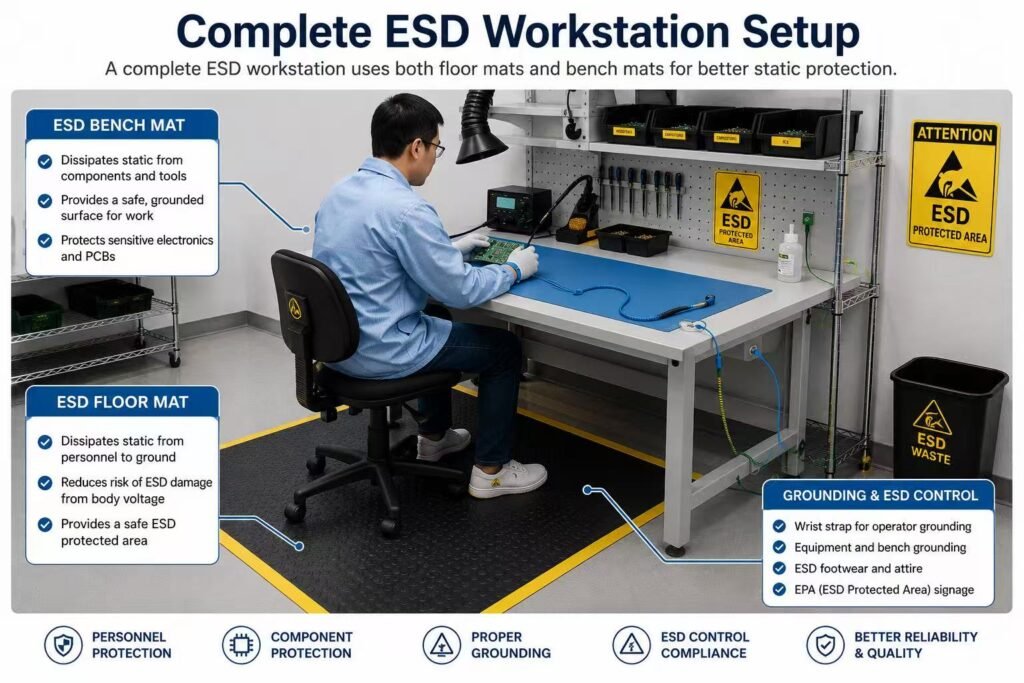
Build a Complete ESD Workstation
An ESD floor mat is one of the most important components of an Electrostatic Protected Area (EPA). However, effective static control requires a complete ESD workstation where all grounding devices work together.
For maximum protection, your workstation should include:
✅ ESD Workbench
✅ ESD Wrist Strap
✅ Ionizer
Request a Free Quote
Looking for a Reliable ESD Floor Mat Manufacturer?
ESDBEST supplies high-quality ESD floor mats for electronics factories, PCB assembly lines, cleanrooms, laboratories, and industrial workplaces worldwide.
Why Choose ESDBEST?
✔ 29+ Years of Manufacturing Experience
✔ IEC 61340 & ANSI/ESD S20.20 Compliant
✔ Surface Resistance 10⁶–10⁹ Ω
✔ OEM & Custom Sizes Available
✔ Factory Direct Pricing
✔ Fast Worldwide Delivery
✔ Professional Technical Support
Get Started Today
👉 Request a Free Quote
👉 Contact Our ESD Specialists
Explore the Complete ESD Mat Resource Center
Want to learn everything about ESD mats?
Visit our comprehensive guide covering:
- What Is an ESD Mat
- Conductive vs Dissipative ESD Mats
- ESD Floor Mats
- ESD Bench Mats
- Grounding Methods
- Resistance Testing
- ANSI/ESD S20.20
- IEC 61340
- PCB Static Protection
- Complete ESD Workstation Setup
- Buying Guide
- OEM Manufacturing
👉 Explore the Complete ESD Mat Guide
/esd-mat/