Types of ESD Gloves: Carbon Fiber, PU, Nylon Explained
Types of ESD Gloves and How to Choose
Quick Comparison
| Type | Measured resistance | Reusable | Best for |
|---|---|---|---|
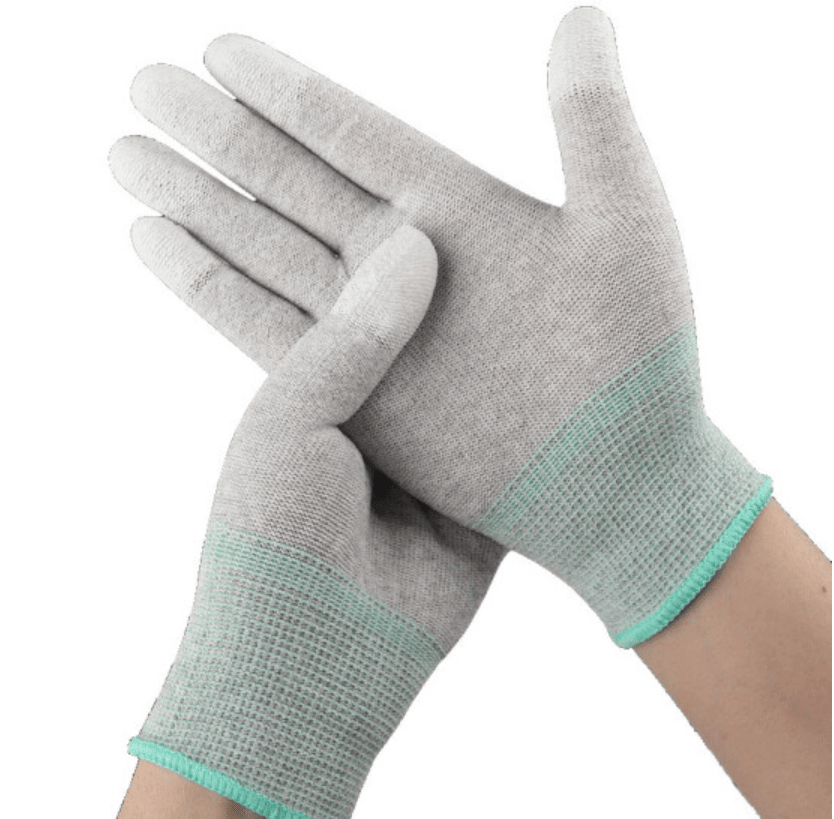
| Carbon fibre knitted, PU fingertip | 2.52 × 10⁶ – 2.01 × 10⁷ Ω/sq | Yes | General assembly, inspection, all-shift wear |
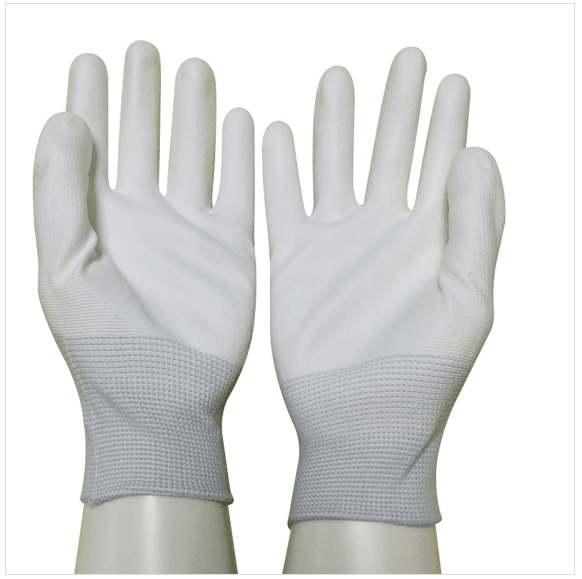
| Carbon fibre knitted, PU palm | Same base material | Yes | Heavier handling, more grip |
| Carbon fibre, PVC dotted | Same base material | Yes | Smooth or slippery components |
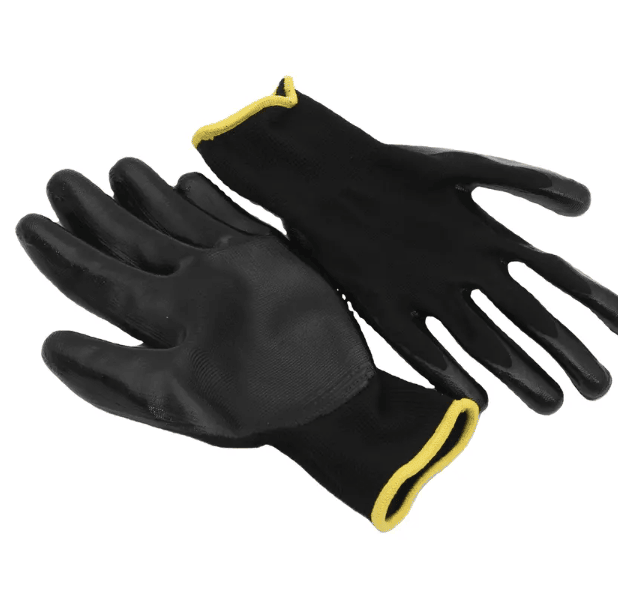
| Nitrile, powder-free | 3.72 – 4.28 × 10⁸ Ω/sq | No | Contamination control, cleanroom, flux exposure |
All measurements taken at 60–65% RH, 30 °C, on a calibrated ACL Staticide Model 800.
Carbon Fibre Knitted Gloves
The conductive path is carbon fibre spun into the yarn. It is structural, so it survives washing and does not wear off with the coating.
These are the default choice for operators who wear gloves for a full shift: breathable, reusable, and the lowest cost per shift of any ESD glove.
Three coating options change the grip, not the electrical performance.
→ Top Fit, Palm Fit and dotted gloves
ESD Nitrile Gloves
Disposable, powder-free, latex-free. The reason to choose nitrile is not electrical — it is barrier performance.
Where the process involves flux, solvents, adhesives or cleanroom protocol, a knitted glove cannot keep contamination off the product. A disposable nitrile glove can.
How to Choose
Start with the contamination requirement, not the resistance.
Both glove types measured inside the static-dissipative range. Either will meet an EPA resistance specification. What separates them is everything else:
| Question | If yes |
|---|---|
| Does the process involve flux, solvent or adhesive? | Nitrile |
| Is it a cleanroom with a disposable-only protocol? | Nitrile |
| Are gloves worn for a full shift? | Carbon fibre |
| Is breathability a comfort complaint? | Carbon fibre |
| Do operators handle sharp or heavy parts? | Carbon fibre, PU palm |
| Are components smooth and hard to grip? | Carbon fibre, dotted |
| Is cost per shift the main constraint? | Carbon fibre |
Many EPAs use both: carbon fibre on the general assembly line, nitrile at stations where contamination matters.
Gloves Are One Part of Personnel Grounding
Gloves are one part of a personnel grounding system, not the whole of it.
A glove limits charge transfer at the point of contact. It does not ground the operator. Grounding requires either:
- A wrist strap connected to a common point ground, or
- ESD footwear used with a dissipative or conductive floor
Specify gloves alongside footwear and wrist straps, not instead of them. See ESD gloves overview for how the parts fit together.
Related
📞 Contact Us Today
For bulk orders, quotes, or product guidance, get in touch with our expert team:
Email: sales2@esdbest.com
Phone: +86 137 1427 2599
Learn more disposable glove types, please click this link:https://esdbest.com/nitrile-vs-latex-gloves/