ESD Bags for Electronic Components, PCBs and Static-Safe Packaging
ESD bags help protect electrostatic-discharge-sensitive components, printed circuit boards and electronic assemblies during handling, storage, production and transportation.
However, not every bag labelled “anti-static” provides the same level of protection.
Pink anti-static bags, static-dissipative bags, conductive bags, metallized shielding bags and moisture-barrier bags are designed for different environments and risks. Selecting the wrong bag can leave an electronic device exposed to electrostatic fields, direct discharges, moisture or physical contamination.
ESDBEST supplies customizable ESD packaging bags for electronics manufacturing, PCB assembly, semiconductor handling, component storage, repair operations and international transportation.
📞 Contact Us Today
For bulk orders, quotes, or product guidance, get in touch with our expert team:
Email: sales2@esdbest.com
Whatsapp: +86 137 1427 2599
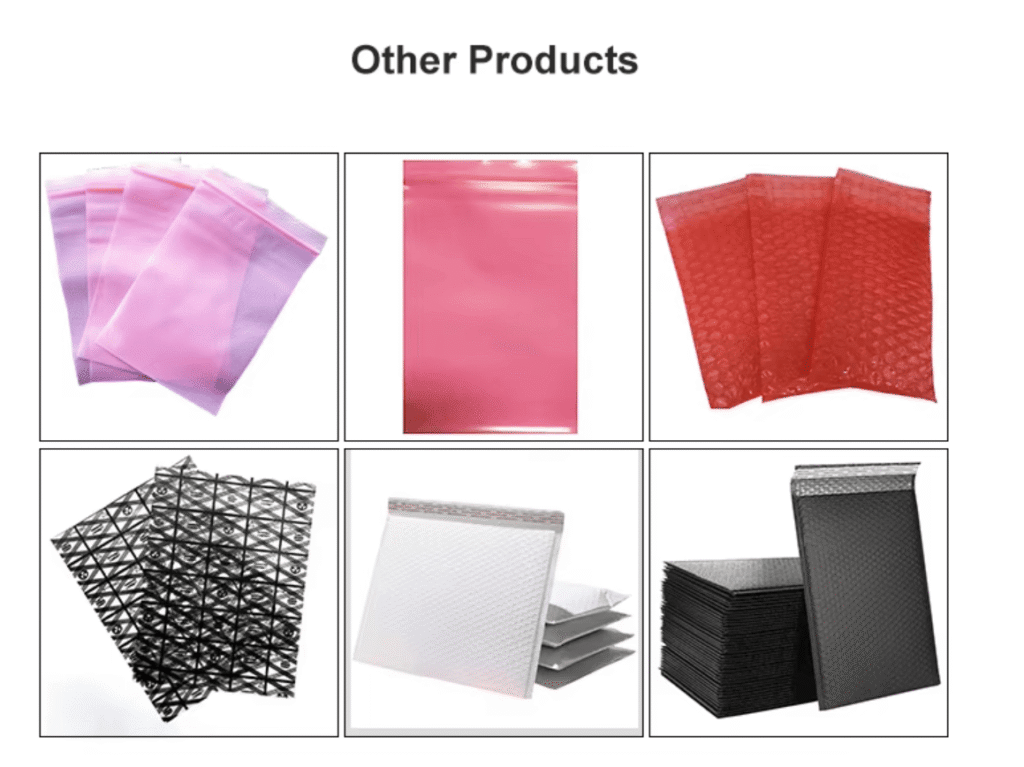


Item name | Customized Anti Static Bag |
Usage | Consumer Electronics,making antistatic shielding bag for electronic component protection,mobile phone accessories, Mobile Phone, Speakers, Camera, Earphone, Smart Watch, Smart Electronics, Home Appliance, COMPUTER,Projector, and Others |
Plastic Type: | PET/VMPET/PE |
Feature | Inner and surface resistance can be10(8-10) or 10(6-9)Ohm Widely used for packing PCB,IC,LED and other ESD sensitive devices |
Sample | In stock samples in free but freight charged |
QC | Advanced equipment and experienced QC team will strictly inspect materials semi-finishedproducts and finished products at every step before shipment |
- Electronics Packaging Applications
- Custom Sizes and Printing
- Open-Top and Ziplock Options
- Static-Dissipative and Shielding Structures
- OEM Thickness and Packaging
- Test Report Support
Module 2:What Are ESD Bags?
ESD bags are packaging materials designed to help control one or more electrostatic risks when electronic components and assemblies are handled, stored or transported.
Depending on the bag construction, an ESD bag may provide:
- Low charge generation
- Static-dissipative contact surfaces
- Conductive properties
- Electrostatic-discharge shielding
- Protection from external electrostatic fields
- Moisture protection
- Physical contamination protection
The term “ESD bag” is a broad category rather than one specific product.
A pink anti-static polyethylene bag and a multilayer metallized shielding bag are both commonly marketed as ESD bags, but they do not provide identical protection.
The correct bag must be selected according to:
- Device sensitivity
- Packaging location
- Contact requirements
- Transportation conditions
- Moisture sensitivity
- Required shielding
- Customer specifications
- Applicable ESD control plan
ANSI/ESD S541 defines packaging properties intended to protect ESD-sensitive items through production, transportation and storage. IEC 61340-5-3:2022 similarly defines protective-packaging properties, test methods and performance limits for ESDS devices throughout production, rework, maintenance, transport and storage.
Module 3:Why Electronic Components Need ESD Packaging
Electronic components can be exposed to electrostatic risks at many stages:
- Component manufacturing
- Incoming inspection
- Warehouse storage
- SMT assembly
- Manual insertion
- PCB testing
- Rework and repair
- Internal transport
- Customer delivery
- International shipping
Static charge can arise through:
- Film separation
- Plastic contact
- Bag opening
- Component movement
- Sliding
- Friction
- Adhesive-tape removal
- Handling by personnel
- Movement through ordinary packaging
An electronic component may be damaged even when no visible spark is observed.
Possible consequences include:
- Immediate functional failure
- Latent damage
- Parametric change
- Reduced reliability
- Intermittent failure
- Higher return rates
- Increased rework
- Reduced production yield
ESD packaging should not be treated as decorative plastic packaging. It forms part of the complete ESD control system.
Module 4: How Do ESD Bags Work?
Different ESD bags work through different mechanisms.
1. Low-Charging Properties
A low-charging material is designed to generate less charge when it contacts and separates from another material.
This property is important because the packaging itself should not become a major source of electrostatic charge.
Low charging is sometimes described commercially as “anti-static.”
However, low charge generation alone does not automatically provide discharge shielding.
2. Static Dissipation
Static-dissipative materials allow charge to move across or through the material in a controlled manner.
They are generally designed to avoid the rapid discharge associated with highly conductive materials while allowing accumulated charge to decay more predictably.
Static-dissipative properties can be important for surfaces that directly contact ESDS items.
3. Conductive Protection
Conductive layers allow charge to move readily through or across the packaging material.
Black conductive bags often use carbon-loaded polyethylene.
They can be useful in controlled handling and storage applications, but their opacity and conductive surface must be considered.
Conductive packaging should not automatically be assumed to provide the same discharge shielding performance as a qualified multilayer shielding bag.
4. Electrostatic-Discharge Shielding
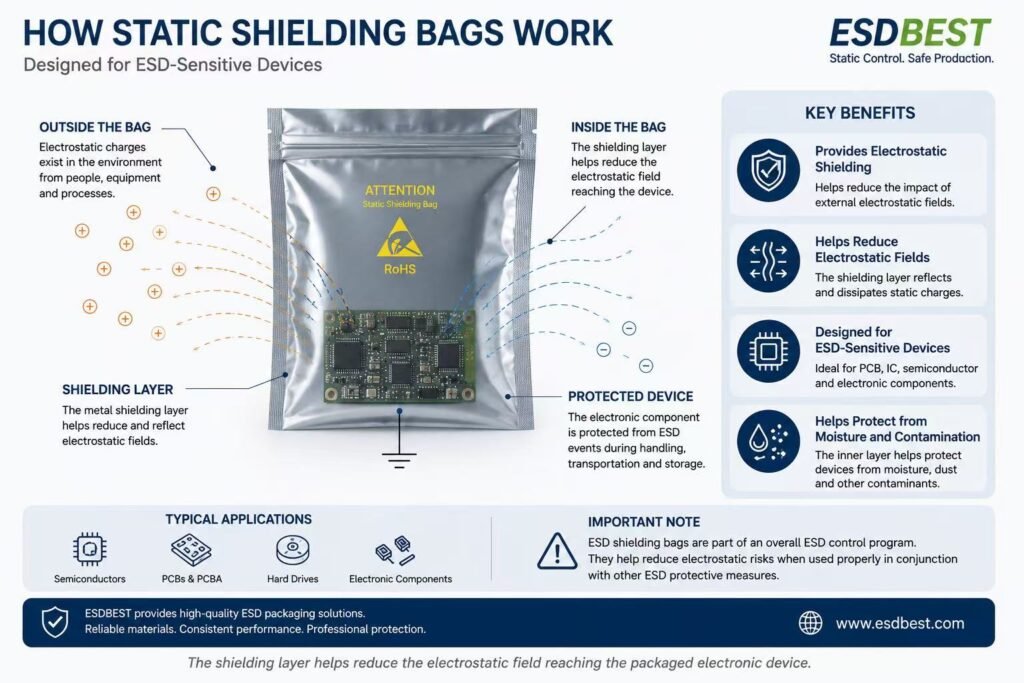
A static shielding bag contains a conductive shielding layer designed to reduce the energy reaching the protected item during an external electrostatic discharge.
This is often described through the Faraday-cage principle.
When the bag is properly closed, the outer conductive layer helps distribute an external discharge around the bag instead of allowing the full energy to pass directly through to the electronic device.
A shielding bag must be evaluated as a complete package. The material name, silver appearance or metallized layer alone does not prove shielding performance.
IEC 61340-4-8 specifies a test method for evaluating electrostatic-discharge shielding bags under IEC 61340-5-3 requirements, using a 1,000 V DC design voltage for the test apparatus.
5. Moisture Protection
Moisture-barrier bags combine ESD protection with resistance to moisture-vapor transmission.
They are commonly used for:
- Moisture-sensitive devices
- Semiconductors
- Integrated circuits
- Long-term storage
- Vacuum packaging
- International shipping
Moisture protection and ESD shielding are separate performance characteristics.
A bag should not be called a moisture-barrier bag simply because it looks silver.
Module 5: Types of ESD Bags
Type 1: Pink Anti-Static Bags
Pink anti-static bags are normally manufactured from polyethylene containing an anti-static additive.
Typical properties
- Low charge generation
- Lightweight
- Transparent
- Economical
- Suitable for general handling
- Commonly available in open-top and ziplock versions
Best applications
- Non-sensitive hardware
- Components already protected by another package
- Handling within a controlled EPA
- Secondary packaging
- Non-ESDS items that must not create excessive charge
Limitations
Pink anti-static bags generally do not provide the same external-discharge shielding as qualified static shielding bags.
They should not automatically be selected for transporting unpackaged sensitive electronic components outside an EPA.
Type 2: Static-Dissipative Bags
Static-dissipative bags are designed to provide controlled surface or volume resistance.
Typical benefits
- Controlled charge decay
- Suitable contact surface
- Reduced rapid discharge
- Available in transparent structures
- Useful in controlled packaging systems
Applications
- EPA handling
- Electronic component storage
- Inner packaging
- Work-in-process transport
- PCB assemblies
Performance should be confirmed through relevant resistance and charge-generation tests rather than judged only by color.
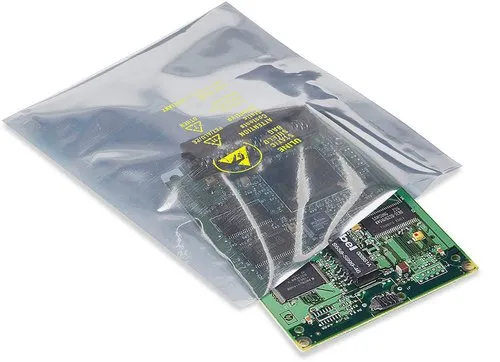
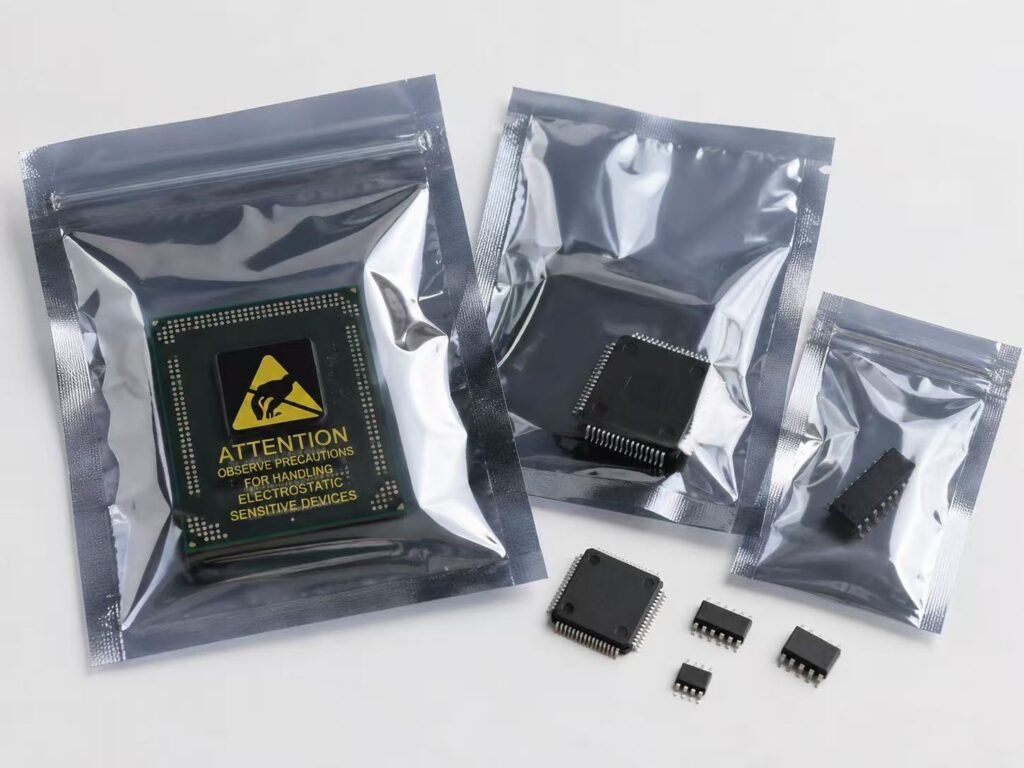
Type 3: Metallized Static Shielding Bags
Static shielding bags normally use a multilayer film containing a thin metal layer.
Common appearance:
- Silver
- Semi-transparent
- Metallized
- Printed with ESD warning symbols
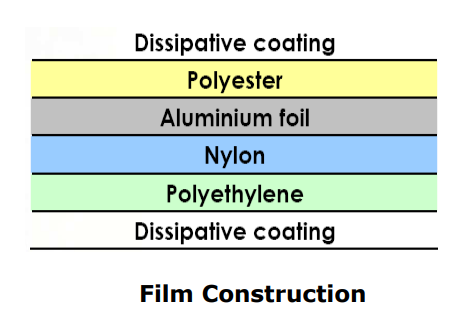
Typical structure
- Outer protective layer
- Metallized shielding layer
- Inner static-dissipative or low-charging layer
Main functions
- Low charge generation
- Controlled contact properties
- External ESD shielding
- Protection during transport and storage
- Visibility of contents
Best applications
- PCBs
- Integrated circuits
- Modules
- Sensitive components
- Finished electronics assemblies
- Transportation outside the EPA
Static shielding bags are among the most widely used packaging formats for sensitive electronic devices.
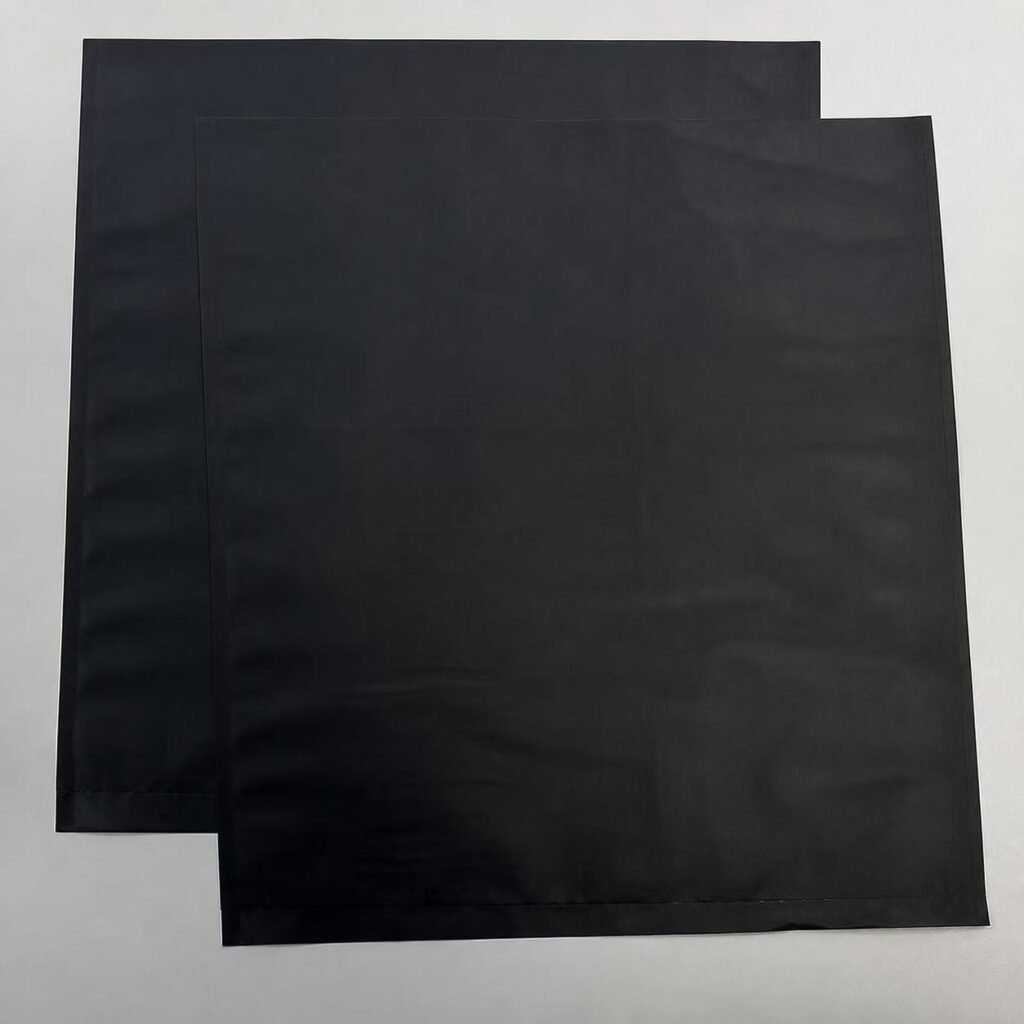
Type 4: Black Conductive Bags
Black conductive bags commonly use carbon-loaded polyethylene.
Advantages
- Conductive material
- Strong physical construction
- Opaque
- Suitable for some reusable handling systems
- Available in custom thicknesses
Limitations
- Contents are not visible
- Carbon contamination may be relevant in some processes
- Conductive contact must be assessed
- Shielding performance must not be assumed without test data
Applications
- Conductive waste bags
- Component handling
- EPA storage
- Conductive liners
- Industrial packaging
Type 5: Moisture Barrier Bags
Moisture-barrier bags normally use multilayer structures that provide:
- ESD protection
- Moisture-vapor resistance
- Light resistance
- Oxygen resistance
- Vacuum-sealing capability
Common applications
- Moisture-sensitive devices
- Semiconductor components
- IC packaging
- Long-term warehouse storage
- Vacuum packaging
- Dry-pack operations
A complete dry-pack system may also include:
- Desiccant
- Humidity indicator card
- Moisture-sensitivity label
- Vacuum sealing
- Traceability label
Type 6: ESD Bubble Bags
ESD bubble bags combine cushioning with electrostatic-control properties.
Applications
- PCB assemblies
- Finished electronic modules
- Displays
- Sensors
- Fragile electronics
- Repair parts
Selection concerns
- Bubble layer type
- Inner-contact material
- Charge generation
- Closure method
- Shielding requirement
- Cushioning thickness
A pink bubble bag and a metallized shielding bubble bag do not provide the same electrostatic protection.
Type 7: ESD Ziplock Bags
Ziplock bags can be repeatedly opened and closed.
Benefits
- Reusable closure
- Easy component access
- Suitable for small parts
- Reduces need for heat sealing
- Available in pink, dissipative and shielding films
Limitations
- A damaged zip seal reduces package integrity
- The closure must be fully engaged
- Ziplock construction may affect shielding
- Repeated use can create scratches and contamination
Type 8: Open-Top ESD Bags
Open-top bags are usually:
- Heat sealed
- Tape sealed
- Folded and labelled
- Used as inner packaging
For shielding applications, the bag must be properly closed. Leaving a shielding bag open can significantly reduce the protective enclosure effect.
Module 6: ESD Bag Comparison Table
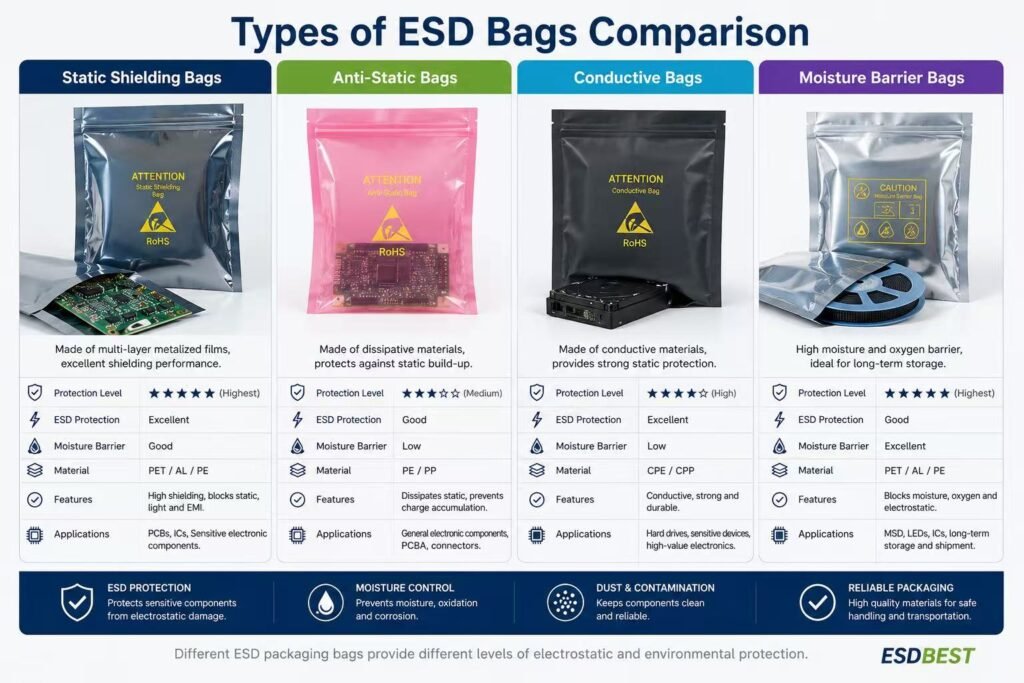
| Bag Type | Low Charging | Dissipative Contact | Conductive | ESD Shielding | Moisture Barrier | Typical Use |
|---|---|---|---|---|---|---|
| Pink anti-static bag | Yes | Depends on product | No | Usually no | No | EPA handling |
| Static-dissipative bag | Yes | Yes | No | Not necessarily | No | Inner packaging |
| Metallized shielding bag | Yes | Usually yes | Shielding layer | Yes | Limited unless specified | PCB and components |
| Black conductive bag | Depends | No or conductive | Yes | Must be verified | No | Conductive handling |
| Moisture-barrier bag | Usually | Depends on construction | Metallized layer | Often yes | Yes | Moisture-sensitive devices |
| ESD bubble bag | Depends | Depends | Depends | Depends on design | No | Fragile electronics |
Important:
- Surface resistance: 10³–10¹¹ Ω
- Shielding: <10 nJ
- Static decay: <2 seconds
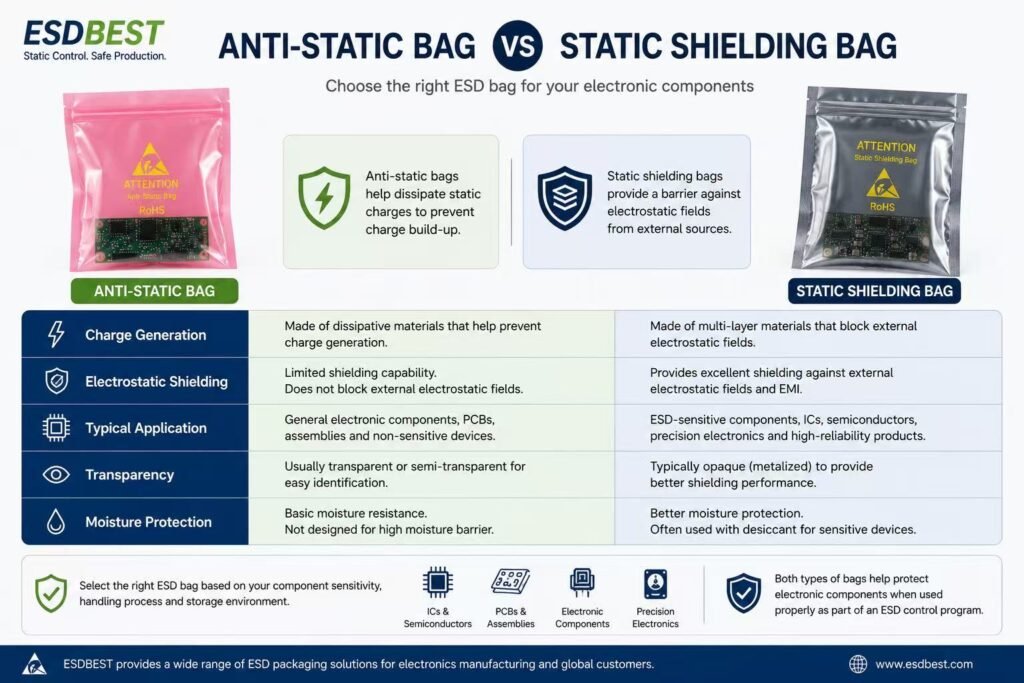
Module 7: Anti-Static Bag vs Static Shielding Bag
Comparison
| Feature | Anti-Static Bag | Static Shielding Bag |
| Reduces charge generation | Yes | Yes |
| Conductive shielding layer | Usually no | Yes |
| Protection from external discharge | Limited | Designed for this purpose |
| Suitable outside an EPA | Not always | Commonly selected |
| Typical color | Pink | Silver |
| Typical cost | Lower | Higher |
| Best use | Controlled internal handling | Sensitive electronics transport |
SEO Conclusion
An anti-static bag reduces charge generation, while a static shielding bag is designed to protect an enclosed ESDS item from external electrostatic discharge.
“Pink anti-static bags generally do not provide the same discharge-shielding performance as qualified multilayer static shielding bags.”
📞 Contact Us Today
For bulk orders, quotes, or product guidance, get in touch with our expert team:
Email: sales2@esdbest.com
Whatsapp: +86 137 1427 2599
Module 8: Conductive Bag vs Static Shielding Bag
Anti-Static Bag vs Static Shielding Bag: What’s the Difference?
Many buyers assume that every pink or silver bag offers the same level of ESD protection. In reality, anti-static bags and static shielding bags are designed for different purposes.
An anti-static bag is intended to reduce the generation of electrostatic charge on the packaging material itself. A static shielding bag, however, is engineered to protect electrostatic discharge sensitive (ESDS) devices from external electrostatic discharges during handling, storage and transportation.
Selecting the wrong bag may expose sensitive printed circuit boards (PCBs), integrated circuits (ICs) and electronic assemblies to unnecessary ESD risk, especially once they leave an ESD Protected Area (EPA).
For electronics manufacturers, EMS providers and PCB assemblers, understanding this distinction is essential when choosing compliant ESD packaging.
What Is an Anti-Static Bag?
An anti-static bag is manufactured from polymer materials formulated to minimize triboelectric charge generation.
These bags help reduce the amount of static electricity generated when the bag rubs against other materials during normal handling.
Typical applications include:
- Plastic hardware
- Mechanical components
- General warehouse handling
- EPA internal logistics
- Secondary packaging
- Temporary work-in-process storage
Most anti-static bags are easily recognized by their transparent pink appearance.
However, the color alone does not define performance. Product specifications and applicable test reports should always be reviewed before selecting packaging for electrostatic discharge sensitive devices.
What Is a Static Shielding Bag?
A static shielding bag is a multilayer ESD packaging material designed to reduce the energy transferred from an external electrostatic discharge to the device enclosed inside the package.
Most shielding bags contain multiple functional layers that typically include:
- Protective outer layer
- Metallized shielding layer
- Static-dissipative inner layer
- Heat-sealable polyethylene layer
When properly closed, the conductive shielding layer distributes the energy from an external discharge around the outside of the package rather than allowing it to reach the electronic device directly.
This principle is commonly described as Faraday shielding.
Main Differences
| Feature | Anti-Static Bag | Static Shielding Bag |
|---|---|---|
| Reduces charge generation | ✅ | ✅ |
| Dissipative inner surface | Depends on product | Usually Yes |
| Conductive shielding layer | No | Yes |
| Protection from external ESD events | Limited | Yes |
| Recommended for shipping PCBs | No | Yes |
| Typical appearance | Pink | Silver |
| Common use | Internal handling | Shipping & storage |
| Suitable outside EPA | Limited | Yes |
Why Pink Bags Should Not Be Used for Shipping Sensitive PCBs
Pink anti-static bags reduce static generation but do not normally provide electrostatic discharge shielding.
When a PCB is transported:
- through warehouses
- inside cardboard boxes
- by logistics companies
- between production facilities
- during international shipping
the package may encounter charged plastics, insulating materials and people outside an EPA.
Without an appropriate shielding structure, external electrostatic discharges may reach the electronic assembly.
For this reason, multilayer shielding bags are commonly selected when transporting sensitive electronic devices outside controlled production environments.
When Should You Choose an Anti-Static Bag?
Anti-static bags are commonly selected when:
✓ Products remain inside the EPA
✓ Components already have another level of ESD protection
✓ Static generation from the packaging itself needs to be minimized
✓ Cost-effective temporary packaging is required
Typical examples include:
- Plastic fixtures
- Mechanical accessories
- Assembly consumables
- Non-sensitive hardware
When Should You Choose a Static Shielding Bag?
Static shielding bags are generally preferred when packaging:
- Bare PCBs
- PCB assemblies
- Integrated circuits
- Semiconductor devices
- SSD modules
- Industrial controllers
- Electronic repair parts
- High-value electronic assemblies
Typical situations include:
- Customer shipment
- Export packaging
- Warehouse storage
- Third-party logistics
- Service replacement parts
- Finished product packaging
Can a Pink Anti-Static Bag Replace a Shielding Bag?
Generally, no.
Although both products belong to the broader category of ESD packaging, they address different electrostatic risks.
An anti-static bag primarily minimizes charge generated by the packaging material itself.
A shielding bag is designed to reduce the effect of external electrostatic discharge on the enclosed device.
Therefore, they should not be considered interchangeable for sensitive electronics.
Common Purchasing Mistakes
Many purchasing teams focus only on price or bag color.
Typical mistakes include:
❌ Buying pink bags because they are cheaper
❌ Assuming all silver bags have identical shielding performance
❌ Ignoring customer packaging specifications
❌ Using ordinary polyethylene bags for PCB shipment
❌ Reusing damaged shielding bags
❌ Selecting packaging without reviewing test reports
A proper packaging specification should always consider:
- Device sensitivity
- Transportation environment
- Customer requirements
- Applicable ESD control procedures
- Required package performance
ESDBEST Recommendation
For electronic assemblies leaving an ESD Protected Area, ESDBEST generally recommends selecting an appropriate static shielding bag based on:
- Product dimensions
- Required shielding performance
- Packaging method
- Transportation distance
- Moisture requirements
- Customer specifications
For work-in-process handling inside an EPA, anti-static or static-dissipative bags may be suitable depending on the application.
Need Help Choosing the Right ESD Bag?
Whether you need anti-static bags for internal handling or multilayer static shielding bags for PCB shipment, ESDBEST can recommend the most suitable packaging solution based on your product, packaging process and customer requirements.
Buttons
Module 9: Inside an EPA vs Outside an EPA
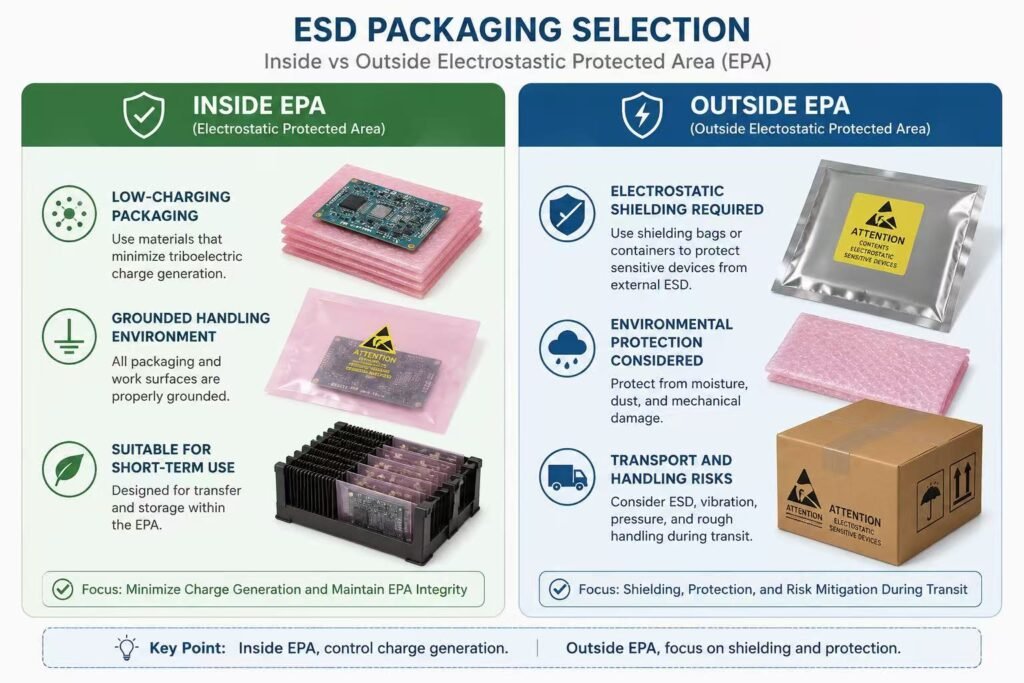
ESD Packaging Requirements Inside and Outside an ESD Protected Area
One of the most misunderstood aspects of ESD packaging is that the same bag is often used for every application, regardless of where the product will be handled.
In reality, packaging requirements change significantly depending on whether an electrostatic discharge sensitive (ESDS) item remains inside an ESD Protected Area (EPA) or is transported outside the controlled environment.
Inside an EPA, operators, workstations, flooring and handling procedures are all designed to minimize electrostatic hazards. Once a product leaves this controlled area, however, it may encounter unknown electrostatic fields, ungrounded personnel, ordinary plastic packaging and uncontrolled environmental conditions.
Choosing the correct ESD bag therefore depends not only on the sensitivity of the electronic device, but also on where the product will be handled, stored and transported.
What Is an ESD Protected Area (EPA)?
An ESD Protected Area (EPA) is a designated workspace where electrostatic discharge risks are controlled through engineering controls, grounding systems and documented operating procedures.
A typical EPA includes:
- Grounded ESD workbenches
- ESD table mats
- Common point grounding
- Wrist straps
- ESD footwear and flooring
- Ionizers where required
- ESD storage bins
- ESD shelving
- Qualified ESD packaging
- Routine compliance verification
Within this environment, sensitive electronic devices are protected by a complete ESD control system rather than by packaging alone.
Packaging Requirements Inside an EPA
Inside a properly established EPA, packaging is primarily intended to support the existing static control system.
Typical objectives include:
- Minimize triboelectric charging
- Prevent unnecessary charge accumulation
- Maintain controlled handling
- Protect products from contamination
- Improve production efficiency
- Support work-in-process movement
Common packaging used inside an EPA includes:
- Static dissipative bags
- Pink anti-static bags (where appropriate)
- Conductive bins
- Conductive totes
- ESD trays
- Conductive foam
- ESD storage boxes
- Reusable ESD containers
Because personnel and equipment are already grounded, the packaging itself does not always need to provide the same level of shielding required during transportation.
Packaging Requirements Outside an EPA
Once an ESDS device leaves the protected area, the situation changes completely.
Products may be exposed to:
- Ordinary cardboard cartons
- Plastic pallets
- Stretch film
- Bubble wrap
- Delivery vehicles
- Distribution warehouses
- Dry storage environments
- Ungrounded handling personnel
- Plastic conveyor systems
These uncontrolled environments significantly increase electrostatic risk.
For products leaving an EPA, packaging commonly needs to provide:
- Low charge generation
- Static dissipative inner contact
- Electrostatic discharge shielding
- Mechanical protection
- Transportation durability
Typical packaging includes:
- Static shielding bags
- Moisture barrier bags
- Shielding bubble bags
- ESD shipping cartons
- Protective cushioning materials
Why Packaging Requirements Change Outside the EPA
Inside an EPA, electrostatic hazards are controlled by the workplace.
Outside the EPA, the packaging itself becomes the primary protective barrier.
Consider the following example:
Inside the EPA
A PCB is:
- assembled on a grounded ESD workstation
- handled by grounded operators
- stored in ESD containers
- transferred using ESD-safe carts
The surrounding environment continuously helps control static electricity.
Outside the EPA
The same PCB may then be:
- packed into export cartons
- transported by logistics companies
- stored in customer warehouses
- unpacked by unknown operators
- exposed to ordinary plastic materials
The product is now dependent on its packaging for electrostatic protection.
Packaging Comparison
| Packaging Environment | Inside EPA | Outside EPA |
|---|---|---|
| Work-in-process transport | ✓ | — |
| PCB production | ✓ | — |
| Assembly storage | ✓ | — |
| Customer shipment | — | ✓ |
| Export packaging | — | ✓ |
| Long-term storage | Depends | ✓ |
| Third-party logistics | — | ✓ |
| International transportation | — | ✓ |
Why Static Shielding Is Important During Transportation
Grounding systems protect operators and conductive equipment inside an EPA.
Outside the EPA there is no guarantee that:
- personnel are grounded
- humidity is controlled
- handling procedures follow ESD practices
- transport equipment is ESD-safe
- storage conditions are controlled
For this reason, multilayer static shielding bags are widely used to reduce the effect of external electrostatic discharges during shipping and storage.
Shielding packaging does not replace an EPA—it extends protection beyond the manufacturing environment.
Typical Packaging Workflow
A recommended packaging process is:
PCB Assembly
↓
Electrical Testing
↓
Visual Inspection
↓
Final Cleaning
↓
Package Inside EPA
↓
Seal Static Shielding Bag
↓
Apply Product Label
↓
Place in Shipping Carton
↓
Customer Delivery
Packaging should be completed before the product leaves the controlled area whenever possible.
Common Packaging Mistakes
Many ESD failures result from incorrect packaging practices rather than defective electronic components.
Common mistakes include:
❌ Packing PCBs in ordinary polyethylene bags
❌ Shipping products in pink anti-static bags when shielding is required
❌ Leaving shielding bags partially open
❌ Reusing damaged shielding bags
❌ Using damaged ziplock closures
❌ Mixing ordinary plastic packaging with ESD-safe materials
❌ Ignoring customer packaging specifications
❌ Assuming all silver bags provide identical protection
Best Practice Recommendations
For products that remain inside an EPA:
- Use packaging compatible with your ESD control program.
- Prevent unnecessary static generation.
- Keep work-in-process protected during movement.
- Follow documented handling procedures.
For products that leave the EPA:
- Use qualified static shielding packaging.
- Seal the package correctly.
- Protect against electrostatic discharge and physical damage.
- Follow customer packaging specifications.
- Maintain traceability throughout transportation.
ESDBEST Recommendation
At ESDBEST, we recommend selecting ESD packaging according to the actual handling environment, rather than relying only on bag color or cost.
A complete packaging solution should consider:
- Product sensitivity
- Transportation distance
- Customer requirements
- Storage conditions
- Moisture protection
- Packaging method
- Applicable ESD standards
Choosing the correct ESD bag helps reduce packaging-related ESD risks and supports a more reliable electronics manufacturing process.

How to Choose the Right ESD Bag
How to Choose the Right ESD Bag for Electronic Components
Selecting an ESD bag is not simply a matter of choosing the correct size or color. Different electronic products have different electrostatic sensitivity, packaging environments and transportation requirements. Using the wrong type of ESD bag may increase the risk of electrostatic discharge (ESD), moisture damage or mechanical damage during storage and shipping.
Instead of asking “Which ESD bag is the best?”, manufacturers should ask:
- Where will the product be handled?
- Will it leave an ESD Protected Area (EPA)?
- Is moisture protection required?
- How sensitive is the device?
- What packaging standard does the customer require?
Answering these questions first makes it much easier to select the appropriate ESD packaging solution.
Step 1 — Identify the Electronic Product
Different electronic products require different levels of ESD protection.
Typical products include:
- Bare PCBs
- PCB assemblies (PCBAs)
- Integrated circuits (ICs)
- MOSFET devices
- Semiconductor wafers
- SSD modules
- Memory modules
- Automotive electronic modules
- Medical electronic devices
- Consumer electronic assemblies
Products with higher electrostatic sensitivity generally require more comprehensive packaging protection.
Step 2 — Determine the Packaging Environment
The packaging environment has a major influence on bag selection.
Packaging Inside an EPA
Typical applications include:
- SMT production
- PCB assembly
- Functional testing
- Internal warehouse movement
- Work-in-process storage
Possible packaging:
- Static dissipative bags
- Conductive containers
- Pink anti-static bags (where appropriate)
Packaging Outside an EPA
Applications include:
- Customer delivery
- Export shipping
- Third-party logistics
- International transportation
- Long-term storage
Recommended packaging may include:
- Static shielding bags
- Moisture barrier bags
- Shielding bubble bags
Step 3 — Determine Whether Shielding Is Required
One of the most important questions is whether the package must protect the product from external electrostatic discharge.
Static shielding is commonly required when products:
- Leave the EPA
- Are shipped to customers
- Pass through logistics warehouses
- Are handled by unknown personnel
- Are transported internationally
- Contain highly sensitive electronic devices
If shielding is required, a multilayer static shielding bag is generally more appropriate than a simple anti-static bag.
Step 4 — Evaluate Moisture Requirements
Not every electronic product requires moisture barrier packaging.
However, moisture-sensitive devices (MSDs) often require additional protection.
Typical examples include:
- IC packages
- BGA devices
- Semiconductor components
- High-density PCB assemblies
Typical moisture-control systems include:
- Moisture barrier bag
- Desiccant
- Humidity indicator card
- Heat sealing
- Moisture sensitivity label
Remember that moisture protection and ESD protection are different performance characteristics. A bag should only be described as a moisture barrier bag when it is designed and specified for that purpose.
Step 5 — Select the Correct Bag Material
Different bag materials provide different functions.
| Material | Typical Function |
|---|---|
| Pink polyethylene | Low charge generation |
| Static dissipative film | Controlled surface resistance |
| Metallized multilayer film | Electrostatic discharge shielding |
| Conductive polyethylene | Conductive packaging applications |
| Moisture barrier laminate | Moisture and ESD protection |
Material selection should always be based on application requirements rather than appearance.
Step 6 — Choose the Correct Bag Style
Several bag styles are commonly available.
Open Top Bags
Suitable for:
- Heat sealing
- High-volume production
- Automated packaging
Ziplock Bags
Suitable for:
- Small electronic components
- Reusable packaging
- Service departments
- Repair operations
Gusset Bags
Suitable for:
- Thick assemblies
- Large electronic products
- Bulky components
Bubble Shielding Bags
Suitable for:
- Fragile electronic assemblies
- Display modules
- Precision instruments
Step 7 — Select the Correct Bag Size
Choosing the correct dimensions improves both protection and packaging efficiency.
Consider:
- Product length
- Product width
- Product thickness
- Connector height
- Heat-sealing allowance
- Label position
Avoid selecting bags that are:
- Too small
- Excessively oversized
- Difficult to seal
- Likely to damage connectors
A properly sized bag reduces unnecessary movement during transportation.
Step 8 — Review Technical Specifications
Before purchasing, ask the supplier for available technical information such as:
- Material structure
- Film thickness
- Surface resistance (where applicable)
- Shielding performance (where applicable)
- Moisture barrier properties (if required)
- Product dimensions
- Closure type
- Printing options
Avoid comparing products based solely on marketing descriptions.
Step 9 — Confirm Compliance Requirements
Different industries may require different packaging specifications.
Typical references include:
- Customer packaging specifications
- Internal ESD control procedures
- ANSI/ESD packaging requirements
- IEC ESD packaging requirements
The package should be selected according to the complete ESD control program rather than a single product feature.
Step 10 — Consider Customization Options
Many electronics manufacturers require customized packaging.
Common customization options include:
- Custom dimensions
- Company logo printing
- ESD warning symbols
- Part number printing
- Barcodes
- QR codes
- Lot number identification
- Thickness options
- Custom packaging quantities
OEM packaging can improve inventory management and product traceability.
ESD Bag Selection Matrix
| Application | Recommended Bag |
|---|---|
| PCB shipment | Static shielding bag |
| PCB assembly (inside EPA) | Static dissipative bag |
| IC transportation | Static shielding bag |
| Moisture-sensitive IC | Moisture barrier bag |
| Mechanical hardware | Anti-static bag |
| Precision display module | Shielding bubble bag |
| Repair spare parts | Ziplock shielding bag |
| Large electronic assemblies | Gusset shielding bag |
This table should be used as a general guide. Final selection should always consider customer requirements and the organization’s ESD control procedures.
Common Purchasing Mistakes
Avoid these common mistakes:
❌ Selecting bags by color only
❌ Choosing the lowest price without reviewing specifications
❌ Ignoring customer packaging requirements
❌ Using ordinary plastic bags
❌ Reusing damaged shielding bags
❌ Forgetting moisture protection
❌ Ordering incorrect bag dimensions
❌ Assuming all silver bags provide identical shielding performance
ESDBEST Selection Advice
At ESDBEST, we recommend evaluating every packaging project based on four key factors:
- Product sensitivity
- Packaging environment
- Transportation conditions
- Customer requirements
Our engineering team can recommend suitable ESD packaging solutions for PCB manufacturers, EMS providers, semiconductor companies and electronics factories.
Need Help Selecting the Right ESD Bag?
Whether you need static shielding bags for PCB shipment, moisture barrier bags for semiconductor devices or custom ESD packaging for electronics manufacturing, ESDBEST can recommend a solution based on your product, packaging process and customer requirements.
📞 Contact Us Today
For bulk orders, quotes, or product guidance, get in touch with our expert team:
Email: sales2@esdbest.com
Whatsapp: +86 137 1427 2599
Buttons
How to Test ESD Bags: Surface Resistance, Shielding Performance and Quality Inspection
How to Test ESD Bags Correctly
Choosing the right ESD bag is only the first step. Regular testing and inspection help verify that the packaging continues to provide the intended level of electrostatic protection throughout manufacturing, storage and transportation.
ESD packaging may gradually lose performance because of:
- Mechanical wear
- Surface contamination
- Repeated opening and closing
- Improper storage
- High humidity or temperature
- Damage to the shielding layer
- Aging of anti-static additives
For this reason, electronics manufacturers commonly include ESD packaging verification as part of their overall ESD control program.
Why ESD Bag Testing Is Important
An ESD bag that looks normal may no longer provide the required protection.
Common failure modes include:
- Scratched metallized layers
- Torn bag edges
- Damaged ziplock closures
- Delaminated film
- Surface contamination
- Heat-seal defects
- Mechanical punctures
Without inspection, these defects may not be visible until product failures occur.
Routine testing helps reduce:
- Product damage
- Customer complaints
- Field failures
- Rework costs
- Warranty claims
Test 1 — Visual Inspection
Visual inspection should always be performed before electrical testing.
Inspect the bag for:
- Holes
- Tears
- Punctures
- Deep scratches
- Delamination
- Broken seals
- Damaged zip closures
- Excessive creasing
- Surface contamination
- Missing ESD warning symbols
Any damaged bag should be removed from production before use.
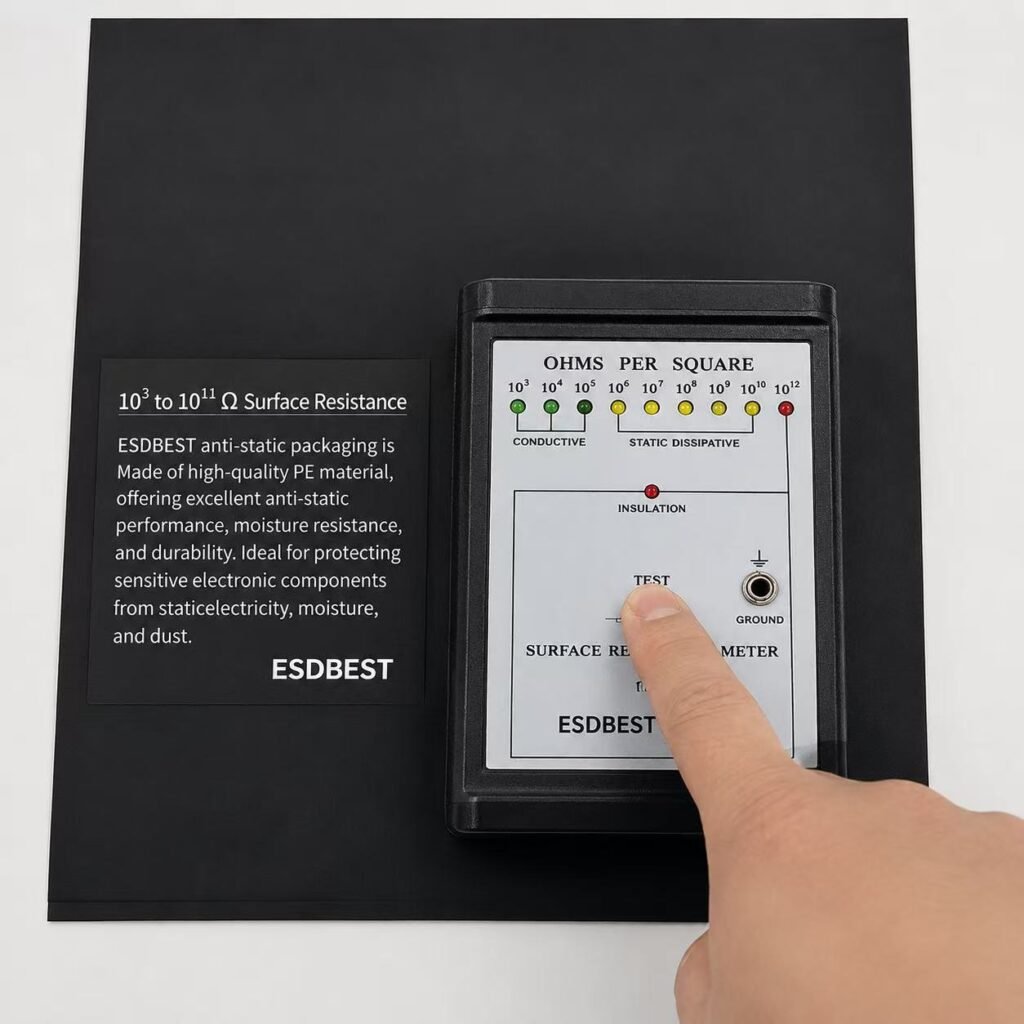
Test 2 — Surface Resistance Measurement
Surface resistance testing evaluates the electrical characteristics of the bag material.
Typical inspection records should include:
- Test instrument
- Test method
- Test voltage (as applicable)
- Sample identification
- Test location
- Environmental conditions
- Operator
- Date
Surface resistance should always be measured according to the selected material specification and applicable test procedure.
Do not compare values measured under different environmental conditions without documenting temperature and humidity.
Test 3 — Static Shielding Performance
For static shielding bags, the most important characteristic is the ability of the complete package to reduce the effect of an external electrostatic discharge.
Shielding evaluation focuses on the performance of the finished bag, not simply the raw film.
Typical evaluation considers:
- Complete bag construction
- Proper closure
- Test configuration
- Energy reaching the protected device
- Repeatability
- Sample conditioning
IEC 61340-4-8 specifies a standardized method for evaluating the shielding performance of electrostatic discharge shielding bags used for packaging ESDS devices.
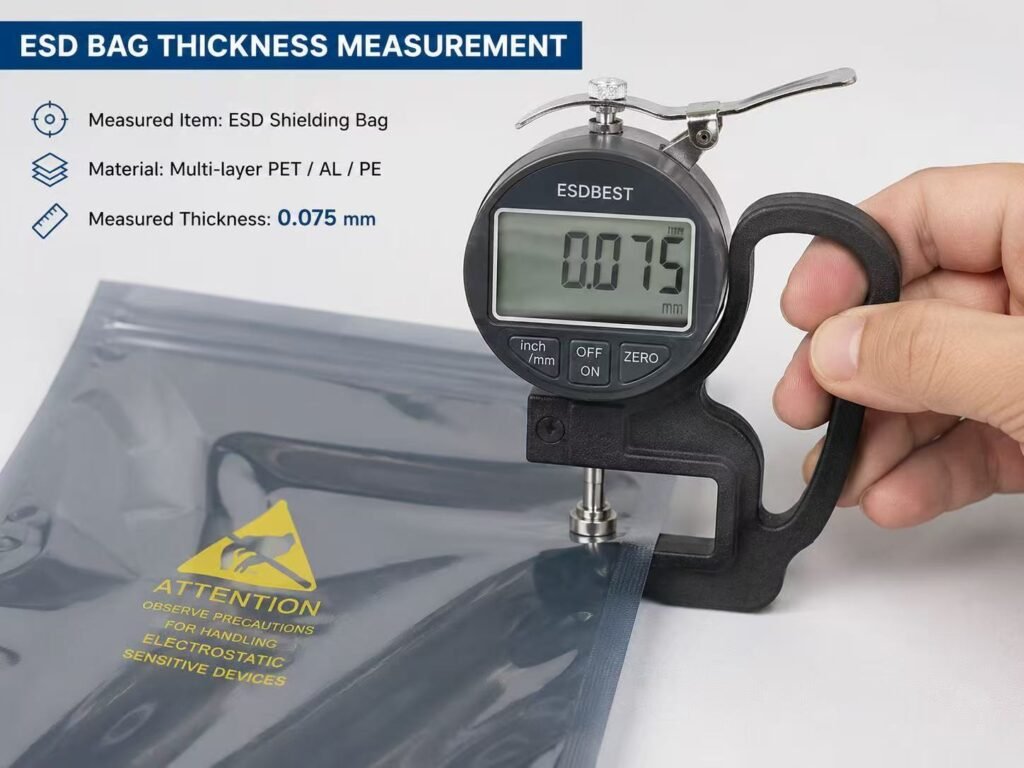
Test 4 — Film Thickness Inspection
Film thickness directly affects:
- Mechanical durability
- Puncture resistance
- Heat sealing quality
- Overall package consistency
Thickness inspection should be performed at several different locations rather than a single point.
Typical inspection includes:
- Top area
- Center
- Bottom
- Both side edges
Production tolerances should follow the agreed product specification.
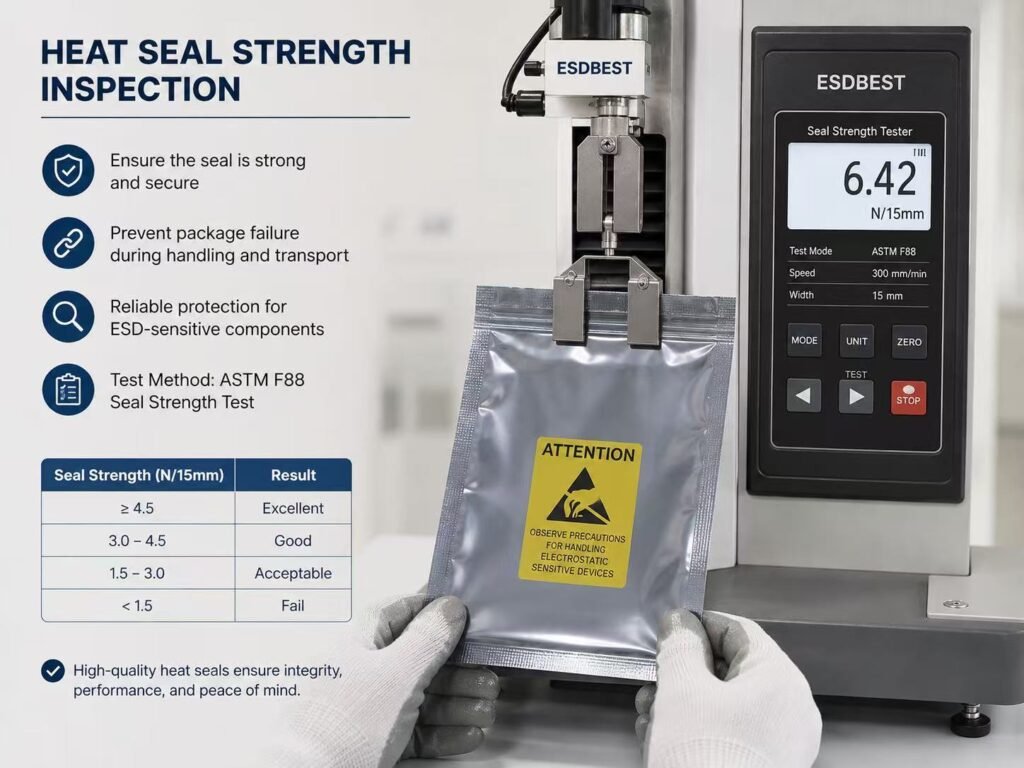
Test 5 — Heat Seal Quality
For heat-sealable bags, seal quality is critical.
Inspect for:
- Continuous sealing
- Uniform seal width
- No wrinkles
- No channel leaks
- No incomplete sealing
- Good mechanical strength
A damaged seal can reduce both physical protection and shielding performance.
Test 6 — Ziplock Closure Inspection
For reusable ziplock ESD bags:
Verify:
- Smooth opening
- Complete closure
- No broken locking profile
- No contamination
- No deformation
- Reliable repeated operation
If the closure cannot fully engage, the bag should not be reused for sensitive electronic devices.
Test 7 — Printing and Identification
Printed information should remain clear throughout normal handling.
Typical markings include:
- ESD warning symbol
- Manufacturer identification
- Product code
- Batch number
- Lot number
- Recycling information
- Customer logo (if applicable)
Missing or unreadable identification may affect traceability.
Test 8 — Packaging Dimension Inspection
Measure:
- Width
- Length
- Opening size
- Seal width
- Gusset depth (if applicable)
Dimensional inspection helps ensure that:
- Components fit correctly
- Heat sealing is possible
- PCB connectors are not damaged
- Products do not move excessively during transportation
Test 9 — Moisture Barrier Verification (Where Applicable)
For moisture barrier bags, additional inspections may include:
- Laminate integrity
- Seal quality
- Barrier film condition
- Vacuum packaging quality
- Desiccant placement
- Humidity indicator card
- Packaging cleanliness
Moisture barrier performance should be verified according to the product specification rather than assumed from appearance.
Inspection Frequency
Inspection frequency depends on:
- Production volume
- Customer requirements
- Internal quality procedures
- Packaging type
- Product sensitivity
- Historical quality data
Many manufacturers perform:
- Incoming material inspection
- First article inspection
- Production sampling
- Final outgoing inspection
The appropriate inspection frequency should be documented within the organization’s quality management system.
Typical Inspection Workflow
Incoming Material
↓
Visual Inspection
↓
Dimension Check
↓
Surface Resistance Verification (if applicable)
↓
Shielding Performance Verification (qualification or periodic verification as applicable)
↓
Seal Inspection
↓
Packaging Approval
↓
Production Use
↓
Final Shipment
Maintaining consistent inspection records improves traceability and supports continuous quality improvement.
Common Testing Mistakes
Avoid these common errors:
❌ Testing only one sample
❌ Ignoring environmental conditions
❌ Measuring damaged bags
❌ Using uncalibrated instruments
❌ Comparing different materials without documenting specifications
❌ Assuming all silver bags perform equally
❌ Skipping visual inspection
❌ Failing to document inspection results
ESDBEST Quality Inspection
Every production batch should be verified according to the applicable product specification and internal quality procedures.
Inspection may include:
- Appearance verification
- Dimension measurement
- Film thickness
- Printing inspection
- Seal inspection
- Material verification
- Electrical properties (where applicable)
- Packaging integrity
Inspection reports should be retained to support product traceability.
MOULD 12
ESD Packaging Standards: ANSI/ESD S541, IEC 61340-5-3 and IEC 61340-4-8
ESD Packaging Standards Explained
Selecting the correct ESD bag is only one part of an effective electrostatic discharge (ESD) control program. The packaging itself should also be evaluated according to recognized industry standards to ensure it provides the intended level of protection for electrostatic discharge sensitive (ESDS) devices.
For electronics manufacturers, EMS providers, PCB assemblers and semiconductor companies, the three most commonly referenced packaging standards are:
- ANSI/ESD S541 – Packaging Materials for ESD Sensitive Items
- IEC 61340-5-3 – ESD Protective Packaging Requirements
- IEC 61340-4-8 – Test Method for ESD Shielding Bags
Understanding the purpose of each standard helps engineers select appropriate packaging materials without confusing material properties with package performance.
ANSI/ESD S541 — Packaging Materials for ESD Sensitive Items
ANSI/ESD S541 is published by the EOS/ESD Association and provides guidance on selecting and using packaging materials intended to protect electrostatic discharge sensitive devices.
The standard addresses packaging used during:
- Manufacturing
- Assembly
- Testing
- Storage
- Internal transportation
- Customer shipment
- Long-term storage
Rather than specifying one universal bag construction, ANSI/ESD S541 defines the performance characteristics that packaging materials should provide based on the intended application.
Typical considerations include:
- Low charge generation
- Static dissipative properties
- Conductive materials where appropriate
- Electrostatic discharge shielding
- Material qualification
- Package identification
The standard should be applied as part of the organization’s documented ESD control program rather than as a stand-alone purchasing specification.
IEC 61340-5-3 — Requirements for ESD Protective Packaging
IEC 61340-5-3 focuses on packaging intended to protect electrostatic discharge sensitive devices throughout their life cycle.
Typical applications include:
- PCB transportation
- Semiconductor packaging
- Customer shipment
- Warehouse storage
- International logistics
- Spare parts packaging
The standard references required material characteristics and associated test methods rather than prescribing one specific bag design.
It also emphasizes that packaging performance should be demonstrated using recognized testing procedures.
IEC 61340-4-8 — Test Method for Shielding Bags
IEC 61340-4-8 specifies a standardized method for evaluating the shielding performance of electrostatic discharge shielding bags.
Unlike simple resistance measurements, this test evaluates the ability of the complete package to reduce the energy transferred from an external electrostatic discharge.
The standard considers the performance of:
- Complete bag construction
- Proper package closure
- Shielding effectiveness
- Repeatable laboratory testing
This is one of the most widely referenced standards when qualifying multilayer static shielding bags used for electronic components.
Understanding the Difference Between Material Properties and Package Performance
A common misunderstanding is that a material with a specified surface resistance automatically provides electrostatic discharge shielding.
This is not correct.
Material properties describe characteristics such as:
- Surface resistance
- Volume resistance
- Charge generation
- Static decay
Package performance considers how the finished bag performs as a complete protective package.
Examples include:
- Shielding effectiveness
- Mechanical durability
- Seal integrity
- Package construction
- Barrier performance
A qualified shielding bag should therefore be evaluated as a complete package rather than by one material property alone.
Packaging Requirements Inside and Outside an EPA
Packaging requirements also depend on where the product will be used.
Inside an EPA
Typical objectives include:
- Low charge generation
- Controlled handling
- Compatible contact materials
- Work-in-process protection
Typical packaging:
- Static dissipative bags
- Conductive containers
- Reusable ESD packaging
Outside an EPA
Additional protection is often required because the environment is uncontrolled.
Typical packaging:
- Static shielding bags
- Moisture barrier bags
- Shielding bubble bags
- Export packaging systems
Packaging should be selected according to the actual transportation environment.
What These Standards Do NOT Mean
Many websites incorrectly state:
“This ESD bag is ANSI certified.”
or
“IEC approved bag.”
In reality, these standards define technical requirements and test methods.
Compliance depends on:
- Product qualification
- Material construction
- Test results
- Quality control
- Proper use
Avoid making unsupported certification claims unless a formal certification program specifically exists for the product.
Typical Documents Requested by Buyers
Industrial buyers often request supporting documentation before placing an order.
Common documents include:
- Product specification sheet
- Material structure description
- Technical datasheet
- Test report
- Certificate of conformity (if applicable)
- RoHS declaration
- REACH declaration
- Packaging dimensions
- Product drawings
Providing complete documentation helps simplify technical approval and purchasing decisions.
How ESDBEST Supports Packaging Compliance
ESDBEST supports electronics manufacturers by providing packaging solutions designed for applications involving:
- PCB assemblies
- Integrated circuits
- Semiconductor devices
- Electronic modules
- Industrial control systems
- Automotive electronics
Available support may include:
- Product specifications
- Material information
- Custom dimensions
- Printing services
- Technical consultation
- Available test documentation
Customers should verify that the selected packaging meets their own product requirements, internal ESD procedures and applicable customer specifications.
Comparison of Major ESD Packaging Standards
| Standard | Primary Purpose | Typical Application |
|---|---|---|
| ANSI/ESD S541 | Packaging guidance for ESDS items | Manufacturing, storage, transportation |
| IEC 61340-5-3 | Protective packaging requirements | Electronics packaging systems |
| IEC 61340-4-8 | Shielding bag test method | Qualification of static shielding bags |
Each standard addresses a different aspect of ESD packaging and should be understood together rather than treated as interchangeable.
Common Compliance Mistakes
Avoid these common errors:
❌ Assuming every silver bag meets shielding requirements
❌ Using resistance values alone to claim shielding performance
❌ Ignoring package construction
❌ Purchasing bags without technical documentation
❌ Mixing different packaging materials without evaluation
❌ Assuming one standard replaces another
❌ Making unsupported certification claims in product descriptions
Best Practice Recommendations
When selecting ESD packaging:
- Review the product application.
- Determine whether shielding is required.
- Confirm customer specifications.
- Request available technical documentation.
- Evaluate the complete packaging system.
- Follow your organization’s ESD control program.
Packaging should always be considered one component of an integrated ESD protection system.
📞 Contact Us Today
For bulk orders, quotes, or product guidance, get in touch with our expert team:
Email: sales2@esdbest.com
Whatsapp: +86 137 1427 2599
MOULD 13
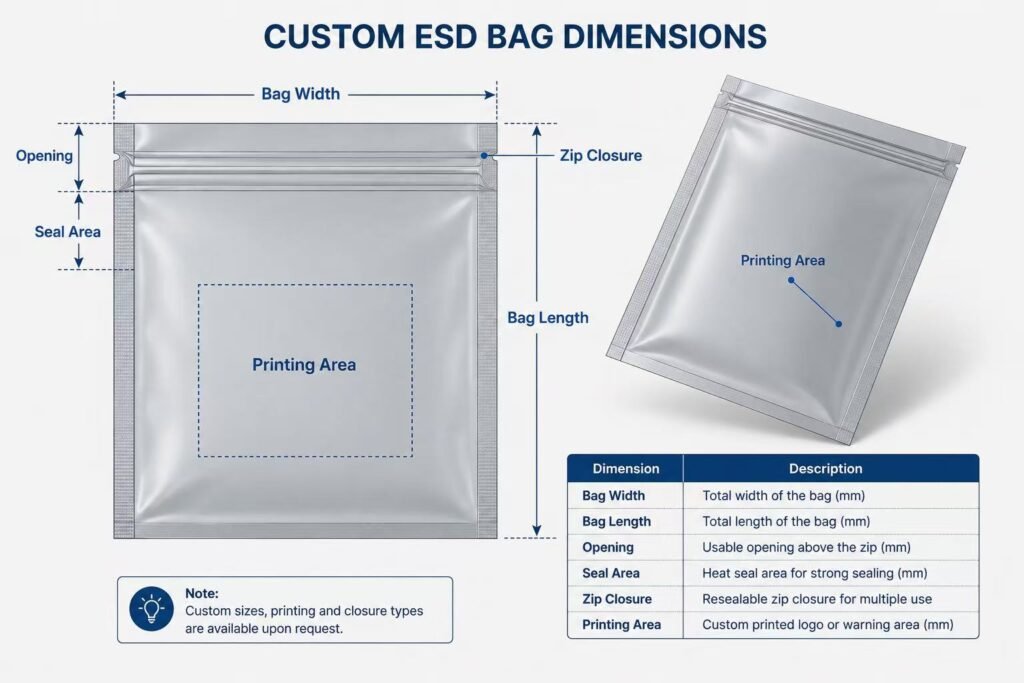
ESD Bag Sizes, Customization and OEM Manufacturing
Custom ESD Bags for Electronics Manufacturing
Every electronic product has different packaging requirements. A bag designed for a small integrated circuit cannot properly protect a large PCB assembly, and a package suitable for domestic transportation may not be appropriate for export shipments.
For this reason, most electronics manufacturers prefer custom ESD bags rather than selecting standard stock sizes.
A properly designed ESD bag should provide:
- Sufficient internal space
- Reliable sealing
- Appropriate ESD protection
- Mechanical protection
- Efficient packaging operations
- Clear product identification
Choosing the correct dimensions and construction helps improve packaging efficiency while reducing the risk of product damage.
Standard ESD Bag Sizes
Although custom sizes are common, many manufacturers also use standard dimensions for routine production.
| Width × Length | Typical Application |
|---|---|
| 75 × 100 mm | ICs, chips, small connectors |
| 100 × 150 mm | Electronic components |
| 150 × 200 mm | Small PCB assemblies |
| 200 × 250 mm | Medium-sized PCBs |
| 250 × 350 mm | Industrial controller boards |
| 300 × 400 mm | Large PCB assemblies |
| 400 × 500 mm | Power electronics |
| Custom | Special electronic products |
These sizes are examples only. Final dimensions should always be based on the actual product and packaging process.
How to Measure the Correct ESD Bag Size
Many buyers simply measure the product length and width.
A better method is to consider:
Product Width
Measure the widest point of the product, including:
- Connectors
- Heat sinks
- Mounting brackets
- Protective covers
Product Length
Measure the longest dimension of the assembled product.
Product Thickness
Thickness is often overlooked.
Consider:
- Tall capacitors
- Connectors
- Shielding covers
- Cooling components
- Mechanical supports
Sealing Allowance
Leave sufficient space for:
- Heat sealing
- Ziplock closure
- Vacuum sealing (if applicable)
- Product insertion
An oversized bag wastes material, while an undersized bag may stress the seal or damage the product.
Choosing the Correct Film Thickness
Film thickness depends on:
- Product weight
- Transportation distance
- Mechanical protection requirements
- Packaging method
- Customer specifications
Generally:
| Product Type | Typical Recommendation |
|---|---|
| Small ICs | Standard film |
| PCB assemblies | Medium-duty film |
| Heavy industrial electronics | Heavy-duty film |
| Export packaging | Based on transportation requirements |
Film thickness should always match the selected bag construction and application.
Available Bag Styles
ESDBEST can manufacture different styles according to customer requirements.
Open Top Bags
Suitable for:
- Heat sealing
- High-volume production
- Automatic packaging
Ziplock Bags
Ideal for:
- Reusable packaging
- Maintenance departments
- Spare parts
- Small electronic components
Gusset Bags
Suitable for:
- Thick products
- Large assemblies
- Industrial controllers
Three-Side Seal Bags
Commonly used for:
- Semiconductor packaging
- Vacuum sealing
- Moisture barrier packaging
Bubble Shielding Bags
Suitable for:
- Displays
- Precision instruments
- Sensitive assemblies
- Fragile electronics
Custom Printing Options
Custom printing improves both identification and traceability.
Available options include:
- Company logo
- ESD warning symbol
- Product number
- Barcode
- QR code
- Batch number
- Lot number
- Production date
- Customer artwork
Custom printing also helps warehouse personnel quickly identify the correct packaging material.
OEM & Private Label Services
Many distributors and electronics manufacturers require OEM packaging.
Typical OEM services include:
- Custom dimensions
- Private label printing
- Multilingual packaging
- Retail packaging
- Export carton design
- Barcode labeling
- Packaging instruction sheets
OEM packaging helps maintain brand consistency while simplifying inventory management.
Export Packaging Solutions
International transportation introduces additional challenges.
Export packaging may include:
- Static shielding bags
- Moisture barrier bags
- Vacuum packaging
- Desiccants
- Humidity indicator cards
- Foam cushioning
- Carton reinforcement
- Pallet packaging
The final packaging system should be designed according to the transportation route and customer requirements.
Typical Industries Served
Custom ESD bags are widely used in:
- PCB manufacturing
- SMT assembly
- Semiconductor production
- Automotive electronics
- Medical electronics
- Aerospace electronics
- Consumer electronics
- Industrial automation
- Telecommunications
- Electronic repair services
Different industries may have different documentation and packaging requirements.
Minimum Order Quantity (MOQ)
MOQ depends on:
- Bag size
- Material structure
- Printing requirements
- Film thickness
- Packaging style
- Production process
Standard stock products may have lower MOQs, while fully customized products generally require larger production quantities.
Customers should confirm MOQ during quotation.
Information Required for Quotation
To recommend the correct ESD bag, suppliers typically require:
- Product type
- Product dimensions
- Weight
- Packaging environment
- Shielding requirement
- Moisture protection requirement
- Quantity
- Printing requirements
- Packaging style
- Destination country
Providing complete information helps reduce quotation time and minimizes specification errors.
Why Choose ESDBEST
ESDBEST provides ESD packaging solutions for electronics manufacturers worldwide.
Our capabilities include:
- Custom dimensions
- Multiple bag constructions
- OEM printing
- Engineering support
- Technical documentation
- Flexible production
- Export packaging
- Bulk manufacturing
Whether you require standard shielding bags or fully customized ESD packaging systems, our team can help identify a suitable solution for your application.
📞 Contact Us Today
For bulk orders, quotes, or product guidance, get in touch with our expert team:
Email: sales2@esdbest.com
Whatsapp: +86 137 1427 2599
MOULD 14
How to Use ESD Bags Correctly: Best Practices for Handling, Storage and Transportation
How to Use ESD Bags Correctly
Choosing the correct ESD bag is only part of an effective electrostatic discharge (ESD) protection strategy. Even a high-quality static shielding bag can fail to protect electronic components if it is used incorrectly.
Improper packaging practices—such as leaving a shielding bag open, using the wrong bag type or storing bags in unsuitable environments—may reduce the effectiveness of the overall ESD control program.
The following best practices help improve packaging reliability for PCBs, integrated circuits (ICs), semiconductor devices and other electrostatic discharge sensitive (ESDS) items.
Step 1 — Verify the Product Before Packaging
Before placing an electronic component into an ESD bag, verify that the product has completed the required manufacturing and inspection processes.
Typical checks include:
- Functional testing completed
- Visual inspection passed
- Product cleaned (if required)
- Correct product identification
- No loose hardware
- No physical damage
Packaging defective products may create unnecessary handling and increase the risk of additional damage.
Step 2 — Package Products Inside an EPA
Whenever possible, ESDS items should be packaged inside an ESD Protected Area (EPA).
Inside the EPA:
- Operators are grounded.
- ESD workstations are properly connected to ground.
- Approved ESD packaging materials are available.
- Handling procedures are controlled.
- Electrostatic risks are minimized.
Packaging products outside an EPA increases the likelihood of charge generation before the item is protected.
Step 3 — Select the Correct ESD Bag
Confirm that the selected bag matches the application.
Consider:
- Product dimensions
- Product sensitivity
- Transportation method
- Moisture requirements
- Customer packaging specifications
- Required shielding performance
Never assume that all silver or pink bags provide the same protection.
Step 4 — Insert the Product Carefully
Place the electronic component gently into the bag.
Avoid:
- Sliding the PCB against the bag opening
- Bending connectors
- Damaging heat sinks
- Scratching the metallized layer
- Overfilling the bag
For large PCB assemblies, support the product during insertion to avoid excessive stress on components.
Step 5 — Seal the Bag Properly
A shielding bag provides the intended protection only when properly closed.
Depending on the bag type, sealing methods may include:
- Heat sealing
- Ziplock closure
- Vacuum sealing
- Approved ESD-safe tape (where specified)
Avoid:
❌ Leaving the bag partially open
❌ Folding the opening without sealing
❌ Using damaged zip closures
❌ Reusing failed seals
Step 6 — Add Product dentification
Each package should be clearly identified.
Typical labels include:
- Product name
- Part number
- Revision number
- Quantity
- Lot number
- Production date
- ESD warning symbol
- Customer barcode
- QR code (if applicable)
Proper identification improves inventory control and product traceability.
Step 7 — Use Appropriate Outer Packaging
An ESD bag protects against electrostatic hazards, but it does not replace mechanical packaging.
For shipment, additional protection may include:
- Corrugated cartons
- Foam cushioning
- Bubble protection
- Corner protection
- Carton dividers
- Moisture barrier systems (where required)
Electronic products should be protected from both electrostatic and mechanical damage.
Step 8 — Store ESD BagsCorrectly
Unused ESD bags should be stored in clean, dry conditions.
Recommended storage practices:
- Keep away from direct sunlight
- Avoid excessive heat
- Avoid high humidity
- Protect from dust
- Store in original cartons where possible
- Prevent mechanical damage
- Keep away from sharp objects
Improper storage may affect both physical condition and packaging performance.
Step 9 — Inspect Before Reuse
Some ESD bags may be reused, depending on internal procedures and customer requirements.
Before reuse, inspect for:
- Holes
- Tears
- Scratches
- Delamination
- Broken zip closures
- Seal damage
- Surface contamination
- Excessive wear
If the package is damaged, replace it with a new bag.
Typical Packaging Workflow
Recommended packaging process:
PCB Assembly
↓
Functional Testing
↓
Visual Inspection
↓
Final Cleaning
↓
Package Inside EPA
↓
Seal ESD Bag
↓
Apply Product Label
↓
Place in Shipping Carton
↓
Final Inspection
↓
Customer Shipment
Following a consistent workflow helps improve packaging quality and traceability.
Packaging Mistakes
void these common mistakes:
❌ Using ordinary plastic bags
❌ Leaving shielding bags open
❌ Selecting oversized bags
❌ Using undersized bags
❌ Shipping products without outer protection
❌ Reusing damaged bags
❌ Ignoring customer packaging requirements
❌ Packaging products outside the EPA
❌ Mixing ordinary tape with ESD packaging without approval
Best Practices
For best results:
✔ Package products inside an EPA whenever possible.
✔ Select the correct bag type.
✔ Handle products carefully during insertion.
✔ Fully close the package.
✔ Label every package clearly.
✔ Protect products against both ESD and physical damage.
✔ Store unused bags correctly.
✔ Replace damaged packaging immediately.
Consistent packaging procedures help improve product reliability throughout manufacturing and transportation.
ESDBEST Recommendation
At ESDBEST, we recommend treating ESD packaging as part of the complete ESD control system—not as an isolated product.
Proper packaging should work together with:
- ESD workbenches
- Wrist straps
- Grounding systems
- ESD flooring mat
- Ionizers (where required)
- Personnel training
- Routine compliance verification
When all of these elements are combined, electronic products are better protected from electrostatic damage during production, storage and shipment.
Need Help Choosing the Right ESD Packaging Process?
ESDBEST can recommend complete ESD packaging solutions for PCB manufacturers, EMS providers and electronics factories—including static shielding bags, moisture barrier bags and customized packaging systems.
Buttons
MOULD 15
Common ESD Packaging Mistakes That Can Damage Electronic Components
15 Common ESD Packaging Mistakes to Avoid
Even the highest-quality ESD bag cannot protect electronic components if it is used incorrectly. In many electronics factories, ESD failures are caused not by defective packaging materials but by incorrect packaging procedures, improper storage or human error.
By understanding these common mistakes, manufacturers can reduce the risk of electrostatic discharge (ESD), improve product reliability and lower rework or warranty costs.
Mistake 1 — Using Ordinary Plastic Bags
One of the most common errors is packaging electrostatic discharge sensitive (ESDS) devices in ordinary polyethylene bags.
Ordinary plastic packaging is not designed for ESD protection and may generate electrostatic charge during handling and transportation.
For products such as:
- Bare PCBs
- PCB assemblies
- Integrated circuits
- Semiconductor devices
use ESD protective packaging that matches the application and transportation environment.
Mistake 2 — Assuming Every Pink Bag Is Suitable
Pink anti-static bags reduce charge generation but are not automatically suitable for every application.
Many buyers incorrectly assume:
Pink bag = complete ESD protection.
In reality, packaging should be selected according to:
- Product sensitivity
- Packaging location
- Customer requirements
- Transportation method
- Required shielding performance
Mistake 3 — Leaving a Shielding Bag Open
A static shielding bag should be properly closed before transportation.
Leaving the opening partially exposed may reduce the effectiveness of the protective enclosure and increase the likelihood of contamination or handling damage.
Always use the intended closure method:
- Heat seal
- Ziplock
- Vacuum seal (where applicable)
Mistake 4 — Reusing Damaged Bags
Before reusing any ESD bag, inspect it carefully.
Replace bags showing:
- Holes
- Tears
- Delamination
- Broken zip closures
- Excessive scratches
- Seal damage
- Heavy contamination
Damaged packaging should not be used for sensitive electronic products.
Mistake 5 — Selecting the Wrong Bag Size
A bag that is too small may:
- Stress connectors
- Bend components
- Damage the seal
A bag that is too large may:
- Allow excessive movement
- Increase handling damage
- Reduce packaging efficiency
Always select dimensions based on the actual product, including component height and sealing allowance.
Mistake 6 — Ignoring Moisture Protection
Not every ESD bag provides moisture protection.
Moisture-sensitive devices may require:
- Moisture barrier bags
- Desiccant
- Humidity indicator cards
- Heat sealing
Electrostatic protection and moisture protection are separate packaging requirements and should be evaluated independently.
Mistake 7 — Packaging Products Outside an EPA
Whenever practical, ESDS devices should be packaged inside an ESD Protected Area (EPA).
Packaging outside the EPA may expose products to:
- Charged insulating materials
- Ungrounded personnel
- Ordinary plastic packaging
- Uncontrolled electrostatic environments
Packaging should be completed before products leave the controlled work area.
Mistake 8 — Ignoring Physical Protection
An ESD bag protects against electrostatic hazards but does not replace mechanical packaging.
During transportation, products may also require:
- Foam cushioning
- Cartons
- Dividers
- Corner protection
- Shock absorption
A complete packaging system addresses both ESD and physical handling risks.
Mistake 9 — Using Incorrect Labels
Packaging labels should remain clear and traceable.
Recommended information includes:
- Product name
- Part number
- Quantity
- Batch number
- Production date
- ESD warning symbol
- Customer barcode
Poor labeling can lead to handling errors and inventory problems.
Mistake 10 — Failing to Inspect Incoming Bags
Packaging materials should be inspected before production.
Typical incoming inspection includes:
- Appearance
- Dimensions
- Printing
- Seal quality
- Material verification
- Packaging condition
Inspection helps prevent defective packaging from entering production.
Mistake 11 — Assuming Every Silver Bag Performs the Same
Silver appearance alone does not guarantee equivalent shielding performance.
Performance depends on factors such as:
- Material construction
- Layer design
- Manufacturing quality
- Applicable test methods
- Overall package construction
Evaluate technical documentation rather than relying on appearance.
Mistake 12 — Ignoring Customer Packaging Specifications
Many OEMs specify detailed packaging requirements.
These may include:
- Approved bag type
- Film thickness
- Printing format
- Label location
- Moisture protection
- Export packaging method
Always review customer documentation before production.
Mistake 13 — Storing Bags Improperly
Unused ESD bags should be stored:
- In clean conditions
- Away from direct sunlight
- Away from excessive heat
- Away from sharp objects
- In original cartons where possible
Poor storage conditions may affect both physical condition and packaging consistency.
Mistake 14 — Using Unverified Suppliers
Selecting suppliers based only on price may create long-term quality risks.
A reliable supplier should be able to provide:
- Product specifications
- Material information
- Technical support
- Quality documentation
- Consistent manufacturing
Purchasing decisions should consider both product performance and supplier capability.
Mistake 15 — Treating Packaging as an Afterthought
ESD packaging is often viewed as the final step of production.
In reality, packaging should be integrated into the entire ESD control program.
Packaging should work together with:
- ESD workstations
- Grounding systems
- Wrist straps
- ESD flooring
- Ionizers
- Personnel training
- Quality management procedures
An integrated approach provides more reliable protection throughout the product lifecycle.
Summary Checklist
Before shipping any electronic product, confirm:
✔ Correct ESD bag selected
✔ Correct bag size
✔ No bag damage
✔ Product packaged inside EPA
✔ Bag properly sealed
✔ Product correctly labeled
✔ Outer packaging applied
✔ Final inspection completed
✔ Customer specifications verified
✔ Shipment documentation complete
A standardized checklist reduces packaging errors and supports consistent quality.
ESDBEST Best Practice
At ESDBEST, we recommend documenting ESD packaging procedures as part of your quality management system.
Regular employee training, packaging inspections and supplier qualification help reduce packaging-related failures and improve long-term product reliability.
The most effective ESD protection comes from combining proper packaging, grounded workstations, trained operators and routine verification, rather than relying on any single product.
📞 Contact Us Today
For bulk orders, quotes, or product guidance, get in touch with our expert team:
Email: sales2@esdbest.com
Whatsapp: +86 137 1427 2599
MOULD 16
ESD Bag Applications Across Different Industries
Where Are ESD Bags Used?
Electrostatic discharge (ESD) can damage sensitive electronic components at any stage of the supply chain—from component manufacturing and PCB assembly to warehousing, transportation and field service.
Because every industry has different products, environments and quality requirements, there is no single ESD bag suitable for every application. Selecting the appropriate packaging depends on the product’s electrostatic sensitivity, transportation conditions and customer specifications.
Below are the most common industries where ESD bags are used and the typical packaging solutions recommended for each.
PCB Manufacturing
Printed circuit boards (PCBs) are among the most common products packaged in ESD shielding bags.
Typical applications include:
- Bare PCB shipment
- PCB assembly (PCBA)
- Prototype boards
- Multilayer PCBs
- High-density interconnect (HDI) boards
- Rigid-flex PCBs
Recommended packaging:
- Static shielding bags
- Moisture barrier bags (when required)
- ESD trays for internal movement
For export shipments, combine ESD bags with protective cartons and cushioning materials.
SMT & EMS Manufacturing
Surface Mount Technology (SMT) and Electronics Manufacturing Services (EMS) companies move thousands of assemblies every day.
Typical packaging applications:
- Work-in-process storage
- Finished PCBAs
- Functional test output
- Customer shipment
- Spare assemblies
Recommended packaging:
- Static shielding bags
- Conductive totes
- ESD trays
- Reusable ESD containers
Packaging should integrate with the factory’s documented ESD control procedures.
Semiconductor Industry
Semiconductor devices are often among the most ESD-sensitive products in the electronics industry.
Typical products include:
- Integrated circuits (ICs)
- MOSFETs
- Microprocessors
- Memory devices
- Sensors
- Chipsets
Recommended packaging:
- Moisture barrier bags
- Static shielding bags
- Vacuum packaging (where specified)
- Desiccant and humidity indicator cards for moisture-sensitive devices
Packaging should follow both ESD and moisture-control requirements.
Consumer Electronics
Manufacturers of consumer electronics package a wide range of finished products and replacement parts.
Typical products:
- Smartphones
- Tablets
- Smart watches
- Audio equipment
- Smart home devices
- Gaming products
Recommended packaging:
- Static shielding bags
- Bubble shielding bags
- Custom printed ESD bags
Packaging should provide electrostatic protection while supporting efficient logistics.
Automotive Electronics
Modern vehicles contain hundreds of electronic modules that require protection during manufacturing and distribution.
Typical products:
- Engine control units (ECUs)
- Battery management systems (BMS)
- Infotainment modules
- ADAS controllers
- Sensors
- Power control modules
Recommended packaging:
- Static shielding bags
- Heavy-duty ESD bags
- Custom returnable packaging systems
Automotive manufacturers often define their own packaging specifications in addition to industry standards.
Medical Electronics
Medical electronic devices require careful handling throughout manufacturing and transportation.
Typical products:
- Patient monitoring systems
- Diagnostic equipment
- Medical sensors
- Imaging electronics
- Surgical control systems
Recommended packaging:
- Static shielding bags
- Moisture barrier bags
- Clean packaging where required
Packaging should comply with customer quality requirements and applicable regulatory processes.
Aerospace & Defense Electronics
Aerospace and defense electronics often require enhanced traceability and strict process control.
Typical products:
- Flight control modules
- Navigation systems
- Radar electronics
- Satellite electronics
- Military communication equipment
Recommended packaging:
- High-quality static shielding bags
- Moisture barrier bags
- Serialized packaging labels
- Controlled documentation
Many projects require packaging approval before production begins.
Industrial Automation
Industrial control systems are frequently transported over long distances before installation.
Typical products:
- PLC controllers
- Servo drives
- HMI panels
- Industrial communication modules
- Power supplies
Recommended packaging:
- Static shielding bags
- Heavy-duty packaging
- Protective foam inserts
- Export cartons
Mechanical protection should complement electrostatic protection.
Telecommunications
Telecommunications equipment often contains high-density circuit boards and sensitive electronic modules.
Typical products:
- Optical modules
- Base station boards
- Router assemblies
- Network switches
- Communication cards
Recommended packaging:
- Static shielding bags
- Moisture barrier bags
- Bubble shielding bags
Packaging should support global transportation and warehouse storage.
Electronics Repair & After-Sales Service
Replacement parts frequently travel through uncontrolled environments before reaching service engineers.
Typical products:
- Replacement PCBs
- Service kits
- Repair modules
- Spare ICs
- Maintenance components
Recommended packaging:
- Ziplock static shielding bags
- Small shielding bags
- Bubble shielding bags
Reusable packaging may improve efficiency if inspection procedures are in place.
Industry Application Comparison
| Industry | Typical Product | Recommended Packaging |
|---|---|---|
| PCB Manufacturing | Bare PCBs | Static shielding bag |
| SMT / EMS | PCB assemblies | Static shielding bag |
| Semiconductor | ICs, chips | Moisture barrier bag |
| Consumer Electronics | Finished products | Shielding bag + cushioning |
| Automotive | ECU, BMS | Heavy-duty shielding bag |
| Medical | Diagnostic electronics | Shielding bag / Moisture barrier bag |
| Aerospace | Flight electronics | Qualified shielding packaging |
| Industrial Automation | PLC, HMI | Shielding bag + export carton |
| Telecommunications | Communication modules | Shielding bag |
| Repair Service | Spare PCBs | Ziplock shielding bag |
This comparison provides general guidance. Final packaging should always be selected according to the product application and customer requirements.
Why Industry Requirements Differ
Packaging requirements vary because different industries have different priorities.
Examples include:
- Semiconductors — ESD sensitivity and moisture control
- Automotive — Traceability and logistics durability
- Medical — Documentation and cleanliness
- Aerospace — Qualification and process control
- Consumer Electronics — High-volume production efficiency
- Industrial Automation — Mechanical protection during transport
Selecting packaging according to industry requirements helps improve product reliability throughout the supply chain.
ESDBEST Industry Solutions
ESDBEST supplies ESD packaging solutions for manufacturers in multiple industries.
Our product range includes:
- Static shielding bags
- Moisture barrier bags
- Ziplock shielding bags
- Bubble shielding bags
- Custom printed ESD bags
- OEM packaging services
We also support:
- Custom dimensions
- Technical documentation
- OEM printing
- Export packaging
- Bulk manufacturing
MOULD 17
ESDBEST ESD Bag Specifications, Technical Data and Download Center
ESD Bag Specifications and Technical Documentation
Professional buyers rarely purchase ESD packaging based only on photographs or product descriptions. Before approving a supplier, most electronics manufacturers request technical documentation to verify that the packaging is suitable for their products and manufacturing process.
Providing complete documentation helps engineering teams evaluate packaging more efficiently while improving purchasing confidence.
At ESDBEST, technical information can be provided according to the selected product type and customer requirements.
Static Shielding Bag Specifications
The table below shows a typical specification overview. Actual specifications should match the selected product model.
| Item | Specification |
|---|---|
| Product Type | Static Shielding Bag |
| Material Structure | Multilayer Metallized Film |
| Appearance | Transparent Silver |
| Closure | Open Top / Ziplock / Heat Seal |
| Printing | Standard ESD Symbol or Custom Logo |
| Width | Custom Available |
| Length | Custom Available |
| Thickness | Multiple Options Available |
| Surface Properties | According to Product Specification |
| Application | PCB, PCBA, IC, Electronic Assemblies |
Important: Publish only specifications that match your actual production models. Avoid listing electrical values that are not verified for every product variant.
Moisture Barrier Bag Specifications
Typical applications include moisture-sensitive semiconductor devices and export packaging.
| Item | Specification |
|---|---|
| Product Type | Moisture Barrier Bag |
| Material | Multilayer Barrier Film |
| Appearance | Silver |
| Closure | Heat Seal |
| Printing | Custom Available |
| Vacuum Packaging | Supported |
| Desiccant Compatible | Yes |
| Humidity Indicator Card | Optional |
| Applications | Semiconductor, IC, BGA, MSD Components |
Pink Anti-Static Bag Specifications
| Item | Specification |
|---|---|
| Product Type | Anti-Static Bag |
| Material | Anti-Static Polyethylene |
| Color | Transparent Pink |
| Closure | Open Top / Ziplock |
| Printing | Available |
| Custom Size | Yes |
| Applications | EPA Internal Handling, Work-in-Process |
These bags are typically selected where low charge generation is required but full shielding is not necessary.
Custom Manufacturing Capabilities
ESDBEST supports OEM and customized production.
Available options include:
- Custom dimensions
- Custom film thickness
- Company logo printing
- ESD warning symbols
- Barcodes
- QR codes
- Lot number printing
- Custom packaging quantities
- Export cartons
- Private label manufacturing
Custom solutions help manufacturers simplify inventory management while maintaining consistent packaging specifications.
Engineering Documents Available
Technical documentation often requested by customers includes:
✓ Product Specification Sheet
✓ Technical Datasheet
✓ Material Description
✓ Product Drawing
✓ Packing Specification
✓ Packaging Dimensions
✓ Material Safety Information (where applicable)
✓ RoHS Declaration
✓ REACH Declaration
✓ Certificate of Conformity (when applicable)
Providing complete documentation helps speed up supplier qualification.
Product Drawings
Engineering drawings should include:
- Overall dimensions
- Opening direction
- Seal width
- Film thickness
- Tolerance (if specified)
- Printing position
- Bag type
- Product code
Drawings help reduce specification errors during purchasing.
Packaging Configuration
Typical export packaging information includes:
| Item | Description |
|---|---|
| Inner Packaging | Protective Poly Bag / Bundle |
| Outer Packaging | Corrugated Export Carton |
| Carton Label | Product Identification |
| Pallet Packaging | Available |
| Export Marking | Custom |
| Shipping Label | Customer Requirements |
Packaging configuration may be customized according to logistics requirements.
Quality Documentation
Quality-related documents may include:
- Incoming inspection records
- Production inspection records
- Final inspection reports
- Packaging inspection checklist
- Batch traceability records
- Product identification labels
Maintaining traceability supports quality management and customer audits.
Download Center
Providing downloadable engineering documents improves both user experience and SEO.
Recommended downloads include:
1. ESD Bag Technical Datasheet (PDF)
Contents:
- Product overview
- Material structure
- Dimensions
- Applications
- Custom options
2. ESD Bag Selection Guide (PDF)
Contents:
- Bag comparison
- Selection flowchart
- Industry recommendations
- Product comparison table
3. ESD Packaging Inspection Checklist (PDF)
Contents:
- Incoming inspection
- Visual inspection
- Final shipment inspection
- Packaging approval
4. ESD Packaging Work Instruction (PDF)
Contents:
- Packaging procedure
- Correct sealing
- Labeling
- Storage requirements
5. Custom ESD Bag RFQ Form (PDF)
Contents:
- Product information
- Dimensions
- Material
- Printing
- Quantity
- Destination
Engineering downloads help reduce quotation time while providing additional value for technical buyers.
Why Technical Documents Improve Purchasing Efficiency
Purchasing engineers often compare several suppliers before approving a packaging solution.
Providing complete documentation allows buyers to:
- Compare specifications
- Verify dimensions
- Review available options
- Confirm customization
- Simplify internal approval
Well-organized technical documents also reduce repetitive technical inquiries.
ESDBEST Documentation Support
ESDBEST provides documentation to support technical evaluation before production.
Depending on the selected product, available documentation may include:
- Product specifications
- Engineering drawings
- Material information
- Custom printing layouts
- Packaging configurations
- Inspection documentation
Customers should confirm that all specifications meet their own application requirements before production.
📞 Contact Us Today
For bulk orders, quotes, or product guidance, get in touch with our expert team:
Email: sales2@esdbest.com
Whatsapp: +86 137 1427 2599
MOULD 18
Why Choose ESDBEST for ESD Bags
This is the final module of the ESD Bags pillar page.
Its primary purpose is to convert visitors into inquiries while strengthening E-E-A-T, improving Topical Authority, and increasing lead generation.
Why Choose ESDBEST as Your ESD Bag Manufacturer?
Selecting an ESD bag supplier involves more than comparing prices. For electronics manufacturers, packaging quality directly affects product protection, shipping reliability and long-term supplier performance.
Whether you produce PCB assemblies, semiconductor devices, automotive electronics or industrial control systems, choosing a supplier with consistent manufacturing capability and technical support can help reduce packaging-related risks.
ESDBEST provides ESD packaging solutions designed for electronics manufacturing, with support for OEM production, custom dimensions and international export requirements.
Complete ESD Packaging Product Range
ESDBEST offers multiple ESD packaging solutions for different applications.
Our product portfolio includes:
- Static Shielding Bags
- Pink Anti-Static Bags
- Moisture Barrier Bags
- Conductive Bags
- ESD Bubble Bags
- Ziplock Shielding Bags
- Open-Top Shielding Bags
- Custom Printed ESD Bags
- OEM Packaging Solutions
This allows customers to source multiple packaging types from one supplier while maintaining consistent specifications.
Custom Manufacturing Services
Every electronics manufacturer has different packaging requirements.
ESDBEST supports customization including:
✓ Custom dimensions
✓ Custom film thickness
✓ OEM logo printing
✓ Private label production
✓ Barcodes and QR codes
✓ Product identification printing
✓ Export packaging
✓ Carton customization
✓ Packaging design assistance
Custom manufacturing helps improve warehouse efficiency while supporting brand consistency.
Applications We Serve
Our ESD bags are suitable for packaging:
- PCB assemblies
- Bare PCBs
- Integrated circuits
- Semiconductor devices
- SSD modules
- Automotive electronic modules
- Medical electronics
- Industrial control systems
- Communication equipment
- Consumer electronics
Packaging recommendations are based on the product application rather than a one-size-fits-all approach.
Technical Support
Choosing the right ESD bag often requires technical evaluation.
ESDBEST can assist customers with:
- Bag selection
- Size recommendations
- Packaging configuration
- OEM printing
- Packaging drawings
- Product specifications
- Documentation support
Our goal is to help customers identify packaging solutions that match their product requirements and manufacturing processes.
Quality Control
Consistent quality begins with controlled manufacturing.
Typical quality processes include:
- Raw material verification
- Production monitoring
- Appearance inspection
- Dimension inspection
- Seal inspection
- Printing verification
- Packaging inspection
- Final shipment inspection
Inspection procedures help maintain product consistency throughout production.
Export Experience
International shipments often require packaging that supports long-distance transportation.
ESDBEST provides export-oriented packaging solutions including:
- Custom carton labeling
- OEM packaging
- Pallet packaging
- Shipping identification
- Export documentation support
Packaging configurations can be customized according to customer logistics requirements.
Fast OEM Development Process
Typical customization workflow:
Customer Inquiry
↓
Engineering Review
↓
Packaging Recommendation
↓
Quotation
↓
Artwork Confirmation
↓
Sample Production (if required)
↓
Mass Production
↓
Inspection
↓
Export Packaging
↓
Worldwide Delivery
A structured workflow helps reduce communication errors and improve production efficiency.
Why Electronics Manufacturers Choose ESDBEST
Customers choose ESDBEST because we provide:
- Custom manufacturing
- OEM support
- Multiple packaging options
- Engineering assistance
- Export packaging
- Flexible production
- Technical documentation
- Responsive quotation support
Our objective is to help customers select packaging solutions that fit their products, quality requirements and supply chain needs.
Frequently Requested Services
Most customer inquiries involve:
- Custom bag sizes
- OEM printing
- Static shielding bags
- Moisture barrier bags
- Bulk production
- Export packaging
- Product specifications
- Technical documentation
- Packaging recommendations
Providing these services from one supplier simplifies procurement.
Request a Custom ESD Packaging Solution
Every electronic product is different.
If you are unsure which ESD bag is appropriate, our technical team can help evaluate:
- Product dimensions
- Product type
- Packaging environment
- Transportation requirements
- Moisture protection needs
- Custom printing requirements
This information helps identify a suitable packaging solution for your application.
Protect Your Electronic Products with the Right ESD Packaging
Whether you need static shielding bags, moisture barrier bags, custom printed ESD bags, or OEM packaging solutions, ESDBEST can help you select the right packaging for your products.
📞 Contact Us Today
For bulk orders, quotes, or product guidance, get in touch with our expert team:
Email: sales2@esdbest.com
Whatsapp: +86 137 1427 2599
Related ESD Resources
Strengthen internal linking by adding a “Related Resources” section at the bottom of the page.
Recommended Articles
- What Are ESD Bags?
- Static Shielding Bag vs Anti-Static Bag
- Moisture Barrier Bag Guide
- How to Test ESD Bags
- ESD Protected Area (EPA)
- ANSI/ESD S20.20 Explained
- IEC 61340-5-1 Guide
- PCB Static Protection Guide
Recommended Products
- Static Shielding Bags
- Moisture Barrier Bags
- Pink Anti-Static Bags
- Conductive Bags
- ESD Bubble Bags
FAQ
1. What is an ESD bag?
An ESD bag is protective packaging designed to control electrostatic risks during the storage, handling and transportation of electronic components. Depending on its construction, an ESD bag may provide low charge generation, static dissipation, electrostatic shielding or moisture protection.
2. What is the difference between an anti-static bag and a static shielding bag?
An anti-static bag is primarily designed to reduce charge generation caused by contact and separation. A static shielding bag includes a conductive or metalized shielding layer that helps reduce the electrostatic field reaching the packaged device. Anti-static bags should not automatically be treated as substitutes for shielding bags.
3. What are static shielding bags used for?
Static shielding bags are commonly used to package printed circuit boards, integrated circuits, electronic modules and other electrostatic-discharge-sensitive devices. They are particularly important when products are moved outside a controlled electrostatic protected area.
4. Do pink anti-static bags provide electrostatic shielding?
Pink anti-static polyethylene bags generally provide low charge generation but do not provide the same electrostatic shielding performance as metalized static shielding bags. Their suitability depends on the packaged item and the handling environment.
5. When should moisture barrier bags be used?
Moisture barrier bags should be considered when electronic components require both electrostatic protection and moisture control. They are frequently used for moisture-sensitive semiconductor devices, integrated circuits and electronic assemblies stored or transported under controlled packaging conditions.
6. Can ESD bags be used outside an EPA?
The packaging used outside an electrostatic protected area should be selected according to the sensitivity of the device and the expected handling risks. Static shielding packaging is commonly used outside an EPA because low-charging packaging alone may not provide sufficient protection from external electrostatic fields or discharge events.
7. Are ESD bags reusable?
Some ESD bags may be reused if they remain clean, undamaged and within the required electrical and physical specifications. Bags with punctures, damaged seals, excessive creasing, contamination or uncertain performance should not be reused for sensitive devices.
8. How should I choose the correct ESD bag size?
Measure the width, length and thickness of the packaged device, then allow sufficient clearance for insertion and sealing. The device should not stretch the bag, contact sharp edges or interfere with the closure. Custom sizes can reduce excess material and improve packing efficiency.
9. Can ESD bags be custom printed?
Yes. ESD bags can be customized with warning symbols, product identification, lot numbers, handling instructions, barcodes and customer branding. Printing requirements should be confirmed during quotation because inks and printing processes must be compatible with the bag material and intended application.
10. Can ESD bags be supplied with zip closures?
Yes. Depending on the bag construction, ESD bags can be manufactured with open-top, heat-seal, adhesive or zip-lock closures. The closure should be selected according to whether the bag requires repeated access, tamper control, moisture protection or permanent sealing.
11. How are ESD bags tested?
Testing may include surface resistance, point-to-point resistance, static decay, charge generation, shielding performance, thickness, seal strength and visual inspection. The applicable tests depend on the type of bag and the customer’s technical requirements.
12. What information is needed to request an ESD bag quotation?
A quotation normally requires the bag type, material construction, width, length, thickness, closure, printing requirements, order quantity, packaged product and required test or compliance documentation. Providing a drawing or sample can improve quotation accuracy.
13. Are all silver ESD bags moisture barrier bags?
No. A silver or metalized appearance does not by itself confirm that a bag meets moisture barrier requirements. Static shielding bags and moisture barrier bags may look similar but can use different material constructions and provide different moisture transmission performance.
14. Can ordinary plastic bags damage electronic components?
Ordinary plastic packaging can generate and retain electrostatic charge during handling. When used around sensitive electronics, uncontrolled plastic packaging may increase the risk of electrostatic discharge or field-induced damage.
15. Can ESDBEST manufacture custom ESD bags?
Yes. ESDBEST supplies customizable ESD packaging bags with options for bag dimensions, material construction, thickness, closure style, warning printing, customer branding and bulk packaging. Final specifications should be confirmed according to the device, handling environment and required protection level.