ESD Mat Grounding: How the Ground Path Actually Works
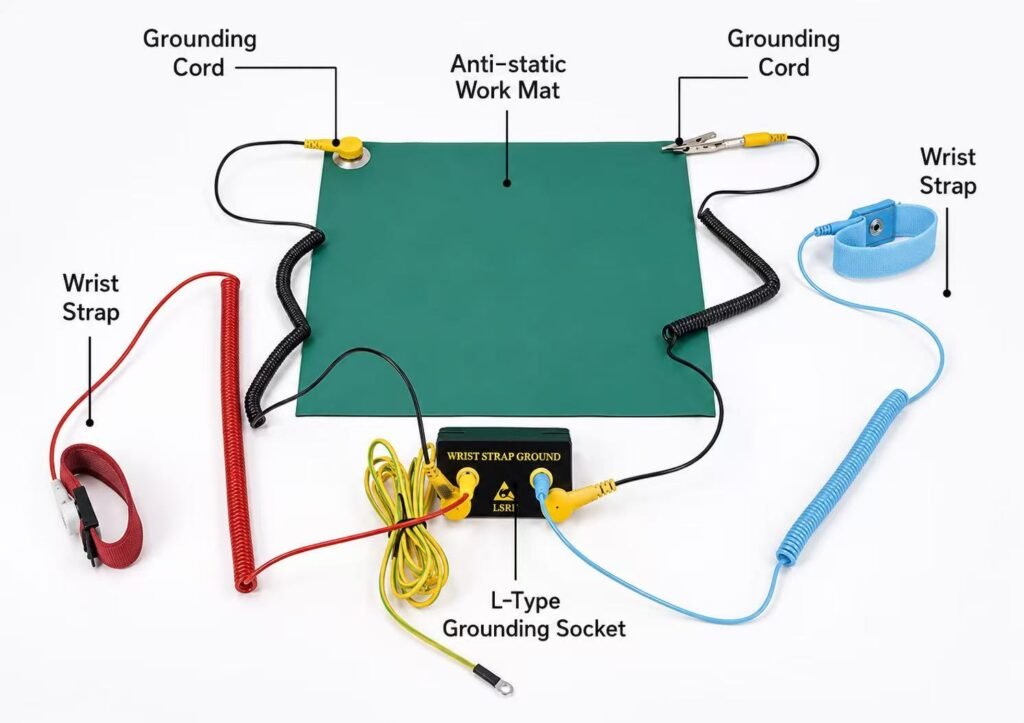
An ESD mat is grounded by a snap fastener fitted through the mat, a ground cord containing a 1 MΩ resistor, and a common point ground wired to the building’s protective earth. Every link in that chain has to be intact, and none of them can be confirmed by looking at it.
Quick Summary
- The chain: Mat → ground snap → ground cord (1 MΩ) → common point ground → building protective earth
- How the snap connects: Fitted from the green surface, four metal prongs pierce through and fold against the back, contacting the conductive bottom layer
- Why 1 MΩ: Operator safety — it limits current if a person in contact with the mat touches a live conductor
- Where earth comes from: The building’s protective earth, via the socket ground
- How to confirm it works: Measure resistance to ground. Do not assume it from appearance
Why Does an ESD Mat Need to Be Grounded?
An ungrounded ESD mat has nowhere to send charge, so it stops being a static control device and becomes a coloured surface.
The mat’s function is to provide a controlled path to earth. Charge arriving on the working surface moves through the dissipative top layer, into the conductive bottom layer, out through the snap and cord, and into the building’s protective earth. Break that chain at any point and charge simply accumulates on the mat instead of on the bench — no improvement at all.
This is why an ESD mat is never a standalone product. It is one component in a grounding system, and it is only as good as the connection behind it.
What Does the Ground Path Actually Look Like?
The complete path runs from the working surface to the building’s earth in five stages.
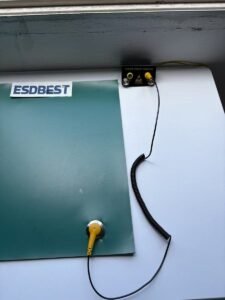
- Dissipative top layer — charge arrives here and moves in a controlled way, at 1 × 10⁶ to 1 × 10⁹ Ω
- Conductive bottom layer — carries charge efficiently, at 1 × 10⁴ to 1 × 10⁶ Ω
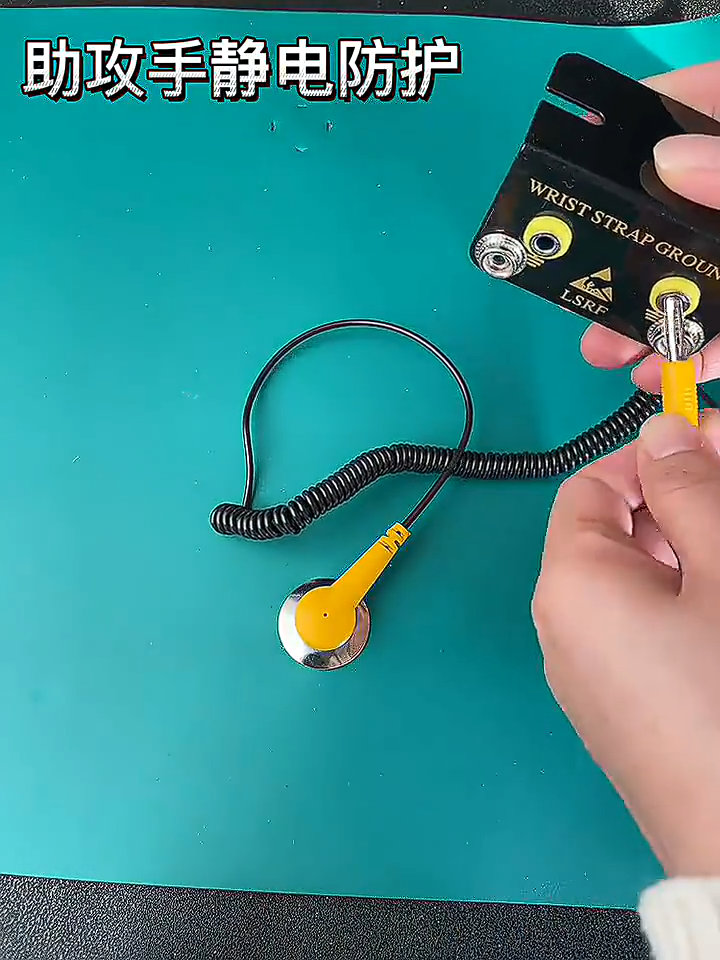
- Ground snap — a mechanical connection through the mat to the conductive layer
- Ground cord — contains a 1 MΩ resistor
- Common point ground — a single termination point wired to the building’s protective earth
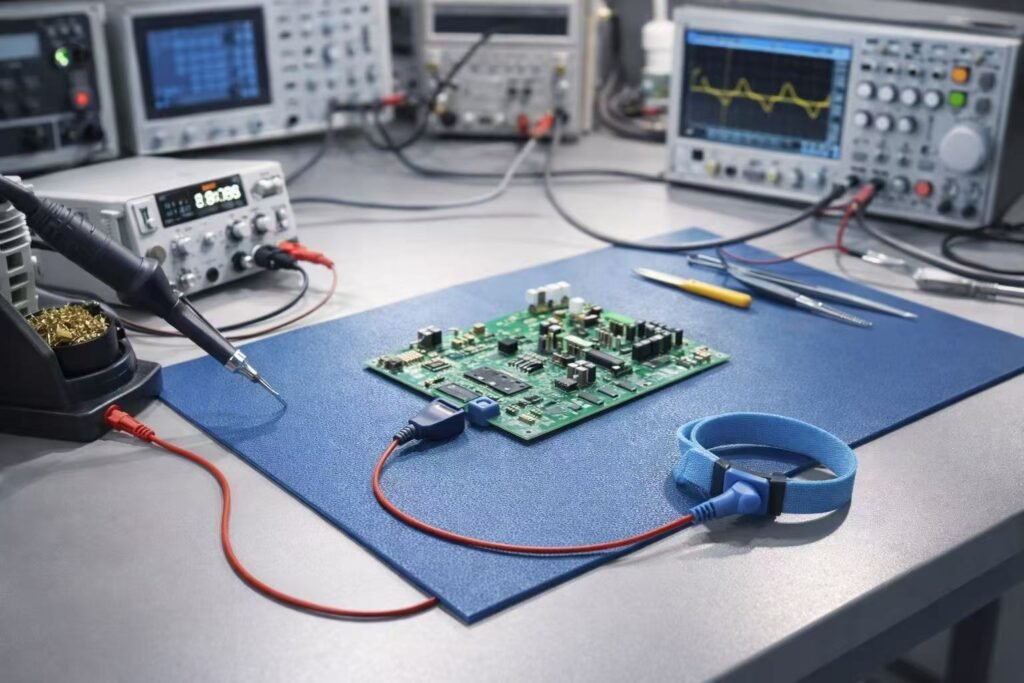
The common point ground also accepts the operator’s wrist strap. Putting the mat and the operator at the same potential is the point of a common point ground — it is not a convenience.
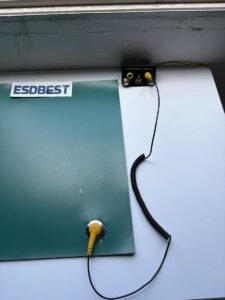
How Does the Ground Snap Reach the Conductive Layer?
The snap is fitted from the green surface. Four metal prongs pierce through both layers and fold against the back of the mat, forming a mechanical clamp that contacts the conductive bottom layer.
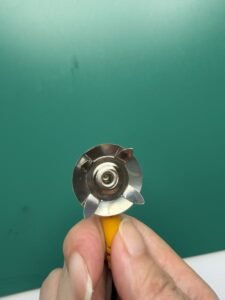
This matters more than it appears. The green working surface sits at 10⁶–10⁹ Ω; a connection made only to the top layer would be a poor ground path. What makes the connection work is the prongs penetrating through to the conductive layer beneath, which is two to three orders of magnitude less resistive.

It also explains a failure mode that is easy to miss. A snap that has loosened, corroded, or been fitted with insufficient pressure can look completely normal from above while making poor contact underneath. There is no visual symptom. The only way to detect it is to measure.
Why Is There a 1 MΩ Resistor in the Ground Cord?
The resistor is there for operator safety. If a person in contact with the grounded mat also touches a live conductor, the 1 MΩ resistance limits the current that can flow through them to earth.
It is deliberately high enough to protect the operator and low enough to be irrelevant to static dissipation. Charge dissipation happens through resistances in the 10⁶–10⁹ Ω range anyway, so 1 MΩ in series does not meaningfully slow it down.
What this means when you test
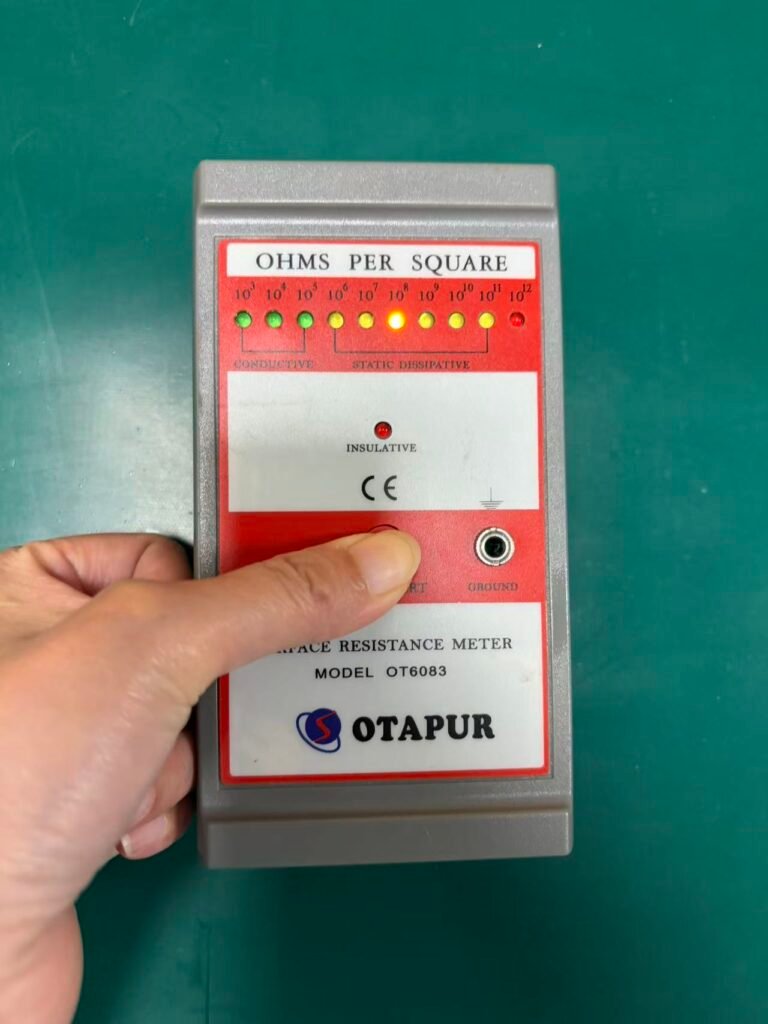
A resistance-to-ground measurement on a mat with a 1 MΩ cord will not read close to zero. It will read approximately 1 MΩ plus the mat’s own contribution — and that is the correct result.
Engineers who expect a near-zero reading sometimes conclude the mat is faulty. It is not. They are measuring a safety resistor that is doing exactly what it was specified to do. See how to test an ESD mat for the full method.
Where Should the Common Point Ground Connect?
To the building’s protective earth, normally taken from the socket ground.
The protective earth is the reference the rest of the facility is already tied to. Grounding a bench to anything else — a water pipe, a separate rod, an isolated frame — risks creating a potential difference between the bench and nearby equipment, which is the problem you were trying to eliminate.
Two practical points:
- Verify the socket ground is real. In older facilities, a socket with a ground pin does not guarantee a ground conductor behind it. Test it before you rely on it.
- Terminate to bare metal. A ground clip attached to a painted or anodised surface is not connected to anything. Paint is an insulator.
How Do You Confirm the Mat Is Actually Grounded?
Measure resistance to ground after installation, and periodically thereafter. Do not infer it from the fact that a cord is plugged in.
Every link in the chain fails silently. The snap can loosen. The cord can break internally while the jacket stays intact. The common point ground can be attached to painted metal. The socket ground can be absent. None of these is visible, and all of them produce an installation that looks entirely correct.
Test on installation, after any bench move or rework, and on the interval defined by your ESD control programme. Record the ambient temperature and relative humidity with every reading — surface resistance varies with humidity, and a figure logged without its conditions cannot be compared against a later measurement.
Common Mistakes to Avoid
- Assuming a plugged-in cord means a working ground. The most common failure of all, and the easiest to check.
- Clipping the ground to painted or anodised metal. No electrical connection at all.
- Expecting a near-zero resistance-to-ground reading. The 1 MΩ safety resistor is in the path by design.
- Grounding the mat and the wrist strap to different points. Defeats the purpose of a common point ground.
- Using a socket ground without verifying it exists. A ground pin is not proof of a ground conductor.
- Never re-testing after installation. Snaps loosen, cords fail internally, and neither is visible.
- Removing the 1 MΩ resistor to get a “better” reading. It is a safety component, not an obstacle.
Frequently Asked Questions
How do you ground an ESD mat?
Fit a ground snap through the mat, connect a ground cord from the snap to a common point ground, and wire the common point ground to the building’s protective earth.
Does an ESD mat work without being grounded?
No. Without a path to earth, charge accumulates on the mat instead of dissipating.
Why is there a 1 MΩ resistor in the ground cord?
For operator safety. It limits current through a person who contacts a live conductor while in contact with the grounded mat.
What resistance should a grounded ESD mat read?
Approximately 1 MΩ plus the mat’s own contribution, because of the safety resistor in the cord. A near-zero reading is not expected.
Where should the ground wire connect?
To the building’s protective earth, normally via the socket ground. Verify the socket ground actually exists before relying on it.
Can I ground an ESD mat to a water pipe?
No. Use the building’s protective earth so that the bench shares a reference with surrounding equipment.
How does the snap connect to the conductive layer?
It is fitted from the green surface and its four metal prongs pierce through both layers, folding against the back of the mat to contact the conductive bottom layer.
Can the mat and the wrist strap share a ground point?
They should. A common point ground puts the operator and the work surface at the same potential.
How often should grounding be checked?
On installation, after any bench move or rework, and at the interval set by your ESD control programme.
My mat reads out of range. Is the mat faulty?
Not necessarily. Check the snap, the cord, the common point ground and the socket ground first. Most grounding failures are in the chain, not in the mat.
Do you supply grounding hardware?
Yes. Snaps, ground cords and common point grounds are supplied alongside our ESD bench mats and mat rolls.
Written by Rachel Zhong, HORBEST Tech Co., Ltd. HORBEST has manufactured ESD control products in Shenzhen since 1996, supplying OEM and private-label matting to distributors in Europe, North America, Japan and Southeast Asia. The measurements published on this page were taken in-house. Jinwen Shuzigu, Huangtian, Xixiang, Bao’an, Shenzhen, China. Tel: +86 137 1427 2599