What’s the Difference and Which One Do You Need?
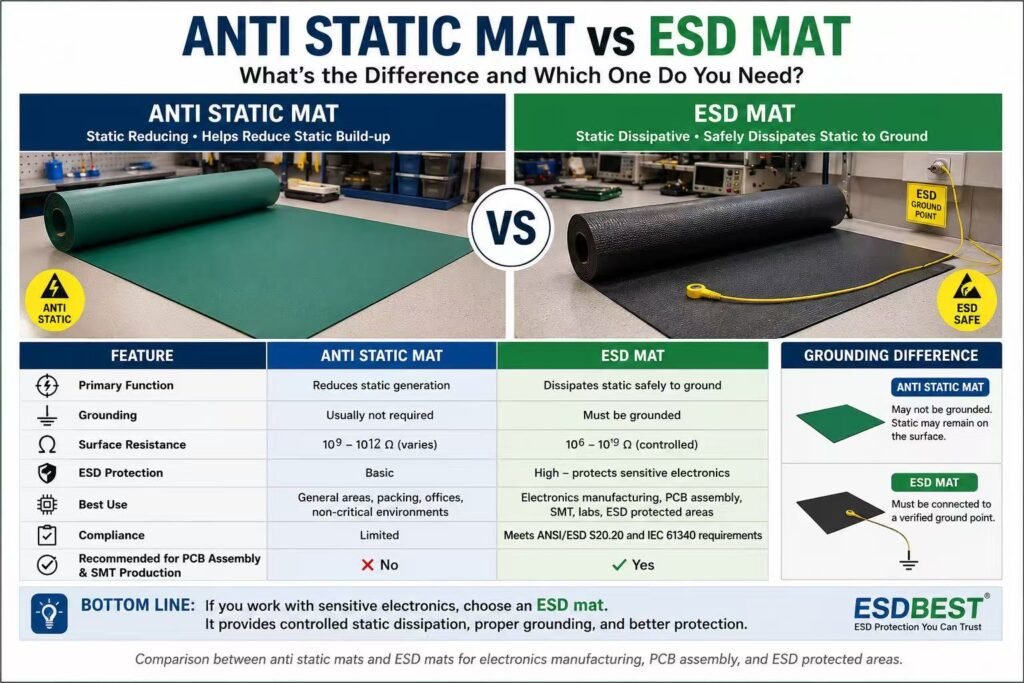
Anti Static Mat vs ESD Mat: What’s the Difference and Which One Do You Need?
Quick Answer: An anti static mat mainly helps reduce static generation, while an ESD mat is designed to safely dissipate static electricity to ground. For electronics manufacturing, PCB assembly, SMT production, semiconductor handling, and ESD Protected Areas, a properly grounded ESD mat is usually the better choice.
Many buyers use the terms “anti static mat” and “ESD mat” interchangeably. However, they are not always the same. Choosing the wrong mat can leave sensitive electronic components exposed to electrostatic discharge risk.
This guide explains the difference between anti static mats and ESD mats, including grounding, resistance, applications, compliance, testing, and how to choose the right mat for electronics work.
What Is An Anti Static Mat?
An anti static mat is designed to reduce static electricity generation. It may help prevent static buildup caused by friction between shoes, carts, tools, packaging materials, or work surfaces.
However, not all anti static mats provide a reliable path to ground. Some anti static mats only reduce charge generation but do not safely dissipate static electricity in a controlled way.
Anti static mats are commonly used in general industrial areas, packing areas, office environments, and non-critical static control applications.
What Is An ESD Mat?
An ESD mat is a static dissipative or conductive mat designed to safely drain static electricity to ground. It is commonly used in ESD Protected Areas where sensitive electronic components are handled.
A proper ESD mat usually works together with grounding cords, common point ground, wrist straps, ESD footwear, and regular resistance testing.
ESD mats are widely used in PCB assembly, SMT production, semiconductor manufacturing, electronics repair, testing benches, and cleanroom environments.
Anti Static Mat vs ESD Mat: Side-by-Side Comparison
| Feature | Anti Static Mat | ESD Mat |
|---|---|---|
| Main Function | Reduces static generation | Dissipates static safely to ground |
| Grounding | Usually not required or not reliable | Must be connected to verified ground |
| Static Protection | Basic | Controlled and reliable |
| Resistance Control | May vary | Controlled resistance range |
| PCB Assembly | Not recommended for sensitive work | Recommended |
| SMT Production | Limited use | Recommended |
| Semiconductor Handling | Not recommended | Recommended |
| ESD Compliance | Limited | Supports ESD control programs |
| Best Use | General static reduction | Electronics manufacturing and ESD areas |
How Do Anti Static Mats Work?
Anti static mats help reduce static buildup by limiting friction-related charge generation. They may be useful where static is annoying but not highly dangerous.
For example, anti static mats may be used in packaging areas, general workshops, computer areas, or light-duty environments.
However, if the mat is not grounded and does not have controlled resistance, static charge may remain on personnel, tools, or equipment.
How Do ESD Mats Work?
ESD mats provide a controlled path for static electricity to move safely to ground. When an operator, cart, tool, or electronic product contacts the mat, static charge can dissipate gradually instead of discharging suddenly into sensitive components.
A typical ESD grounding path works like this:
- Static charge is generated on the operator or equipment.
- The charge contacts the ESD mat surface.
- The mat dissipates the charge through its conductive or dissipative layer.
- The grounding cord carries the charge to common point ground.
- The charge is safely directed to earth ground.
Resistance Difference Between Anti Static Mats And ESD Mats
Resistance is one of the most important differences.
Anti Static Mat Resistance
Anti static mats may have a wide resistance range and may not be designed for verified ESD control. Some may reduce static generation but do not provide consistent static dissipation performance.
ESD Mat Resistance
Many ESD mats used in electronics manufacturing are designed within a static dissipative range such as:
106 Ω to 109 Ω
This range allows static electricity to dissipate gradually and safely. If resistance is too low, discharge may happen too quickly. If resistance is too high, static may not dissipate effectively.
Grounding Difference
Anti Static Mat
An anti static mat may not require grounding, depending on its design. But without grounding, it may not provide a reliable discharge path.
ESD Mat
An ESD mat should be connected to a verified ground. This usually includes:
- Grounding snap
- Grounding cord
- Common point ground
- Verified earth ground
Without proper grounding, even a high-quality ESD mat cannot perform correctly.
Which Mat Is Better For PCB Assembly?
For PCB assembly, an ESD mat is the better choice.
Printed circuit boards, IC chips, sensors, and semiconductor components can be damaged by electrostatic discharge. Many ESD events are invisible and may not be felt by operators.
An anti static mat may reduce static generation, but it may not provide enough protection for sensitive PCB assembly environments.
A grounded ESD mat is recommended because it provides controlled static dissipation and supports a complete ESD protection system.
Which Mat Is Better For Electronics Manufacturing?
For electronics manufacturing, ESD mats are generally recommended.
Electronics factories need reliable static control across production lines, testing areas, repair stations, and packing areas. ESD mats help reduce the risk of:
- PCB damage
- Latent electronic defects
- Component failure
- Product returns
- Production quality problems
For high-risk areas such as SMT lines, semiconductor facilities, and ESD Protected Areas, anti static mats alone are usually not enough.
Can An Anti Static Mat Be Used As An ESD Mat?
Not always.
Some anti static mats may have static reducing properties, but they are not necessarily designed to meet ESD control requirements. To be used as an ESD mat, the mat should have proper resistance performance, grounding capability, and regular test verification.
If your work involves sensitive electronic components, do not choose a mat only because it says “anti static.” Check whether it is groundable, testable, and suitable for ESD Protected Areas.
Common Mistakes When Choosing A Mat
1. Thinking All Anti Static Mats Are ESD Safe
This is one of the most common mistakes. Anti static does not always mean ESD safe.
2. Using A Mat Without Grounding
If an ESD mat is not grounded, static charge may not dissipate properly.
3. Never Testing Resistance
ESD mat performance can change over time due to wear, dirt, cleaning chemicals, and environmental conditions.
4. Using Normal Rubber Mats
Normal rubber mats are not suitable for ESD protection unless they are specifically designed and tested for static control.
5. Choosing Only By Price
A low-cost mat that does not control static properly can cause expensive electronic failures.
How To Choose Between Anti Static Mat And ESD Mat
| Application | Recommended Choice | Reason |
|---|---|---|
| Office computer area | Anti static mat | Basic static reduction may be enough |
| General warehouse | Anti static mat or ESD mat | Depends on product sensitivity |
| Electronics repair | ESD mat | Protects sensitive boards |
| PCB assembly | ESD mat | Controlled grounding is needed |
| SMT production | ESD mat | High ESD risk environment |
| Semiconductor handling | ESD mat | Requires strict static control |
| ESD Protected Area | ESD mat | Supports compliance and testing |
ESD Mat Testing
To confirm ESD mat performance, regular testing is recommended.
Common tests include:
- Point-to-point resistance test
- Resistance-to-ground test
- Surface resistance test
- Grounding continuity test
Testing helps confirm whether the mat is still performing within the required resistance range.
ESD Mat Grounding Setup
A basic ESD mat grounding setup includes:
- ESD mat
- Grounding snap
- Grounding cord
- Common point ground
- Verified earth ground
The grounding connection should be inspected and tested regularly. Poor grounding is one of the most common reasons an ESD mat fails to protect electronics.
Anti Static Mat vs ESD Mat: Final Recommendation
If you only need basic static reduction in a non-critical area, an anti static mat may be acceptable.
But if you work with PCBs, IC components, SMT lines, semiconductor devices, or sensitive electronics, choose a properly grounded ESD mat.
For electronics manufacturing, ESD mats provide stronger protection, better grounding, more reliable resistance control, and better support for ESD compliance programs.
Why Choose ESDBEST ESD Mats?
ESDBEST supplies ESD mats for electronics manufacturing, PCB assembly, SMT production, cleanrooms, repair benches, and ESD Protected Areas.
- Static dissipative and conductive options
- Groundable ESD mat design
- Stable resistance performance
- Custom sizes available
- Bulk factory supply
- Suitable for electronics manufacturing
- Export support for global buyers
Need ESD mats for your production line?
Contact ESDBEST for bulk supply and factory pricing.
Email: sales2@esdbest.com
Related Guides
- ESD Floor Mat Guide
- ESD Bench Mat Guide
- How To Ground An ESD Mat
- How To Test An ESD Mat
- Conductive vs Dissipative Mats
FAQ
Is an anti static mat the same as an ESD mat?
No. An anti static mat mainly reduces static generation, while an ESD mat is designed to dissipate static charge safely to ground.
Which is better for electronics manufacturing?
An ESD mat is usually better for electronics manufacturing because it provides controlled static dissipation and grounding.
Can I use an anti static mat for PCB assembly?
For sensitive PCB assembly, a grounded ESD mat is recommended instead of a basic anti static mat.
Do ESD mats need grounding?
Yes. ESD mats should be connected to a verified ground to safely dissipate static electricity.
What resistance should an ESD mat have?
Many ESD mats used in electronics manufacturing are designed within the static dissipative range, commonly around 106 Ω to 109 Ω.
How do you test an ESD mat?
You can test an ESD mat using a surface resistance meter, megohmmeter, or ESD tester. Common tests include point-to-point resistance and resistance-to-ground.
Are anti static mats safe for electronics?
Some anti static mats may reduce static, but they may not provide enough protection for sensitive electronics unless they are designed, grounded, and tested as ESD mats.
Can normal rubber mats replace ESD mats?
No. Normal rubber mats are not suitable for ESD protection unless they are specifically manufactured and tested for static control.