

01
Comparison Guide
Anti Static Mat vs ESD Mat
Understand the terminology, performance requirements and differences before selecting a mat for electronics manufacturing.
Read the ComparisonComplete Guide for Electronics and ESD Protection

An anti static mat is a specially engineered surface used to reduce the generation, accumulation and uncontrolled discharge of static electricity in electronics manufacturing and other static-sensitive environments.
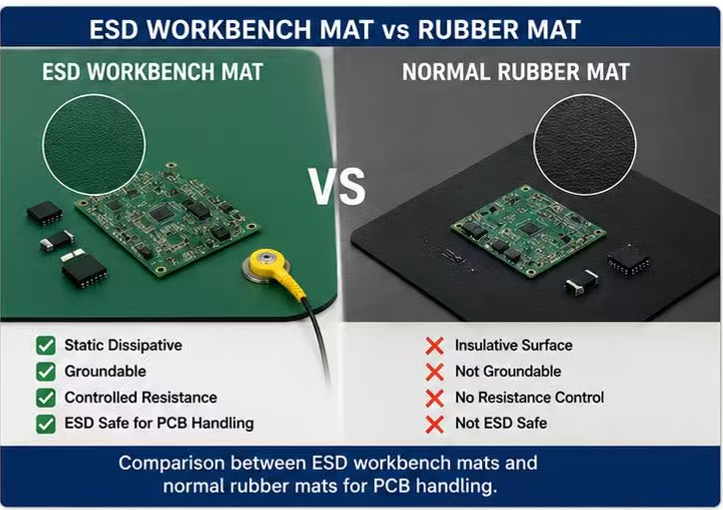
Unlike an ordinary rubber mat, desk pad or floor covering, a professional anti static mat has defined electrical properties and is designed to become part of a controlled grounding system.
When correctly selected, installed, grounded and tested, an anti static mat helps protect printed circuit boards, integrated circuits, semiconductor devices, electronic assemblies and production equipment against electrostatic discharge risks.
ESDBEST manufactures 2-layer rubber anti static mats for electronics workbenches, PCB assembly stations, SMT production lines, laboratories, quality-control areas, repair centers and industrial floors.
Available options include:
Request a Free Sample
Download the Technical Datasheet
Get a Factory Quote
Different anti static mats are designed for different areas and grounding functions. Selecting the correct mat begins with identifying where it will be installed and what must be protected.
Installed on an electronics workbench to provide a controlled surface for handling PCBs, components, tools and electronic assemblies.
Best for:
Explore ESD Bench Mats
Installed in standing or walking areas to support personnel grounding when used with an approved footwear system.
Best for:
Explore ESD Floor Mats
Supplied in continuous lengths for long workbenches, production lines and customized installations.
Best for:
Produced to match specific table dimensions, floor areas, grounding positions and workstation layouts.
Best for:
May include:
📞 Contact Us Today
For bulk orders, quotes, or product guidance, get in touch with our expert team:
Email: sales2@esdbest.com
Whatsapp: +86 137 1427 2599
An anti static mat is a surface designed to control static electricity in environments where electrostatic charge may damage electronic products, affect manufacturing quality or interfere with sensitive processes.
The term “anti static” is widely used in the market. However, it can describe products with very different levels of electrical performance.
Some low-cost products are designed only to reduce triboelectric charge generation. Other professional mats provide a measurable static-dissipative or conductive path that can be connected to ground.
For electronics manufacturing, buyers should not rely on the words “anti static” alone.
A professional product should have:
An anti static mat does not make static electricity disappear instantly.
Its purpose is to control how charge is generated, accumulated and dissipated.
A well-designed system reduces the probability that stored charge will discharge suddenly through an electrostatic discharge sensitive device.
The goal is controlled charge movement—not simply the fastest possible path to ground.
Anti static mats are commonly used in:
The terms are often used interchangeably, but they do not always mean exactly the same thing.
“Anti static mat” is a broad commercial term that may refer to any mat intended to reduce or manage static electricity.
“ESD mat” normally implies a product designed as part of a formal electrostatic discharge control system with measurable electrical performance, grounding and verification requirements.
A professional electronics anti static mat should therefore be evaluated as an ESD control product rather than selected only by product name.
Read our complete comparison:
Anti Static Mat vs ESD Mat
Static electricity can be generated whenever two materials contact and separate.
Examples include:
An operator may carry electrostatic charge without feeling or seeing a spark.
When the charged operator, tool or material contacts an electronic component, the stored charge may discharge through a sensitive electrical path.
Possible consequences include:
An anti static mat helps establish a controlled surface where components, tools and assemblies can be handled with lower electrostatic risk.
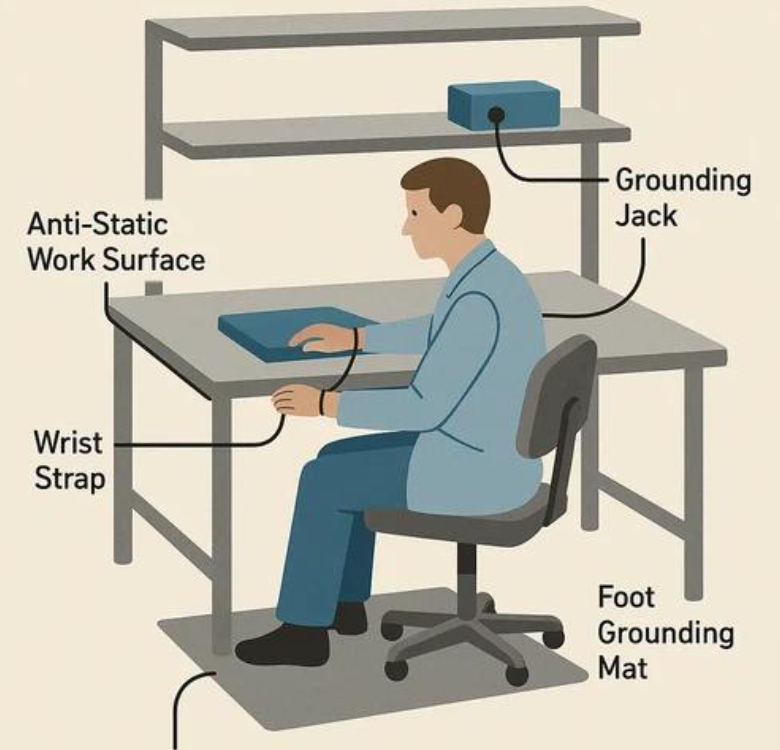
However, the mat should be part of a complete ESD control program that may also include:


Request a Free Sample
Download the Technical Datasheet
Get a Bulk Quote
Email: sales2@esdbest.com
Phone / WhatsApp: +86 137 1427 2599
A professional anti static mat works by controlling the generation and movement of electrostatic charge.
The exact mechanism depends on the material, resistance range, construction and grounding arrangement.
Charge may develop when operators, tools, packaging and production materials move or separate.
When a charged object touches the mat, the mat provides a more predictable electrical interface than an ordinary table or floor surface.
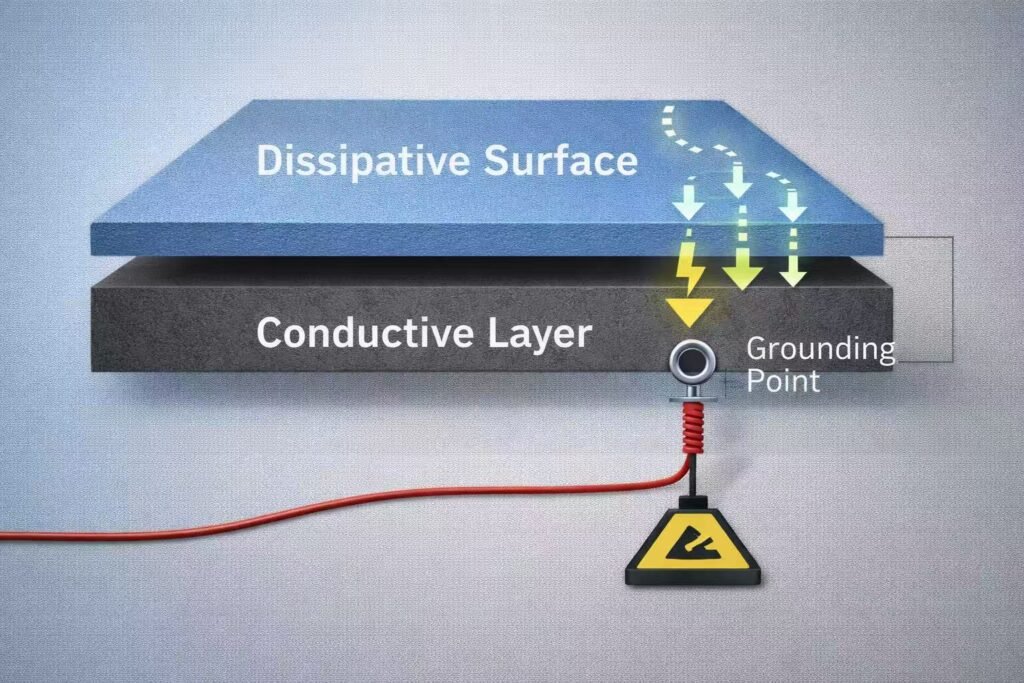
A static-dissipative working layer allows charge to move at a controlled rate.
The controlled rate helps reduce the possibility of an abrupt discharge into a sensitive device.
In a 2-layer rubber mat, a more conductive lower layer helps create a consistent path across the mat toward its groundable point.
The mat is connected through an approved grounding cord to a common point ground or another verified grounding arrangement.
The complete system should be installed and verified according to the facility’s ESD control plan and electrical-safety requirements.
The performance of an anti static mat can be affected by:
The complete installed system must therefore be tested—not only the mat material.
Anti static mats can be classified by installation area, material and electrical behavior.
An anti static table mat is installed on a desk, table or electronics workbench.
It provides a controlled surface for:
The mat is normally connected to a common point ground using an approved grounding cord.
“Anti static bench mat” and “anti static table mat” are often used for the same type of product.
Bench mats are generally designed for industrial production and technical workstations.
They may offer:
An anti static floor mat is installed under or near an operator’s workstation.
It is generally used to support personnel grounding through:
A floor mat does not replace a bench mat, because the two products perform different functions.
Roll material is suitable for:
Rolls should be stored and installed carefully to prevent permanent curling, creasing and surface damage.
An anti-fatigue static-control mat combines personnel grounding properties with cushioning for standing operators.
It is typically thicker and more structured than a flat rubber ESD floor mat.
Buyers must verify both:
Mats for controlled environments may require additional characteristics such as:
Some soldering and rework applications require greater resistance to short-duration heat exposure.
Rubber materials are often selected for these environments, but the supplier’s actual temperature test data should be reviewed.
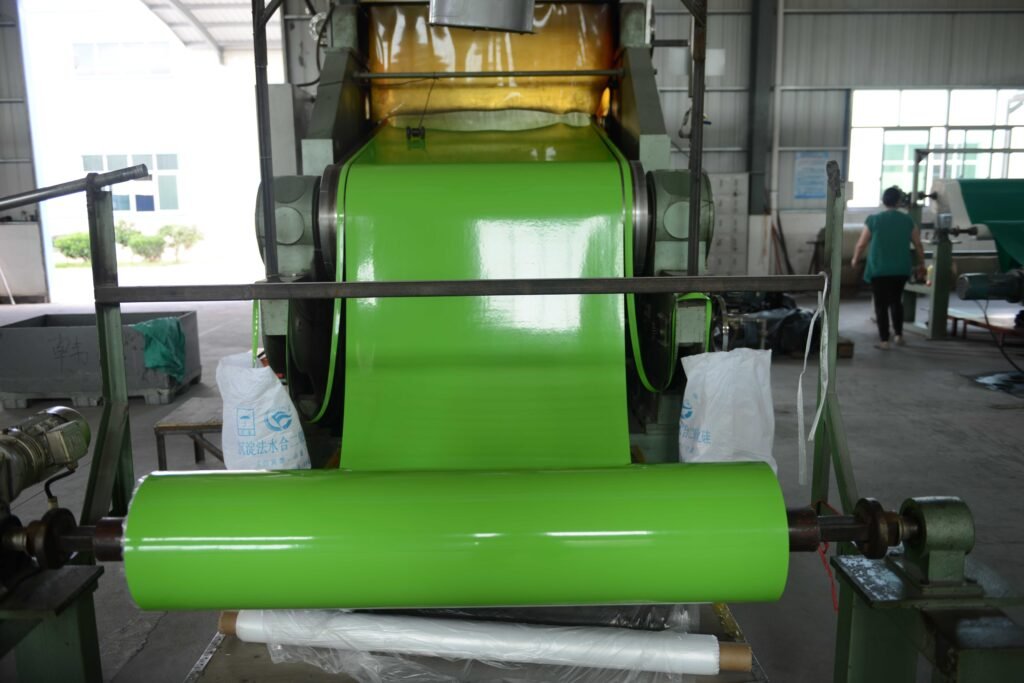
ESDBEST supplies professional 2-layer rubber anti static mats for electronics workstations and static-controlled production areas.
The top layer forms the working surface.
Its main functions include:
The lower layer supports electrical consistency and charge distribution.
Its functions include:
A two-layer structure separates the functions of the working surface and the grounding layer.
The static-dissipative top provides controlled interaction with products, while the conductive bottom supports a reliable path toward ground.
The benefits may include:
A typical configuration may include:
Actual color, size, resistance and accessory availability should be confirmed through the current ESDBEST technical datasheet.
Electrical resistance is one of the most important factors when evaluating an anti static mat.
However, buyers should distinguish between different measurements.
Surface resistance describes electrical behavior across a material surface under a defined test arrangement.
It may be used for material classification and quality control, but it should not be confused automatically with installed workstation performance.
Resistance point to point measures resistance between two positions on the mat.
It helps evaluate:
Resistance to ground measures the path from the working surface to the mat’s groundable point or grounding reference.
This measurement is highly relevant after installation.
A mat may have acceptable material properties but fail resistance-to-ground testing because of:
Terms frequently used in ESD control include:
These categories should be connected to a defined test method and measured values.
Do not judge electrical performance from color, material name or marketing language alone.
The correct resistance depends on:
For work surfaces where unprotected ESD-sensitive items are handled, ANSI/ESD S20.20 guidance is commonly interpreted as requiring point-to-point and point-to-groundable-point qualification values below (1 × 10^9) ohms, with in-use resistance-to-ground verification also below that limit.
The actual product must still be tested under the applicable method and approved by the customer’s ESD control program.
No.
An excessively conductive surface is not automatically the best work surface.
The goal is to provide controlled and predictable charge dissipation while satisfying the applicable technical and safety requirements.
The two terms overlap, but they are not always identical.
A broad term used for a mat intended to reduce static generation or static accumulation.
Some products sold under this name may have limited technical information.
A more technical term for a mat intended to operate as an element of an ESD control program.
An ESD mat should normally have:
| Feature | General Anti Static Mat | Professional ESD Mat |
|---|---|---|
| Static-generation reduction | May be provided | Expected |
| Defined resistance | Not always | Required |
| Grounding point | May be absent | Normally included |
| Test method | May be unclear | Should be specified |
| Batch data | Not always available | Recommended |
| Electronics suitability | Must be verified | Designed for ESDS handling |
| Compliance program | Not necessarily | Intended for integration |
For PCB, SMT, semiconductor and other sensitive electronics applications, select a professional product with measurable electrical performance rather than relying only on an “anti static” label.
A product suitable for electronics manufacturing should be evaluated as part of the complete ESD-control system.
Conductive and static-dissipative materials allow charge to move at different rates.
A conductive mat allows charge to move relatively easily.
Conductive material can be useful for:
However, the suitability of a conductive top work surface depends on the approved ESD program and application.
A static-dissipative mat provides a more controlled path for charge movement.
It is frequently used as the upper work surface for handling sensitive components.
Many professional rubber mats combine:
This structure provides a controlled work surface and a consistent grounding path.
Consider:
Read the detailed guide:
Conductive vs Static-Dissipative ESD Mats
Rubber and PVC are two common materials used for static-control mats.
Rubber mats are frequently selected for industrial electronics applications.
Potential benefits include:
PVC mats may be suitable for lighter-duty and budget-sensitive applications.
Potential benefits include:
The material description does not prove ESD performance.
Always confirm:
A groundable anti static mat requires a verified path to ground to provide its intended performance.
Do not connect the mat to a random table leg, machine casing, water pipe or unverified metal object.
The workbench or floor should be:
Install the mat flat and ensure it does not:
Use the mat’s designated groundable point.
The snap must contact the correct conductive layer.
Attach the approved mat grounding cord securely to the snap.
Inspect for:
Connect the mat to the workstation common point ground.
The common point may also provide a designated wrist-strap connection.
The grounding system should be verified by qualified personnel.
Electrical grounding and ESD grounding must be implemented without creating an electrical-safety hazard.
Test the installed mat using the approved test method.
Record:
Include the mat and grounding cord in routine compliance verification.
Read the complete installation guide:
How to Ground an ESD Mat
Testing should confirm both the mat material and the installed grounding system.
Depending on the selected procedure:
Environmental conditions can influence measured resistance.
For consistent records, document:
Read the complete testing guide:
How to Test an ESD Mat
PCB assembly requires a controlled work surface because boards may contain electrostatic discharge sensitive devices.
A complete PCB workstation may include:
Anti static mats provide a controlled area for handling:
The mat supports safe handling while operators:
Rubber mats are commonly used around soldering stations because they offer better heat resistance than many general-purpose plastic surfaces.
Do not place extremely hot tools directly on the mat unless the product is specifically rated for that use.
During testing, ensure that powered equipment, grounding and electrical safety are managed together.
An anti static mat is not an electrical-insulation mat.
Finished products should remain within the controlled ESD area until placed into approved protective packaging.
Used for assembly, inspection, testing, repair and packaging.
Used at feeder-preparation stations, offline inspection areas, repair benches and quality-control points.
Used for handling integrated circuits, wafers, modules and microelectronic devices.
Used for sensors, control units, displays, battery-management systems and electronic modules.
Used in the manufacture and servicing of diagnostic, monitoring and control equipment.
Used in controlled production areas that require traceability and documented verification.
Used for circuit boards, networking devices, communication modules and optical electronics.
Used for computers, phones, industrial controls, communication products and instruments.
Used in research, engineering, product development and electronics education.
Bench mats and floor mats should not be treated as interchangeable products.
Primary purpose:
Protecting electronic products and components on the work surface.
Installation:
On the workbench.
Grounding:
Normally connected to a common point ground.
Typical personnel system:
Wrist strap.
Primary purpose:
Supporting personnel grounding and controlling charge in standing areas.
Installation:
On the floor.
Grounding:
Connected as part of the approved floor system.
Typical personnel system:
ESD shoes or heel grounders.
A complete workstation may use:
The correct combination depends on the facility ESD control plan and operator activity.
Actual availability should be confirmed before publication or quotation.
Suitable for:
Advantages:
Suitable for:
Advantages:
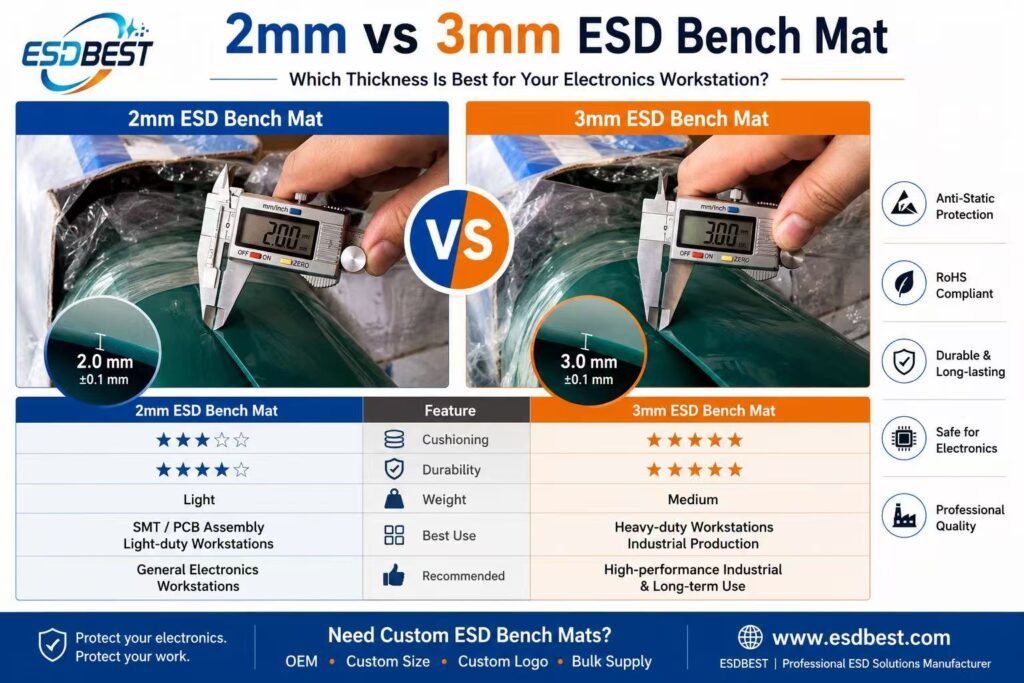
Thickness does not determine electrical performance by itself.
Determine whether you need:
Identify whether the primary requirement is:
Review:
Choose rubber for demanding industrial, soldering and continuous-use applications.
Consider PVC for lighter-duty or temporary applications.
Two-layer rubber construction is recommended where a controlled working surface and consistent grounding layer are required.
Measure:
Specify:
Consider:
Ask for:
Evaluate the sample under actual:
Compare:
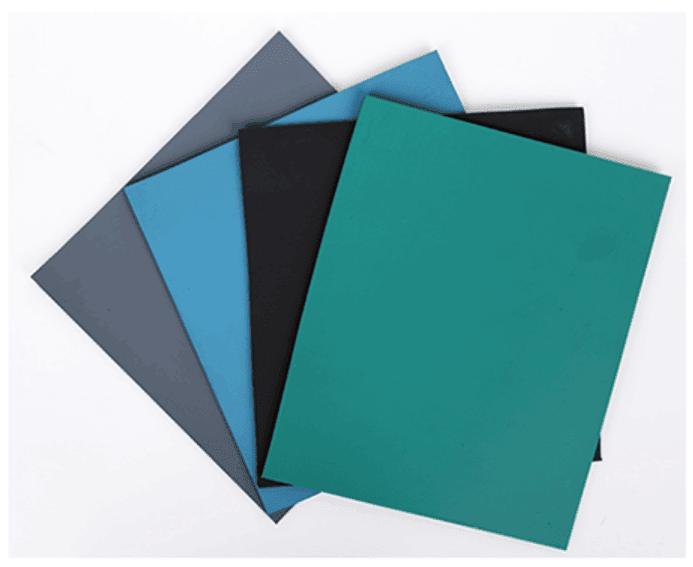
Green, blue, gray and black do not prove ESD performance.
A groundable mat without a valid ground path may not provide its intended performance.
Ordinary rubber may be highly resistive and unsuitable for ESDS handling.
Wax, polish and silicone residue may change resistance.
Ordinary plastic sheets, tape and packaging may generate or hold charge.
A damaged grounding cord can make the installed system ineffective.
Installation changes, wear and contamination can affect performance.
Anti static mats are not automatically designed to protect against electrical shock.
Very low resistance is not automatically better for a work surface.
Ask for test values, test methods and product documentation.
ESDBEST supplies anti static mats for electronics manufacturers, distributors, laboratories and private-label customers.
Available options include:
Possible options include:
Custom color production is subject to minimum quantity and technical approval.
Options may include:
Options may include:
ESDBEST can customize:
To request a quotation, provide:
A professional anti static rubber mat requires control throughout production.
A typical process may include:
Depending on product and order requirements:
Request or download:
Recommended videos:
Request a Free Sample
Download the Technical Datasheet
Get a Bulk Quote
Email: sales2@esdbest.com
Phone / WhatsApp: +86 137 1427 2599
Request a Free Sample
Download the Technical Datasheet
Get a Bulk Quote
Email: sales2@esdbest.com
Phone / WhatsApp: +86 137 1427 2599
An anti static mat is a surface designed to reduce static generation and provide controlled electrostatic charge dissipation in static-sensitive environments.
The terms are often used interchangeably, but an ESD mat normally implies defined resistance, grounding and testing requirements.
A groundable mat must be connected to an approved grounding system to provide its intended charge-dissipation path.
A mat may reduce charge generation without grounding, but it cannot provide a verified path to ground unless correctly connected.
The required resistance depends on the application, test method, customer specification and ESD control program.
No. Electronics work surfaces require controlled charge dissipation, not simply the lowest resistance.
A static-dissipative mat allows electrostatic charge to move at a controlled rate.
A conductive mat allows charge to move more easily and may be used as a lower grounding layer or in approved floor systems.
The upper layer provides the controlled work surface, while the lower conductive layer supports a more consistent path to ground.
Rubber is generally preferred for demanding industrial and soldering environments. PVC may suit lighter-duty installations.
No. Ordinary rubber may be highly resistive and may not provide measurable ESD-control performance.
Yes, provided the mat is correctly grounded and used as part of a complete ESD-controlled workstation.
Rubber ESD mats are commonly used at soldering stations, but hot tools should not be placed directly on the mat unless the product is specifically rated for that use.
The mat controls the work surface. A wrist strap controls charge on the operator. Follow the facility’s ESD control plan.
Not necessarily. An ESD mat should not be assumed to provide electrical shock insulation.
Measure resistance point to point and resistance to ground using the approved instrument, electrodes and test method.
Testing frequency should be established through the facility’s compliance-verification plan and risk assessment.
Use an approved ESD-safe surface cleaner and a clean low-lint cloth.
Some cleaners leave insulating residue or damage the rubber, so only approved cleaners should be used.
Service life depends on material quality, wear, heat, chemical exposure, cleaning and maintenance.
Replace it when it is physically damaged, delaminated, chemically degraded or repeatedly fails electrical testing.
Two millimeters is suitable for many standard workstations. Three millimeters provides additional cushioning and durability.
The mat should cover the complete active handling area without blocking equipment, controls or ventilation.
Many roll mats can be cut, but cutting should not damage the layer structure or grounding design.
Yes. ESDBEST provides custom-cut mats and roll materials.
Yes. Custom logo printing and private-label packaging are available.
Grounding cords can be supplied as part of a complete workstation kit. Confirm the required connector and resistor configuration.
Yes. Provide the required size, thickness, color, application and electrical specification.
Provide size, thickness, color, quantity, resistance requirement, grounding accessories, packaging and destination country.
A professional anti static mat should be combined with appropriate ESD control products.
Recommended equipment includes:
Need rubber anti static mats for electronics workbenches, factory floors or custom production lines?
Send ESDBEST:
Our team will recommend a suitable 2-layer rubber static-control mat and provide a factory quotation.
📞 Contact Us Today
For bulk orders, quotes, or product guidance, get in touch with our expert team:
Email: sales2@esdbest.com
Whatsapp: +86 137 1427 2599
Explore these practical guides to better understand ESD mat selection, grounding, testing and resistance performance.
Understand the terminology, performance requirements and differences before selecting a mat for electronics manufacturing.
Read the ComparisonFollow the correct grounding procedure for bench mats, floor mats and common point ground systems.
View Grounding StepsLearn how to perform point-to-point and resistance-to-ground testing using an approved resistance meter.
Learn the Test MethodCompare conductive and dissipative materials, resistance behavior and suitable applications.
Compare Mat MaterialsNeed help choosing the correct ESD mat for your workstation or factory?
Ask an ESD Mat Specialist