What’s the Difference and Which One Is Better?
ESD Mat vs Anti Static Mat: What’s the Difference?
Quick Answer
An anti static mat is designed to reduce static electricity, while an ESD mat is designed to provide controlled electrostatic discharge protection for sensitive electronic components.
For general static reduction, an anti static mat may be enough.
But for PCB assembly, electronics manufacturing, SMT production, repair stations, testing benches, and ESD protected areas, an ESD mat is usually the better and safer choice because it offers controlled resistance, grounding connection, and more predictable static dissipation.
In simple terms:
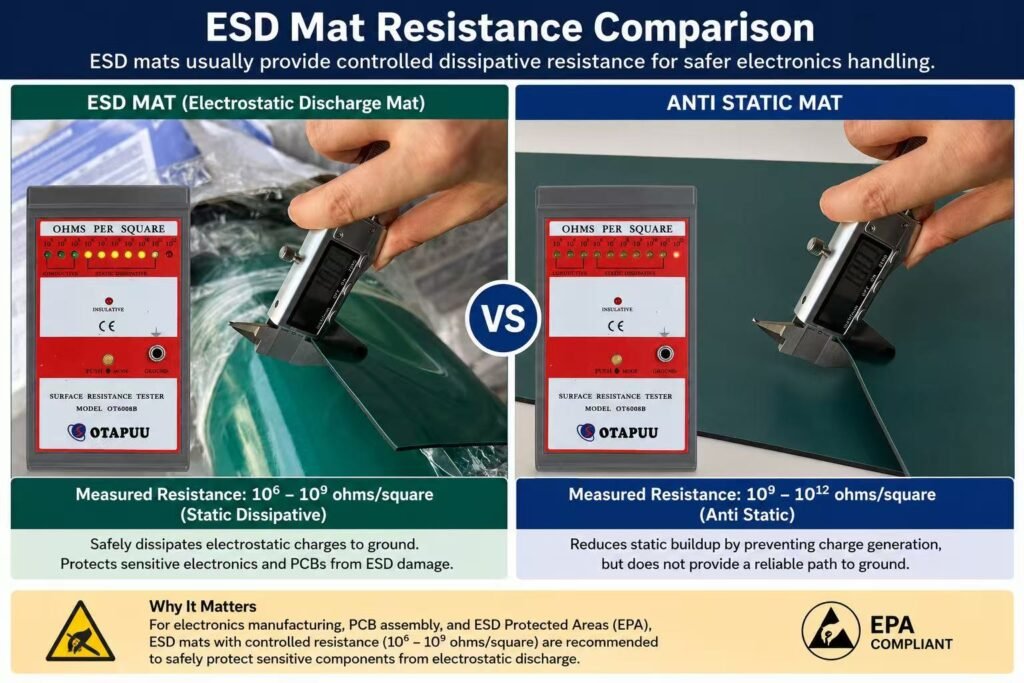
ESD Mat vs Anti Static Mat: Quick Comparison
| Feature | ESD Mat | Anti Static Mat |
|---|---|---|
| Main Purpose | Controlled ESD protection | Reduce static generation |
| Static Reduction | Yes | Yes |
| Controlled Dissipation | Yes | Sometimes |
| Grounding | Required / recommended | Optional or not available |
| PCB Assembly | Recommended | Limited |
| Electronics Manufacturing | Recommended | Basic use only |
| ESD Protected Area | Suitable | Not always suitable |
| Resistance Control | More controlled | May vary |
| Workstation Use | Professional | General |
| Best For | PCBs, SMT, ICs, electronics | Light static control |
📞 Contact Us Today
For bulk orders, quotes, or product guidance, get in touch with our expert team:
Email: sales2@esdbest.com
Whatsapp: +86 137 1427 2599
What Is An ESD Mat?
An ESD mat is a static control mat designed to protect sensitive electronic components from electrostatic discharge.
ESD means Electrostatic Discharge. It happens when static electricity suddenly transfers from one object to another. In electronics manufacturing, this discharge can damage PCBs, ICs, sensors, LEDs, semiconductor components, and other sensitive devices.
A professional ESD mat usually has:
A typical ESD workstation uses:
Recommended reading:
ESD Mat Guide: Anti-Static, Bench & Floor Mats for Electronics
What Is An Anti Static Mat?
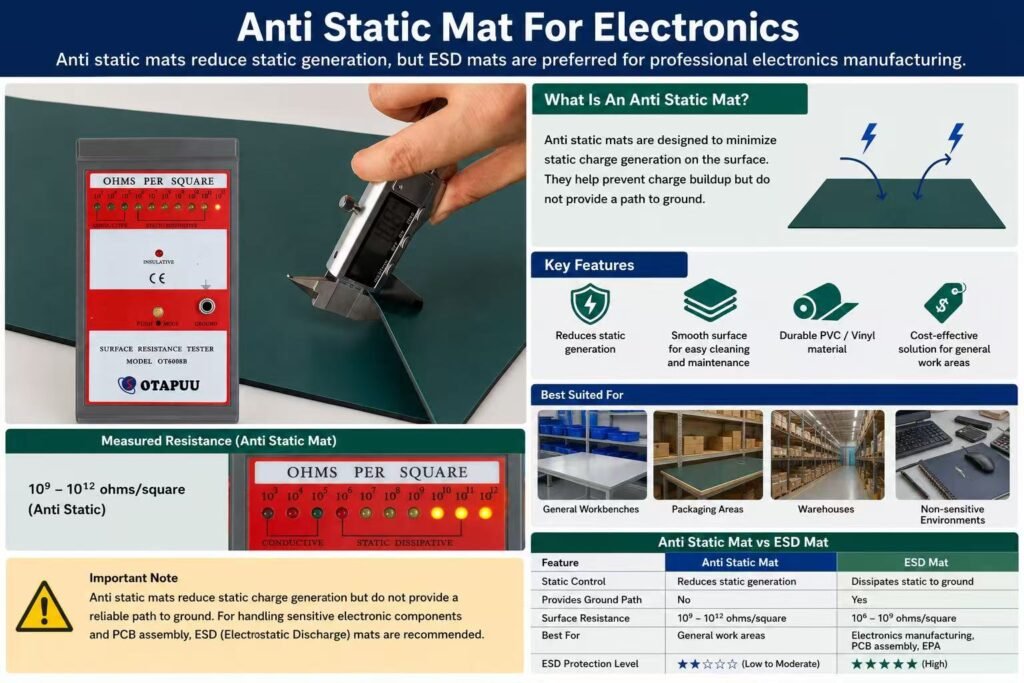
An anti static mat is a mat designed to reduce static electricity buildup.
It can help reduce static charge caused by friction, movement, plastic packaging, clothing, tools, and work surfaces.
Anti static mats are commonly used in:
General workstations
Packaging areas
Warehouses
Office desks
Light electronics handling
Basic static control areas
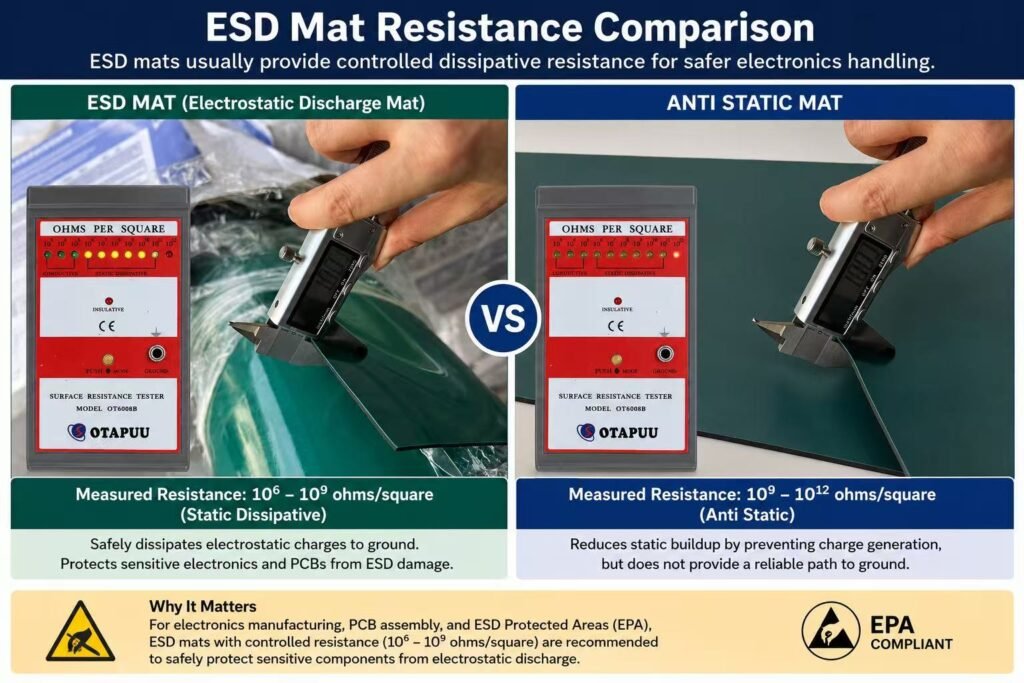
However, not every anti static mat is suitable for professional electronics manufacturing.
Some anti static mats only reduce static generation but do not provide a controlled grounding path. Some may also have unstable resistance performance.
That is why factories handling sensitive electronic components usually prefer ESD mats instead of generic anti static mats.
Recommended reading:
Anti Static Mat
Main Difference Between ESD Mat and Anti Static Mat
The biggest difference is control.
An anti static mat mainly reduces the generation of static electricity.
An ESD mat is designed to control how static electricity dissipates.
This matters because static electricity should not disappear suddenly. If discharge happens too fast, it may damage sensitive components. If it cannot dissipate, static charge may remain on the surface.
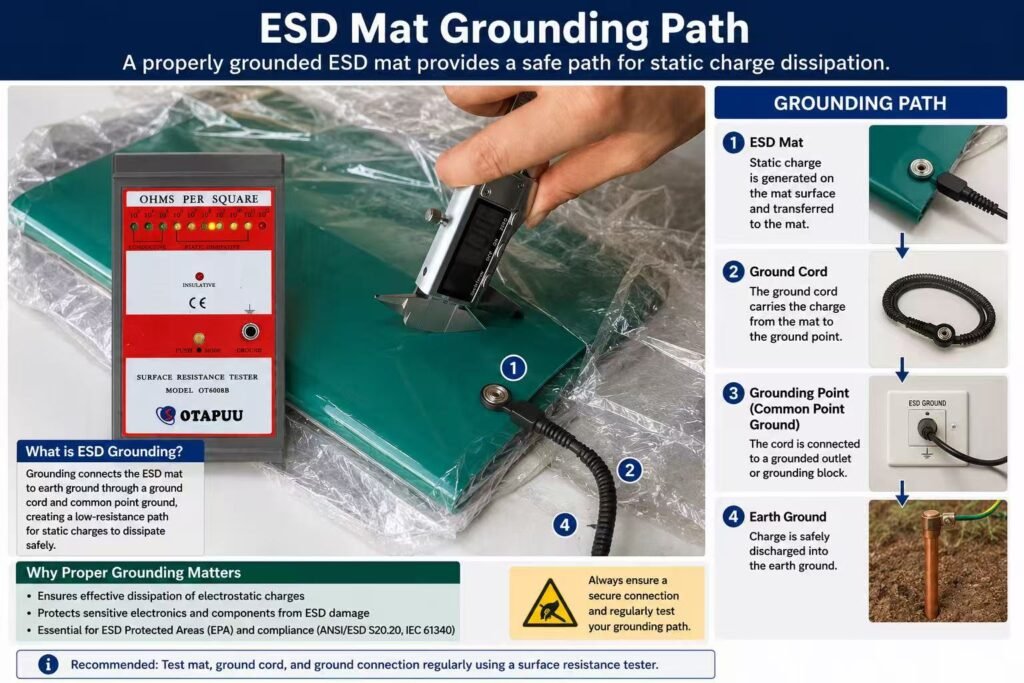
A good ESD mat provides a controlled path:
Static charge
↓
ESD mat surface
↓
Grounding cord
↓
Common point ground
↓
Earth ground
Resistance Comparison
Resistance is one of the most important differences between ESD mats and anti static mats.
| Material / Surface Type | Typical Resistance Range | Meaning |
|---|---|---|
| Conductive Surface | 10⁴–10⁶ Ω | Fast discharge |
| Dissipative ESD Mat | 10⁶–10⁹ Ω | Controlled discharge |
| Anti Static Surface | 10⁹–10¹¹ Ω | Reduces static generation |
| Insulative Surface | >10¹¹ Ω | Poor static control |
For many electronics workstations, the common dissipative range is:
10⁶ Ω to 10⁹ Ω
This range helps static charge dissipate in a controlled way instead of discharging suddenly into a PCB or component.
Grounding Difference
Grounding is another major difference.
An ESD mat is normally connected to ground. This allows static charge to safely dissipate away from the work surface.
An anti static mat may or may not have grounding.
| Grounding Feature | ESD Mat | Anti Static Mat |
|---|---|---|
| Grounding snap | Usually yes | Sometimes |
| Grounding cord | Recommended | Optional |
| Common point ground | Yes | Not always |
| Wrist strap compatible | Yes | Not always |
| Suitable for EPA areas | Yes | Limited |
Without grounding, a mat may reduce static generation, but it may not safely remove accumulated static charge.
For electronics manufacturing, grounding is strongly recommended.
Recommended reading:
How to Ground an ESD Mat
Which One Is Better For PCB Assembly?
For PCB assembly, an ESD mat is better.
PCB assemblies contain sensitive electronic components that may be damaged by static discharge. Even if the operator does not feel a shock, the PCB can still suffer hidden ESD damage.
An ESD mat is better for PCB assembly because it provides:
Controlled resistance
Grounding path
Stable dissipative surface
Compatibility with wrist straps
Better workstation protection
Professional ESD control
An anti static mat may reduce static, but it may not provide enough controlled protection for sensitive PCB work.
Recommended page:
ESD Bench Mat
📞 Contact Us Today
For bulk orders, quotes, or product guidance, get in touch with our expert team:
Email: sales2@esdbest.com
Whatsapp: +86 137 1427 2599
Which One Is Better For Electronics Manufacturing?
For electronics manufacturing, an ESD mat is usually the better choice.
This includes:
SMT production
PCB assembly
IC testing
Electronics repair
Semiconductor handling
LED assembly
Sensor production
Electronic module assembly
Quality inspection
In these environments, static control must be stable and repeatable.
A mat that only claims to be “anti static” may not be enough unless it has verified resistance and grounding performance.
Can An Anti Static Mat Replace An ESD Mat?
In some low-risk areas, yes.
But in professional electronics work, usually no.
An anti static mat may be acceptable for:
General packaging
Office desk use
Light static reduction
Non-sensitive materials
Warehouse areas
But it should not replace an ESD mat for:
PCB assembly
SMT production
IC handling
Electronics manufacturing
Repair stations
ESD protected areas
If your work involves sensitive electronics, choose an ESD mat.
ESD Mat vs Normal Rubber Mat
Many buyers confuse ESD mats, anti static mats, and normal rubber mats.
A normal rubber mat may look similar, but it may be insulating.
| Feature | ESD Mat | Normal Rubber Mat |
|---|---|---|
| Static control | Yes | No or unknown |
| Grounding | Yes | No |
| Resistance tested | Yes | Usually no |
| PCB safe | Yes | Not recommended |
| Electronics manufacturing | Suitable | Not suitable |
| Hidden ESD risk | Low | High |
Never choose a mat for electronics work based only on appearance.
A black or green rubber mat is not automatically ESD safe.
Which Mat Should You Choose?
Use this simple decision table:
| Application | Recommended Mat |
|---|---|
| PCB assembly | ESD mat |
| SMT production | ESD mat |
| Electronics repair | ESD mat |
| IC testing | ESD mat |
| Semiconductor handling | ESD mat |
| General packaging | Anti static mat |
| Warehouse static reduction | Anti static mat |
| Office desk static control | Anti static mat |
| Factory ESD workstation | ESD bench mat |
| Standing production area | ESD floor mat |
Common Mistakes When Choosing Mats
Mistake 1: Thinking Anti Static Means ESD Safe
Anti static does not always mean professional ESD protection.
A product can reduce static generation but still fail to provide controlled dissipation.
Mistake 2: Not Grounding The Mat
An ungrounded mat may not protect sensitive electronics properly.
Grounding is essential for ESD workstation safety.
Mistake 3: Using Ordinary Rubber Mats
Ordinary rubber mats may be insulative and unsafe for PCB assembly.
They may allow static charge to accumulate instead of dissipating it.
Mistake 4: Never Testing Resistance
A mat should be tested regularly.
Resistance can change due to:
Wear
Contamination
Cleaning chemicals
Surface damage
Aging
Poor grounding connection
Recommended reading:
How to Test an ESD Mat Correctly
Mistake 5: Buying Only By Price
Cheap mats may have unstable resistance, weak grounding points, poor durability, or inconsistent materials.
For electronics manufacturing, the cost of one damaged PCB batch can be much higher than the cost of a proper ESD mat.
How To Test If A Mat Is ESD Safe
To test whether a mat is suitable for ESD protection, check:
Need ESD Mats For Electronics Manufacturing?
ESDBEST provides ESD mats, anti static mats, ESD bench mats, ESD floor mats, and grounding accessories for PCB assembly, SMT production, electronics repair, and ESD workstations.
- Stable dissipative resistance
- Bench mat and floor mat options
- Custom sizes available
- Grounding accessories available
- OEM and bulk supply support
Email: sales2@esdbest.com
Surface resistance
Resistance to ground
Ground cord continuity
Ground snap connection
Surface condition
Workstation grounding path
Common tools include:
Surface resistance meter
Resistance-to-ground tester
ESD workstation monitor
ESD test kit
A proper ESD mat should provide stable readings within the required range for the application.
Best ESD Mat Setup For Electronics Workstations
A complete ESD workstation should include:
ESD bench mat
Grounding cord
Common point ground
Wrist strap
ESD gloves
ESD-safe tools
ESD storage boxes
Regular resistance testing
The mat is only one part of the system.
For better protection, the entire workstation should be designed as an ESD-safe area.
Why Choose ESDBEST ESD Mats?
ESDBEST provides ESD mats and anti static mats for electronics manufacturing, PCB assembly, repair workstations, SMT production, and factory static control areas.
Our ESD mat solutions are designed for professional use in ESD protected environments.
Key advantages:
Stable dissipative resistance
Suitable for PCB assembly and electronics manufacturing
Bench mat and floor mat options
Grounding accessories available
Custom sizes available
OEM and ODM support
Factory supply for bulk orders
Suitable for ESD workstation setup
For electronics manufacturing and PCB assembly, choosing the right mat is not just about reducing static. It is about building a reliable ESD control system.
Contact ESDBEST:
sales2@esdbest.com
Whatsapp: +86 137 1427 2599
Conclusion
The difference between an ESD mat and an anti static mat is simple:
Anti static mat reduces static generation.
ESD mat controls static discharge and provides better protection for sensitive electronics.
For general static reduction, an anti static mat may be enough.
For PCB assembly, SMT production, electronics repair, semiconductor handling, and ESD protected areas, an ESD mat is the better choice.
If your goal is to protect electronic components, reduce hidden ESD damage, and build a reliable workstation, choose a properly grounded and tested ESD mat.
FAQ
What is the difference between an ESD mat and an anti static mat?
An anti static mat mainly reduces static generation, while an ESD mat provides controlled static dissipation and is usually grounded. For electronics manufacturing and PCB assembly, an ESD mat is usually the better choice.
Is an anti static mat the same as an ESD mat?
No. The terms are often used together, but they are not always the same. An anti static mat may only reduce static buildup, while an ESD mat is designed for controlled electrostatic discharge protection.
Which mat is better for PCB assembly?
An ESD mat is better for PCB assembly because it provides controlled resistance, grounding, and more reliable protection for sensitive electronic components.
Does an ESD mat need grounding?
Yes. An ESD mat should be connected to a proper ground to allow static charges to dissipate safely.
Does an anti static mat need grounding?
It depends on the mat and application. For electronics work, grounding is recommended. Without grounding, static charge may not dissipate effectively.
Can I use a normal rubber mat instead of an ESD mat?
No. A normal rubber mat may be insulating and unsafe for electronics work. It may not provide controlled resistance or grounding.
What resistance should an ESD mat have?
For many electronics workstations, a common dissipative range is 10⁶ Ω to 10⁹ Ω. The exact requirement depends on the application and ESD control program.
Can an anti static mat protect electronics?
It can help reduce static risk, but for sensitive electronics, PCB assembly, SMT production, and ESD protected areas, an ESD mat is usually more reliable.
📞 Contact Us Today
For bulk orders, quotes, or product guidance, get in touch with our expert team:
Email: sales2@esdbest.com
Whatsapp: +86 137 1427 2599