How to Test an ESD Mat Correctly
An ESD mat may look normal on the surface, but appearance does not prove ESD protection.
In electronics manufacturing, PCB assembly, SMT production, repair stations and cleanroom work areas, an ESD mat must do one important job:
Safely dissipate static electricity through a controlled resistance path.
If the mat is too conductive, it may discharge too quickly.
If the mat is too insulating, static charge may remain on the surface.
If the grounding cord is broken, the mat may not work at all.
That is why ESD mat testing is necessary.
This guide explains how to test an ESD mat, what resistance range to check, what tools are needed, how to verify grounding, and when an ESD mat should be replaced.
Quick Answer: How Do You Test an ESD Mat?
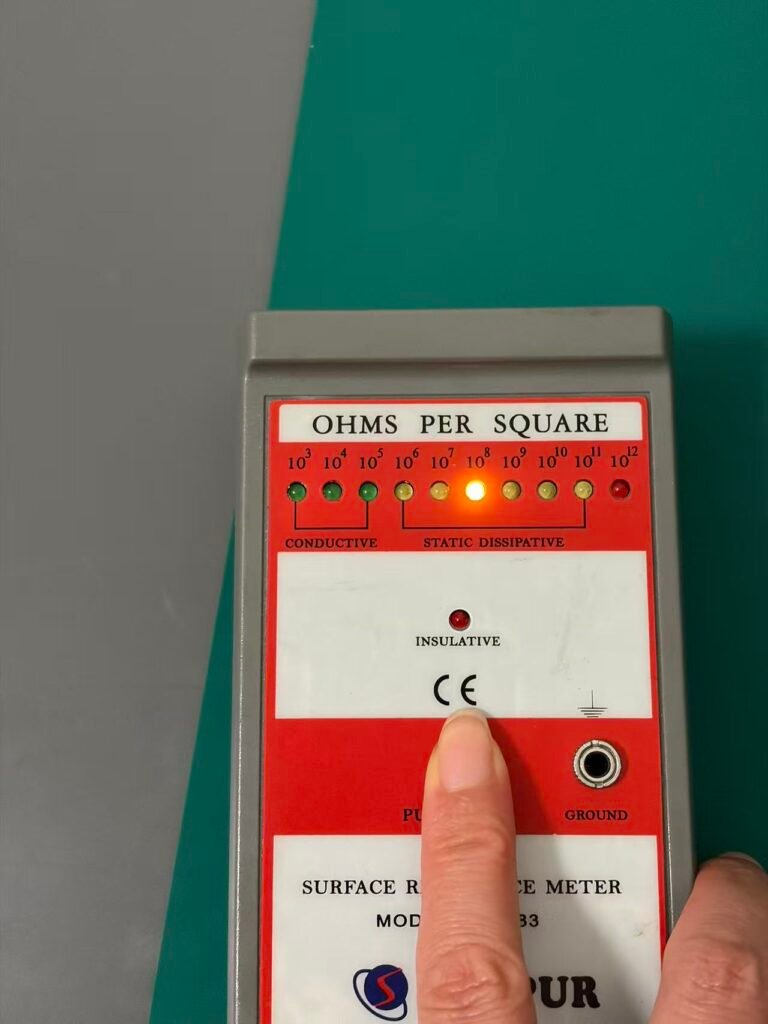
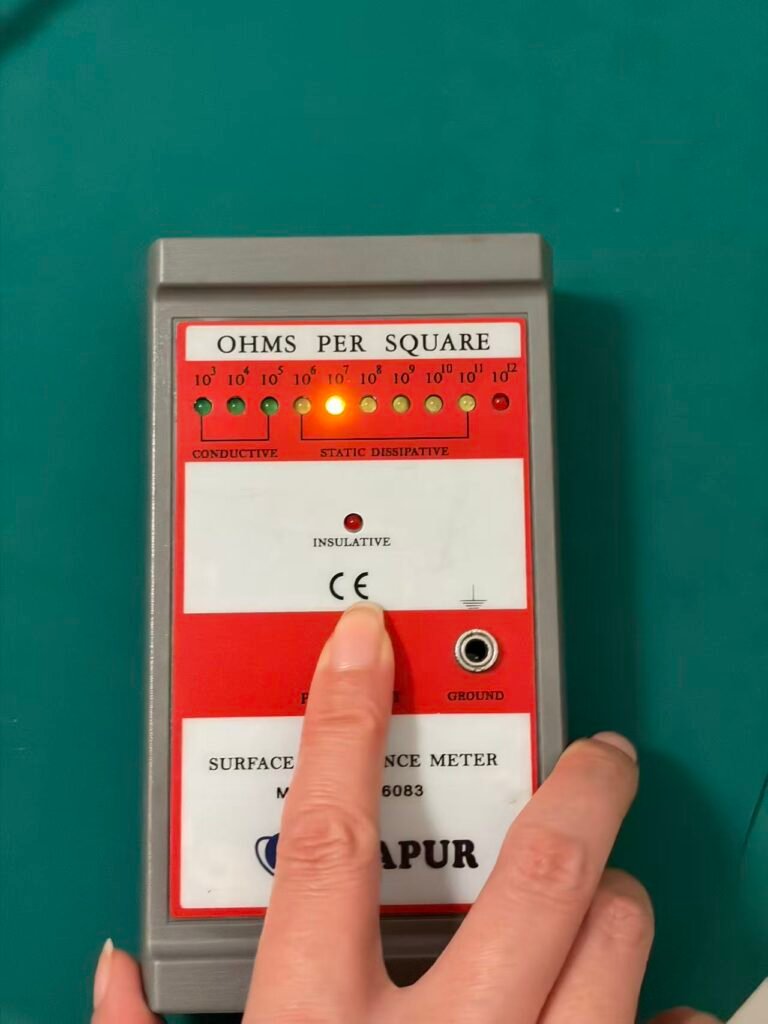
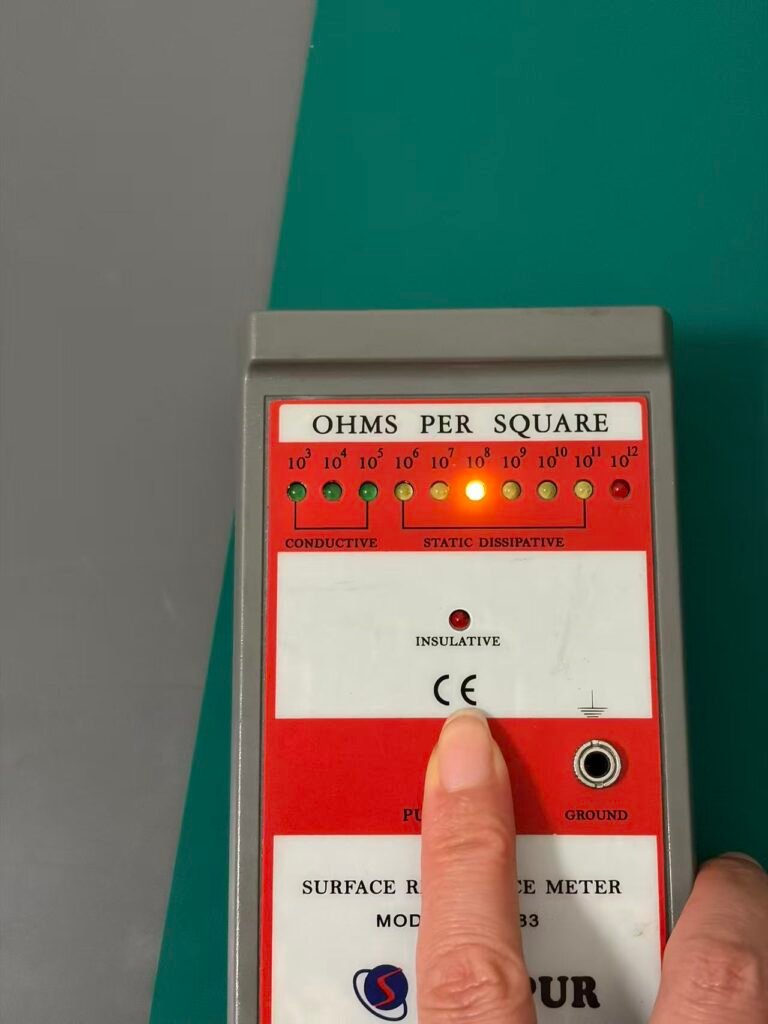
To test an ESD mat, use a surface resistance meter or megohmmeter to measure the mat’s resistance. Then check the grounding path from the mat snap to the ground cord and earth ground.
Most ESD mats used in electronics workstations are designed to stay within the dissipative resistance range.
Common target range:
10⁶ Ω to 10⁹ Ω
This controlled resistance helps static charge drain safely instead of remaining on the mat surface or discharging suddenly into sensitive electronic components.
Need ESD Grounding Mats for Your Factory?
ESDBEST supplies grounded ESD mats, ESD bench mats, ESD floor mats, grounding cords, and complete ESD workstation solutions for electronics manufacturing.
Email: sales2@esdbest.com
Contact ESDBEST📞 Contact Us Today
For bulk orders, quotes, or product guidance, get in touch with our expert team:
Email: sales2@esdbest.com
Whatsapp: +86 137 1427 2599
What Is ESD Mat Testing?
ESD mat testing is the process of verifying whether an ESD mat can safely control static electricity.
A proper ESD mat test usually checks three things:
- Surface resistance
- Point-to-ground resistance
- Grounding continuity
The purpose is to confirm that the mat is still working as part of an ESD protected area.
An ESD mat is not a normal rubber mat. A normal rubber mat may provide comfort or insulation, but it does not necessarily provide controlled static dissipation.
A real ESD mat must have a controlled electrical resistance and a verified ground connection.
Why Is ESD Mat Testing Important?
Static damage is often invisible.
A PCB or electronic component may not fail immediately after an electrostatic discharge. Instead, it may suffer hidden damage and fail later during testing, shipment or customer use.
This is why many electronics factories include ESD mat testing in their ESD control program.
Regular ESD mat testing helps prevent:
- PCB damage
- IC failure
- Latent electronic defects
- SMT production quality issues
- Customer complaints
- Failed audits
- Unstable workstation grounding
ANSI/ESD S20.20 and IEC61340 includes requirements for ESD control programs, including technical and administrative controls such as grounding, personnel grounding, EPA requirements and compliance verification.
What Tools Are Needed to Test an ESD Mat?
You can test an ESD mat with several tools depending on your factory requirements.
1. Surface Resistance Meter
This is the most common tool for ESD mat testing.
It is used to measure:
- Surface resistance
- Point-to-point resistance
- Resistance to ground
This tool is suitable for regular workstation checks.
2. Megohmmeter or ACL 800
A megohmmeter is used when higher accuracy is required.
It is often used for:
- ESD audits
- Quality control records
- Factory compliance testing
- Supplier verification
3. Ground Continuity Tester
This tool checks whether the mat grounding path is connected properly.
It helps verify:
- Ground cord condition
- Common point ground connection
- Snap connection
- Earth ground path
4. ESD Workstation Tester
This is useful when you want to check the full workstation system.
It may test:
- ESD mat
- Wrist strap
- Ground cord
- Common point ground
- Workbench grounding
For production lines, this is often more useful than testing only the mat surface.
Step 1: Inspect the ESD Mat Before Testing
Before using any testing equipment, inspect the mat visually.
Check for:
- Cracks
- Cuts
- Burn marks
- Oil contamination
- Chemical damage
- Surface wear
- Delamination
- Loose snaps
- Broken ground cords
If the mat is physically damaged, the resistance reading may become unstable.
A mat with a damaged surface may still look usable, but it may not provide reliable ESD protection.
Step 2: Clean the Mat Surface
Before testing, clean the ESD mat with an ESD-safe cleaner.
Do not use aggressive solvents unless the mat manufacturer confirms they are safe.
Avoid:
- Alcohol overuse
- Wax
- Silicone cleaners
- Strong chemical solvents
- Household cleaners with residue
Contamination can affect the resistance reading.
A dirty mat may test too high.
A chemically damaged mat may test too low or unstable.
Step 3: Measure Surface Resistance
Surface resistance testing checks whether the top layer of the mat can dissipate static charge.
Basic method:
- Place the mat on a flat surface.
- Place the resistance meter electrodes on the mat.
- Apply the correct test voltage.
- Record the reading.
- Test several positions on the mat.
Do not test only one corner.
Test at least:
- Left side
- Right side
- Center area
- Near the ground snap
- Main working area
This gives a more reliable result.
Step 4: Measure Point-to-Point Resistance
Point-to-point testing measures resistance between two points on the mat surface.
This test helps verify whether the surface resistance is consistent.
If one area reads normal but another area reads too high, the mat may be worn, dirty or damaged.
Point-to-point testing is useful for:
- ESD bench mats
- ESD table mats
- ESD floor mats
- High-use production workstations
- SMT assembly lines
Step 5: Measure Resistance to Ground
Resistance to ground is one of the most important tests.
This test checks whether static charge can move from the mat surface through the ground cord to ground.
Basic path:
Mat Surface → Ground Snap → Ground Cord → Common Point Ground → Earth Ground
If this path is broken, the mat may not protect electronic components.
A mat without grounding is only a surface.
A grounded ESD mat becomes part of the ESD protection system.
Learn more: how to ground esd mat
Step 6: Check the Grounding Cord
Many ESD mat failures are not caused by the mat itself.
They are caused by:
- Loose ground cords
- Broken wires
- Damaged snaps
- Poor common point ground connection
- Wrong installation
Check the grounding cord carefully.
Make sure:
- The snap is tight
- The cord is not broken
- The connection is stable
- The ground point is verified
- The cord is not connected to painted metal
If the grounding cord fails, replace it immediately.
ESD Mat Resistance Range
The resistance range depends on the material and application.
Common classification:
| Resistance Range | Classification | Meaning |
|---|---|---|
| Below 10⁵ Ω | Conductive | Charge drains very quickly |
| 10⁵–10⁹ Ω | Static dissipative | Controlled discharge |
| Above 10⁹ Ω | Insulative | Poor static dissipation |
For most electronics workstations, a dissipative ESD mat is preferred because it allows controlled static discharge.
Typical ESD mat range:
10⁶ Ω to 10⁹ Ω
This range is widely used for electronics assembly, PCB handling and SMT workstations.
What Is a Good ESD Mat Test Result?
A good ESD mat test result should be:
- Within the specified resistance range
- Stable across different test points
- Connected to ground
- Free from physical damage
- Consistent with previous test records
One good reading is not enough.
A reliable ESD mat should perform consistently across the working surface.
What If the ESD Mat Resistance Is Too High?
If resistance is too high, the mat may not dissipate static charge effectively.
Possible causes:
- Dirty surface
- Chemical residue
- Aged material
- Wrong cleaning method
- Surface wear
- Non-ESD mat material
- Broken ground path
Solution:
- Clean the mat with ESD-safe cleaner.
- Retest the surface.
- Check the ground cord.
- Test multiple positions.
- Replace the mat if readings remain too high.
What If the ESD Mat Resistance Is Too Low?
If resistance is too low, the mat may discharge too quickly.
Possible causes:
- Conductive contamination
- Damaged surface layer
- Wrong mat type
- Excessive moisture
- Material breakdown
A very low resistance surface may not be suitable for sensitive electronics handling.
How Often Should ESD Mats Be Tested?
Testing frequency depends on the environment.
Recommended schedule:
| Environment | Suggested Testing Frequency |
|---|---|
| SMT production line | Weekly or monthly |
| Electronics assembly | Monthly |
| Repair workstation | Monthly or quarterly |
| Warehouse packing area | Quarterly |
| Home electronics bench | Every 3–6 months |
| Audit-critical factory | According to ESD control plan |
For professional electronics manufacturing, ESD mats should be tested regularly and records should be kept.
ESD compliance verification is commonly used to confirm that ESD control items continue to perform as intended over time.
ESD Mat Testing Record Template
Factories should keep simple testing records.
Example:
| Date | Workstation | Surface Resistance | Resistance to Ground | Result | Inspector |
|---|---|---|---|---|---|
| 2026-06-05 | Bench A01 | 10⁷ Ω | 10⁷ Ω | Pass | QC |
| 2026-06-05 | Bench A02 | 10¹⁰ Ω | 10¹⁰ Ω | Fail | QC |
Testing records help during:
- Internal audits
- Customer audits
- Quality reviews
- Supplier qualification
- ESD program improvement
Common ESD Mat Testing Mistakes
Mistake 1: Testing Without Grounding
If the mat is not grounded, resistance-to-ground testing is meaningless.
Always verify the grounding path.
Mistake 2: Testing Only One Point
One test point cannot represent the entire mat.
Always test multiple areas.
Mistake 3: Ignoring the Ground Cord
A good mat with a bad cord can still fail.
Always test the full path.
Mistake 4: Using the Wrong Cleaner
Some cleaners leave residue and change resistance.
Use ESD-safe cleaning products.
Mistake 5: No Testing Records
Without records, you cannot prove long-term ESD control.
Keep simple but consistent records.
How to Know If an ESD Mat Is Working
An ESD mat is working if:
- Surface resistance is within range
- Resistance to ground is within range
- Ground cord is connected
- Readings are stable
- The mat surface is clean
- No visible damage is present
If any of these fail, the mat should be cleaned, repaired or replaced.
When Should You Replace an ESD Mat?
Replace an ESD mat if:
- Resistance is outside the acceptable range
- Surface is cracked
- Mat is delaminated
- Ground snap is loose
- Readings fluctuate greatly
- Cleaning does not improve results
- The mat has chemical damage
- The mat fails repeated audits
In a production environment, a failed ESD mat should not remain in use.
ESD Bench Mat vs ESD Floor Mat Testing
ESD Bench Mat Testing
Bench mats are tested mainly for:
- Surface resistance
- Resistance to ground
- Ground snap connection
- Workstation grounding
They are used for:
- PCB assembly
- Soldering
- Repair stations
- Electronics inspection
Recommended internal link:
ESD Floor Mat Testing
Floor mats are tested for:
- Surface resistance
- Resistance to ground
- Walking body voltage control
- Grounding path
They are used for:
- Production areas
- Assembly lines
- ESD protected zones
- Operator movement areas
Recommended internal link:
ESD Mat Testing Checklist
Use this simple checklist:
- Check mat surface condition
- Clean the mat
- Inspect the ground cord
- Inspect the ground snap
- Test surface resistance
- Test point-to-point resistance
- Test resistance to ground
- Record the result
- Replace failed mats
- Retest after replacement
Need Reliable ESD Mats for Electronics Manufacturing?
ESDBEST supplies ESD mats for electronics manufacturing, PCB assembly, SMT production, repair workstations and ESD protected areas.
Our ESD mat solutions include:
- ESD bench mats
- ESD floor mats
- Grounding cords
- Common point grounding accessories
- Static control workstation products
- Recommended internal link:ESD grounding mat
Need bulk ESD mats for your factory?
Contact ESDBEST for ESD mat solutions.
Email: sales2@esdbest.com
Whatsapp: +86 137 1427 2599
Conclusion
Testing an ESD mat is the only reliable way to confirm whether it is still protecting your electronics workstation.
A proper ESD mat test should include:
- Surface resistance test
- Point-to-point resistance test
- Resistance-to-ground test
- Ground cord inspection
- Regular testing records
For electronics manufacturing, PCB assembly and SMT production, ESD mat testing should be part of every static control program.
A mat that is not tested is only a surface.
A tested and grounded ESD mat is part of a real ESD protection system.
10. FAQ
How do you test an ESD mat?
Use a surface resistance meter or megohmmeter to measure surface resistance and resistance to ground. Also check the grounding cord and common point ground connection.
What resistance should an ESD mat have?
Most electronics workstation ESD mats are designed within the static dissipative range, commonly around 10⁶ Ω to 10⁹ Ω.
Can I test an ESD mat with a multimeter?
A basic multimeter may not be suitable for accurate high-resistance ESD mat testing. A surface resistance meter or megohmmeter is recommended.
How often should ESD mats be tested?
For electronics manufacturing, monthly testing is commonly recommended. High-risk or audit-critical areas may require more frequent checks.
Do ESD mats need to be grounded?
Yes. An ESD mat must be connected to a verified ground path to safely dissipate static electricity.
Why does an ESD mat fail?
Common causes include surface wear, contamination, chemical damage, broken grounding cords, loose snaps and aging material.
When should an ESD mat be replaced?
Replace the mat if resistance is outside the required range, readings are unstable, the surface is damaged, or the grounding connection fails repeatedly.
Need Reliable ESD Mats for Electronics Manufacturing?
ESDBEST supplies ESD bench mats, ESD floor mats, grounding cords and static control workstation solutions for electronics manufacturing, PCB assembly and SMT production.
Need bulk ESD mats for your factory?
Contact ESDBEST: sales2@esdbest.com
Need ESD Grounding Mats for Your Factory?
ESDBEST supplies grounded ESD mats, ESD bench mats, ESD floor mats, grounding cords, and complete ESD workstation solutions for electronics manufacturing.
Email: sales2@esdbest.com
Contact ESDBEST