ESD Ionizer Guide for Electronics Manufacturing and Static Control
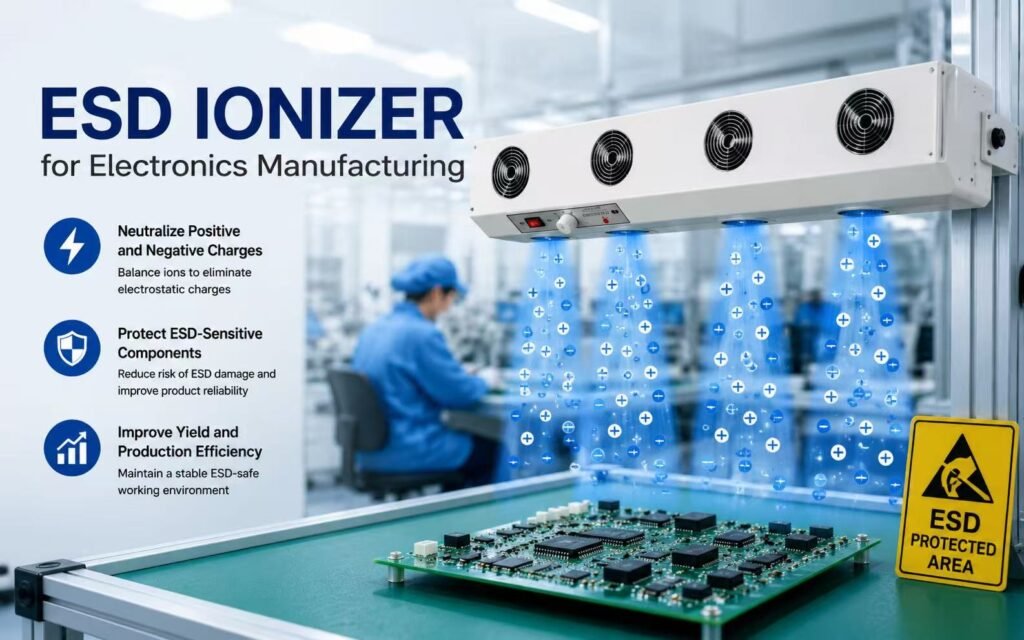
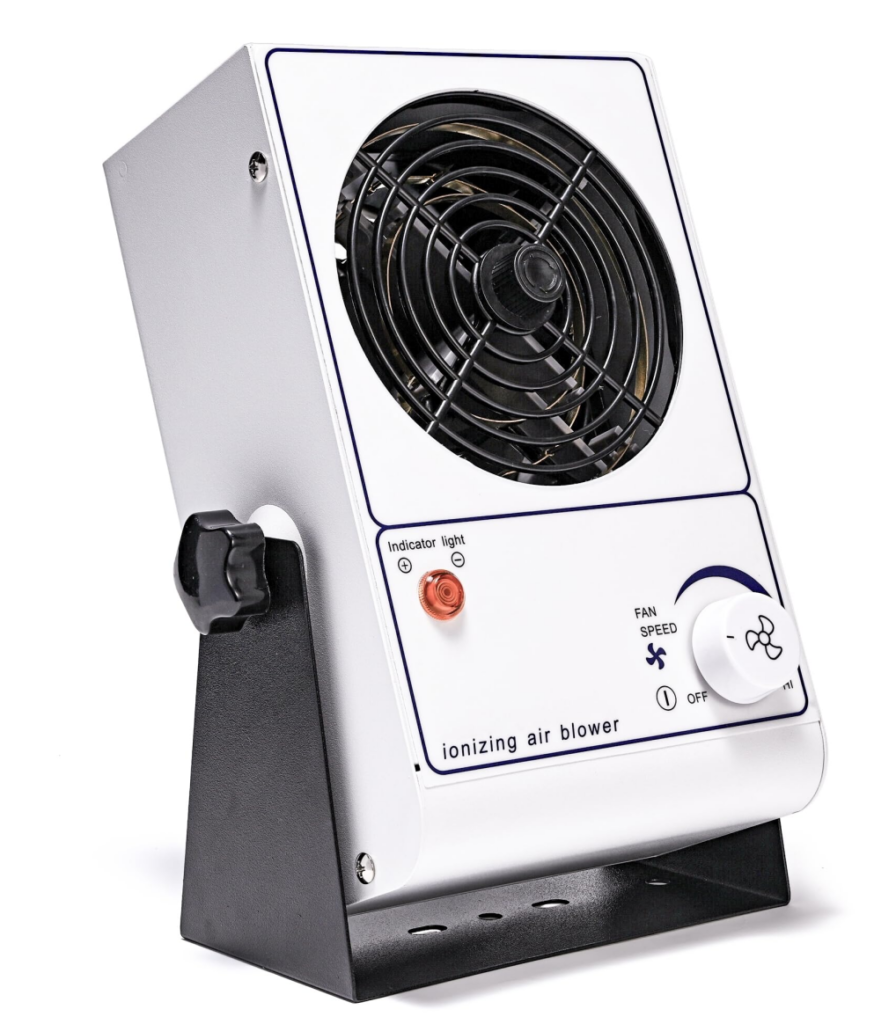
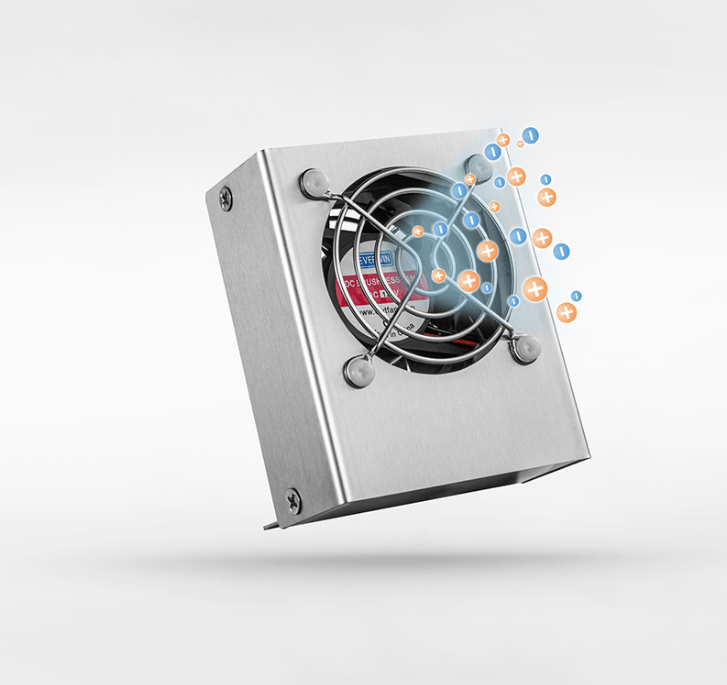
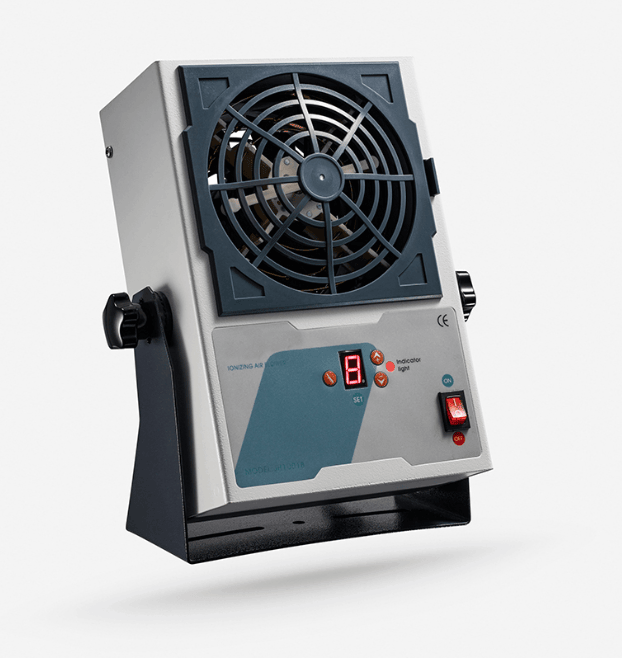
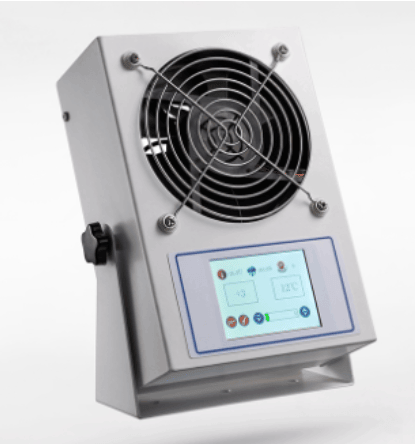
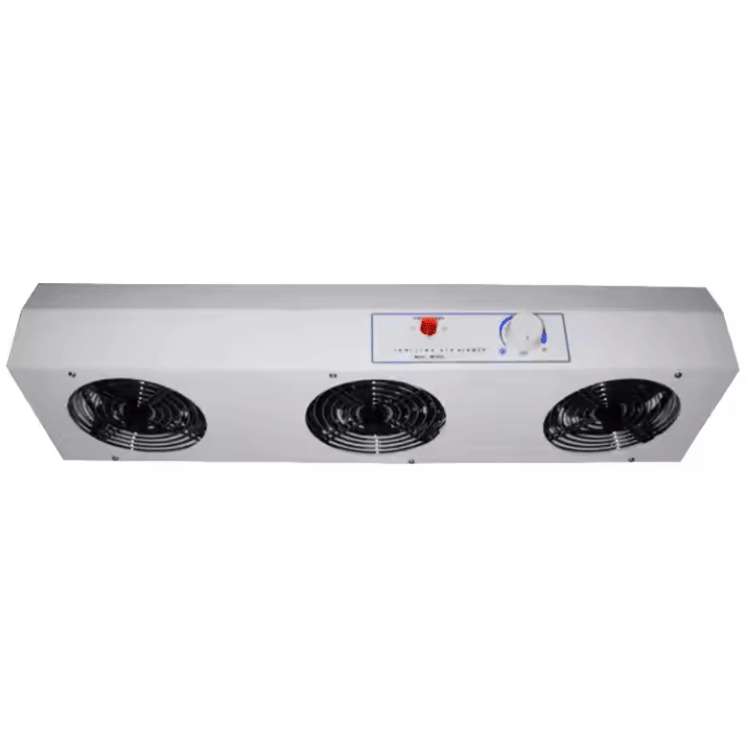
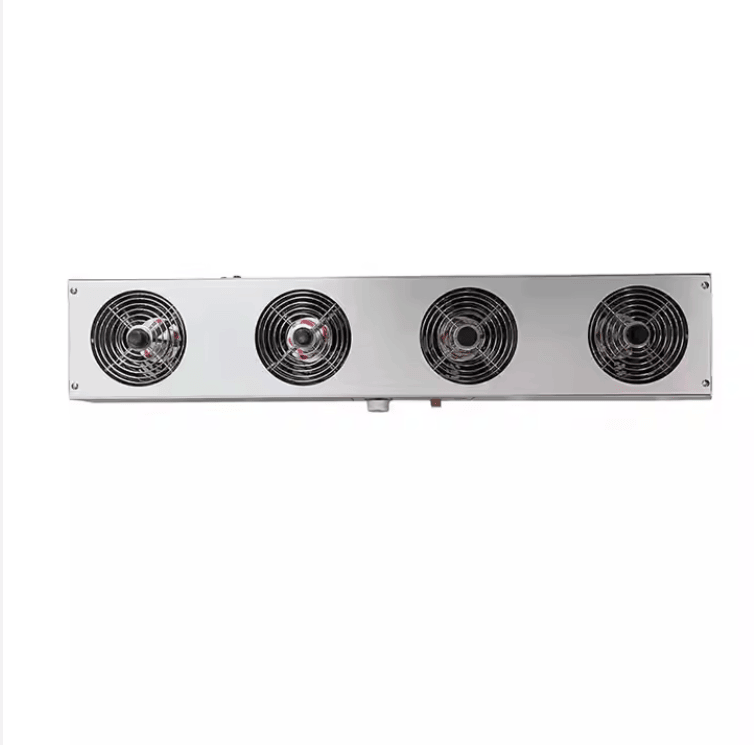
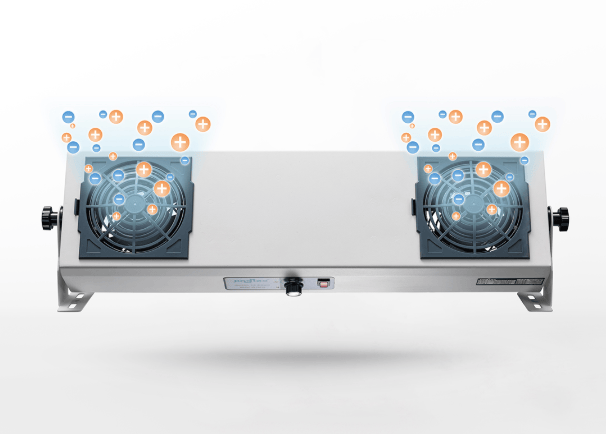
ESD Ionizers for Static Charge Neutralization
ESD ionizers generate balanced positive and negative ions to neutralize electrostatic charge on insulating materials, isolated conductors and other objects that cannot be effectively grounded.
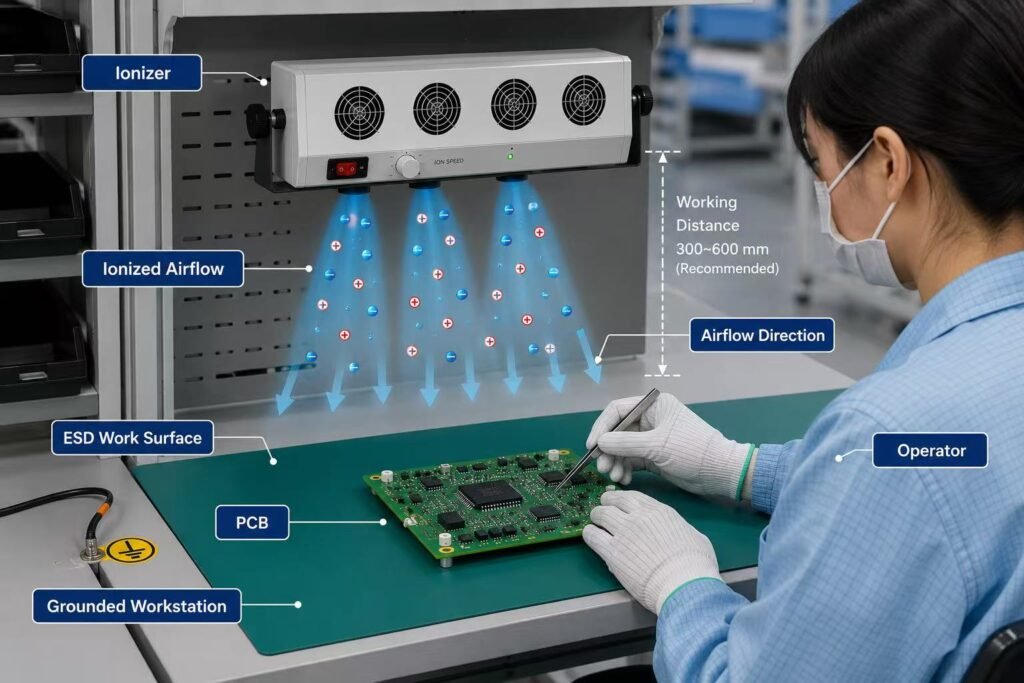
They are commonly installed at PCB assembly stations, electronics inspection areas, cleanrooms, packaging lines, component-handling stations and precision manufacturing processes where uncontrolled electrostatic fields may threaten electrostatic-discharge-sensitive devices.
Unlike wrist straps, ESD footwear and grounded work surfaces, an ionizer does not primarily ground the operator or workbench. Its main function is to neutralize charge on objects that cannot be connected directly to ground.
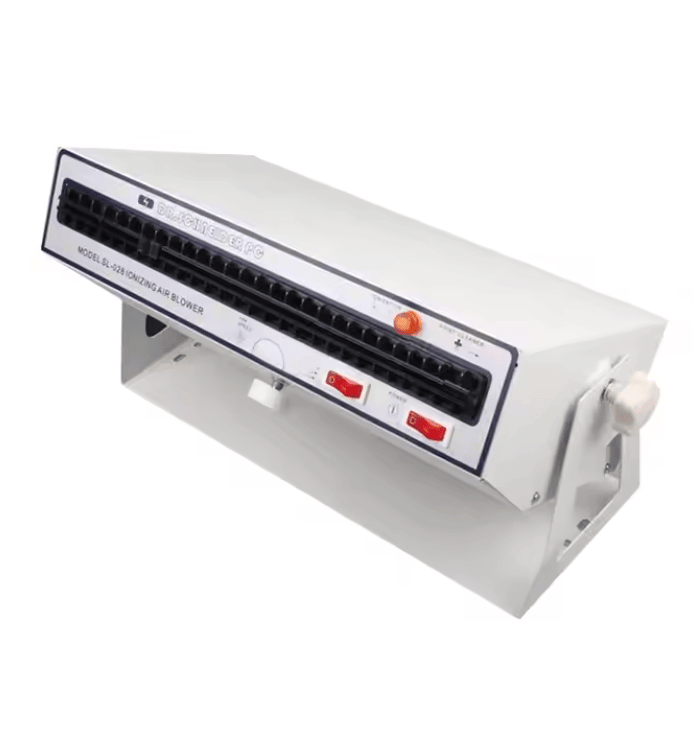
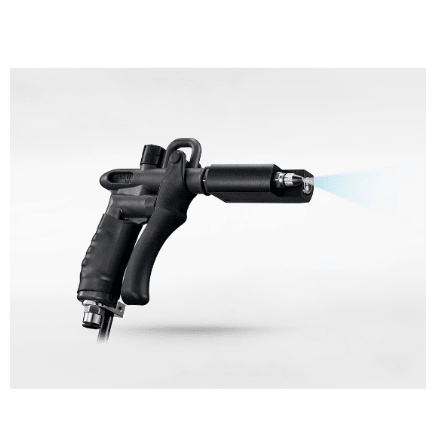
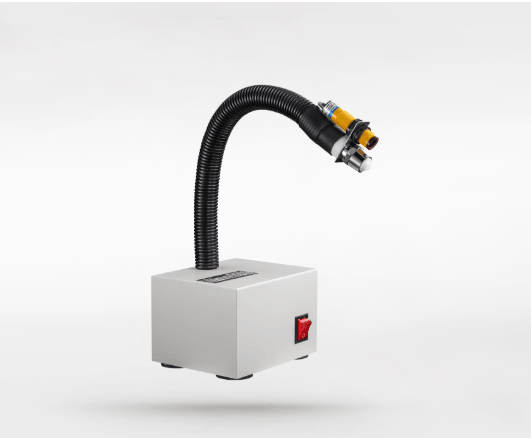
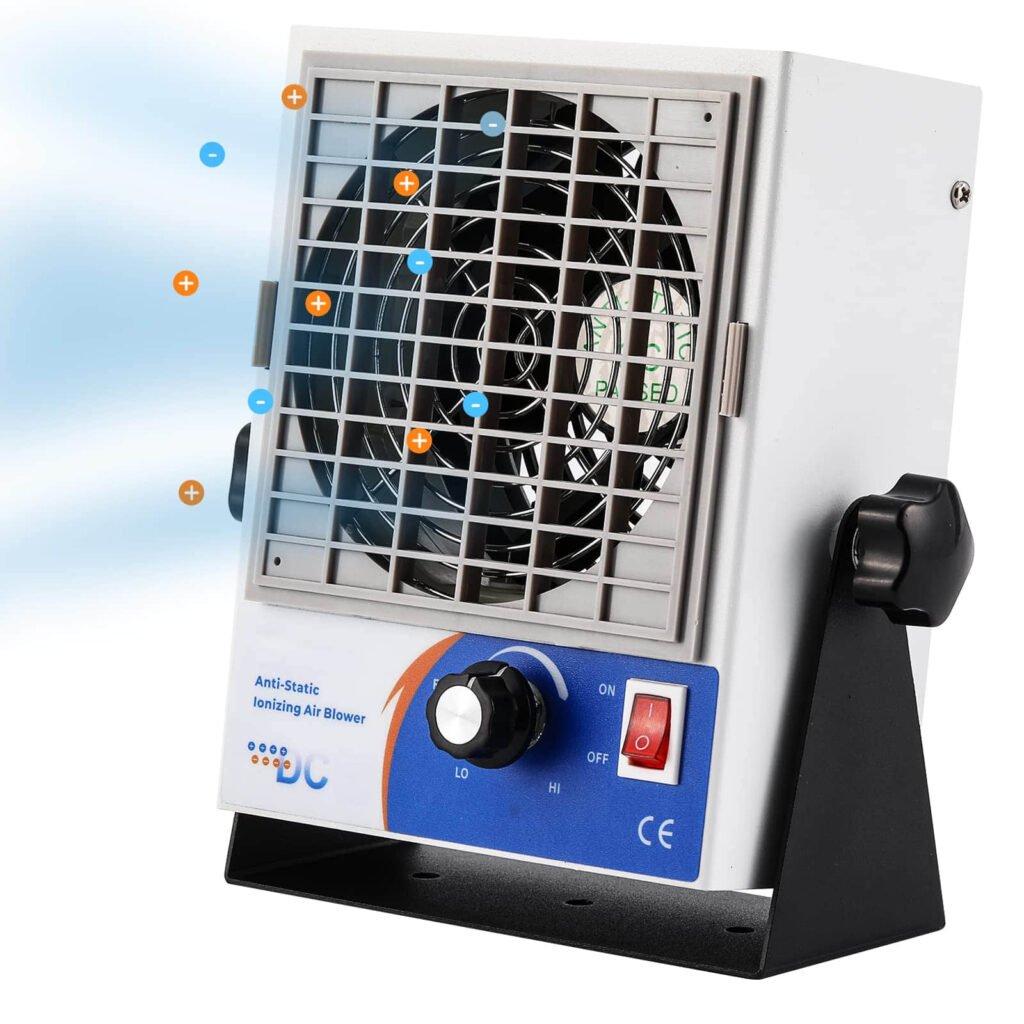
ESDBEST supplies benchtop ionizing fans, overhead ionizers, ionizing air blowers, ionizing bars, ionizing nozzles and ionizing air guns for electronics manufacturing and industrial static-control applications.
📞 Contact Us Today
For bulk orders, quotes, or product guidance, get in touch with our expert team:
Email: sales2@esdbest.com
Whatsapp: +86 137 1427 2599
Module 2: What Is an ESD Ionizer?
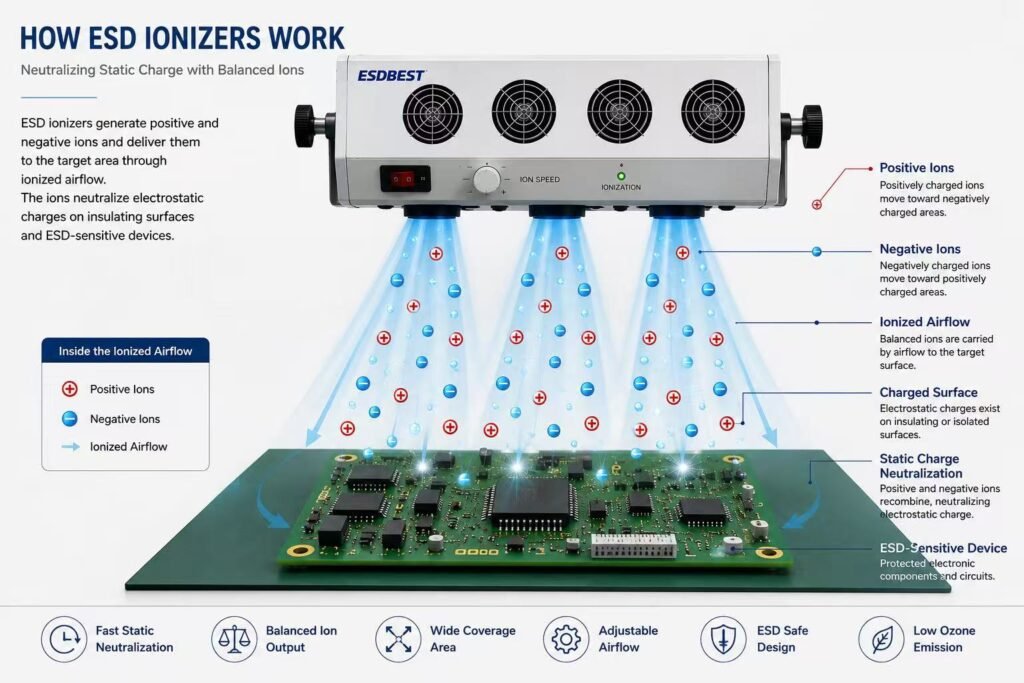
An ESD ionizer is a static-control device that produces positive and negative air ions. These ions are transported through the surrounding air toward charged surfaces. When ions of the opposite polarity reach a charged object, they combine with the excess charge and reduce the object’s electrostatic potential.
Ionization is particularly important for materials that cannot be effectively grounded, including:
- Plastic housings
- Insulating films
- Adhesive tapes
- Component trays
- Acrylic covers
- Glass surfaces
- PCB substrates
- Plastic tools
- Packaging materials
- Process-essential insulators
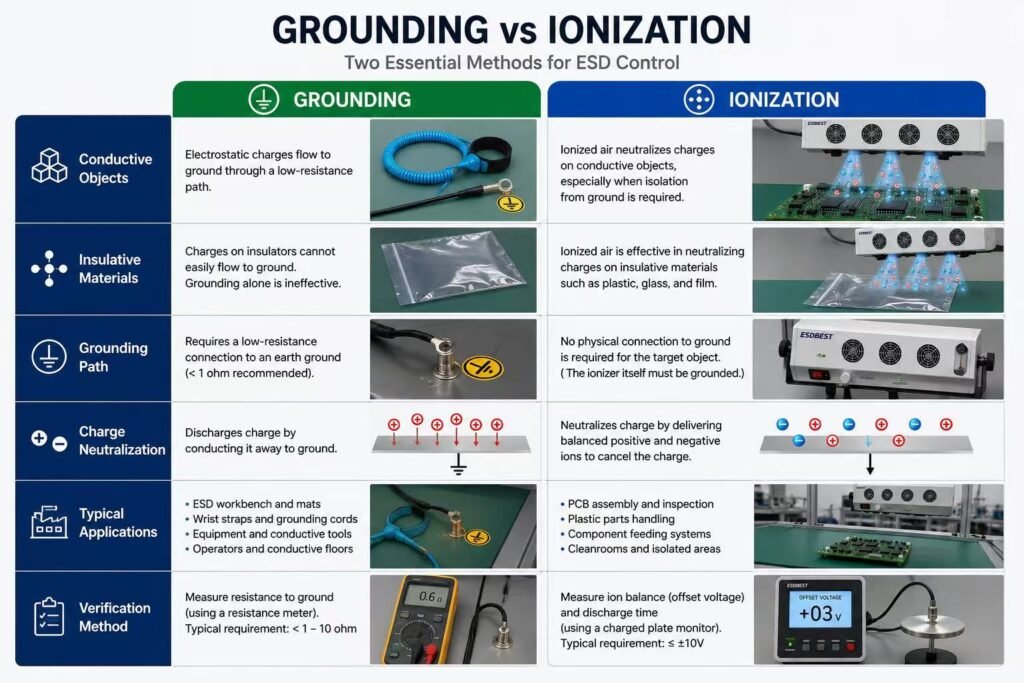
Conductive objects can normally be connected to ground so that accumulated charge is removed through a controlled path. Insulating materials do not allow charge to move freely through the material. Connecting one point of an insulator to ground therefore does not necessarily remove charge from the rest of its surface.
An ionizer addresses this problem by delivering both positive and negative ions through the air.
When a negatively charged surface is exposed to ionized air, it attracts positive ions. When a positively charged surface is exposed to ionized air, it attracts negative ions. As the opposite charges combine, the surface voltage is reduced.
Ionizers are therefore not replacements for grounding systems. They are supplementary control devices used where grounding alone cannot sufficiently control electrostatic charge.
📞 Contact Us Today
For bulk orders, quotes, or product guidance, get in touch with our expert team:
Email: sales2@esdbest.com
Whatsapp: +86 137 1427 2599
Module 3: Why Is Ionization Needed in an EPA?
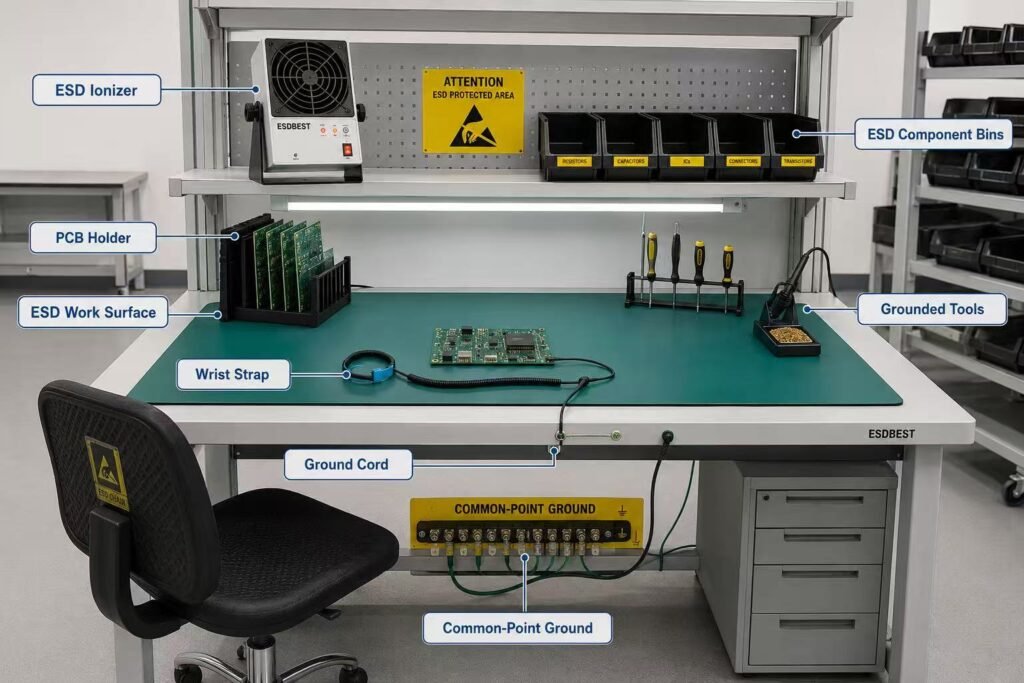
An ESD Protected Area, or EPA, normally includes several coordinated control elements:
- Personnel grounding
- Grounded work surfaces
- ESD flooring
- ESD footwear
- Wrist straps
- Grounded equipment
- ESD packaging
- ESD storage
- Ionization
- Verification procedures
Grounding is highly effective for conductive and dissipative objects. However, many electronics-manufacturing processes involve essential insulating materials that cannot simply be removed or grounded.
Examples include:
- Insulating PCB laminates
- Plastic connector housings
- Protective films
- Component carrier tapes
- Transparent inspection covers
- Plastic machine guards
- Adhesive labels
- Foam packaging
- Display panels
- Optical components
These materials may generate and retain static charge through contact, separation, peeling, sliding or friction.
An ionizer reduces the electrostatic field around these materials and helps prevent charged-device-model events, attraction of dust and uncontrolled discharges near sensitive components.
The EOS/ESD Association identifies ANSI/ESD STM3.1 as the test method for evaluating and selecting air-ionization equipment. It also lists ANSI/ESD SP3.3 for periodic verification of ionizer performance.
📞 Contact Us Today
For bulk orders, quotes, or product guidance, get in touch with our expert team:
Email: sales2@esdbest.com
Whatsapp: +86 137 1427 2599
Module 4: How Does an ESD Ionizer Work?
An ionizer typically contains four main systems:
- High-voltage generation
- Emitter electrodes
- Airflow or compressed-air delivery
- Ion-balance control
The high-voltage circuit supplies energy to sharp emitter points. The strong electric field around the tips ionizes nearby air molecules.
Depending on the design, the ionizer may produce positive and negative ions simultaneously, alternately or in controlled pulses.
A fan or compressed-air source then moves these ions toward the charged object.
The neutralization process follows four stages:
Stage 1: Static charge develops
Contact and separation between materials causes one surface to gain electrons and the other to lose electrons.
Stage 2: The object retains charge
If the object is insulating or electrically isolated, the charge cannot easily flow to ground.
Stage 3: Ionized air reaches the object
The ionizer delivers positive and negative ions into the work area.
Stage 4: Opposite-polarity ions neutralize the surface
The charged object attracts ions of the opposite polarity until its electrostatic potential is reduced.
Module 5: What Can and Cannot Be Grounded?
Objects That Can Usually Be Grounded
- Metal tools
- Conductive equipment frames
- ESD work surfaces
- Conductive racks
- Grounded fixtures
- Operators wearing wrist straps
- ESD flooring systems
- Conductive component containers
Objects That Often Require Ionization
- Plastic trays
- Polyimide films
- Adhesive tapes
- Glass panels
- PCB laminate surfaces
- Plastic housings
- Insulating labels
- Foam inserts
- Protective films
- Isolated metal components
An isolated conductor deserves special attention. A metal object may be conductive, but if it is not connected to ground, charge can remain on it. Ionization can help neutralize the charge until the item is grounded or removed from the process.
📞 Contact Us Today
For bulk orders, quotes, or product guidance, get in touch with our expert team:
Email: sales2@esdbest.com
Whatsapp: +86 137 1427 2599
Module 6: Types of ESD Ionizers
1. Benchtop Ionizing Fan
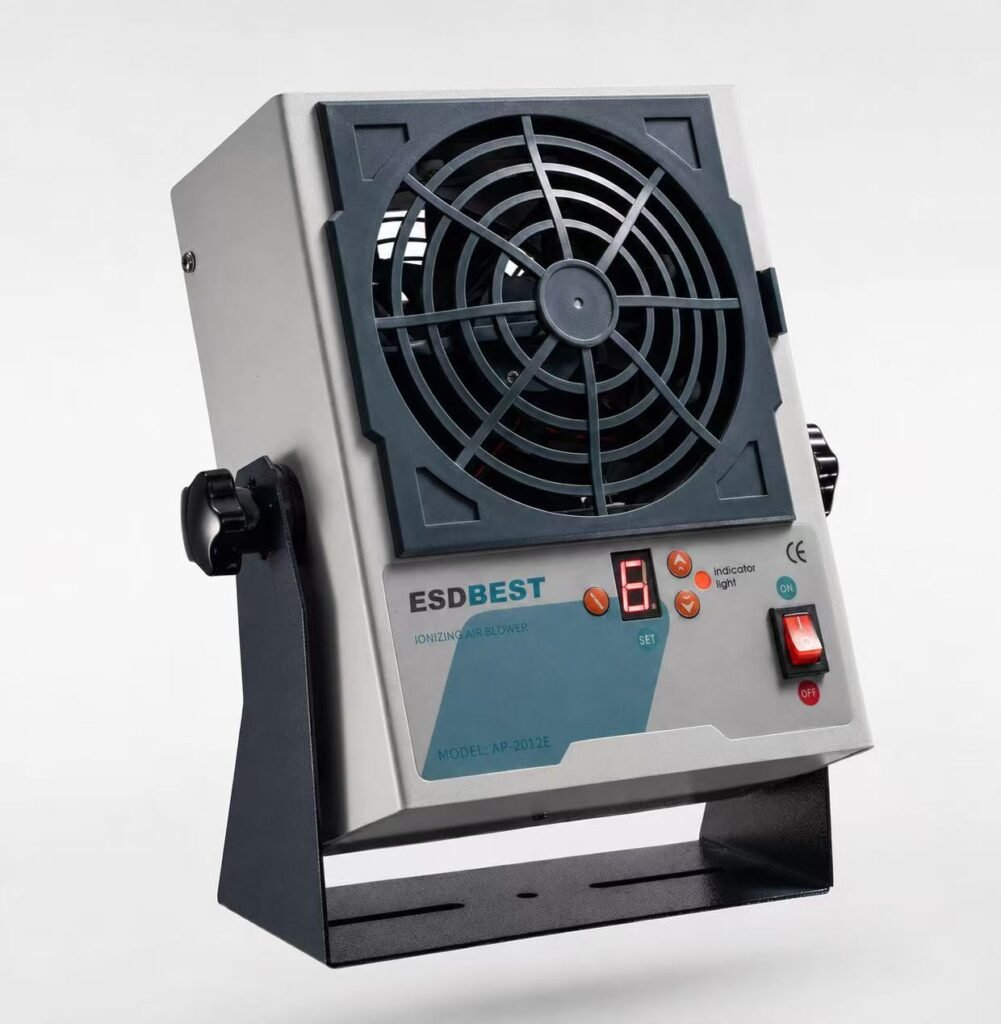
A benchtop ionizing fan is positioned near a single workstation. It uses an internal fan to direct ionized air toward the working area.
Best for
- PCB assembly
- Component inspection
- Electronics repair
- Soldering stations
- Laboratory work
- Manual packaging
Advantages
- Compact
- Easy to install
- Adjustable airflow
- Suitable for individual operators
- Relatively low installation cost
Limitations
- Limited working range
- Performance depends on positioning
- May create airflow near lightweight components
- Requires regular emitter cleaning
2. Overhead Ionizer
An overhead ionizer is installed above a workbench or production area. It distributes ionized air downward across a wider surface.
Best for
- Large workbenches
- Multi-operator stations
- Assembly cells
- Inspection benches
- Areas requiring unobstructed desk space
Advantages
- Covers a wider area
- Does not occupy workbench space
- Can serve multiple work positions
- Suitable for continuous production
Limitations
- Installation height affects discharge time
- Incorrect angle can create uneven coverage
- Requires ceiling or workstation mounting
3. Ionizing Air Blower
An ionizing air blower generally provides higher airflow or broader coverage than a compact workstation fan.
Best for
- Packaging lines
- Plastic handling
- Material-transfer areas
- Larger industrial work zones
- Conveyor applications
Advantages
- Strong airflow
- Wider coverage
- Faster neutralization at suitable distances
- Suitable for larger charged surfaces
Limitations
- Larger footprint
- Higher noise level may occur
- Airflow may disturb small parts
- Not ideal for every precision workstation
4. Ionizing Air Gun
An ionizing air gun combines compressed air with ionization. The operator directs ionized air toward a specific part or surface.
Best for
- Spot cleaning
- Removing dust from components
- Plastic-part neutralization
- Precision assembly
- Optical products
- Irregularly shaped objects
Advantages
- Directional
- Fast spot treatment
- Removes dust and neutralizes charge
- Flexible for manual operations
Limitations
- Requires compressed air
- Operator-dependent
- Not designed for continuous full-area coverage
- Air quality and pressure must be controlled
5. Ionizing Air Nozzle
An ionizing nozzle delivers concentrated ionized air to a specific process point.
Best for
- Automated machinery
- Small cavities
- Component feeding
- Film separation
- Robotic production cells
- Confined work areas
Advantages
- Precise
- Easy to integrate into equipment
- Suitable for automated control
- Effective at targeted locations
Limitations
- Narrow coverage
- Requires careful placement
- May require compressed air
- Not suitable as the only ionizer for a large workbench
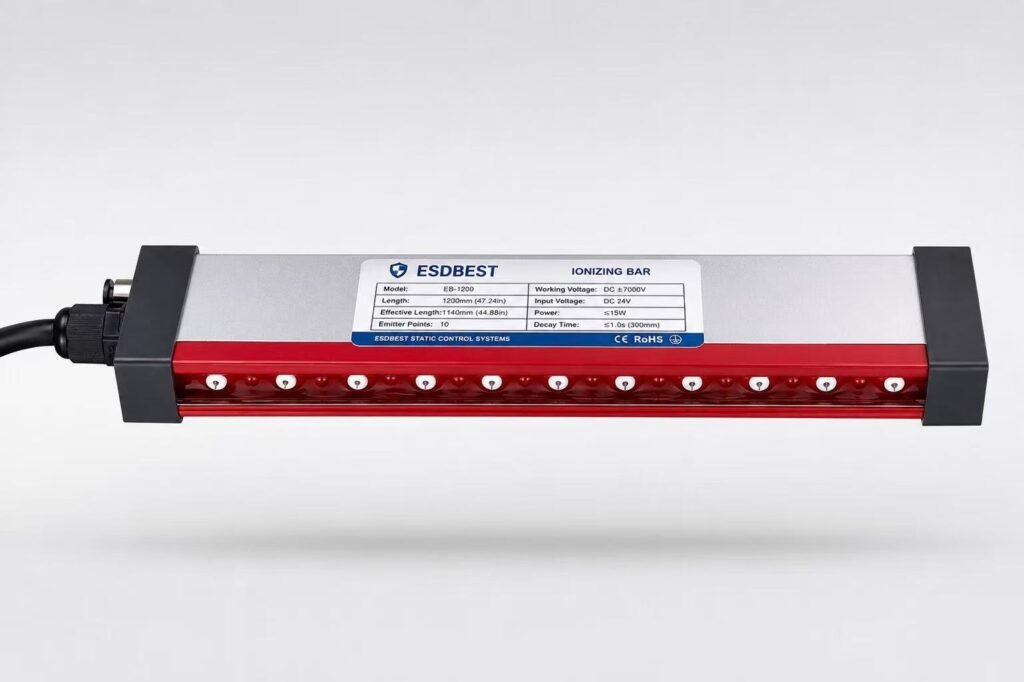
6. Ionizing Bar
An ionizing bar is installed across a conveyor, film-processing area or production line.
Best for
- Conveyor systems
- Plastic films
- Packaging machines
- Printing processes
- Labeling systems
- Sheet and web handling
Advantages
- Wide linear coverage
- Suitable for moving materials
- Integrates into automated production
- Available in fan-assisted and compressed-air designs
Limitations
- Installation distance is critical
- Contamination of emitters reduces performance
- Requires verification across the full bar length
7. Cleanroom Ionizer
Cleanroom ionizers are designed for environments where particle generation, contamination control and compatibility with controlled airflow are important.
Best for
- Semiconductor manufacturing
- Medical-device assembly
- Display manufacturing
- Optics
- Precision electronics
- Controlled environments
Selection factors
- Cleanroom classification
- Particle generation
- Airflow design
- Materials of construction
- Maintenance accessibility
- Ion balance
- Discharge time
- 📞 Contact Us Today
For bulk orders, quotes, or product guidance, get in touch with our expert team:
Email: sales2@esdbest.com
Whatsapp: +86 137 1427 2599
Module 7: AC vs DC Ionization
AC Ionizers
AC ionizers normally alternate the emitter voltage between positive and negative polarity.
Advantages
- Relatively simple design
- Balanced positive and negative ion production
- Common in workstation fans
- Cost-effective for many applications
Considerations
- Ion recombination may occur before ions reach the target
- Performance depends on frequency, airflow and distance
- Balance should be verified at the actual working position
Pulsed DC Ionizers
Pulsed DC ionizers use separate positive and negative emitters or controlled positive and negative pulses.
Advantages
- Suitable for longer operating distances
- Positive and negative output can often be adjusted
- Useful in larger or specialized work areas
- Can provide improved control in some applications
Considerations
- Incorrect settings may create voltage swings
- Verification should include actual process distance
- More advanced control may increase cost and maintenance requirements
High-Frequency AC Ionizers
High-frequency AC systems operate at a much higher switching frequency than traditional AC designs.
Potential benefits
- Compact emitter structure
- Lower visible voltage fluctuation at short distances
- Suitable for precision equipment
- Frequently integrated into nozzles and bars
No ionization technology should be described as universally superior. The correct choice depends on:
- Working distance
- Airflow
- Target size
- Process speed
- Required discharge time
- Acceptable offset voltage
- Cleanroom requirements
- Installation space
The EOS/ESD Association has also discussed the practical differences between AC and DC ionization architectures, reinforcing that ionizer performance should be judged by measured results at the actual application location rather than by technology labels alone.
Module 8: ESD Ionizer vs Wrist Strap
An ESD wrist strap and an ionizer solve different problems.
| Control Device | Primary Function | Controls |
|---|---|---|
| Wrist strap | Grounds the operator | Charge on personnel |
| ESD mat | Provides a controlled grounded surface | Charge on conductive and dissipative items |
| ESD footwear and floor | Grounds standing or mobile personnel | Charge on personnel |
| Ionizer | Neutralizes charge through air ions | Insulators and isolated conductors |
A wrist strap does not neutralize static charge on a plastic tray.
An ionizer does not provide the same direct, continuous grounding path for an operator that a properly connected wrist strap provides.
Therefore, the correct EPA normally uses ionization and grounding together rather than treating them as competing solutions.
📞 Contact Us Today
For bulk orders, quotes, or product guidance, get in touch with our expert team:
Email: sales2@esdbest.com
Whatsapp: +86 137 1427 2599
Module 9: ESD Ionizer vs Anti-Static Fan
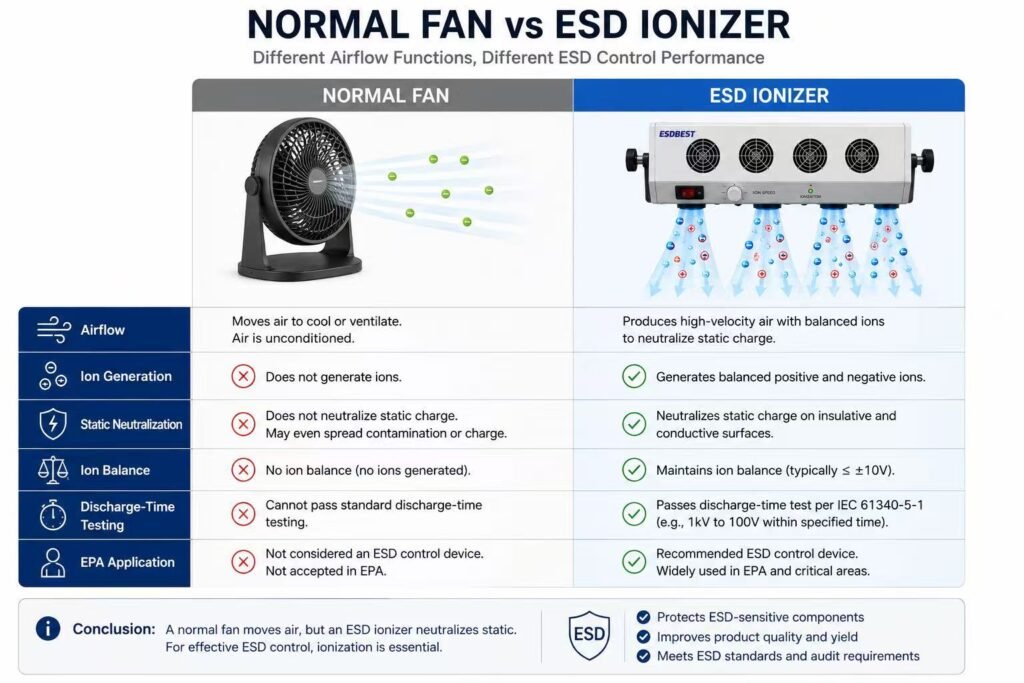
The terms “ESD ionizer,” “ionizing fan” and “anti-static fan” are frequently used interchangeably, but not every ordinary fan is an ionizer.
A standard fan only moves air.
An ionizing fan:
- Generates positive ions
- Generates negative ions
- Moves the ions toward the target
- Neutralizes electrostatic charge
When selecting a product, do not rely only on the phrase “anti-static fan.” Review whether the equipment provides measurable:
- Discharge time
- Offset voltage
- Working distance
- Air velocity
- Test conditions
- Maintenance instructions
Module 10: Ionizer Performance Parameters
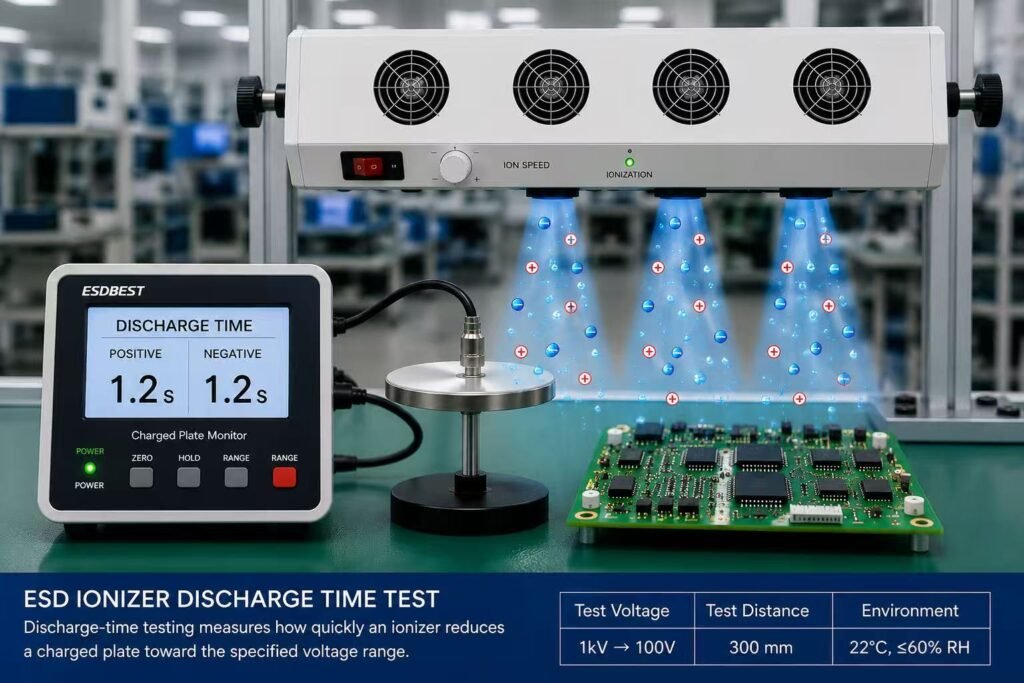
1. Discharge Time
Discharge time measures how quickly an ionizer reduces a charged test plate from a specified initial voltage to a specified lower voltage.
It is one of the main indicators of how quickly the ionizer can neutralize electrostatic charge.
A shorter discharge time generally means faster neutralization under the stated test conditions.
However, discharge-time values should only be compared when the following conditions are similar:
- Test distance
- Initial voltage
- Final voltage
- Plate size
- Air speed
- Fan setting
- Environmental conditions
- Measurement direction
- Test standard
Do not publish isolated “one-second” or “two-second” claims without stating the working distance and test method.
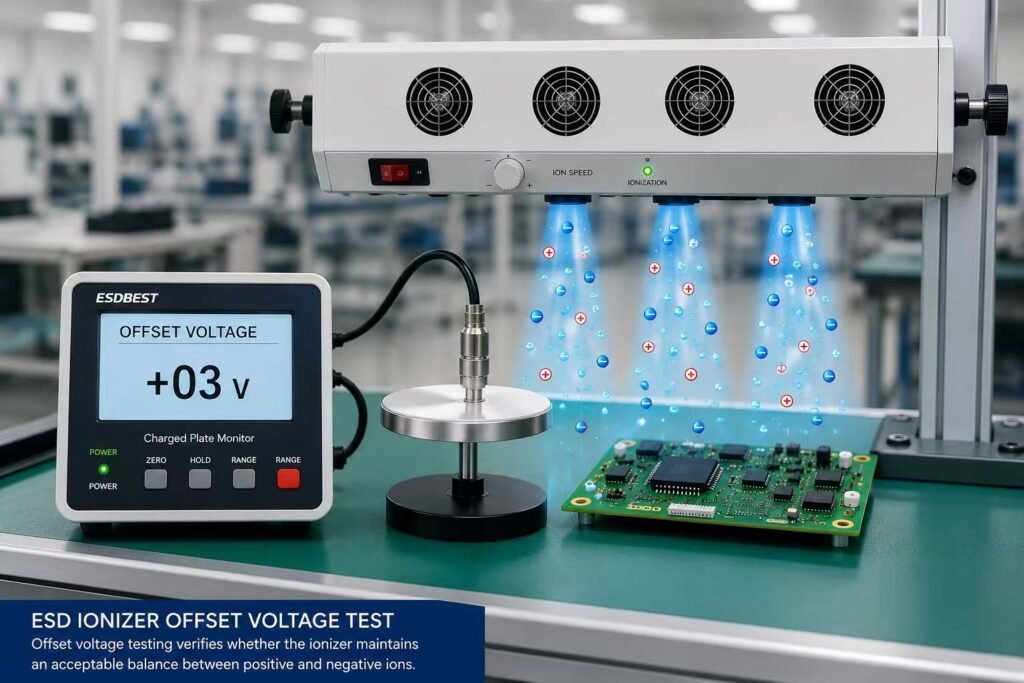
2. Offset Voltage
Offset voltage is sometimes called ion balance.
It represents the residual voltage measured on a test plate when exposed to the ionizer.
A well-balanced ionizer produces positive and negative ions in a controlled relationship so that the target is not driven excessively positive or negative.
Offset voltage can be affected by:
- Dirty emitter points
- Worn electrodes
- Incorrect adjustment
- Blocked airflow
- Positioning
- Nearby grounded objects
- Environmental contamination
- High-voltage circuit drift
3. Working Distance
The effective working distance is the distance between the emitter or air outlet and the target.
As distance increases:
📞 Contact Us Today
For bulk orders, quotes, or product guidance, get in touch with our expert team:
Email: sales2@esdbest.com
Whatsapp: +86 137 1427 2599
- Ion density may decrease
- Ions may recombine
- Airflow may weaken
- Discharge time may increase
- Coverage may become less uniform
The correct distance should be verified at the exact position where the ESDS item is handled.
4. Coverage Area
Coverage describes the physical area in which the ionizer can meet the required discharge-time and offset-voltage performance.
A wide airflow pattern does not automatically mean the entire area provides identical static neutralization.
Measure:
- Center
- Left
- Right
- Near edge
- Far edge
- Actual component position
5. Airflow
Higher airflow can move ions more quickly toward the target, but excessive airflow can:
- Move small components
- Spread contamination
- Affect soldering
- Create operator discomfort
- Disrupt cleanroom airflow
- Dry process materials
The highest airflow setting is not automatically the best setting.
6. Noise
Noise is important for:
- Manual assembly
- Inspection rooms
- Laboratories
- Multi-operator production lines
- Continuous operation
Publish noise information only when it has been measured under stated conditions.
7. Ozone
Corona ionization may generate a small amount of ozone. Product selection should consider applicable workplace requirements, maintenance conditions and ventilation.
Avoid making unsupported claims such as “zero ozone” unless verified by a suitable test report.
📞 Contact Us Today
For bulk orders, quotes, or product guidance, get in touch with our expert team:
Email: sales2@esdbest.com
Whatsapp: +86 137 1427 2599

Module 11: How to Test an ESD Ionizer
Ionizer testing normally uses a charged plate monitor.
The EOS/ESD Association describes ANSI/ESD STM3.1 as the standard test method for ionizer performance, while ANSI/ESD SP3.3 addresses periodic performance verification. The currently listed STM3.1 edition is 2024.
Required Equipment
- Charged plate monitor
- Ionizer under test
- Approved test location
- Distance-measuring tool
- Environmental record
- Cleaning tools
- Test form
- Manufacturer instructions
Basic Test Process
Step 1: Inspect the Ionizer
Check:
- Power connection
- Fan condition
- Air outlet
- Emitter points
- Filters
- Warning indicators
- Mounting angle
- Physical damage
Step 2: Clean the Emitters if Required
Contaminated emitter points can reduce ion output and alter balance.
Follow the manufacturer’s cleaning method. Power should be disconnected before accessing high-voltage components unless the prescribed procedure specifically states otherwise.
Step 3: Position the Charged Plate Monitor
Place the monitor at the actual working position of the sensitive component.
Record:
- Distance
- Height
- Angle
- Fan speed
- Ionizer mode
- Nearby equipment
Step 4: Measure Positive Discharge Time
Charge the plate positively according to the selected test procedure.
Expose the plate to the ionizer and measure the time required to reduce the voltage to the specified endpoint.
Step 5: Measure Negative Discharge Time
Repeat the procedure with a negative charge.
Step 6: Measure Offset Voltage
Allow the plate to stabilize in the ionized airflow and record the residual voltage.
Step 7: Test Multiple Positions
For a workbench or wide coverage area, test:
- Center
- Left side
- Right side
- Closest component position
- Farthest component position
Step 8: Record and Compare Results
Compare results against:
- Internal ESD control plan
- Product qualification limits
- Customer requirements
- Manufacturer specification
- Compliance-verification limits
Do not invent a universal discharge-time limit. The acceptable discharge time should be defined by the organization’s ESD-control plan and process risk.
Module 12: Product Qualification vs Periodic Verification
Product Qualification
Product qualification determines whether a particular ionizer model and configuration can meet the organization’s technical requirements before routine use.
Qualification should consider:
- Ionizer model
- Installation height
- Working distance
- Airflow setting
- Coverage area
- Offset voltage
- Positive discharge time
- Negative discharge time
- Environment
- Process configuration
Compliance Verification
Periodic verification confirms that installed ionizers continue to perform as intended.
Verification frequency should be established in the ESD control plan based on:
- Process risk
- Ionizer type
- Contamination
- Operating hours
- Historical drift
- Manufacturer recommendations
- Customer requirements
The verification record should contain:
- Equipment ID
- Location
- Date
- Operator
- Test instrument
- Calibration status
- Test distance
- Positive decay time
- Negative decay time
- Offset voltage
- Pass or fail
- Corrective action
IEC 61340-5-1:2024 provides current requirements for an ESD control program, while IEC TS 61340-5-4:2026 describes compliance-verification testing for technical items included in such programs.
Module 13: Where Are ESD Ionizers Used?
PCB Assembly
Ionizers help control charge on:
- PCB substrate surfaces
- Plastic component trays
- Connector housings
- Inspection covers
- Protective films
- Adhesive materials
SMT Production
Common positions include:
- Feeder setup
- Manual component loading
- Inspection stations
- Rework benches
- Carrier-tape handling
- Packaging stations
Electronics Repair
A benchtop ionizer may be installed near:
- Soldering stations
- Component-removal areas
- Microscope inspection
- Device programming
- Testing benches
Semiconductor Manufacturing
Ionization may be required in processes involving:
- Wafers
- Plastic carriers
- Cleanroom fixtures
- Automated handling
- Precision inspection
- High-sensitivity devices
Display and Optical Manufacturing
Ionizers help reduce:
- Dust attraction
- Charge on protective films
- Charge on glass
- Static around optical surfaces
- Contamination during assembly
Plastic and Packaging Processes
Typical charge-generation sources include:
- Film unwinding
- Label peeling
- Bag opening
- Tray separation
- Conveyor movement
- Plastic-part handling
Module 14: How to Choose an ESD Ionizer
Step 1: Identify the Charged Material
Determine whether the source is:
- Plastic
- Film
- Glass
- Foam
- Adhesive
- Isolated metal
- PCB material
- Packaging
Step 2: Define the Process Area
Measure:
- Working width
- Working depth
- Installation height
- Target distance
- Conveyor speed
Operator position
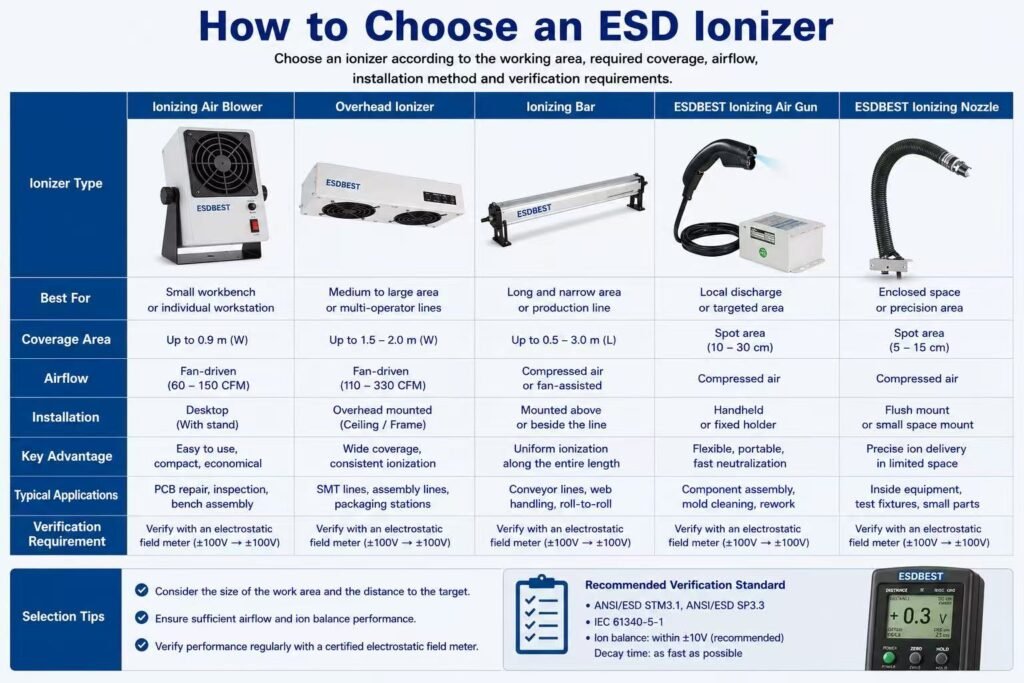
Step 3: Choose the Ionizer Type
| Application | Recommended Type |
| Individual electronics workstation | Benchtop ionizing fan |
| Large workbench | Overhead ionizer |
| Conveyor or film line | Ionizing bar |
| Spot cleaning | Ionizing air gun |
| Automated machine location | Ionizing nozzle |
| Larger industrial area | Ionizing blower |
| Precision cleanroom process | Cleanroom-compatible ionizer |
Step 4: Define Performance Requirements
Specify:
- Required discharge time
- Maximum acceptable offset voltage
- Test distance
- Coverage area
- Airflow requirements
- Noise limit
- Environmental conditions
Step 5: Consider Maintenance
Check whether:
- Emitters are easy to access
- Cleaning reminders are available
- Filters can be replaced
- Alarm outputs are included
- Balance can be adjusted
- Spare parts are available
Step 6: Verify Electrical Compatibility
Confirm:
- Input voltage
- Frequency
- Plug type
- Power consumption
- Grounding requirement
- Factory electrical standard
Step 7: Request Test Evidence
Ask the supplier for:
- Discharge-time test data
- Offset-voltage results
- Test distance
- Test setup
- Product specification
- Inspection report
- Operating manual
Module 15: Installation Guidelines
Positioning
Install the ionizer so that ionized air reaches the actual charged object rather than merely blowing across an empty part of the bench.
Avoid placing the ionizer behind:
- Shelves
- Monitors
- Tool racks
- Component bins
- Machine guards
- Large equipment
Distance
Use the manufacturer’s recommended distance as a starting point, then confirm performance with a charged plate monitor at the real handling location.
Airflow Direction
The airflow should cover the charged surface without:
- Blowing components away
- Disturbing solder smoke extraction
- Creating operator discomfort
- Interfering with cleanroom airflow
- Spreading contamination
Grounding
Follow the manufacturer’s grounding and electrical-installation instructions.
Do not assume that the presence of ionization removes the need to ground:
- Workbenches
- Tools
- Equipment frames
- Operators
- Conductive racks
- Test instruments
Multiple Ionizers
When multiple ionizers are installed:
- Avoid opposing airflow
- Check overlapping coverage
- Test the complete work zone
- Assign equipment IDs
- Record settings separately
- 📞 Contact Us Today
For bulk orders, quotes, or product guidance, get in touch with our expert team:
Email: sales2@esdbest.com
Whatsapp: +86 137 1427 2599
Module 16: Maintenance and Cleaning
Ionizer performance can degrade over time because emitter points attract contamination.
Common contaminants include:
- Dust
- Flux residue
- Smoke
- Oil
- Fibers
- Process particles
- Cleaning-product residue
Recommended Maintenance Tasks
- Inspect emitter points
- Clean emitter points
- Clean fan guards
- Replace or clean filters
- Check airflow
- Verify alarm indicators
- Measure offset voltage
- Measure discharge time
- Record results
- Repair or replace failed units
Maintenance Frequency
The correct frequency depends on:
- Operating environment
- Contamination level
- Daily operating time
- Ionizer design
- Process sensitivity
- Historical test results
Avoid stating that every ionizer must be cleaned exactly once per month. Some environments require more frequent cleaning, while controlled environments may allow longer intervals.
Module 17: Common Ionizer Problems
Problem 1: Slow Discharge Time
Possible causes:
- Dirty emitter points
- Excessive working distance
- Low airflow
- Blocked outlet
- Worn electrodes
- Incorrect installation angle
- High contamination
- Fan failure
Problem 2: High Offset Voltage
Possible causes:
- Unequal positive and negative ion output
- Contaminated emitter points
- Incorrect balance setting
- Component aging
- Nearby grounded objects
Incorrect test location
Problem 3: Uneven Coverage
Possible causes:
- Obstructed airflow
- Incorrect mounting height
- Narrow fan pattern
- Workbench equipment blocking ions
- Target outside the qualified area
Problem 4: Ionizer Passes at the Center but Fails at the Edges
This normally indicates that the stated coverage area is larger than the qualified performance area.
Test multiple points and reposition or add equipment where necessary.
Problem 5: Good Airflow but Poor Neutralization
Air movement alone does not prove that the ion-generation system is working.
Verify performance with a charged plate monitor.
Module 18: Standards and Compliance
ANSI/ESD STM3.1
ANSI/ESD STM3.1 provides test methods and procedures for evaluating ionizer performance and supporting equipment selection. The EOS/ESD Association currently lists ANSI/ESD STM3.1-2024.
ANSI/ESD SP3.3
ANSI/ESD SP3.3 provides procedures for periodic verification of air-ionization equipment.
ANSI/ESD SP3.4
ANSI/ESD SP3.4 addresses verification using a smaller test fixture in confined spaces where conventional fixtures may not be practical.
ANSI/ESD S20.20
ANSI/ESD S20.20 establishes requirements for developing an ESD control program. Ionization is one possible control element for process-essential insulators and other charge sources that cannot be adequately controlled through grounding alone.
IEC 61340-5-1
IEC 61340-5-1:2024 provides requirements for establishing and maintaining an ESD control program.
Important Compliance Statement
Do not write:
“Using this ionizer automatically makes your factory ANSI/ESD S20.20 compliant.”
Use:
“This ionizer can be incorporated into an ESD control program. Final compliance depends on product qualification, installation, verification procedures, process requirements and the complete ESD control system.”
📞 Contact Us Today
For bulk orders, quotes, or product guidance, get in touch with our expert team:
Email: sales2@esdbest.com
Whatsapp: +86 137 1427 2599
ESD Ionizer FAQ
1. What is an ESD ionizer?
An ESD ionizer is a static-control device that produces positive and negative ions. These ions are carried by airflow toward charged surfaces, helping neutralize electrostatic charge on insulating materials and isolated conductive objects that cannot be effectively grounded.
2. How does an ESD ionizer work?
An ESD ionizer generates positive and negative ions through corona discharge or another ion-generation method. The ions move through the air toward oppositely charged surfaces, reducing the net electrostatic charge on the object.
3. When is an ionizer required in an ESD protected area?
An ionizer is normally considered when process-essential insulators, isolated conductors or other charged materials cannot be removed, replaced or grounded. The requirement should be determined through an ESD risk assessment and the facility’s ESD control program.
4. Can an ESD ionizer replace grounding?
No. Ionization normally complements grounding rather than replacing it. Personnel, conductive work surfaces, tools and equipment should be grounded where appropriate. Ionization is primarily used for objects that cannot be grounded effectively.
5. What is the difference between an ESD ionizer and a normal fan?
A normal fan mainly moves air. An ESD ionizer intentionally produces positive and negative ions that help neutralize electrostatic charge. Ionizers also require performance verification such as ion-balance and discharge-time testing.
6. What is ion balance or offset voltage?
Ion balance, often expressed as offset voltage, indicates whether an ionizer produces a reasonably balanced quantity of positive and negative ions at the test location. Excessive imbalance can leave the test plate with a residual positive or negative voltage.
7. What is ionizer discharge time?
Discharge time is the time required for an ionizer to reduce the voltage on a charged test plate between specified voltage levels. Positive and negative decay times are generally measured separately using a charged plate monitor.
8. How is an ESD ionizer tested?
An ESD ionizer is commonly evaluated with a charged plate monitor. The principal measurements include positive decay time, negative decay time and offset voltage. Testing should be performed at defined working positions and distances.
9. How often should an ESD ionizer be tested?
The verification interval should be defined by the organization’s ESD control plan, equipment stability, process risk, manufacturer recommendations and historical test results. Many facilities test ionizers during installation and then at scheduled intervals.
10. How often should ionizer emitter pins be cleaned?
Emitter-pin cleaning frequency depends on the operating environment, contamination level and manufacturer instructions. Dust and residue on emitter pins can reduce ion output, increase discharge time and affect ion balance.
11. Where should a bench-top ionizer be installed?
A bench-top ionizer should be positioned so ionized airflow reaches the charged materials and ESD-sensitive work area without significant obstruction. The selected distance and fan speed should be verified using actual discharge-time measurements.
12. What types of ESD ionizers are available?
Common types include bench-top ionizing blowers, overhead ionizers, ionizing bars, ionizing air guns, ionizing nozzles and compact ionizers designed for production equipment.
13. Which ionizer is suitable for a PCB assembly workstation?
A bench-top or overhead ionizer is commonly used for PCB assembly and inspection workstations. The correct model depends on the required coverage area, working distance, airflow, noise limits, available space and target discharge time.
14. Can an ionizer remove dust from electronic components?
An ionizing air gun or nozzle can help reduce static attraction while airflow removes loose particles. However, the airflow and filtration must be suitable for the process, and ionization should not be treated as a substitute for an appropriate cleaning procedure.
15. Do ESD ionizers require calibration?
The ionizer itself is normally adjusted, maintained and verified according to its design and the manufacturer’s instructions. The charged plate monitor or other measurement instrument used to verify the ionizer should have appropriate calibration or measurement traceability.
16. Why does ionizer performance decrease over time?
Performance may change because of contaminated emitter pins, worn components, blocked airflow, incorrect placement, fan deterioration or changes in the operating environment. Routine cleaning and verification help identify these conditions.
17. What information is needed when requesting an ESD ionizer quotation?
Useful information includes the application, working distance, coverage area, target discharge time, installation method, input voltage, plug type, airflow requirements, noise limits, cleanroom requirements and required quantity.
18. Can ESDBEST provide customized ESD ionizers?
Customization options depend on the ionizer model and order requirements. Customers can provide their input voltage, plug type, installation arrangement, airflow requirements, branding, packaging and quantity for technical review.
📞 Contact Us Today
For bulk orders, quotes, or product guidance, get in touch with our expert team:
Email: sales2@esdbest.com
Whatsapp: +86 137 1427 2599