Why Do ESD Mats Need Grounding?
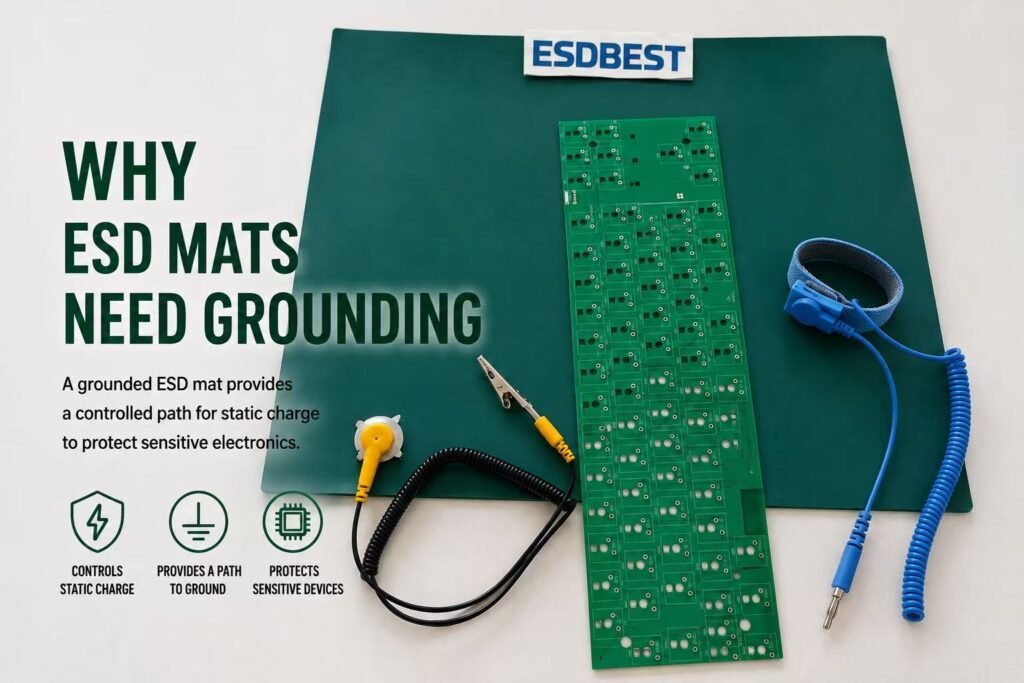
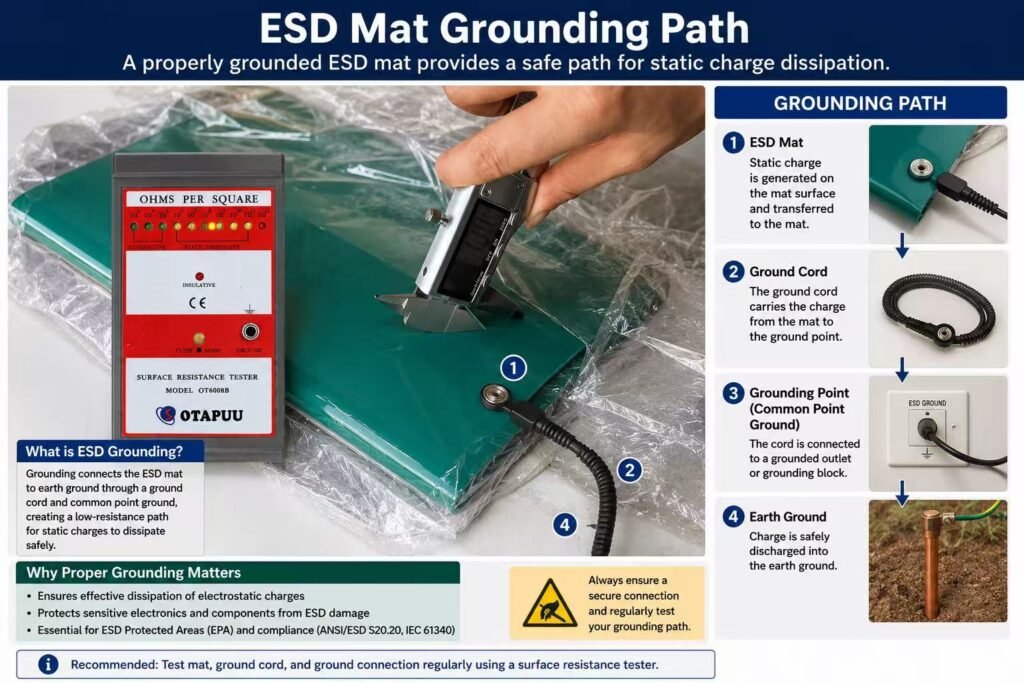
An ESD mat needs grounding because static charge requires a defined path away from the work surface. A static-dissipative mat can control how charge moves across its surface, but the material alone does not make accumulated charge disappear.
When an ESD bench mat is connected to an appropriate grounding system, charge can dissipate through the work surface toward the designated grounding reference instead of remaining on the workstation or discharging unpredictably through sensitive electronics.
This is particularly important when handling PCBs, ICs, sensors, semiconductor devices, electronic assemblies, and other ESD-sensitive components.
Quick Answer: An ESD mat needs grounding to provide a controlled path for accumulated electrostatic charge. The mat controls the rate of charge dissipation, while the grounding system provides the path away from the work surface. An ESD mat without a defined ground path is an incomplete ESD control system.
📞 Contact Us Today
For bulk orders, quotes, or product guidance, get in touch with our expert team:
Email: sales2@esdbest.com
Whatsapp: +86 137 1427 2599
Why Does an ESD Mat Need a Ground Path?
Static electricity can be generated whenever materials contact, separate, move, or rub against each other.
At an electronics workstation, common sources include:
- Operator movement
- Clothing
- Plastic packaging
- Component trays
- Tools
- Chairs
- Protective films
- PCBs moving across surfaces
- Handling of electronic assemblies
An ESD work surface is designed to control electrostatic charge, but charge still needs somewhere to go.
A simplified path is:
Static Charge
↓
Static-Dissipative ESD Mat Surface
↓
Grounding Connection
↓
Common Grounding Reference
The purpose is controlled dissipation, not instant removal of charge.
A properly designed ESD work surface provides electrical resistance that allows charge to move in a controlled manner. Grounding completes the path.
This distinction is important:
The mat controls charge movement. The grounding system provides the path.
Both functions are needed as part of a properly designed ESD workstation.
What Happens If an ESD Mat Is Not Grounded?
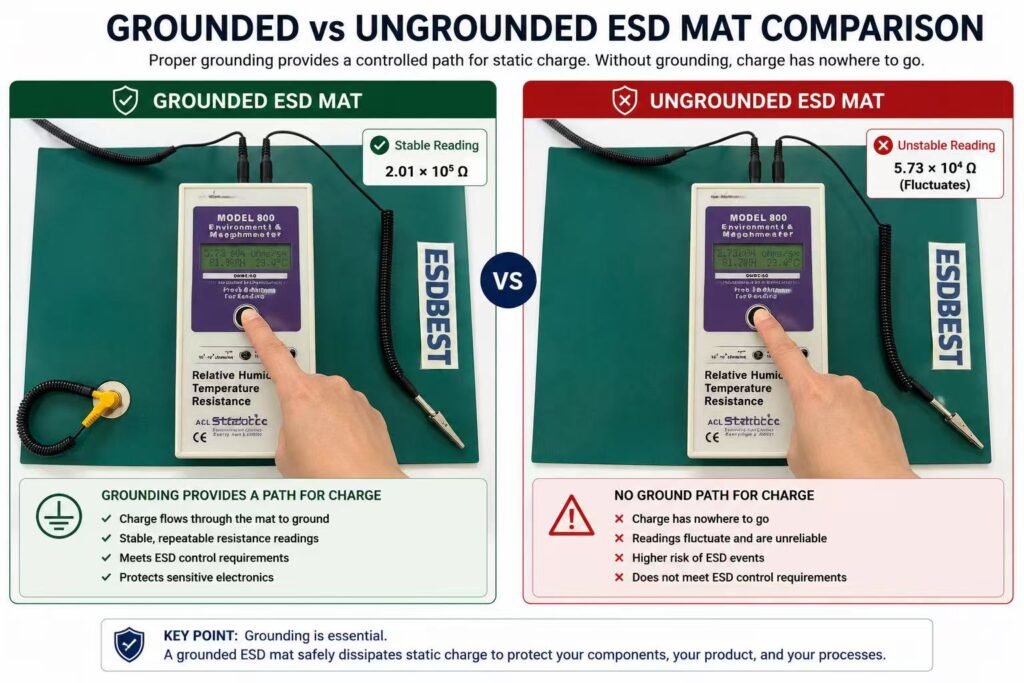
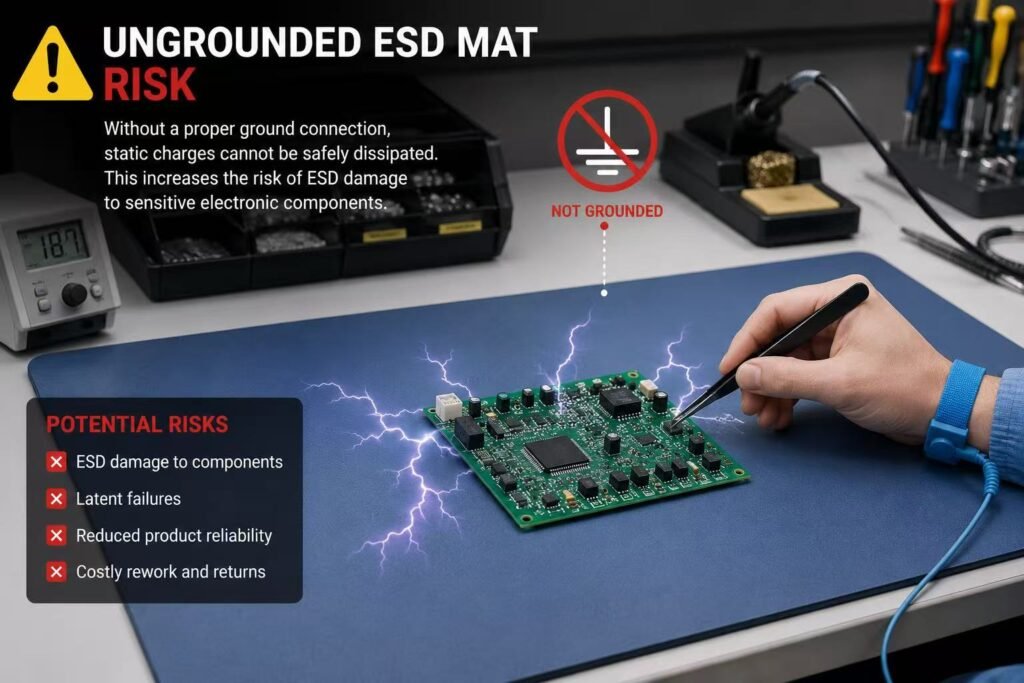
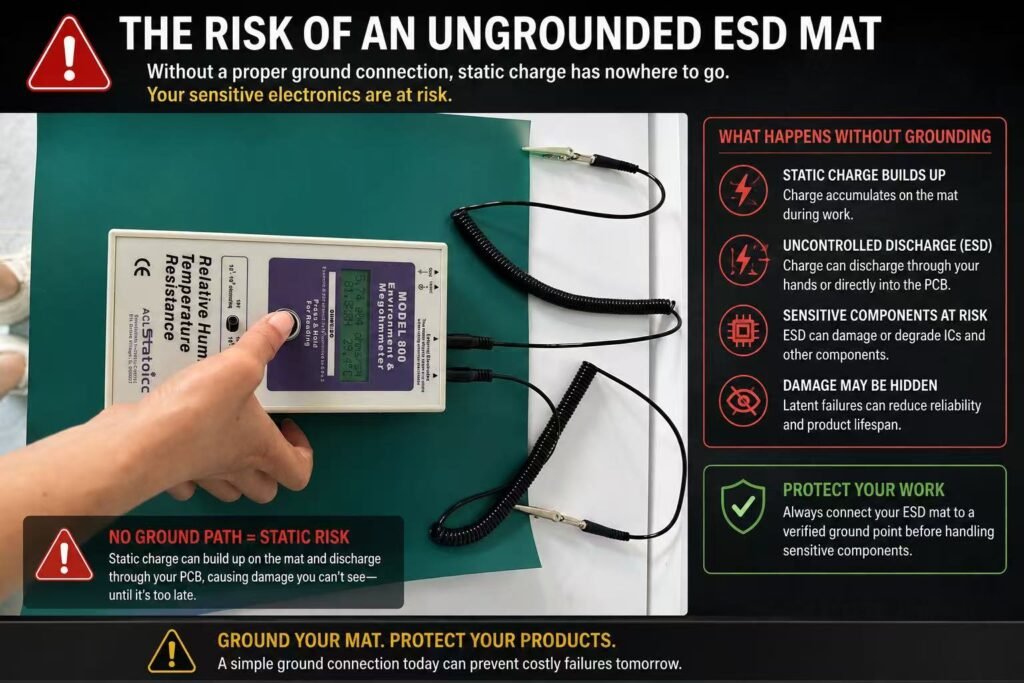
An ungrounded ESD mat may still have static-dissipative material properties, but it does not have a defined path for accumulated charge to leave the work surface.
That means installing an ESD mat on a bench without considering grounding does not automatically create a properly controlled ESD workstation.
Possible problems include:
- Charge remaining on the work surface
- Inconsistent charge dissipation
- Potential differences between the operator, work surface, and electronic device
- Increased risk of uncontrolled electrostatic discharge
- A false sense that the workstation is protected simply because an ESD mat is present
This is especially important in PCB assembly, electronics manufacturing, repair, inspection, testing, and semiconductor handling, where sensitive devices may be exposed to electrostatic events that are too small for an operator to see or feel.
The correct question is therefore not only:
“Is this an ESD mat?”
It is also:
“Does this work surface have a defined and verified grounding path?”
📞 Contact Us Today
For bulk orders, quotes, or product guidance, get in touch with our expert team:
Email: sales2@esdbest.com
Whatsapp: +86 137 1427 2599
Grounded vs Ungrounded ESD Mat
| Feature | Grounded ESD Mat | Ungrounded ESD Mat |
|---|---|---|
| Static-dissipative surface | Yes, depending on mat construction | May still be present |
| Defined path toward ground | Yes | No |
| Charge dissipation | Controlled through the grounding system | No defined ground path |
| Grounding connection | Installed | Missing |
| RTG verification | Can be performed as part of the installed system | Ground path is incomplete |
| Electronics workstation use | Can form part of a controlled ESD workstation | Incomplete ESD control configuration |
| Mat alone provides complete protection | No | No |
Important
Grounding does not turn an ordinary mat into an ESD mat. Likewise, an ESD mat does not become a complete ESD control system simply because a ground cord is attached.
The mat’s electrical characteristics, grounding configuration, operator controls, verification, and overall workstation design must work together.
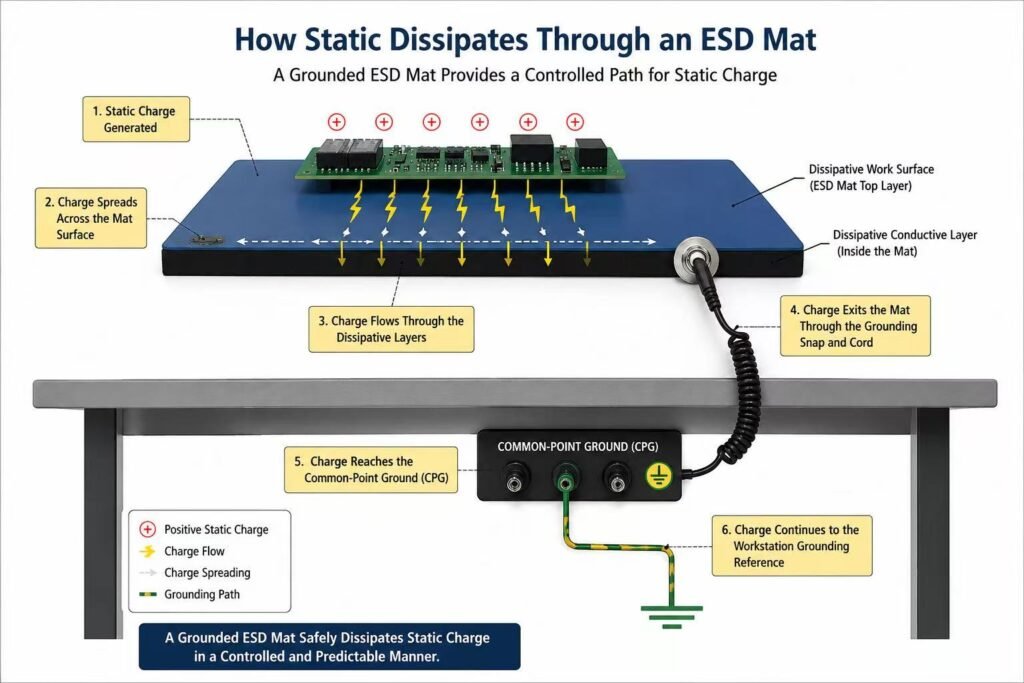
How Static Charge Dissipates Through a Grounded ESD Mat
A grounded ESD mat is intended to provide a controlled electrical path between the work surface and the workstation grounding system.
The basic principle can be represented as:
PCB / Tool / Work Surface
↓
Static-Dissipative Layer
↓
Lower-Resistance / Conductive Layer
↓
Grounding Connection
↓
Designated Grounding Reference
For a two-layer ESD rubber mat, the working surface and lower layer can perform different electrical functions.
In ESDBEST’s current two-layer bench-mat configuration, the upper working surface is static dissipative, while the bottom layer is conductive.
Typical product specifications are:
| Layer | Function | Typical ESDBEST Specification |
|---|---|---|
| Top Working Layer | Static-dissipative work surface | 10⁶–10⁹ Ω |
| Bottom Layer | Conductive lower layer | 10⁴–10⁶ Ω |
These are product specifications, not a substitute for an installed RTG measurement.
Actual workstation performance should be verified after the mat is installed and grounded.
📞 Contact Us Today
For bulk orders, quotes, or product guidance, get in touch with our expert team:
Email: sales2@esdbest.com
Whatsapp: +86 137 1427 2599
📞 Contact Us Today
For bulk orders, quotes, or product guidance, get in touch with our expert team:
Email: sales2@esdbest.com
Whatsapp: +86 137 1427 2599
Why a Static-Dissipative Surface Alone Is Not Enough
A common misunderstanding is that a static-dissipative material automatically eliminates static electricity.
It does not.
Static dissipative describes an electrical behavior of the material. Grounding provides the reference and path needed for charge to move away from the work surface.
This means an ESD mat can have the correct material resistance but still be part of an ineffective workstation if:
- The ground cord is disconnected
- The grounding snap is damaged
- The connection is loose
- The intended ground reference is not verified
- Contamination affects electrical performance
- The grounding path is interrupted
- The workstation has not been periodically verified
This is why electrical specifications and actual workstation verification should be considered together.
For a deeper explanation of conductive and dissipative resistance ranges, see our Conductive vs Static-Dissipative Mats guide.
Why Operator Grounding and Mat Grounding Are Different
An ESD bench mat and an ESD wrist strap control different parts of the workstation.
The mat primarily controls the work surface and objects interacting with that surface.
The wrist strap is used to control charge on the operator when personnel grounding through a wrist strap is appropriate for the workstation.
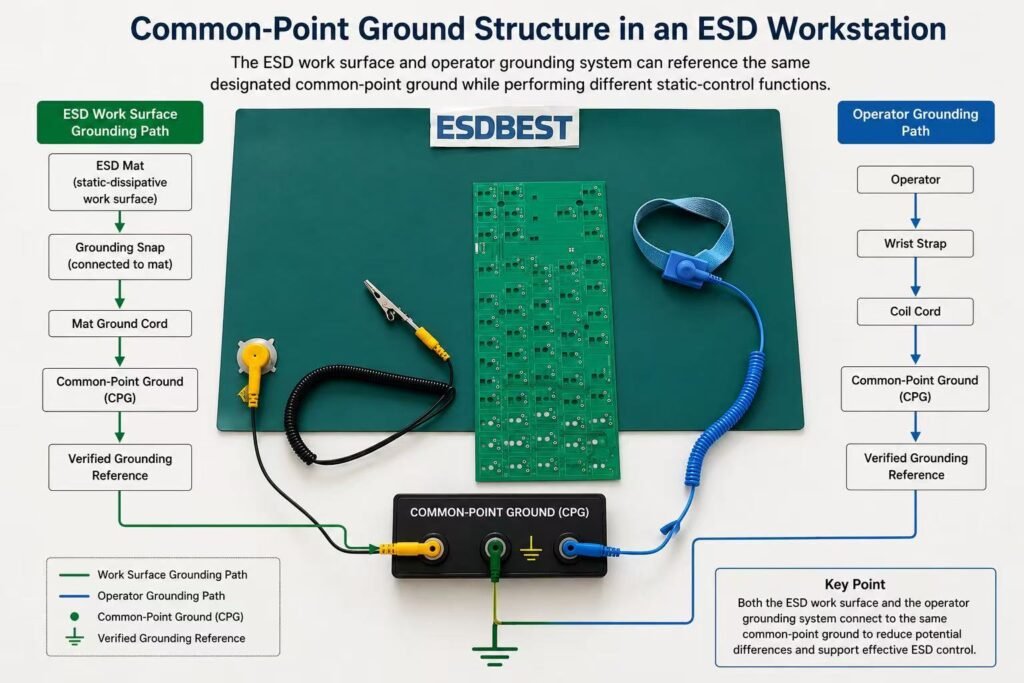
A simplified system looks like:
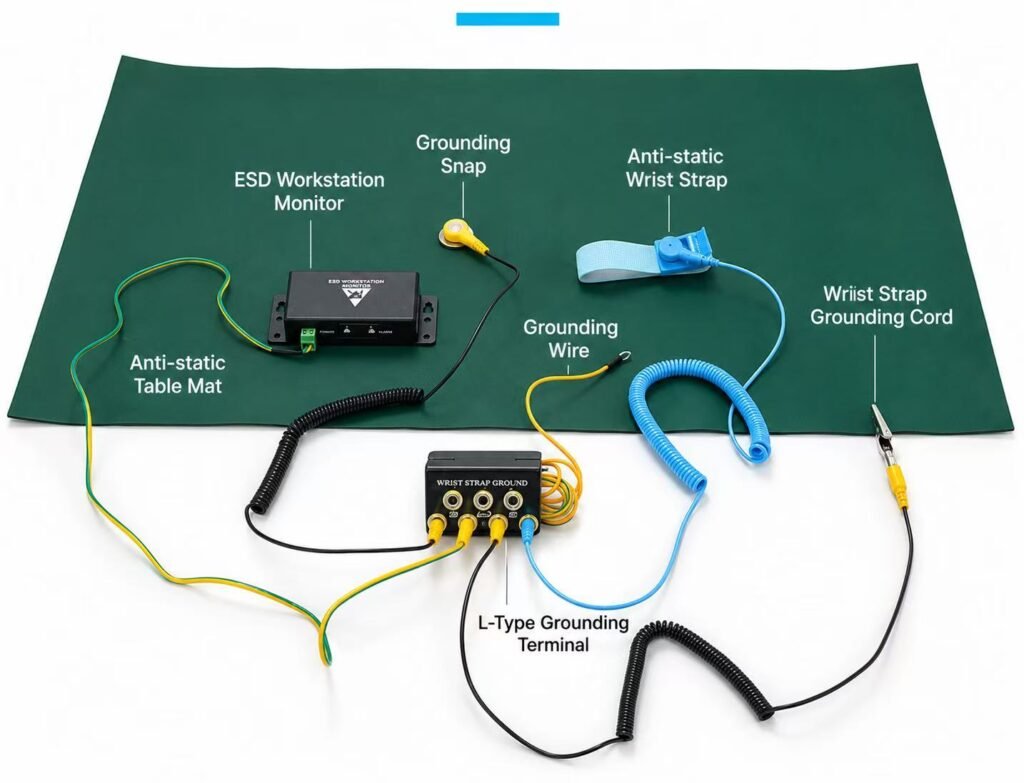
Operator → Wrist Strap → Common-Point Ground
and
PCB / Components → ESD Bench Mat → Common-Point Ground
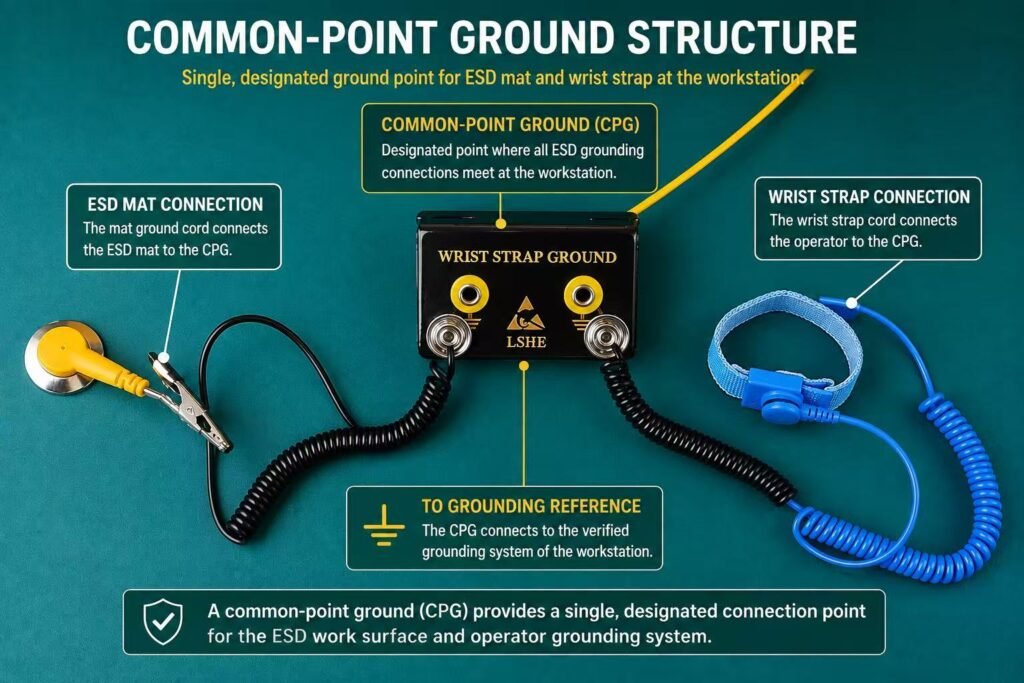
Using the same designated grounding reference helps reduce unwanted electrical potential differences within the controlled workstation.
However:
A grounded ESD mat does not automatically replace operator grounding, and a wrist strap does not replace a controlled ESD work surface.
They perform different functions within the overall ESD control system.
📞 Contact Us Today
For bulk orders, quotes, or product guidance, get in touch with our expert team:
Email: sales2@esdbest.com
Whatsapp: +86 137 1427 2599
Why Grounding Matters During PCB Handling
PCBs and electronic components can be exposed to electrostatic charge during assembly, inspection, soldering, repair, testing, and rework.
The operator may be charged.
The work surface may be charged.
Packaging or tools may introduce charge.
Objects placed on the workbench may also be at different electrical potentials.
A grounded ESD bench mat helps provide a controlled work surface for these activities.
Instead of relying on an ordinary table surface, the workstation uses a material with defined electrical characteristics and a designed grounding path.
Grounding is therefore particularly relevant in:
- PCB assembly
- SMT rework
- Electronics repair
- Component inspection
- Electronic testing
- Semiconductor handling
- Laboratory electronics work
- Production workstations
However, the ESD mat is only one control within the workstation.
Does Grounding an ESD Mat Make the Workstation Compliant?
No.
This is an important distinction.
A grounded ESD mat alone does not make an entire workstation compliant with an ESD standard.
The work surface is only one element of an ESD control program.
Depending on the facility and process, additional controls may include:
- Personnel grounding
- Wrist-strap systems
- Footwear and flooring
- Common grounding systems
- Ionization
- ESD-safe tools
- ESD protective packaging
- Storage and handling controls
- Resistance verification
- Compliance verification procedures
- Documentation and training
Your current /esd-mat/ page also treats the mat as part of a broader grounding and workstation system rather than an isolated product.
For detailed standards information, use the dedicated ESDBEST guides:
ESD Protected Area (EPA) Guide
Do not copy the full standards explanations onto this page.
How Can You Tell Whether an ESD Mat Is Actually Grounded?
You cannot reliably determine grounding performance just by looking at the ground cord.
A cord may appear connected while another part of the electrical path is loose, damaged, contaminated, or incorrectly configured.
The installed work surface can therefore be verified using an appropriate resistance measurement.
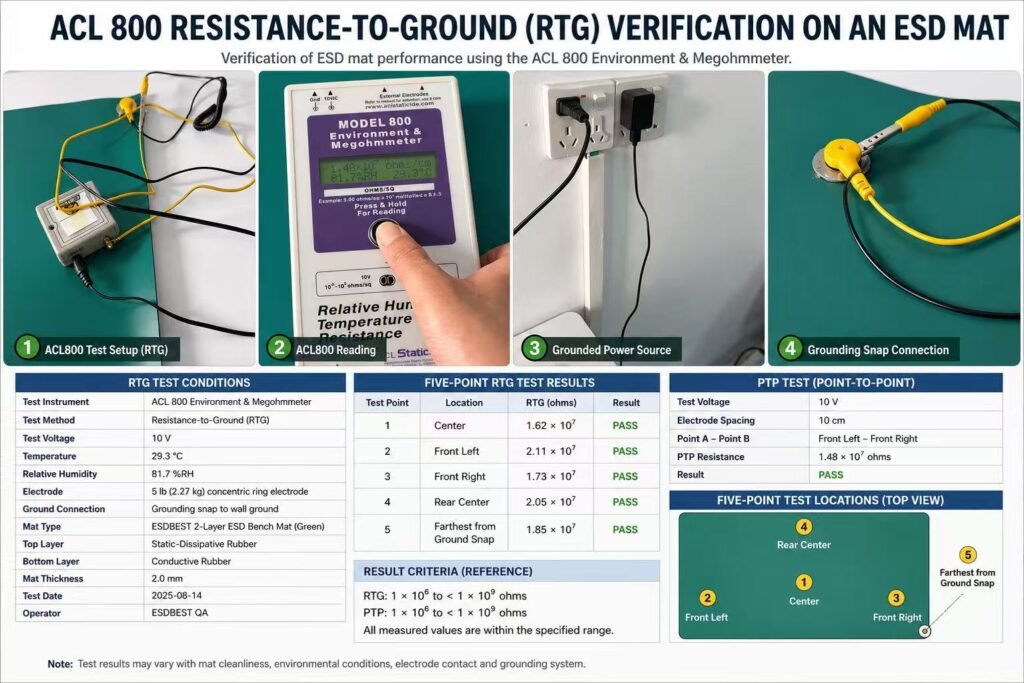
Resistance-to-ground (RTG) evaluates the resistance path between a defined location on the work surface and its grounding reference.
This provides objective evidence of the installed system’s electrical behavior.
For example, an actual ESDBEST test may be recorded as:
Test Method: Resistance-to-Ground (RTG)
Instrument: ACL Model 800
Measured Result: 1.62 × 10⁷ Ω
Only use this result here if it corresponds to the actual mat and grounding configuration shown in your test evidence.
For the complete test method, electrode placement, PTP testing, multi-point verification, and interpretation, see:
Common Grounding Problems That Increase ESD Risk
This section should explain why a grounding system may become ineffective, not teach the complete installation procedure.
Disconnected Ground Cord
If the ground cord becomes disconnected, the work surface loses its intended connection to the workstation grounding system.
Loose or Damaged Grounding Snap
A grounding snap that is loose, damaged, or making poor electrical contact can interrupt the intended path.
Unverified Grounding Reference
Connecting a mat to an arbitrary metal object does not prove that a valid grounding path exists.
Surface Contamination
Dust, oil, flux residue, cleaning residue, and other contamination can affect work-surface condition and resistance measurements.
No Periodic Verification
A workstation that worked correctly when installed may change over time because of wear, contamination, damaged cables, or altered connections.
The important principle is:
Grounding should be verified, not assumed.
Do not put Step 1, Step 2, Step 3 installation instructions in this section.
How Is an ESD Mat Grounded?
An ESD mat is typically connected from its designated grounding point through an appropriate mat grounding cord to the workstation’s specified grounding system. A common-point ground may be used to provide a shared grounding reference for the work surface and operator grounding system.
The exact configuration depends on the workstation, facility grounding system, ESD control plan, and applicable safety requirements.
This page explains why grounding is necessary. For grounding snap installation, ground-cord connection, common-point ground configuration, workstation setup, and resistance verification, use our dedicated installation guide.
Complete Step-by-Step Grounding Guide
📞 Contact Us Today
For bulk orders, quotes, or product guidance, get in touch with our expert team:
Email: sales2@esdbest.com
Whatsapp: +86 137 1427 2599
Why ESD Mat Grounding Should Be Periodically Verified
Grounding is not a one-time assumption.
Normal workstation use can introduce changes through:
wear + contamination + cleaning + damaged cords + loose connections + workstation modifications
For this reason, the work surface and grounding path should be inspected and verified according to the facility’s ESD control procedures.
Periodic verification may include:
- Visual mat inspection
- Grounding snap inspection
- Ground cord inspection
- Connection inspection
- Resistance-to-ground measurement
- Work-surface resistance measurements
- Recording test conditions and results
If an unexpected result occurs, investigate the work surface, contamination, grounding connections, test setup, and environmental conditions before drawing conclusions.
ESD Mat Grounding FAQ
Why does an ESD mat need grounding?
An ESD mat needs grounding because accumulated electrostatic charge requires a defined path away from the work surface. The mat controls how charge dissipates, while the grounding system provides the path toward the designated grounding reference.
Can an ESD mat work without grounding?
An ungrounded ESD mat may retain the electrical properties of its material, but it does not have a defined grounding path. For a professional ESD workstation, the work surface should be integrated with the appropriate grounding system and verification procedure.
What happens if an ESD mat is not grounded?
Without a defined ground path, electrostatic charge may remain on the work surface or dissipate unpredictably. This can leave sensitive PCBs and electronic components exposed to uncontrolled potential differences and electrostatic discharge risk.
Does a static-dissipative mat still need grounding?
For a static-dissipative work surface to function as part of a grounded ESD workstation, it needs an appropriate grounding path. Static-dissipative material controls the rate of charge movement; grounding provides the path away from the work surface.
Is a ground cord enough to prove an ESD mat is grounded?
No. A visible ground cord does not prove that the complete electrical path is functioning correctly. The snap, cord, connections, grounding reference, and installed work surface should be inspected and verified according to the site’s ESD control procedure.
Should the ESD mat and wrist strap use the same grounding reference?
A workstation is commonly designed so the work surface and operator grounding system reference a designated common grounding point. The exact configuration should follow the facility’s ESD control plan and applicable safety requirements.
How do you test whether an ESD mat is grounded?
Resistance-to-ground testing can be used to evaluate the resistance path between a defined location on the work surface and its grounding reference. The measurement should be performed using an appropriate instrument and documented test conditions.
Learn more: How to Test an ESD Mat
How do you ground an ESD mat correctly?
The mat is connected through its designated grounding connection and appropriate grounding cord to the workstation’s specified grounding system. Because installation details vary, use the complete step-by-step guide rather than improvising a grounding connection.
Complete Guide: How to Ground an ESD Mat
Need a Groundable ESD Work Surface?
ESDBEST supplies two-layer rubber ESD bench mats, ESD workbench mats, custom-cut work surfaces, mat rolls, grounding accessories, and workstation static-control solutions for electronics manufacturing and PCB assembly.
Available options include:
- 2 mm and 3 mm rubber ESD bench mats
- Static-dissipative working surfaces
- Conductive bottom layers
- Custom dimensions
- Mat rolls
- Grounding snaps
- Mat ground cords
- Workstation grounding accessories
- OEM and bulk production
CTA
View ESD Bench Mats
Request a Custom ESD Mat Quote
📞 Contact Us Today
For bulk orders, quotes, or product guidance, get in touch with our expert team:
Email: sales2@esdbest.com
Whatsapp: +86 137 1427 2599
Contact ESDBEST: sales2@esdbest.com
📞 Contact Us Today
For bulk orders, quotes, or product guidance, get in touch with our expert team:
Email: sales2@esdbest.com
Whatsapp: +86 137 1427 2599