ANSI/ESD S20.20 Requirements & Compliance Guide
ANSI/ESD S20.20 Requirements: Complete ESD Control Program Guide
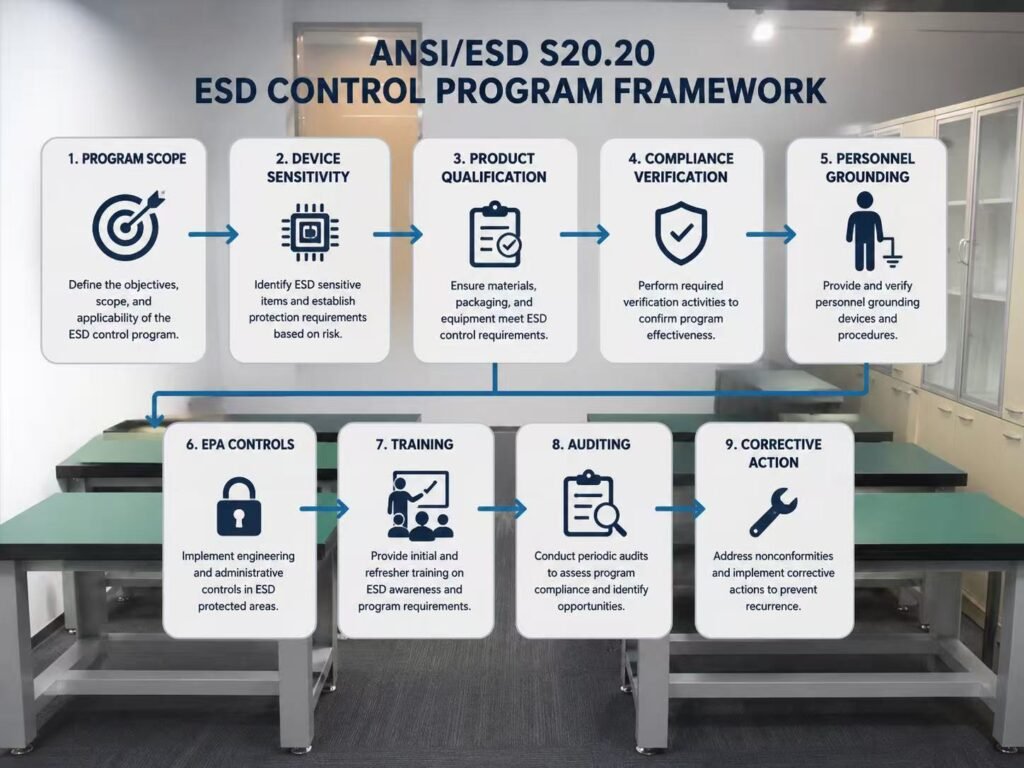
ANSI/ESD S20.20 is a standard for developing, implementing and maintaining an electrostatic discharge control program for sensitive electronic parts, assemblies and equipment. It covers program planning, product qualification, compliance verification, personnel grounding, ESD protected areas, packaging, training and auditing.
What Are the Main ANSI/ESD S20.20 Requirements?
- Define the ESD control program scope.
- Identify the lowest device sensitivity.
- Create an ESD Control Program Plan.
- Qualify ESD control products.
- Establish compliance verification.
- Ground personnel and conductors.
- Create and maintain ESD Protected Areas.
- Control insulators and use ionization where required.
- Train personnel.
- Maintain records and conduct audits.
ANSI ESD S20.20 requirements
what are S20.20 requirements
ESD control program requirements
📞 Contact Us Today
For bulk orders, quotes, or product guidance, get in touch with our expert team:
Email: sales2@esdbest.com
Whatsapp: +86 137 1427 2599
ANSI/ESD S20.20 is one of the most widely used standards for developing, implementing and maintaining an electrostatic discharge control program in electronics manufacturing.
It provides a structured framework for controlling electrostatic discharge risks when sensitive electrical and electronic parts, assemblies and equipment are manufactured, processed, assembled, tested, inspected, packaged, transported or otherwise handled.
The current published edition is ANSI/ESD S20.20-2021. As of 2026, EOS/ESD Association continues to list the 2021 edition as the current standard while work on a future revision remains in progress.
This guide explains:
- What ANSI/ESD S20.20 covers
- Who should use the standard
- How to create an ESD Control Program Plan
- How product qualification differs from compliance verification
- Personnel-grounding requirements
- Worksurface and flooring control
- Ionization and insulator management
- EPA design and operation
- Training and documentation
- How to prepare for an ESD audit
- How ANSI/ESD S20.20 compares with IEC 61340-5-1
This page is an implementation guide and does not replace the official ANSI/ESD S20.20 standard. Organizations should obtain the official document and apply the requirements relevant to their products, processes and customer obligations.
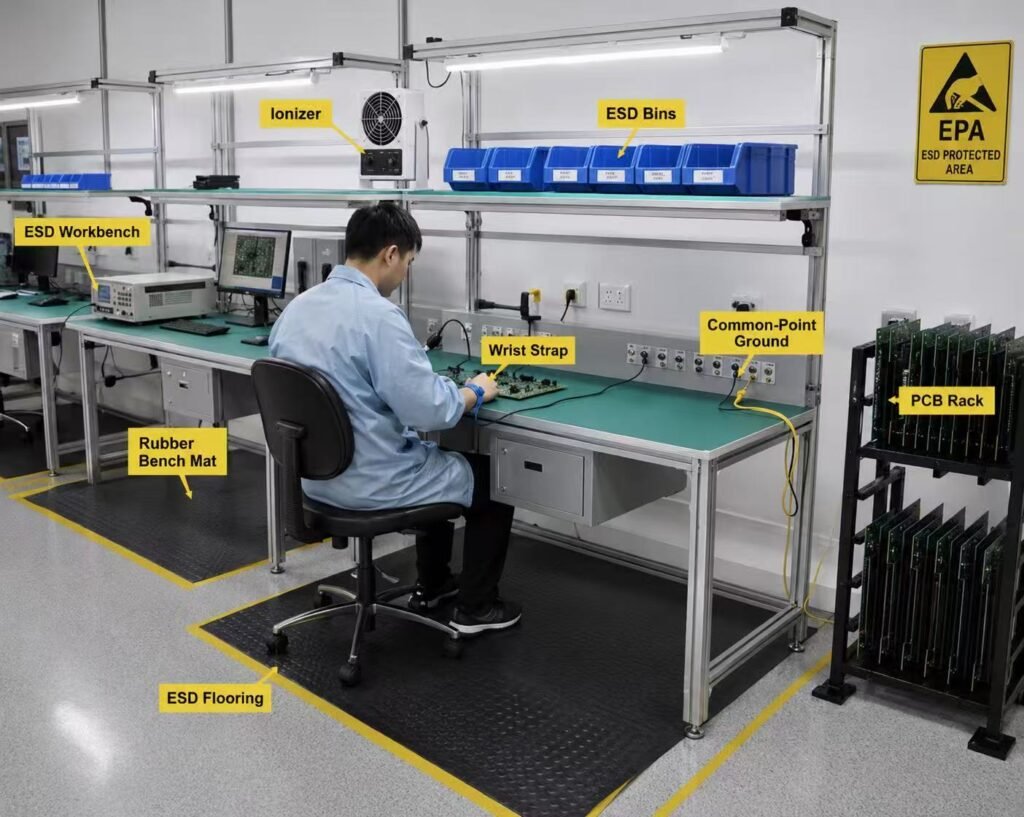
Quick Answer: What Is ANSI/ESD S20.20?
ANSI/ESD S20.20 is a performance-based standard for establishing an ESD control program that protects electrostatic-discharge-sensitive electrical and electronic parts, assemblies and equipment.
The standard does not simply provide a list of anti-static products to purchase. It requires an organization to establish a controlled system that includes:
- Defined program scope
- ESD sensitivity identification
- Documented ESD Control Program Plan
- Product qualification
- Compliance verification
- Personnel grounding
- ESD Protected Areas
- Control of conductors and insulators
- Packaging and material handling
- Employee training
- Records and corrective actions
- Internal auditing and continuous improvement
ANSI/ESD S20.20 provides both administrative and technical requirements. Administrative requirements define how an organization manages its ESD control program, while technical requirements establish performance expectations for control methods and ESD control items.
📞 Contact Us Today
For bulk orders, quotes, or product guidance, get in touch with our expert team:
Email: sales2@esdbest.com
Whatsapp: +86 137 1427 2599
What Does ANSI/ESD S20.20 Stand For?
The full title is:
ANSI/ESD S20.20 — ESD Association Standard for the Development of an Electrostatic Discharge Control Program for Protection of Electrical and Electronic Parts, Assemblies and Equipment.
The standard is developed by EOS/ESD Association, an ANSI-accredited standards developer specializing in electrostatics.
ANSI refers to the American National Standards Institute.
ESD refers to electrostatic discharge.
S20.20 identifies the ESD control-program standard.
The standard excludes electrically initiated explosive devices and does not serve as a component-level ESD design standard.
Why Is ANSI/ESD S20.20 Important?
Electrostatic discharge can cause immediate or latent damage to sensitive electronic devices.
Immediate failures may be detected during manufacturing or testing. Latent damage may weaken a device without causing an immediate complete failure, potentially affecting long-term product reliability.
An effective ESD control program helps an organization:
- Reduce ESD-related defects
- Protect sensitive components
- Standardize production controls
- Improve traceability
- Meet customer requirements
- Prepare for supplier audits
- Reduce inconsistent operator practices
- Verify that ESD control products continue to perform
- Identify process risks before product damage occurs
- Support continuous quality improvement
The standard is especially valuable because it creates a complete management system instead of relying on isolated products such as wrist straps, mats or ionizers.
Who Should Use ANSI/ESD S20.20?
The standard applies to organizations that handle electrostatic-discharge-sensitive electrical or electronic items.
Typical users include:
- PCB assembly factories
- SMT production facilities
- Semiconductor manufacturers
- Electronic component distributors
- Electronics repair centers
- Contract electronics manufacturers
- Automotive electronics suppliers
- Aerospace electronics manufacturers
- Medical-device electronics facilities
- Battery-management-system manufacturers
- Telecommunications-equipment manufacturers
- Laboratories handling sensitive devices
- Electronic-product packaging operations
- Warehouses storing ESDS components
- Field-service organizations
The standard may apply wherever unprotected ESDS items are:
- Received
- Inspected
- Stored
- Kitted
- Assembled
- Reworked
- Tested
- Packaged
- Transported
- Serviced
A company does not need to be a semiconductor manufacturer to benefit from an ESD control program. Any organization handling sensitive electronic parts or assemblies may need a structured ESD process.
ANSI/ESD S20.20 Is a Program Standard
A common misunderstanding is that ANSI/ESD S20.20 is only a material-resistance standard.
It is not.
The standard establishes requirements for an entire ESD control program.
A factory cannot demonstrate effective compliance merely by purchasing:
- ESD mats
- Wrist straps
- ESD shoes
- Gloves
- Ionizers
- Conductive bins
- ESD garments
The factory must also establish:
- Why each item was selected
- Which process risk it controls
- How the item was qualified
- How often it will be verified
- What test method will be used
- Who is responsible for testing
- What limits apply
- What happens after a failure
- How results are recorded
- How employees are trained
The difference between owning ESD products and operating an ESD control program is documentation, verification and process control.
The Main Elements of an ANSI/ESD S20.20 Program
A practical ESD control program can be divided into three levels.
Level 1: Administrative Controls
Administrative controls define how the program is managed.
They include:
- ESD Control Program Plan
- Defined program scope
- ESD coordinator or responsible person
- Training plan
- Product qualification plan
- Compliance Verification Plan
- Record-control procedure
- Corrective-action process
- Internal audit process
- Supplier-control requirements
- Document revision control
Level 2: Technical Controls
Technical controls reduce electrostatic risks in actual operations.
They include:
- Personnel grounding
- ESD work surfaces
- ESD flooring
- Footwear and heel grounders
- Ionization
- Equipment grounding
- ESD packaging
- Garments
- Seating
- Carts and shelving
- Tools and fixtures
- Grounding systems
- Humidity considerations
- Control of conductors and insulators
Level 3: Verification and Improvement
Verification confirms that controls continue to work.
It includes:
- Daily personnel tests
- Periodic resistance measurements
- Ionizer verification
- Grounding checks
- Worksurface testing
- Floor testing
- Packaging inspections
- Calibration
- Audit findings
- Failure investigation
- Corrective and preventive actions
-
📞 Contact Us Today
For bulk orders, quotes, or product guidance, get in touch with our expert team:
Email: sales2@esdbest.com
Whatsapp: +86 137 1427 2599
Step 1: Define the ESD Control Program Scope
The organization should clearly define which facilities, departments, processes and products are included in the ESD control program.
The scope may include:
- Incoming inspection
- Component storage
- Material preparation
- SMT assembly
- Through-hole assembly
- Manual soldering
- Inspection
- Functional testing
- Rework
- Cleaning
- Final assembly
- Packaging
- Shipping
- Field service
The scope should follow the path of ESDS items throughout the organization.
A frequent mistake is to include the SMT production line but exclude upstream or downstream areas that also handle unprotected sensitive items.
For example, an ESDS component may be protected inside the SMT line but exposed during:
- Incoming inspection
- Kitting
- Manual repair
- Programming
- Testing
- Packaging
These areas may also need to be included.
The ESD Control Program Plan should identify the areas that form part of the overall program.
Step 2: Determine the Lowest ESD Sensitivity
The organization should document the lowest sensitivity level of the ESDS items handled within the program.
This is important because the required controls depend on the sensitivity of the devices and assemblies.
The standard’s general control framework is commonly associated with devices having sensitivity thresholds of:
- 100 volts Human Body Model
- 200 volts Charged Device Model
- 35 volts on isolated conductors
Processes handling devices below the standard’s general sensitivity basis may still use ANSI/ESD S20.20, but additional controls, process assessment or tailoring may be necessary.
The organization should obtain sensitivity information from:
- Component manufacturers
- Customer specifications
- Device qualification reports
- Internal engineering data
- Approved supplier documentation
- Product design teams
Do not assume that every PCB assembly has the same ESD sensitivity.
The most sensitive component exposed during the process may determine the control level needed.
Step 3: Create an ESD Control Program Plan
The ESD Control Program Plan is the central document describing how the organization controls electrostatic risks.
A strong plan should include:
Program Scope
Define the sites, departments, processes and products covered.
Roles and Responsibilities
Identify:
- ESD coordinator
- Quality manager
- Production supervisors
- Maintenance personnel
- Training personnel
- Internal auditors
- Operators
- Purchasing staff
- Calibration personnel
Device Sensitivity
Document the lowest ESD sensitivity of items handled.
Grounding Methods
Describe how personnel, equipment, work surfaces and other conductors are grounded.
EPA Requirements
Define where ESDS items may be handled without protective packaging.
Product Qualification
Explain how new ESD control items are evaluated before use.
Compliance Verification
List:
- Items tested
- Test methods
- Limits
- Test frequency
- Responsible personnel
- Equipment used
- Record location
- Corrective actions
Training
Define who receives training, when training occurs and how competency is verified.
Packaging
Explain how ESDS items are protected inside and outside an EPA.
Records
Identify the records retained and retention periods.
Tailoring
Document justified deviations or alternative controls where applicable.
Step 4: Establish a Product Qualification Plan
Product qualification demonstrates that an ESD control item is capable of meeting the required performance before it is introduced into the process.
Examples of items requiring qualification may include:
- Worksurface materials
- Floor materials
- Wrist straps
- Footwear
- Heel grounders
- Garments
- Gloves
- Seating
- Ionizers
- Packaging
- Shelving
- Carts
- Grounding devices
Qualification may be based on:
- Supplier test data
- Independent laboratory reports
- Internal qualification tests
- Historical verification records where permitted
- Testing under facility conditions
A supplier statement saying “ESD compliant” is generally not a sufficient substitute for complete qualification data.
The qualification documentation should identify:
- Product name
- Model or part number
- Manufacturer
- Sample quantity
- Applicable test method
- Test equipment
- Applied test voltage
- Test conditions
- Relative humidity
- Temperature
- Individual results
- Required limits
- Pass/fail conclusion
- Test date
- Approving person
New ESD control items should be qualified using the applicable test method referenced by the organization’s program.
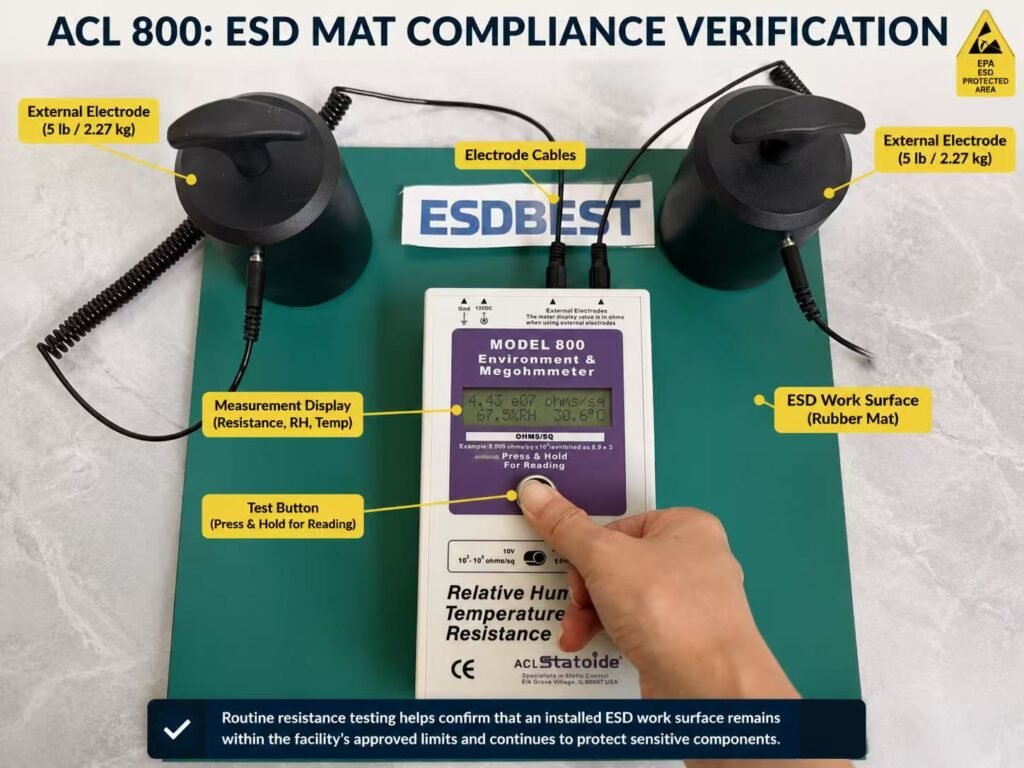
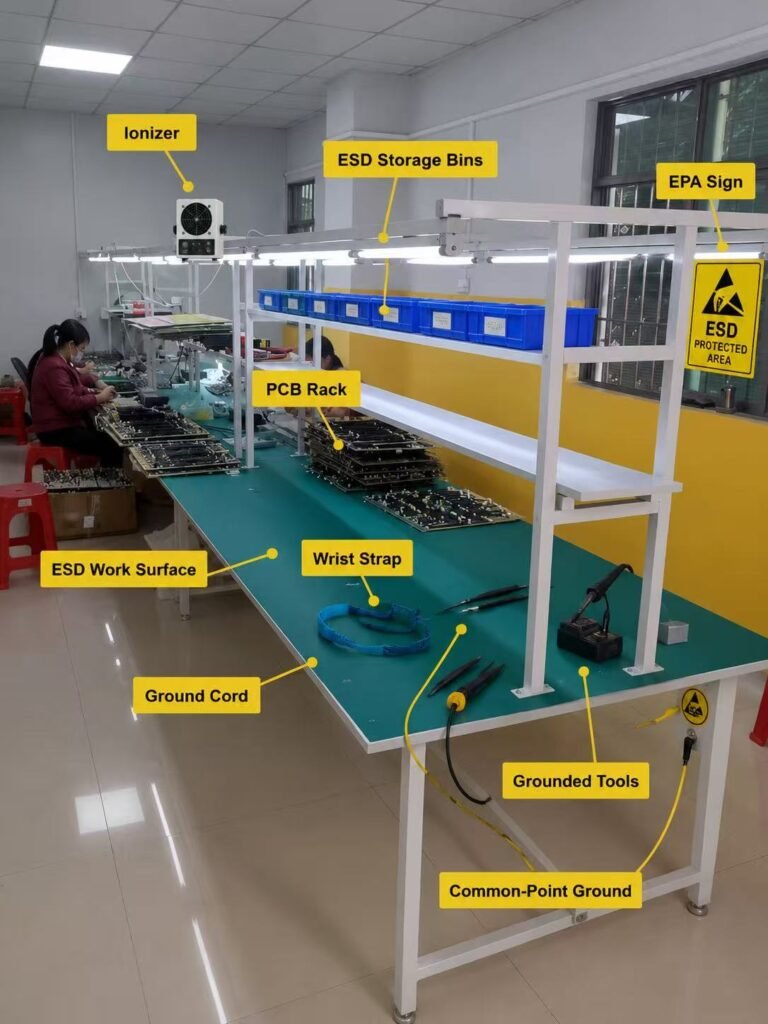
Product Qualification and Low Humidity
Humidity can affect the electrical performance of many materials.
A product that performs adequately at moderate relative humidity may become more resistive under dry conditions.
Product qualification should therefore consider the lowest humidity expected at the facility or the conditioning requirements specified by the applicable test method.
This is particularly important for:
- Worksurface materials
- Flooring
- Footwear-flooring systems
- Packaging
- Garments
- Gloves
- Plastic materials
Qualification testing performed only under favorable laboratory conditions may not represent the facility’s worst operating environment.
The organization should record environmental conditions rather than simply writing “passed.”
Step 5: Create a Compliance Verification Plan
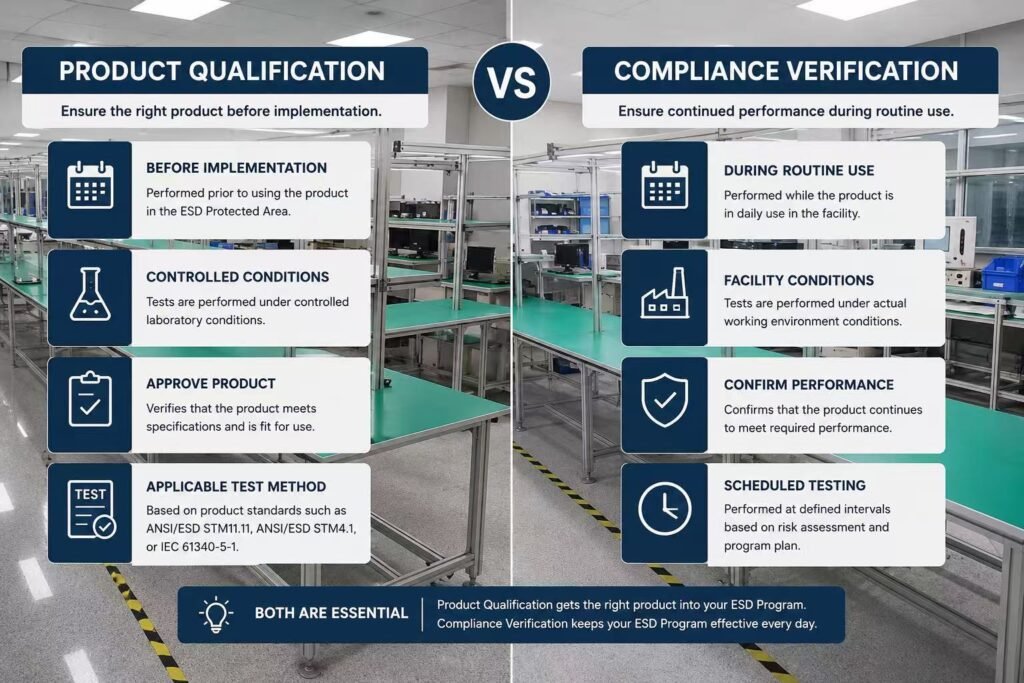
Product qualification and compliance verification are not the same.
Product Qualification
Answers:
Can this product or control method meet the required performance before it is approved for use?
Compliance Verification
Answers:
Is the product or control method still performing correctly after it has been installed and used?
Compliance verification is an ongoing process.
A Compliance Verification Plan should define:
| Control item | Test method | Limit | Frequency | Responsible person | Record |
|---|---|---|---|---|---|
| Wrist straps | System test | Program-defined limit | Daily or before use | Operator | Tester log |
| Work surfaces | Resistance to ground | Applicable program limit | Scheduled | ESD technician | Verification record |
| Floor | Resistance measurement | Applicable program limit | Scheduled | ESD technician | Floor map |
| Footwear | Personnel tester | Program-defined limits | Before EPA entry | Operator | Electronic log |
| Ionizer | Offset voltage and decay | Approved limits | Scheduled | Technician | Ionizer record |
| Ground points | Continuity/resistance | Approved limit | Scheduled | Maintenance | Grounding log |
| Carts | Resistance to ground | Approved limit | Scheduled | Technician | Equipment record |
| Packaging | Inspection/test | Approved specification | Receiving or periodic | Quality | Inspection record |
Test frequencies should be based on:
- Product reliability
- Usage
- Wear
- Environment
- Historical failures
- Customer requirements
- Manufacturer recommendations
- Risk assessment
Avoid copying another factory’s frequencies without considering your own processes.
Product Qualification vs Compliance Verification
| Item | Product Qualification | Compliance Verification |
| Purpose | Approve a product or method | Confirm continuing performance |
| Timing | Before implementation | During routine use |
| Frequency | Initial or after significant change | Periodic |
| Conditions | May include controlled conditioning | Usually facility conditions |
| Data source | Supplier, laboratory or internal testing | On-site measurements |
| Result | Approved or rejected | Pass, fail or corrective action |
| Documentation | Qualification report | Verification record |
One of the most common audit problems is presenting a supplier datasheet when the auditor requests routine compliance-verification records.
A datasheet does not prove that an installed work surface, floor or ionizer is still working correctly.
Step 6: Establish Personnel Grounding
People are major sources of electrostatic charge.
Walking, moving, removing clothing, handling plastic materials or rising from a chair can generate body voltage.
Personnel handling unprotected ESDS items should be connected to ground through a controlled grounding method.
Common methods include:
- Wrist straps
- Footwear-flooring systems
- Heel grounders
- Toe grounders
- ESD shoes
- Groundable static-control garments
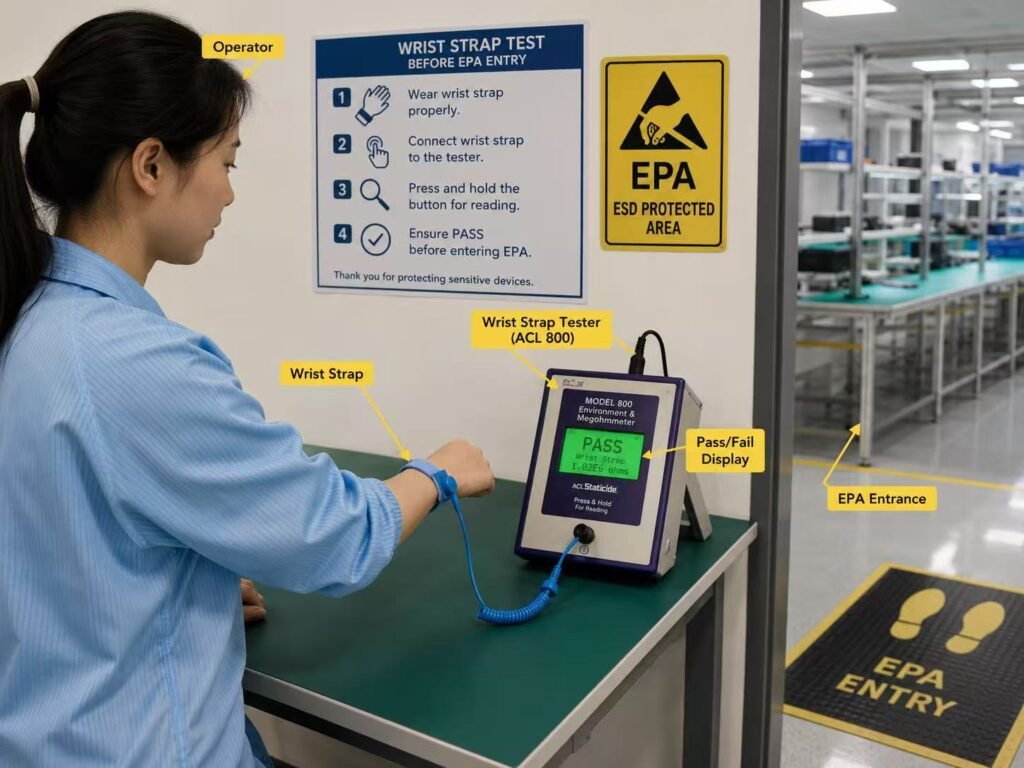
Wrist Strap Grounding
Wrist straps are commonly used for seated operators and fixed workstations.
A wrist-strap system typically includes:
- Wrist band
- Ground cord
- Current-limiting resistor
- Connection point
- Grounding conductor
- Common-point ground
The wrist band should make reliable contact with the operator’s skin.
Daily or continuous testing may be used depending on the facility’s program.
Common wrist-strap failures include:
- Loose wrist band
- Dirty contact surface
- Broken ground cord
- Incorrect connection
- Damaged resistor
- Operator wearing the strap over clothing
- Unverified extension cables
- Disconnected common-point ground
A wrist strap should not be clipped to an unverified metal object.
It must connect to an approved personnel-grounding point.
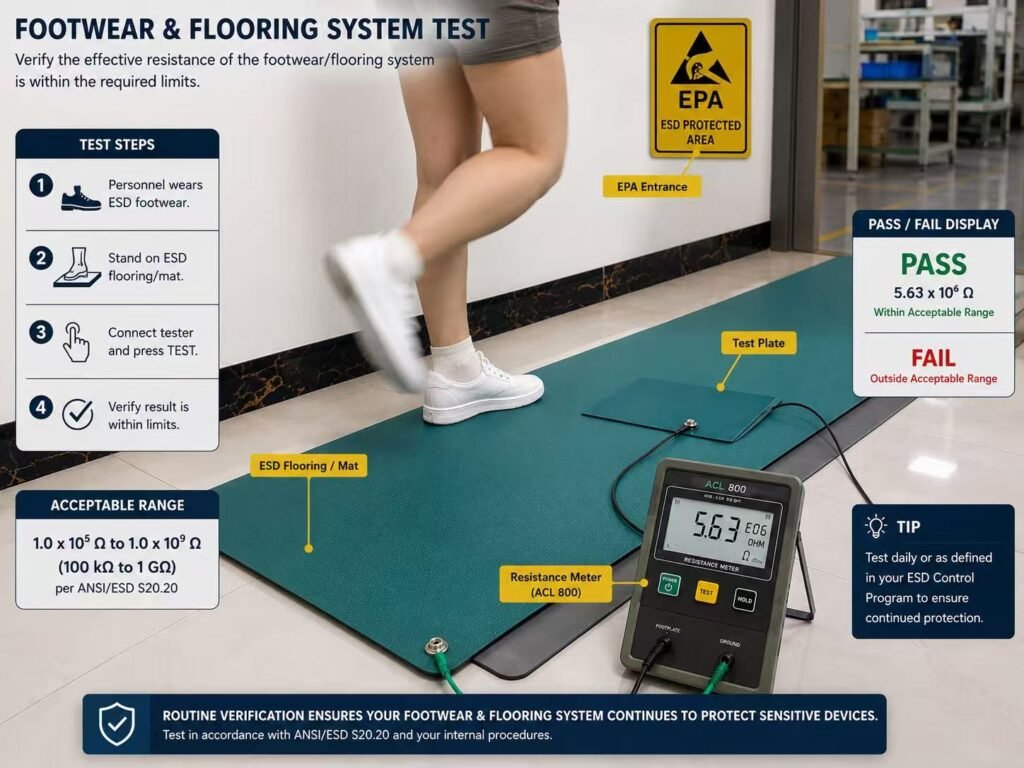
Footwear-Flooring Grounding
A footwear-flooring system allows standing or mobile personnel to dissipate charge through:
Person
↓
ESD footwear
↓
Compatible ESD floor
↓
Ground
Possible footwear includes:
- ESD shoes
- Heel grounders
- Toe grounders
- Conductive footwear
- Static-dissipative footwear
The floor and footwear should be treated as a complete system.
Buying ESD shoes does not guarantee adequate performance on an ordinary insulating floor.
A qualified footwear-flooring system may be evaluated through:
- Person-footwear-floor resistance
- Walking body-voltage generation
- Routine personnel testing
For a commonly referenced footwear-flooring method, total system resistance below 3.5 × 10⁷ ohms is paired with walking body-voltage control below 100 volts. The actual method used by the organization should follow its adopted standard, qualification data and control plan.
Wrist Straps vs ESD Shoes
| Operating condition | Preferred control |
| Seated bench work | Wrist strap |
| Standing production | Qualified footwear-flooring system |
| Mobile material handling | Qualified footwear-flooring system |
| Mixed seated and standing work | Combination defined by the ESD plan |
| Visitor access | Heel straps or approved visitor footwear |
| Continuous monitoring | Wrist-strap monitor where appropriate |
A seated operator should not rely only on footwear because both feet may lose contact with the floor.
Step 7: Establish ESD Worksurface Controls
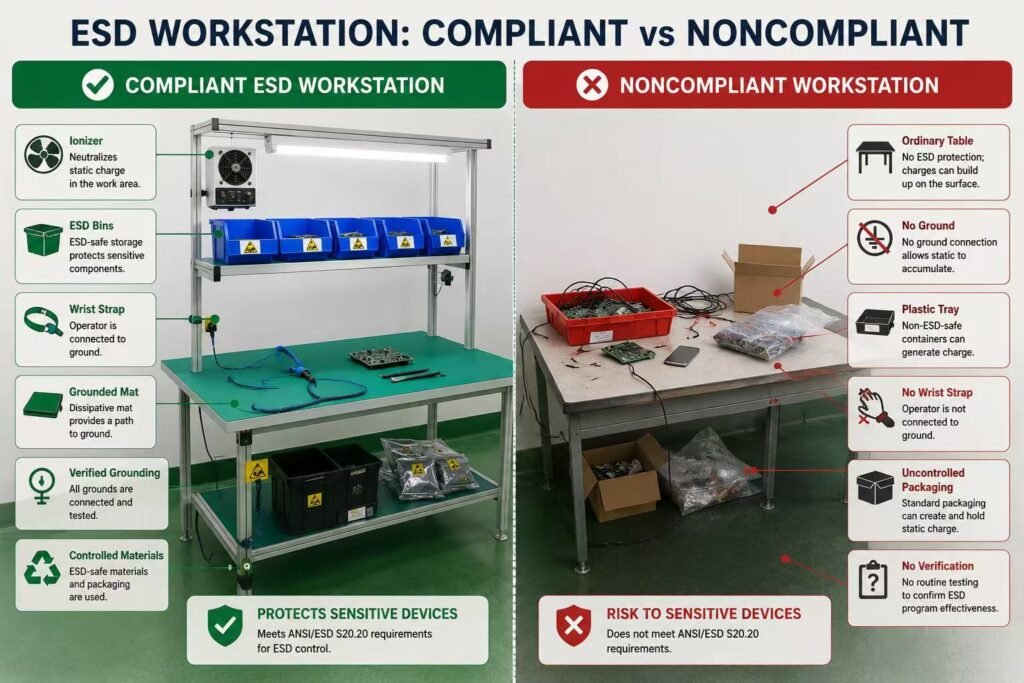
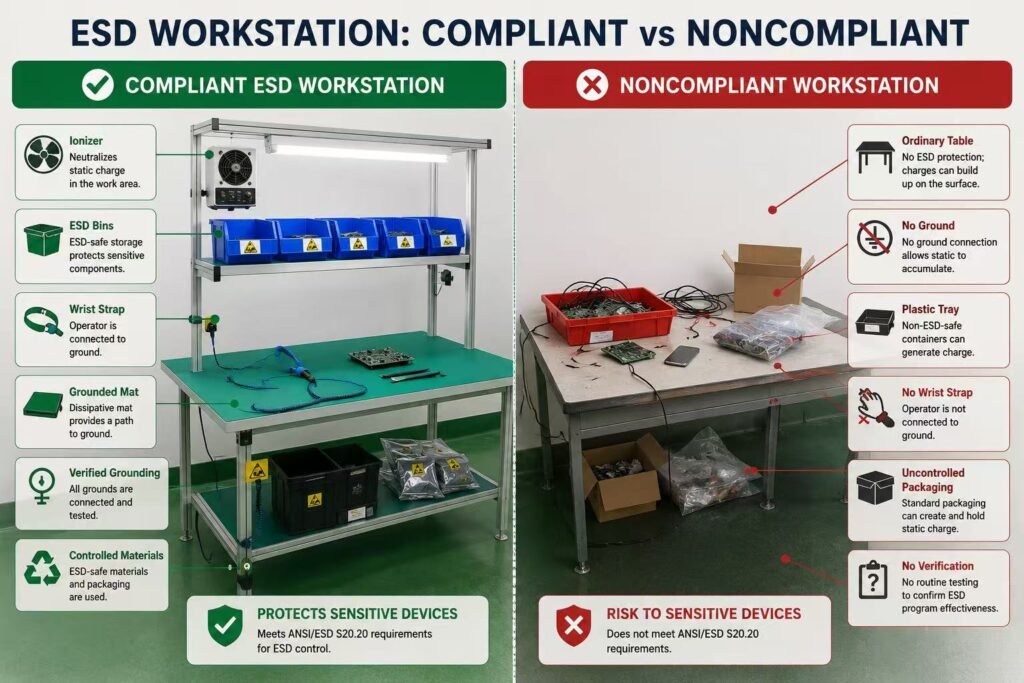
An ESD work surface provides a controlled area for handling ESDS items.
Typical work surfaces include:
- Rubber ESD bench mats
- Static-dissipative laminates
- Conductive work surfaces
- ESD shelving
- Grounded workbench surfaces
- Mobile-cart surfaces
An ESD work surface should:
- Be qualified before use
- Provide controlled charge dissipation
- Be connected to an approved ground
- Be verified periodically
- Be kept clean
- Remain free from insulating contamination
- Be clearly identified as part of the EPA
A commonly cited range for protective worksurfaces is approximately 1.0 × 10⁶ to 1.0 × 10⁹ ohms resistance to ground, although the organization must follow the limits and test methods defined in its adopted program.
Grounding an ESD Worksurface
A typical grounding arrangement includes:
ESD Worksurface
↓
Mat Grounding Snap
↓
Ground Cord
↓
Common-Point Ground
↓
Equipment Ground
Important requirements include:
- Use an identified grounding point.
- Avoid improvised grounding connections.
- Verify the common-point ground.
- Inspect cords and snaps.
- Prevent accidental disconnection.
- Test resistance to ground periodically.
- Document test results.
- Replace damaged grounding hardware.
The work surface should not be grounded through an unknown machine frame, painted metal, plumbing line or unrelated electrical structure.
Step 8: Control Conductors
Conductive objects can accumulate or transfer charge when they are not grounded.
Examples include:
- Metal tools
- Fixtures
- Shelving
- Carts
- Equipment housings
- Containers
- Machine parts
- Soldering equipment
- Test fixtures
- Metal trays
All conductors within the ESD-controlled process should be:
- Grounded
- Bonded to a common reference
- Removed from the area
- Otherwise controlled
Potentially dangerous isolated conductors should be identified during process assessment.
Common examples include:
- Ungrounded metal tweezers
- Floating metal fixtures
- Unconnected machine parts
- Metal trays on insulating surfaces
- Tools with insulating handles and exposed metal tips
- Unbonded carts
- Unsupported metal shelves
Grounding a workbench does not automatically ground every conductive object placed on it.
Contact resistance, coatings, feet, adhesives and insulating layers can interrupt the path.
Step 9: Control Process-Essential Insulators
Insulators do not readily lose charge through grounding.
Common insulators in electronics manufacturing include:
- Plastic bags
- Foam
- Adhesive tape
- Plastic trays
- Document sleeves
- Ordinary binders
- Styrene packaging
- Acrylic guards
- Plastic bottles
- Labels
- Clothing
- Machine covers
- Cable insulation
The preferred approach is:
- Remove unnecessary insulators.
- Replace them with ESD-control alternatives.
- Increase distance from ESDS items.
- Use ionization where removal is not practical.
- Evaluate the electrostatic field or charge.
- Document process-essential insulators.
Ionization is not a substitute for grounding conductive objects or personnel.
It is used mainly where charge cannot be removed effectively through grounding, especially on insulating materials and isolated objects.
Step 10: Use Ionization Correctly
Ionizers produce positive and negative ions that help neutralize charge on insulating materials and isolated objects.
Common ionizer types include:
- Benchtop ionizers
- Overhead ionizers
- Ionizing air guns
- Ionizing nozzles
- In-tool ionizers
- Cleanroom ionizers
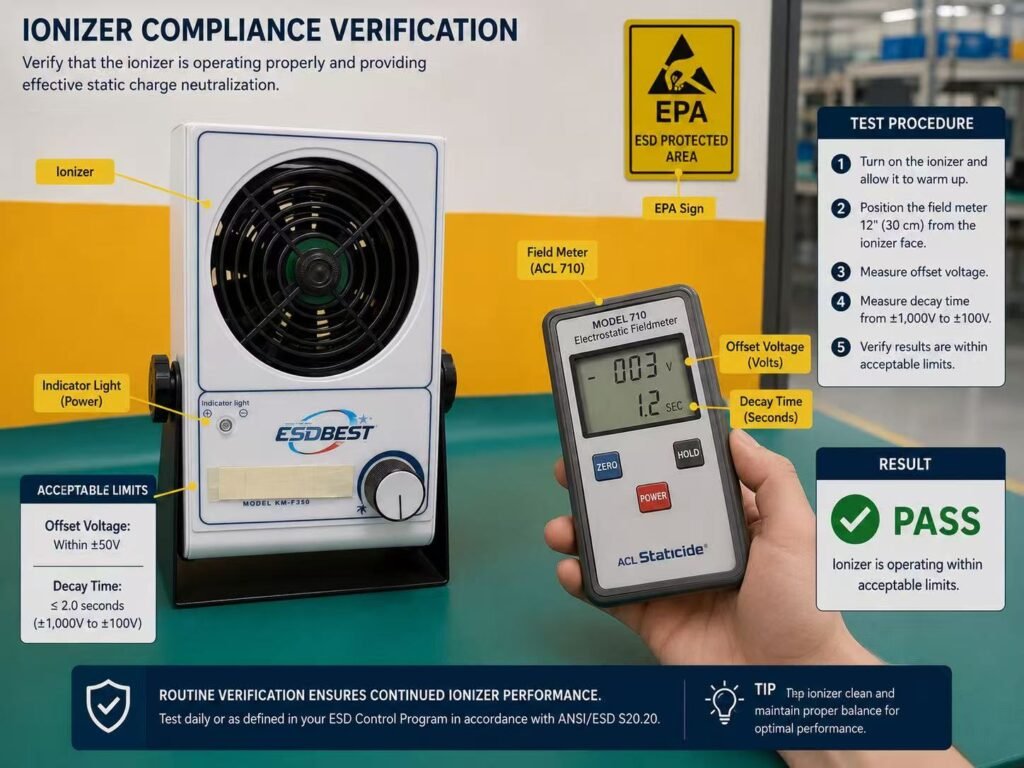
Ionizer qualification and verification may include:
- Offset voltage
- Positive decay time
- Negative decay time
- Test distance
- Airflow setting
- Environmental conditions
- Electrode condition
- Installation position
A factory should not assume an ionizer is working because the fan is operating.
Ionizer performance can deteriorate because of:
- Dirty emitter points
- Incorrect distance
- Obstructed airflow
- Poor positioning
- Electrical faults
- Incorrect settings
- Maintenance problems
Ionizers require scheduled cleaning and verification.
Step 11: Establish an ESD Protected Area
An ESD Protected Area, or EPA, is a defined area where ESDS items can be handled under controlled conditions.
An EPA may be:
- A single workbench
- A repair station
- A production line
- A storage area
- A laboratory
- A cleanroom
- An inspection station
- A complete production room
Typical EPA controls include:
- Grounded work surfaces
- Personnel grounding
- ESD flooring
- Approved footwear
- Ionization
- Grounded tools
- ESD-safe storage
- Approved packaging
- ESD signs
- Access control
- Training
- Compliance verification
Unprotected ESDS items should be handled inside an EPA unless appropriate protective packaging or covering is being used.
ESD Protected Area Checklist
Area Identification
- EPA boundaries are clearly defined.
- ESD warning signs are visible.
- Entry requirements are posted.
- Visitors are controlled.
- Unauthorized materials are restricted.
Personnel
- Operators are trained.
- Grounding devices are worn correctly.
- Personnel testing is completed.
- Failed tests trigger corrective action.
- Records are retained where required.
Workstations
- ESD work surfaces are grounded.
- Ground cords are intact.
- Common-point grounds are identified.
- Wrist-strap points are available.
- Work surfaces are clean.
- Ground connections are verified.
Materials
- Ordinary plastic bags are removed.
- Approved ESD packaging is used.
- Process-essential insulators are identified.
- Conductive containers are grounded where required.
- Documents and labels are controlled.
Equipment
- Metal equipment parts are grounded.
- Carts and racks are verified.
- Tools are approved for EPA use.
- Ionizers are positioned correctly.
- Test equipment calibration is current.
Documentation
- ESD Control Program Plan is current.
- Qualification records are available.
- Verification records are complete.
- Training records are available.
- Failed tests have corrective-action records.
- Audit findings are closed.
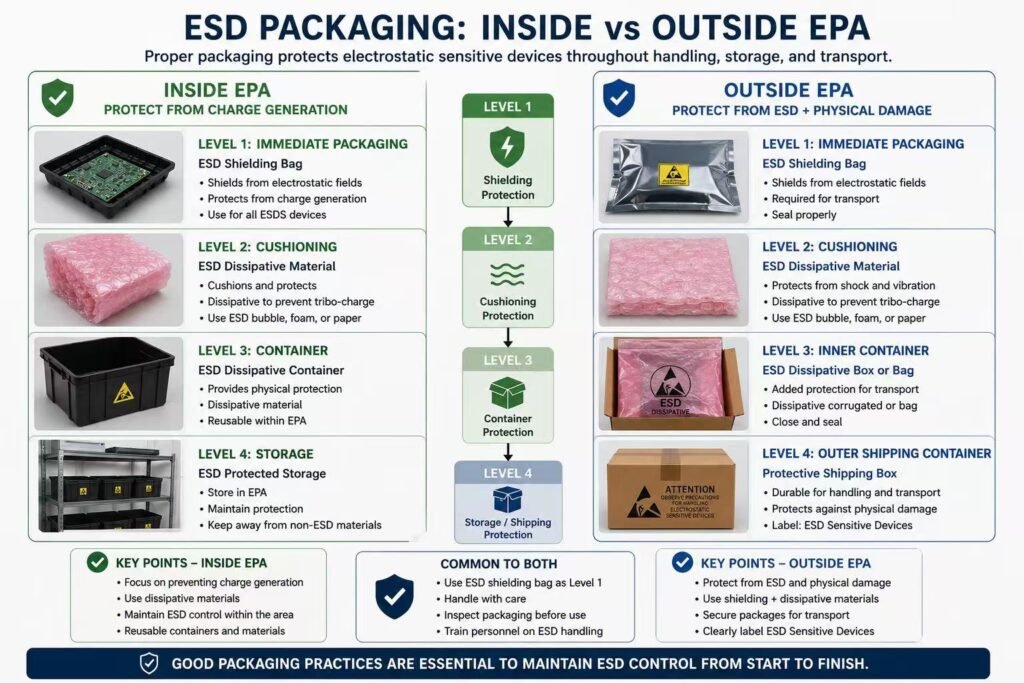
Step 12: Select and Control ESD Packaging
Packaging requirements depend on whether the ESDS item is inside or outside an EPA.
Inside an EPA
Packaging should:
- Avoid generating damaging charge
- Prevent direct discharge
- Maintain suitable electrical properties
- Be compatible with the process
Possible materials include:
- Static-dissipative bags
- Conductive containers
- ESD trays
- Conductive foam
- Dissipative foam
- ESD bins
- PCB racks
Outside an EPA
Additional protection may be required against:
- Electrostatic discharge
- External electrostatic fields
- Triboelectric charging
- Direct contact with charged objects
Static-shielding packaging is commonly used when sensitive devices leave the controlled area.
A pink anti-static bag and a static-shielding bag do not necessarily provide the same protection.
Packaging selection should be based on:
- Device sensitivity
- Transportation environment
- Handling process
- Mechanical protection
- Moisture requirements
- Reuse conditions
- Cleanliness requirements
Step 13: Control ESD Garments and Gloves
ESD garments and gloves should be evaluated as part of the process rather than selected only by appearance.
ESD Garments
Garments may help reduce:
- Charge generation from clothing
- Electrostatic fields from underlying garments
- Contamination
- Uncontrolled contact with sensitive products
Groundable garments may also form part of a personnel-grounding system when properly designed, worn and verified.
ESD Gloves and Finger Cots
Gloves may be selected for:
- ESD control
- Contamination control
- Fingerprint prevention
- Grip
- Cleanroom use
- Chemical compatibility
- Mechanical protection
Glove performance should be evaluated in the actual use configuration.
A glove marked “anti-static” should not automatically be assumed to provide an acceptable person-glove-grounding path.
Step 14: Establish Training Requirements
Training is a fundamental part of an effective ESD control program.
Employees should understand:
- What ESD is
- Why ESDS devices can be damaged
- Which products are sensitive
- Where the EPA begins and ends
- How to wear grounding devices
- How to test wrist straps or footwear
- Which packaging is allowed
- Which materials are prohibited
- How to report failed ESD controls
- How to handle ESDS items safely
Training should be provided:
- Before personnel perform ESD-sensitive work
- After procedure changes
- When new equipment is introduced
- After repeated nonconformities
- At intervals defined by the organization
Training effectiveness should be evaluated.
Possible methods include:
- Written test
- Practical demonstration
- Supervisor observation
- Competency checklist
- Refresher assessment
A training attendance sheet alone may not demonstrate that employees can correctly perform the required ESD procedures.
Step 15: Maintain Records
An ANSI/ESD S20.20-based program depends heavily on documented evidence.
Important records may include:
- ESD Control Program Plan
- Product qualification reports
- Compliance-verification logs
- Personnel grounding results
- Floor-test results
- Worksurface-test results
- Ionizer-test records
- Grounding verification
- Equipment calibration
- Training records
- Internal audits
- Corrective actions
- Supplier documentation
- Environmental records
- Packaging approvals
- Change-control records
Records should be:
- Legible
- Traceable
- Dated
- Approved
- Protected from unauthorized changes
- Retained for the defined period
- Available during audits
Step 16: Manage Failed ESD Tests
A failed test should lead to a controlled response.
A practical process is:
Detect failure
↓
Stop use or isolate affected area
↓
Protect exposed ESDS items
↓
Identify the failed control
↓
Investigate the cause
↓
Repair, clean or replace
↓
Retest
↓
Assess potentially affected product
↓
Document corrective action
↓
Return to service
Possible failure causes include:
- Broken ground cord
- Dirty work surface
- Worn footwear
- Incorrect cleaning chemical
- Disconnected floor ground
- Contaminated ionizer emitters
- Failed tester
- Incorrect test voltage
- Low humidity
- Operator misuse
- Unauthorized material changes
Do not simply retest repeatedly until a passing result appears.
Repeated failure may indicate a process problem requiring investigation.
Step 17: Conduct Internal ESD Audits
Internal audits help determine whether the ESD control program is both documented and effectively implemented.
An audit should review:
Program Management
- Is there an approved ESD Control Program Plan?
- Is the scope clear?
- Is a responsible coordinator identified?
- Is device sensitivity documented?
- Are changes controlled?
Product Qualification
- Are new control items qualified?
- Are reports complete?
- Are applicable test methods used?
- Are low-humidity conditions considered?
- Are model numbers traceable?
Compliance Verification
- Are all required items included?
- Are frequencies defined?
- Are tests completed on time?
- Are instruments calibrated?
- Are failed results investigated?
Personnel
- Are operators trained?
- Are wrist straps and footwear tested?
- Are grounding devices worn correctly?
- Are visitors controlled?
EPA
- Are boundaries clearly marked?
- Are unapproved materials present?
- Are work surfaces grounded?
- Are conductors controlled?
- Are process-essential insulators managed?
Packaging
- Is packaging appropriate inside and outside the EPA?
- Are opened or damaged bags controlled?
- Are reusable containers verified?
- Are ESDS labels used correctly?
Records
- Are records current?
- Are signatures and dates present?
- Are corrective actions closed?
- Can the organization trace a product to its qualification data?
ANSI/ESD S20.20 Audit Checklist
Use this abbreviated checklist before a customer or certification audit.
Program Documentation
-
Current ESD Control Program Plan
-
Defined program scope
-
Identified ESD coordinator
-
Documented lowest device sensitivity
-
Product Qualification Plan
-
Compliance Verification Plan
-
Training Plan
-
Packaging Plan
-
Tailoring statements where applicable
-
Corrective-action procedure
Product Qualification
-
Worksurface qualification
-
Flooring qualification
-
Wrist-strap qualification
-
Footwear qualification
-
Ionizer qualification
-
Packaging qualification
-
Garment qualification
-
Seating qualification
-
Glove qualification where applicable
-
Supplier reports linked to exact product models
Compliance Verification
-
Worksurface testing current
-
Floor testing current
-
Wrist-strap testing current
-
Footwear testing current
-
Ionizer testing current
-
Ground-point testing current
-
Cart and rack testing current
-
Test instruments calibrated
-
Failed tests investigated
-
Corrective actions documented
EPA Inspection
-
EPA signs displayed
-
Boundary defined
-
Ordinary plastic removed
-
Unprotected ESDS items handled only in EPA
-
Workstations grounded
-
Personnel grounded
-
ESD packaging available
-
Conductors grounded
-
Insulators controlled
-
Ionizers positioned correctly
Training
-
New employees trained
-
Refresher training completed
-
Practical competency evaluated
-
Training records retained
-
Visitors instructed
-
Supervisors understand failure response
Common ANSI/ESD S20.20 Compliance Mistakes
Mistake 1: Treating ESD Control as a Product-Purchasing Project
Buying mats and wrist straps does not create a compliant ESD program.
The organization needs documented selection, qualification, verification and corrective-action processes.
Mistake 2: Confusing Product Qualification with Routine Testing
Supplier qualification data and periodic facility verification serve different purposes.
Both may be required.
Mistake 3: Accepting “ESD Safe” Without Test Data
Marketing terms such as:
- ESD safe
- Anti-static
- Conductive
- Static dissipative
do not replace an applicable test report.
Mistake 4: Ignoring Low Humidity
Some materials perform differently during dry seasons.
Qualification should consider the facility’s lowest expected humidity.
Mistake 5: Testing Only the ESD Mat
A complete workstation may also require verification of:
- Ground cords
- Common-point ground
- Wrist straps
- Personnel
- Tools
- Shelving
- Ionizers
- Equipment
Mistake 6: Allowing Ordinary Plastic Inside the EPA
Plastic folders, bottles, tape, foam and packaging can generate significant charge.
Mistake 7: Failing to Control Visitors
Visitors can enter an EPA wearing ordinary shoes, clothing or carrying uncontrolled materials.
Mistake 8: Using an Ionizer Without Verification
Airflow does not prove charge-neutralization performance.
Mistake 9: No Response Procedure for Failed Tests
A failure log without containment, investigation and retesting is incomplete.
Mistake 10: Copying Another Factory’s ESD Plan
The plan should match the organization’s devices, processes, facility, environment and risk.
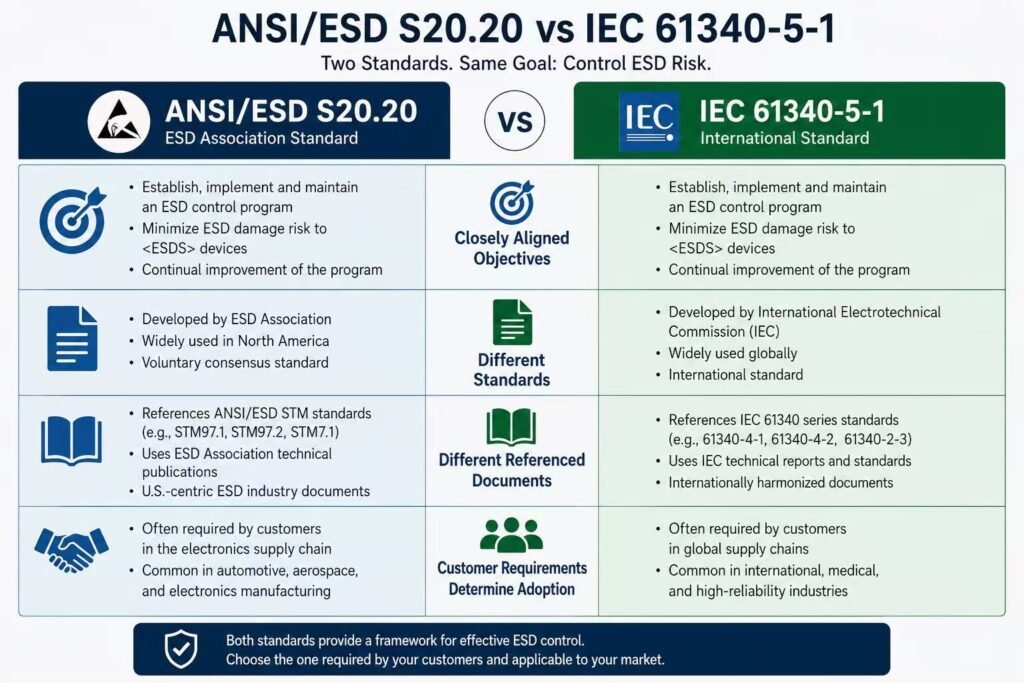
ANSI/ESD S20.20 vs IEC 61340-5-1
ANSI/ESD S20.20 and IEC 61340-5-1 are the two most widely recognized ESD control-program standards used in electronics manufacturing.
| Topic | ANSI/ESD S20.20 | IEC 61340-5-1 |
| Primary use | ESD control-program requirements | International ESD control requirements |
| Publisher | EOS/ESD Association | International Electrotechnical Commission |
| Geographic adoption | Strong in North America and global supply chains | Strong internationally |
| Program structure | Administrative and technical requirements | Technical and program requirements |
| Supporting guidance | ESD TR20.20 and referenced standards | IEC TR 61340-5-2 and referenced standards |
| Certification | Facility certification available through recognized programs | Certification may be offered through certification bodies |
| Core objective | Protect ESDS electronic items | Protect electronic devices from electrostatic phenomena |
The standards are closely aligned in overall purpose, but organizations should not assume every clause, limit or referenced test method is identical.
A company may choose its governing standard based on:
- Customer requirements
- Geographic market
- Existing quality system
- Certification goals
- Corporate policy
- Supplier requirements
Avoid claiming that a product is “ANSI/ESD S20.20 certified.”
ANSI/ESD S20.20 applies primarily to an organization’s control program. Individual products may be tested or qualified according to applicable referenced test methods, but that is not the same as certifying the product to the entire program standard.
Can a Factory Be ANSI/ESD S20.20 Certified?
Yes, organizations may pursue facility certification based on ANSI/ESD S20.20 through an appropriate certification process.
Certification generally evaluates whether the organization has established and implemented an effective ESD control program.
It does not mean that every ESD problem can never occur.
Certification typically requires evidence such as:
- Program documentation
- Product qualification
- Compliance-verification records
- Training
- Internal audits
- Corrective actions
- EPA implementation
- Management support
- Continued surveillance or reassessment
Organizations should distinguish among:
- Standard compliance
- Customer audit approval
- Internal program conformance
- Third-party facility certification
- Product test reports
These terms should not be used interchangeably.
How ESDBEST Supports an ESD Control Program
ESDBEST supplies static-control products that can support electronics factories implementing an ESD control program.
Available product categories include:
ESD Worksurfaces
- Two-layer rubber ESD bench mats
- Custom-size workbench mats
- Grounding cords
- Common-point grounds
- Table-mat accessories
ESD Flooring
- Two-layer rubber ESD floor mats
- Custom floor-mat dimensions
- Grounding accessories
- Floor-mat connection hardware
Personnel Grounding
- Wrist straps
- Coil cords
- Heel grounders
- ESD shoes
- ESD garments
- ESD gloves
Ionization
- Benchtop ionizers
- Overhead ionizers
- Ionizing air guns
- Ionizing nozzles
Material Handling
- ESD bins
- PCB racks
- Conductive containers
- ESD bags
- Static-control packaging
Workstations
- ESD workbenches
- Shelving
- Lighting
- Grounding systems
- Custom workstation configurations
Before purchasing, provide:
- Application
- Device sensitivity
- Existing floor or work surface
- Required test method
- Resistance requirements
- Dimensions
- Order quantity
- Required reports
- Packaging requirements
- Destination
Request an ESD Product Recommendation
Email: sales2@esdbest.com
Phone/WhatsApp: +86 137 1427 2599
Frequently Asked Questions
What is ANSI/ESD S20.20?
ANSI/ESD S20.20 is a standard for establishing, implementing and maintaining an electrostatic discharge control program for sensitive electrical and electronic parts, assemblies and equipment.
What is the current version of ANSI/ESD S20.20?
The current published edition is ANSI/ESD S20.20-2021.
Is ANSI/ESD S20.20 mandatory?
It is not automatically a law for every factory. It may become contractually or commercially required through customer specifications, supplier agreements, certification requirements or corporate quality policies.
What companies need ANSI/ESD S20.20?
Companies manufacturing, assembling, testing, storing, packaging or servicing sensitive electronic devices may use the standard.
Does ANSI/ESD S20.20 apply to PCB assembly?
Yes. PCB assembly processes frequently handle ESDS components and assemblies, making a documented ESD control program important.
What is an ESD Control Program Plan?
It is the main document defining the scope, responsibilities, grounding, qualification, verification, training, packaging and other controls used by an organization.
What is an ESD Protected Area?
An EPA is a controlled area where unprotected ESDS items may be handled using approved ESD controls.
What is product qualification?
Product qualification is the process of demonstrating that an ESD control item can meet the required performance before it is approved for use.
What is compliance verification?
Compliance verification is periodic testing that confirms installed or in-use ESD controls continue to meet the program requirements.
Are product qualification and compliance verification the same?
No. Qualification approves an item or method; verification confirms that it continues to perform after implementation.
Does an ESD mat need to be grounded?
Yes. A dissipative or conductive mat requires a verified connection to an approved grounding point to provide an effective path to ground.
What resistance should an ESD work surface have?
The required limit depends on the adopted program and test method. Protective worksurfaces are commonly designed within the dissipative range and must meet the applicable resistance-to-ground requirements.
How often should an ESD mat be tested?
Frequency should be defined by the Compliance Verification Plan based on risk, usage, wear, environment and historical performance.
Are wrist straps required?
Wrist straps are commonly used for seated personnel and other operations where reliable personnel grounding is required.
Can ESD shoes replace wrist straps?
Not in every situation. Seated operators may lose footwear contact with the floor and may still require wrist-strap grounding.
Do ESD shoes work on normal floors?
Not necessarily. Footwear must be evaluated with a compatible grounded flooring system.
Is an ionizer required in every EPA?
No. Ionization is normally used where essential insulating materials or isolated objects cannot be effectively controlled through grounding.
Does humidity replace ESD controls?
No. Humidity may influence charge generation and material resistance, but it should not be used as the only ESD control method.
Can ordinary plastic be used in an EPA?
Unnecessary charge-generating insulators should generally be removed or replaced. Process-essential insulators should be controlled through distance, ionization or another documented method.
Does an ESD product need certification?
Products generally require applicable qualification data. This is different from claiming that an individual product is certified to the entire ANSI/ESD S20.20 program standard.
Can a factory become ANSI/ESD S20.20 certified?
Yes. Facility certification programs can assess whether an organization’s ESD control program conforms to the applicable requirements.
Is ANSI/ESD S20.20 the same as ISO 9001?
No. ISO 9001 is a general quality-management-system standard. ANSI/ESD S20.20 focuses specifically on ESD control for sensitive electronic items.
Is ANSI/ESD S20.20 the same as IEC 61340-5-1?
They have closely related objectives but are separate standards with their own wording, structure and referenced documents.
What documents are needed for an ESD audit?
Typical documents include the ESD Control Program Plan, qualification reports, verification logs, training records, calibration records, internal audits and corrective actions.
What is the biggest ESD audit mistake?
One of the most common problems is having ESD products in place without complete qualification, routine verification or documented corrective actions.
Download the ANSI/ESD S20.20 Implementation Checklist
Use this checklist to evaluate:
- Program scope
- Device sensitivity
- Personnel grounding
- Workstation grounding
- Flooring and footwear
- Ionization
- Packaging
- Product qualification
- Compliance verification
- Training
- Documentation
- Audit readiness
Download the Checklist
Build a Complete ESD Control System
A compliant ESD process does not depend on one product.
A complete program may require:
- ESD work surfaces
- Common-point grounds
- Wrist straps
- Personnel testers
- ESD flooring
- ESD shoes
- Ionizers
- ESD garments
- ESD gloves
- ESD packaging
- Conductive storage
- Resistance-test equipment
- Training
- Verification records
Contact ESDBEST for product specifications, samples, grounding accessories and customized ESD workstation solutions.
📞 Contact Us Today
For bulk orders, quotes, or product guidance, get in touch with our expert team:
Email: sales2@esdbest.com
Whatsapp: +86 137 1427 2599