Complete Guide for Electronics Manufacturing
ESD Workbench Mat: Complete Guide for Electronics Manufacturing
ESD Workbench Mat: Complete Guide for Electronics Manufacturing
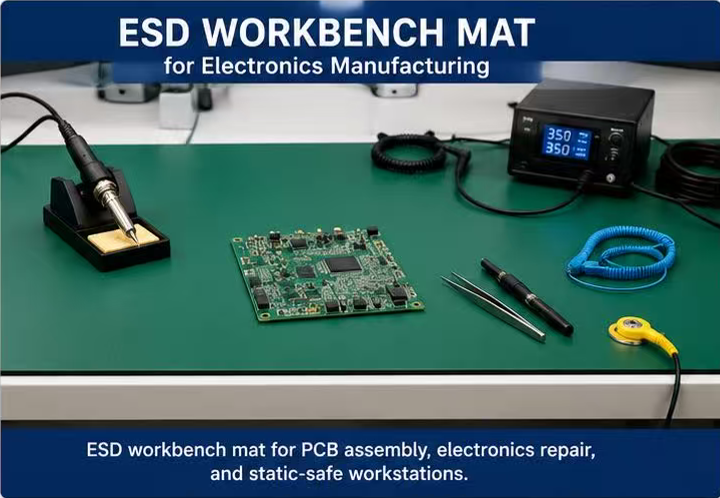
An ESD workbench mat is one of the most important parts of an electrostatic discharge protected workstation. In electronics manufacturing, PCB assembly, SMT production, repair labs, semiconductor handling, and cleanroom work areas, static electricity can damage sensitive components before the damage is even visible.
A normal workbench may look clean and safe, but it does not provide controlled static dissipation. When operators handle PCB boards, IC chips, sensors, connectors, or electronic modules on a non-ESD surface, static charges can build up and discharge suddenly. This may cause immediate product failure, hidden component damage, or long-term reliability problems.
An ESD workbench mat is designed to create a static-safe working surface. It helps dissipate electrostatic charges in a controlled way and connects the work surface to a verified ground through a grounding cord or common point ground. For electronics manufacturers, using the right ESD mat is not only about protecting products. It is also about reducing defects, improving quality control, and supporting ESD program compliance.
At ESDBEST, we supply ESD workbench mats for electronics manufacturing, PCB assembly, SMT production lines, repair stations, and industrial ESD protected areas.
Quick Answer: What Is An ESD Workbench Mat?
An ESD workbench mat is a static dissipative mat installed on an electronics workbench to protect sensitive components from electrostatic discharge. It provides a controlled resistance surface and is normally connected to ground through a grounding cord, snap, and common point ground. A proper ESD workbench mat helps create a safe working area for PCB assembly, electronics repair, and semiconductor handling.
Why ESD Workbench Mats Are Important
Static electricity is invisible, but it can seriously damage electronic components. In many cases, operators do not feel the discharge because the voltage level is below the human sensation threshold. However, many electronic components can be damaged by much lower voltage levels.
This is why electronics workstations need more than a clean table. They need a controlled ESD surface.
An ESD workbench mat helps protect:
- PCB boards
- IC components
- Semiconductors
- Sensors
- Electronic modules
- SMT components
- Precision electronic assemblies
- Repair and testing devices
Without an ESD mat, static charge may remain on the work surface or transfer from the operator, tools, packaging, or the environment to the electronic component.
A good ESD workbench mat helps create a safer path for static charges to drain slowly and safely to ground.
How An ESD Workbench Mat Works
An ESD workbench mat works by providing a controlled static dissipative surface. Instead of allowing static electricity to remain on the workbench or discharge suddenly into a component, the mat allows electrostatic charges to move gradually toward ground.
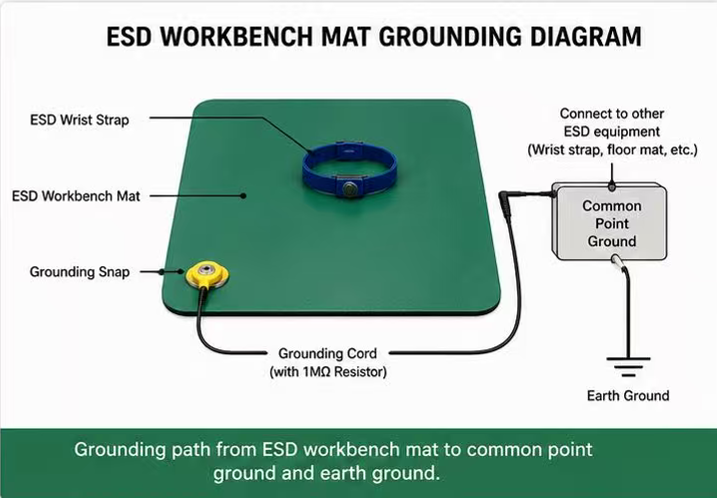
The typical grounding path is:
Operator / Component / Tool
        ↓
ESD Workbench Mat
        ↓
Grounding Cord
        ↓
Common Point Ground
        ↓
Earth Ground
For a complete ESD workstation, the mat is often used together with:
- ESD wrist strap
- Common point ground
- Grounding cord
- ESD gloves
- ESD tools
- ESD storage boxes
- ESD floor mat
- ESD shoes
- Ionizer if needed
The workbench mat is the center of the workstation. It protects the working surface where components are handled, assembled, tested, repaired, and packed.
📞 Contact Us Today
For bulk orders, quotes, or product guidance, get in touch with our expert team:
Email: sales2@esdbest.com
Whatsapp: +86 137 1427 2599
Recommended Resistance Range For ESD Workbench Mats
For most electronics workstations, an ESD workbench mat should be static dissipative rather than fully conductive or insulating.
Common resistance categories:
| Mat Type | Resistance Range | Use |
|---|---|---|
| Conductive Surface | 10³–10⁵ Ω | Fast discharge, special controlled use |
| Static Dissipative Surface | 10⁶–10⁹ Ω | Recommended for most electronics workstations |
| Insulative Surface | >10¹² Ω | Not suitable for ESD protection |
For PCB assembly and electronics manufacturing, the commonly recommended range is:
10⁶–10⁹ ΩThis range helps drain static charges in a controlled way without creating an overly fast discharge path.
ESD Workbench Mat vs Anti Static Workbench Mat
Many buyers search for “anti static workbench mat,” but not all anti-static mats are suitable for electronics manufacturing.
An anti-static mat may reduce static generation, but it may not have a controlled resistance range or proper grounding system. An ESD workbench mat is designed for ESD protected areas and should be groundable and testable.
| Feature | ESD Workbench Mat | Anti Static Mat |
|---|---|---|
| Controlled resistance | Yes | Not always |
| Groundable | Yes | Not always |
| Suitable for PCB assembly | Yes | Limited |
| Used in EPA areas | Yes | Not always |
| Can be tested | Yes | Not always |
| Best for electronics manufacturing | Yes | No, unless ESD rated |
If your application involves PCB assembly, IC handling, electronics repair, SMT production, or semiconductor components, choose an ESD workbench mat instead of a general anti-static mat.
Internal link:
<a href="/anti-static-mat-vs-esd-mat/">Learn the difference between ESD mats and anti-static mats</a>ESD Workbench Mat vs Normal Rubber Mat
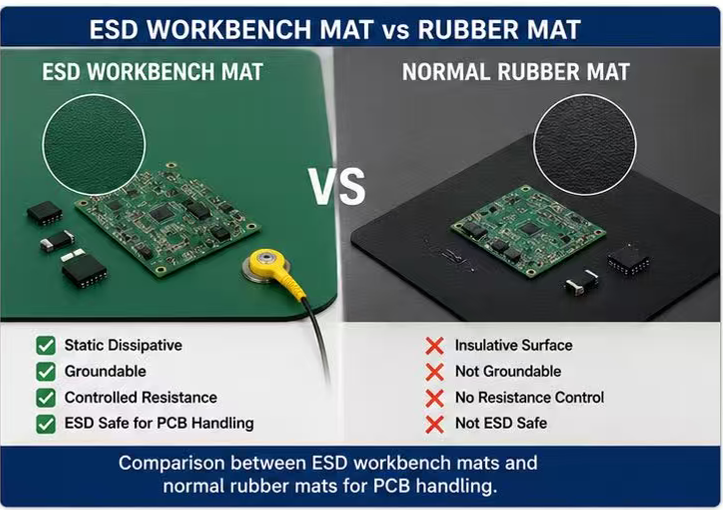
A normal rubber mat is not designed for electrostatic discharge control. It may be comfortable or durable, but it can act as an insulator. This means static charges may stay on the surface instead of safely draining away.
| Feature | ESD Workbench Mat | Normal Rubber Mat |
|---|---|---|
| Static dissipative | Yes | No |
| Grounding point | Yes | No |
| Suitable for PCB work | Yes | No |
| Resistance controlled | Yes | No |
| ESD safe | Yes | No |
A normal rubber mat should not be used as a replacement for an ESD workbench mat in electronics manufacturing.
Best Applications Of ESD Workbench Mats
ESD workbench mats are widely used in industries where static-sensitive devices are handled.
1. PCB Assembly
PCB assembly requires a clean, controlled, and static-safe work surface. Operators may handle bare boards, SMT components, soldered assemblies, and finished electronic products. An ESD mat helps reduce static risk during assembly, inspection, and repair.
2. SMT Production
In SMT lines, electronic components can be extremely sensitive to electrostatic discharge. ESD workbench mats are used in inspection stations, rework areas, testing benches, and manual assembly stations.
3. Electronics Repair
Repair technicians often open electronic devices, remove components, replace ICs, and test circuits. An ESD mat protects components during repair and helps create a professional repair workstation.
4. Semiconductor Handling
Semiconductors require strict ESD control. Workbench mats are often combined with wrist straps, ESD packaging, ionizers, and controlled humidity to reduce static risk.
5. Laboratory Workstations
Electronics laboratories, testing labs, and R&D centers use ESD mats to protect prototypes, testing boards, sensors, and development kits.
6. Medical Device Electronics
Medical electronic devices often require high reliability. ESD workbench mats help reduce hidden damage during assembly and inspection.
7. Aerospace And Automotive Electronics
High-reliability electronics require strong ESD control. ESD workbench mats support safe handling of modules, sensors, PCBs, and electronic control units.
How To Ground An ESD Workbench Mat
An ESD workbench mat must be properly grounded to work effectively. Without grounding, the mat may reduce static generation but cannot fully drain charge to earth ground.
Step 1: Place The Mat On The Workbench
Clean the workbench surface before installation. Make sure the mat lies flat and covers the main working area.
Step 2: Install The Snap Connector
Most ESD mats use a 10 mm snap or similar grounding point. Connect the snap firmly to the mat.
Step 3: Connect The Grounding Cord
Attach the grounding cord to the snap. The cord should include proper resistance where required and should be suitable for ESD workstation use.
Step 4: Connect To Common Point Ground
The mat should connect to a common point ground so the wrist strap and work surface share the same grounding reference.
Step 5: Verify Ground
Do not assume the ground is correct. Use proper testing tools to verify the grounding path.
How To Test An ESD Workbench Mat
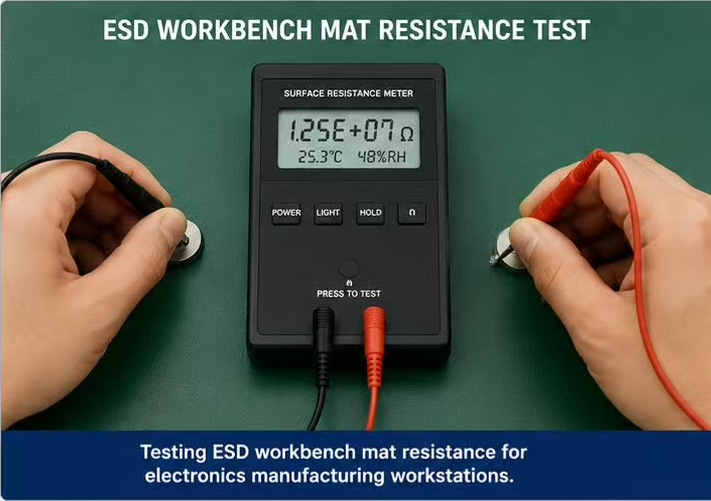
Testing is important because an ESD mat can look normal but fail electrically. Dirt, wear, chemicals, wrong cleaning methods, broken grounding cords, or poor connections can affect ESD performance.
Common ESD mat tests include:
1. Point-To-Point Resistance Test
This test checks the resistance between two points on the mat surface. It helps confirm whether the mat surface provides controlled resistance.
2. Point-To-Ground Resistance Test
This test checks the resistance from the mat surface to the grounding point. It confirms whether the mat is properly connected to ground.
3. Visual Inspection
Check for cracks, burns, swelling, chemical damage, broken snaps, loose cords, and surface contamination.
4. Regular Testing Schedule
For production areas, ESD mats should be tested regularly as part of the factory ESD control program.
Internal link:
How To Choose The Best ESD Workbench Mat
When choosing an ESD workbench mat, do not only compare price. A low-quality mat may look similar but fail resistance, grounding, durability, or surface performance requirements.
1. Choose The Right Resistance Range
For most electronics workstations, choose a static dissipative ESD mat in the 10⁶–10⁹ Ω range.
2. Choose The Right Material
Common ESD workbench mat materials include rubber, vinyl, and multi-layer ESD materials. For industrial electronics manufacturing, two-layer rubber ESD mats are often preferred because they provide durability, heat resistance, and stable electrical performance.
3. Choose The Right Thickness
Common thickness options include:
- 2 mm
- 3 mm
- 4 mm
For most workbench applications, 2 mm or 3 mm is commonly used.
4. Check Heat Resistance
If the workstation involves soldering or rework, choose a mat with suitable heat resistance.
5. Check Surface Texture
A good surface should be smooth enough for electronics handling but not too slippery. It should allow safe movement of tools, components, and PCB boards.
6. Confirm Grounding Accessories
A complete ESD workbench mat setup should include:
- ESD mat
- Snap connector
- Grounding cord
- Common point ground
- Wrist strap connection
- Testing method
7. Choose The Right Size
Common workbench mat sizes include:
- 600 × 900 mm
- 600 × 1200 mm
- 900 × 1200 mm
- Custom roll size
Factories can also use full roll materials and cut them according to workbench size.
ESD Workbench Mat Buying Guide
Before buying ESD workbench mats in bulk, ask these questions:
- What resistance range does the mat provide?
- Is it static dissipative?
- Can it be grounded?
- Is it suitable for PCB assembly?
- Does it include grounding accessories?
- What thickness is available?
- Can the supplier provide custom sizes?
- Is it suitable for soldering or repair work?
- Can the mat be tested with an ESD meter?
- Is it suitable for industrial electronics manufacturing?
For electronics factories, the best ESD workbench mat is not simply the cheapest mat. It should provide stable ESD performance, long service life, and reliable grounding.
ESD Workbench Mat Maintenance
To keep the mat working correctly, maintenance is important.
Recommended maintenance tips:
- Clean the mat regularly with ESD-safe cleaner
- Do not use wax, silicone, or oil-based cleaners
- Avoid cutting directly on the mat
- Avoid strong chemicals
- Check grounding cords regularly
- Test resistance regularly
- Replace damaged mats
- Keep the workbench clean and dry
A dirty or damaged ESD mat may fail resistance testing even if it was originally compliant.
Complete ESD Workstation Setup
An ESD workbench mat works best when it is part of a complete ESD workstation.
A complete setup may include:
- ESD workbench mat
- ESD wrist strap
- Common point ground
- Grounding cord
- ESD gloves
- ESD tools
- ESD storage bins
- ESD floor mat
- ESD shoes
- Ionizer
- ESD warning labels
- Regular testing tools
Internal links:
Why Choose ESDBEST ESD Workbench Mats?
ESDBEST supplies ESD mats and static control products for electronics manufacturing, PCB assembly, SMT lines, repair stations, and industrial ESD protected areas.
Our ESD workbench mats are designed for:
- Electronics manufacturing
- PCB assembly
- SMT production
- Repair workstations
- Semiconductor handling
- Industrial EPA areas
- Bulk factory supply
We can support standard sizes, roll materials, custom cutting, and bulk purchasing for factories and distributors.
For ESD workbench mat inquiries, contact:
FAQ
What is an ESD workbench mat?
An ESD workbench mat is a static dissipative mat used on electronics workbenches to protect sensitive components from electrostatic discharge.
Do ESD workbench mats need to be grounded?
Yes. An ESD workbench mat should be connected to ground through a grounding cord, snap, and common point ground.
What resistance should an ESD workbench mat have?
For most electronics workstations, a static dissipative resistance range of 10⁶–10⁹ Ω is commonly recommended.
Can I use a normal rubber mat instead of an ESD mat?
No. A normal rubber mat is not designed for electrostatic discharge control and may act as an insulator.
What is the difference between an ESD mat and an anti-static mat?
An ESD mat usually has controlled resistance and can be grounded. A general anti-static mat may reduce static generation but may not be suitable for electronics manufacturing.
How often should an ESD workbench mat be tested?
In production areas, ESD mats should be tested regularly according to the factory’s ESD control program.
What is the best ESD mat for PCB assembly?
A static dissipative, groundable ESD workbench mat with stable resistance and good durability is recommended for PCB assembly.
Can ESD workbench mats be customized?
Yes. ESD workbench mats can usually be supplied in standard sizes, rolls, or custom-cut sizes for different workstations.
📞 Contact Us Today
For bulk orders, quotes, or product guidance, get in touch with our expert team:
Email: sales2@esdbest.com
Whatsapp: +86 137 1427 2599