ESD Mat Guide: What Is an ESD Mat and Why It Matters

Intro

In electronics manufacturing, static electricity is not just annoying. It is a real threat to product quality, reliability, and safety. A small electrostatic discharge can damage sensitive components long before a worker feels any shock. That is why ESD control is a basic requirement in electronics assembly, repair, testing, packaging, and clean manufacturing environments.

One of the most important tools in an ESD-safe workstation is the ESD mat.

An ESD mat helps control static electricity on benches, tables, and floors by creating a controlled path for charge dissipation. It protects sensitive components from sudden discharge, reduces the risk of hidden damage, and helps create a more stable electrostatic protected area.

In this complete guide, you will learn:

  • What an ESD mat is

  • How an ESD mat works

  • ESD mat vs anti static mat

  • Conductive vs dissipative mat differences

  • Bench mat vs floor mat applications

  • How to choose the right ESD mat for your workplace

  • Common installation and grounding mistakes

  • How ESD mats fit into a complete ESD protection system

If you are building or upgrading an electronics workstation, this is the page to start with.

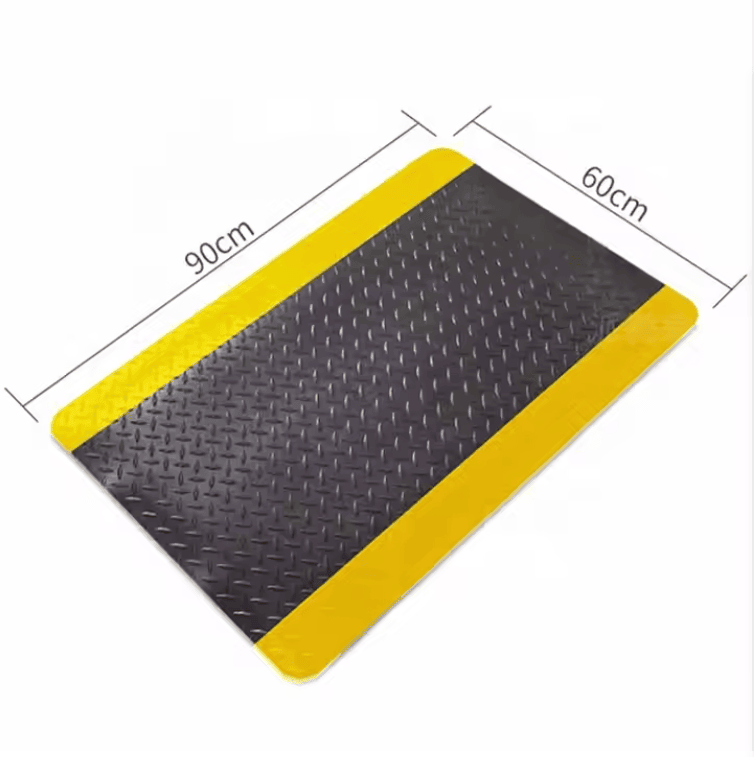
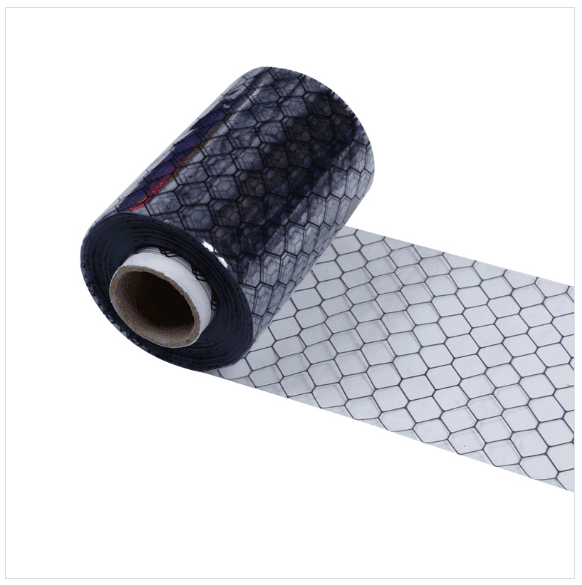
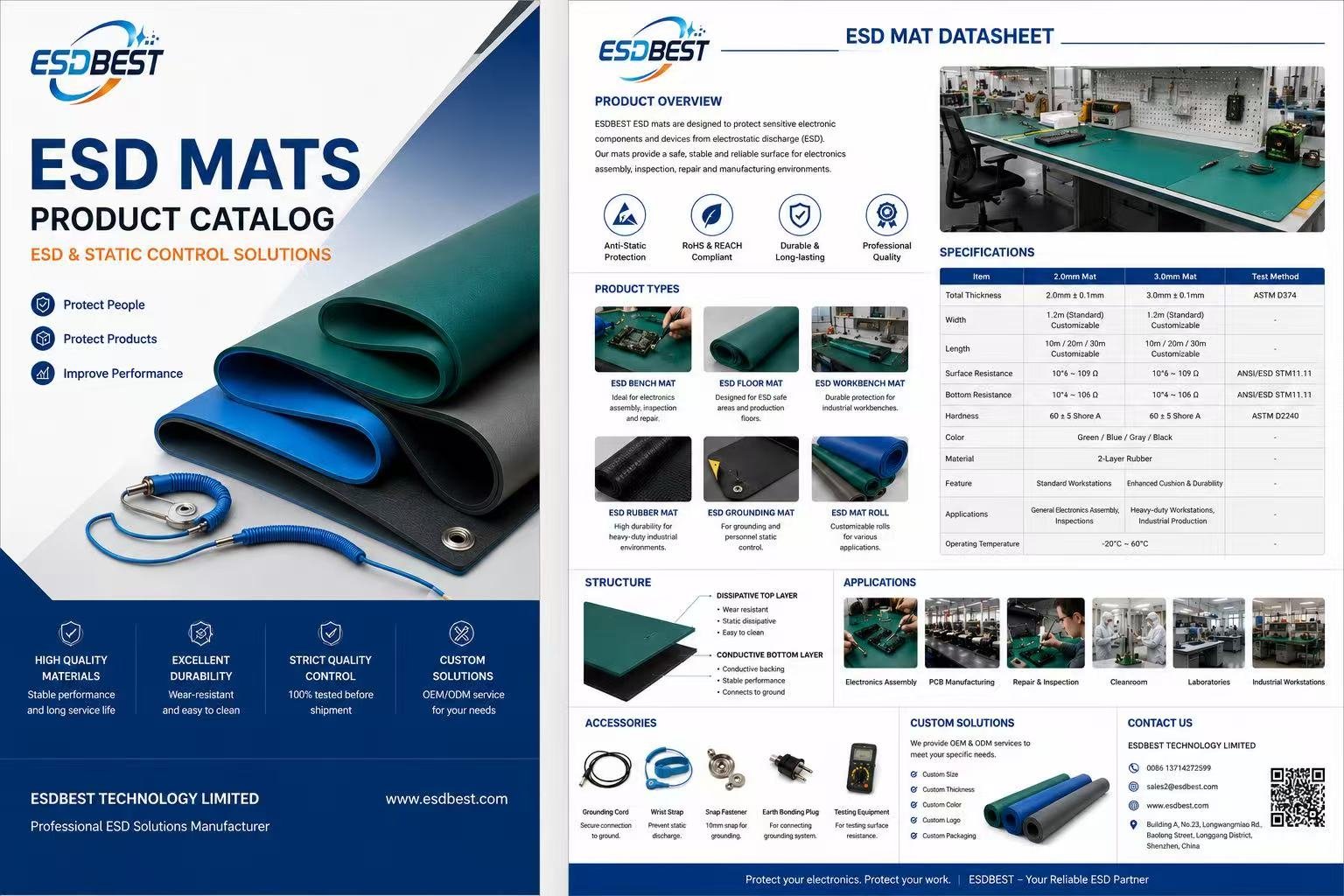
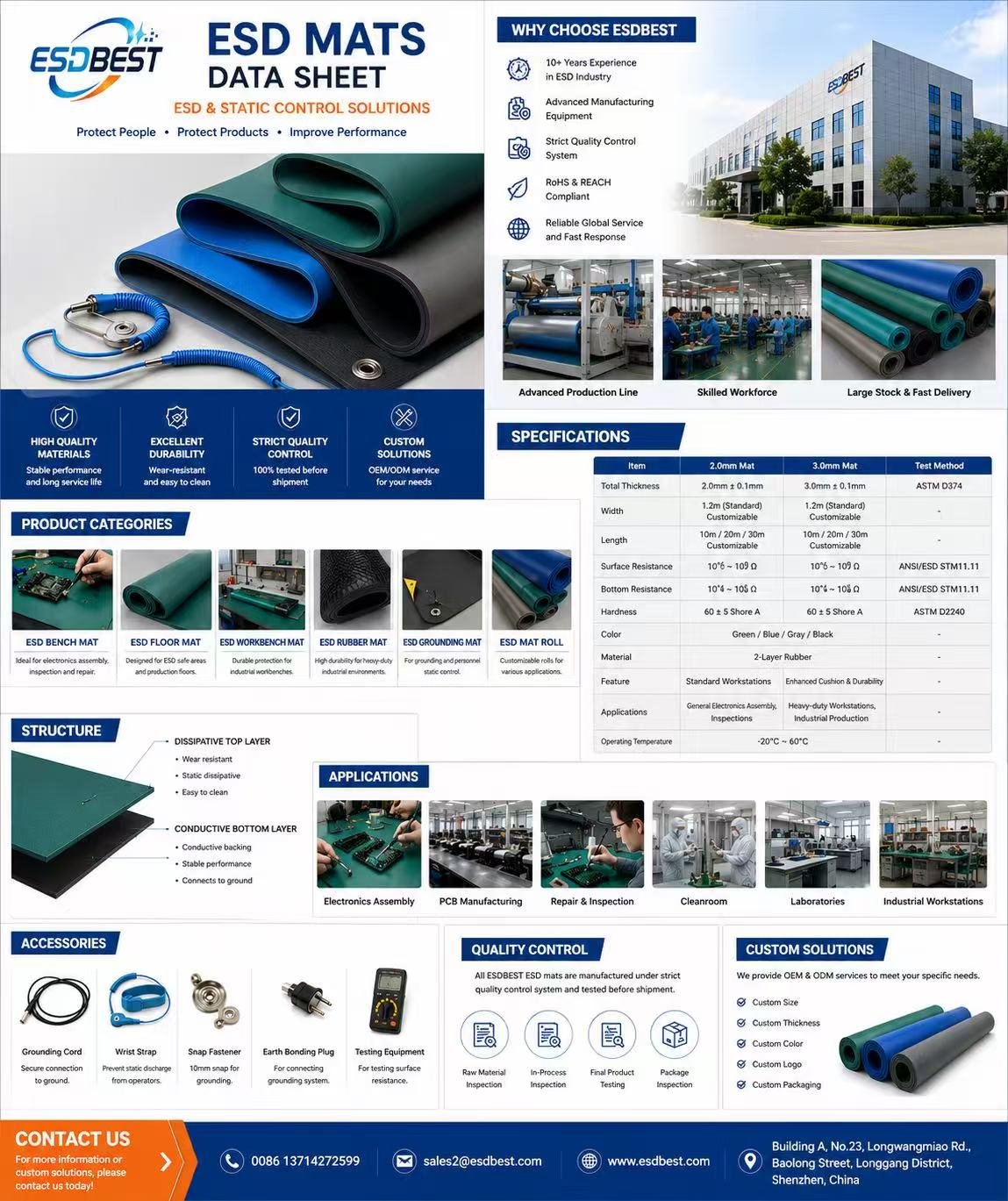
ESDBEST’s range of esd mat and esd floor mat is designed to provide reliable grounding when working with static-sensitive equipment.our product include:mat esd,dual layer ESD floor mat,esd mat grounding,esd earthing mat
Available in a variety of sizes, colors, and stud configurations, our ESD mats are suitable for all types of workstations and applications.📞 Contact us today to learn more or place an order: 0086 137 1427 2599

ESD Mat for ESD Applications

Parameter Specification
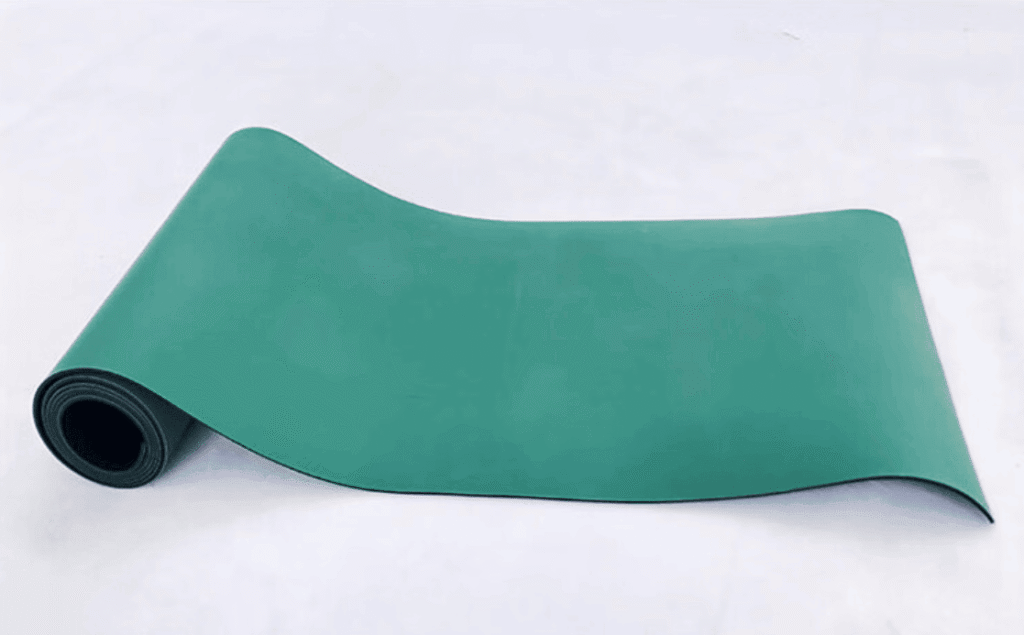
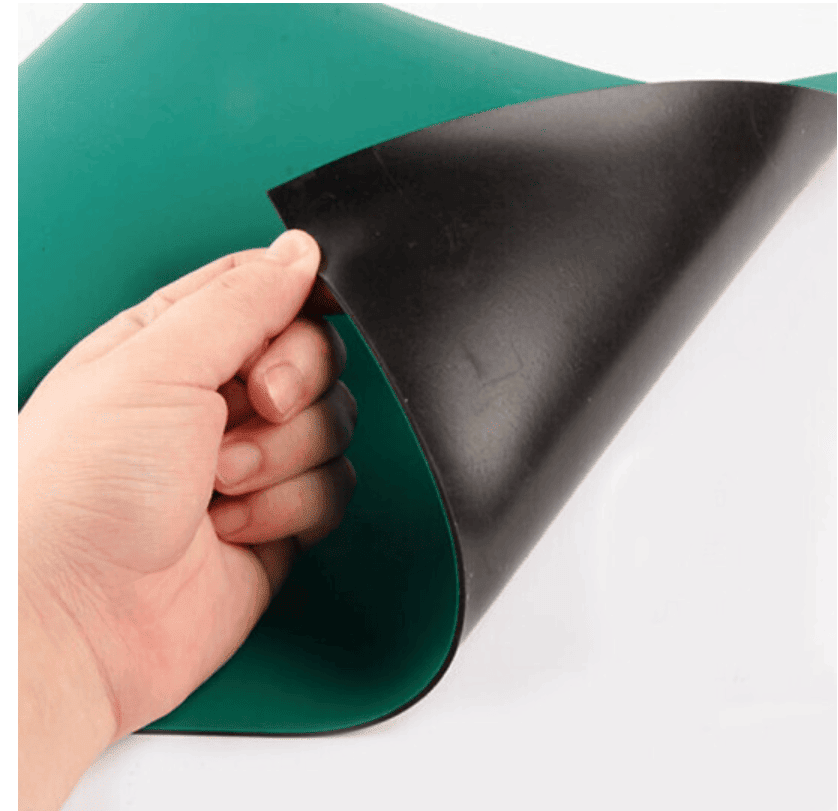
Material High-quality Rubber
Thickness 2 mm
Color Options Green / Blue / Grey
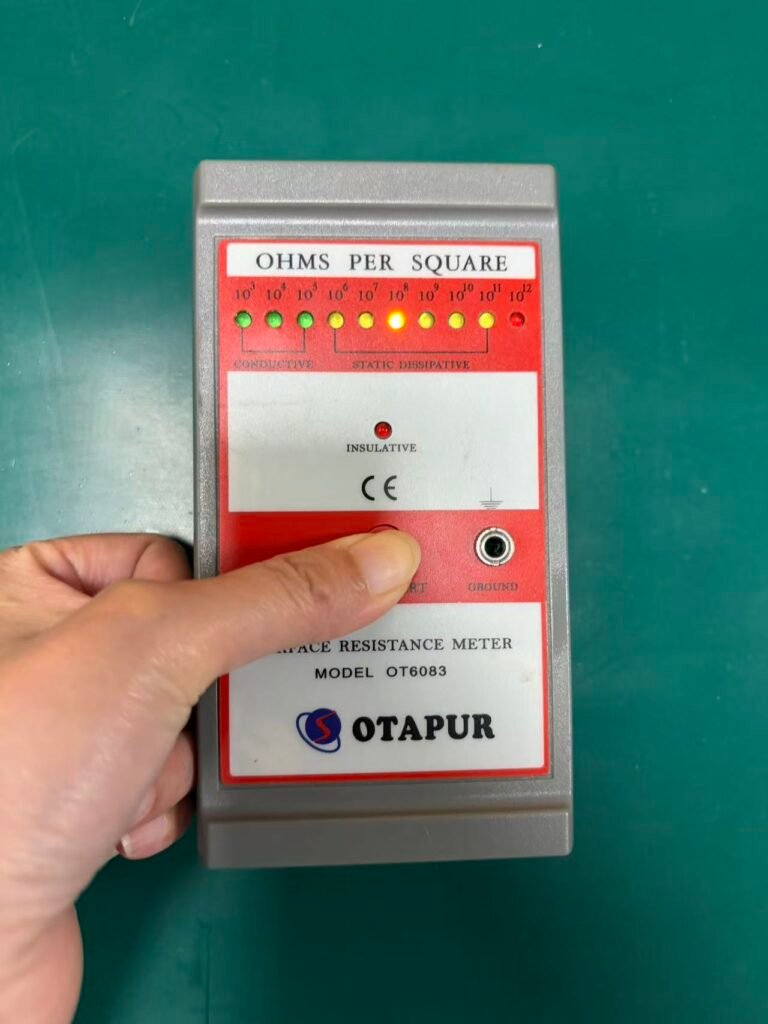
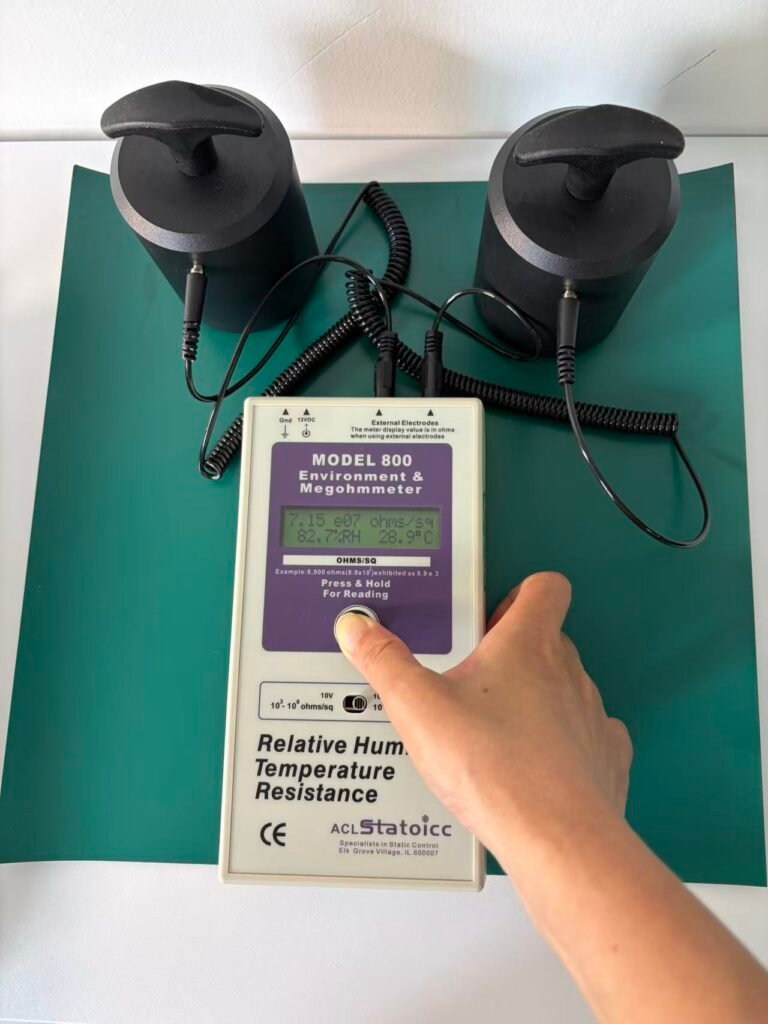
Surface Resistance 106 – 109 Ω
Tested Resistance Range 106 – 109 Ω (Compliant)
Surface Finish Anti-static, Smooth, Wear-resistant
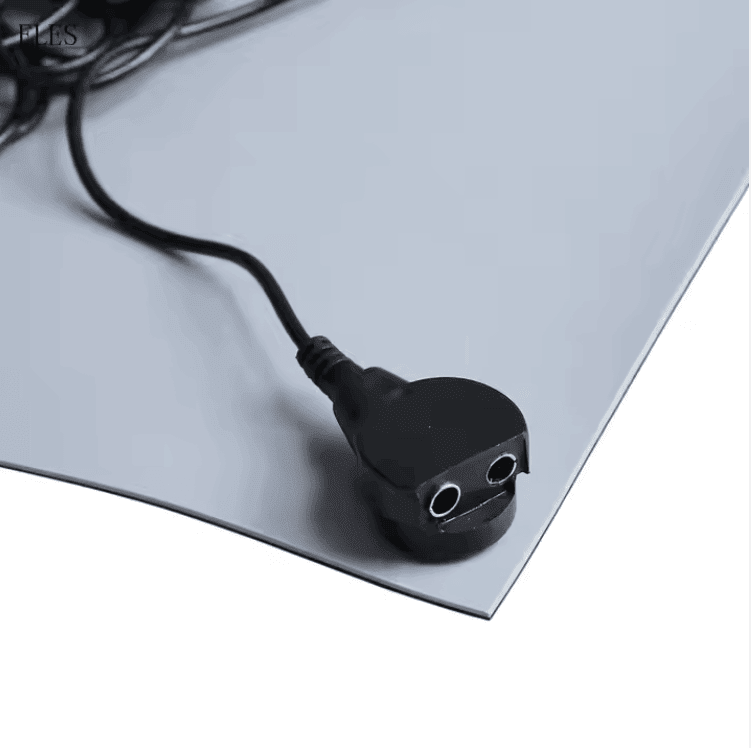
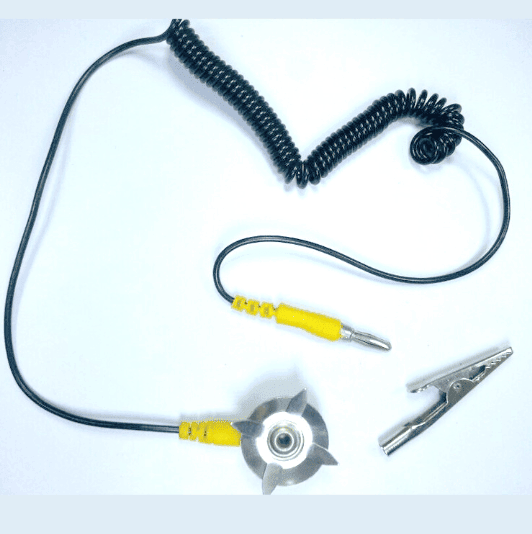
Grounding Accessories Grounding Snap + Cord (Optional / Available)
Available Sizes Customizable (OEM Supported)
Application Scenes Electronics Manufacturing
PCB Assembly
Repair Workstations
Industrial Production Lines
Cleanroom Environments

 What Is an ESD Mat?

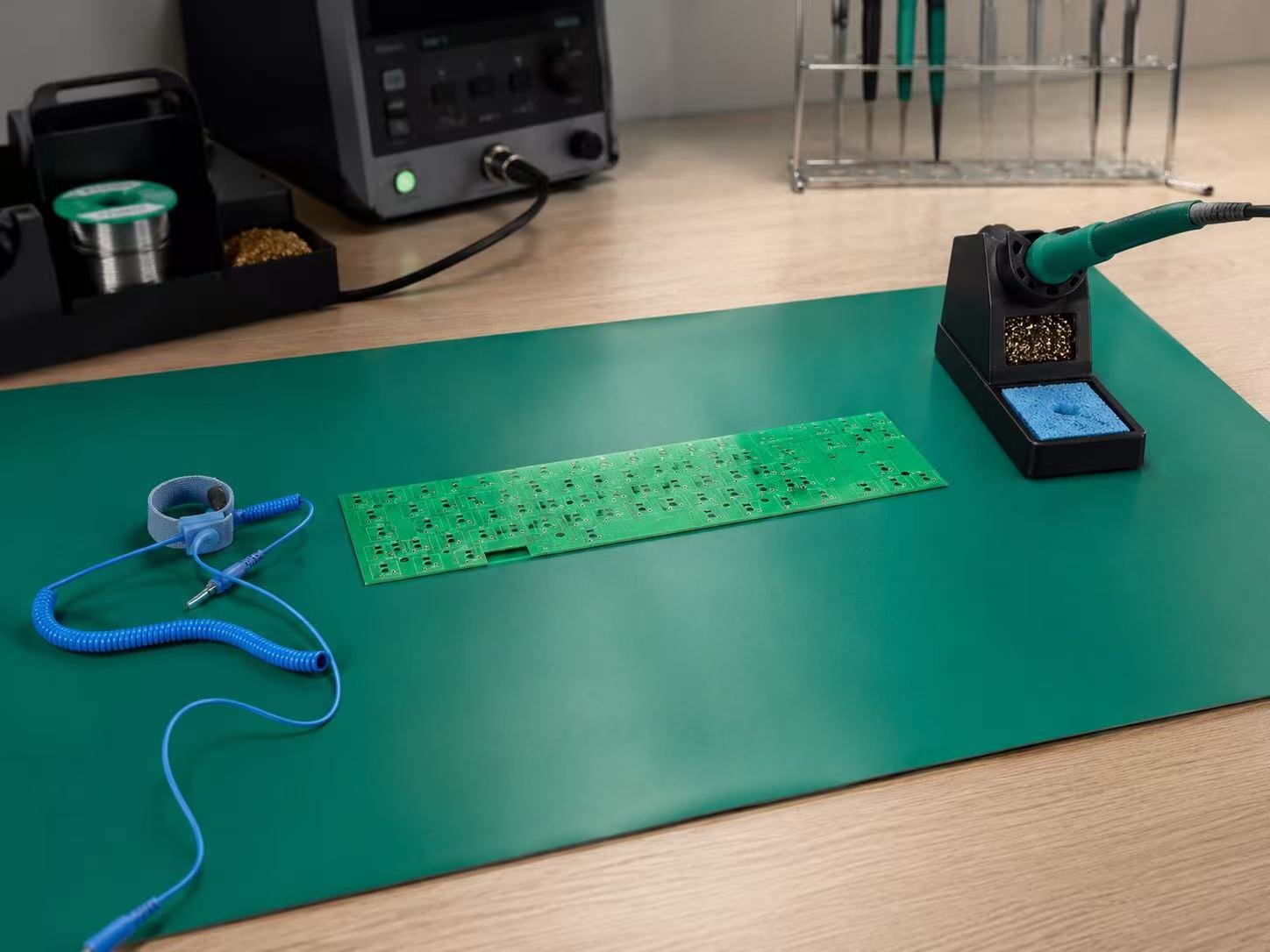
An ESD mat is a static-control mat designed to reduce the risk of electrostatic discharge around sensitive electronics. It is usually placed on a workbench, packing station, assembly table, repair bench, or floor to help dissipate static electricity in a controlled way.

Instead of allowing charge to build up and discharge suddenly, an ESD mat helps guide static away safely through grounding or through a full ESD control system.

In simple terms:

  • Static charge builds on people, tools, packaging, and surfaces

  • An ESD mat helps control that charge

  • Sensitive electronics are less likely to be damaged by sudden discharge

ESD mats are commonly used in:

  • PCB assembly lines

  • Electronics repair benches

  • Semiconductor handling areas

  • Clean manufacturing environments

  • Inspection and testing stations

  • Packaging stations for sensitive electronic products

A proper ESD mat is not just a rubber pad. It is part of a complete static-control environment.


 Why Static Electricity Is a Problem in Electronics Work

Static electricity is easy to underestimate because it is often invisible. In daily life, people notice static when they get a small shock from a doorknob or remove synthetic clothing. In electronics work, the risk is much more serious.

Electronic components can be damaged by discharge levels far below what a human can feel. That means a worker may think everything is normal while a microchip, PCB, connector, or device has already been weakened.

This damage appears in two main forms:

 Catastrophic damage

This is immediate failure. The component stops working right away.

Latent damage

This is hidden damage. The product still works during testing but fails later in the field. This is often more dangerous because it causes warranty claims, reliability problems, and customer complaints.

That is why static control is essential in electronics manufacturing. ESD mats help reduce these risks by making the workstation surface safer.

For a full overview of static discharge basics, link this page to:
what-is-esd


 How Does an ESD Mat Work?

An ESD mat works by controlling how electrical charge moves across or away from a surface.

A normal table, plastic sheet, or untreated rubber surface can allow static to build up. When a charged object touches a sensitive electronic device, the charge may release suddenly. That sudden release is ESD.

An ESD mat is designed differently. It usually contains materials that create a controlled resistance path. This allows charge to dissipate gradually rather than discharge all at once.

A typical setup works like this:

  • The mat is placed on a workbench or floor

  • The mat is connected to ground with a grounding cord or snap

  • Static from items on the mat is controlled and dissipated safely

  • The surface becomes more suitable for handling ESD-sensitive electronics

The key idea is controlled dissipation, not uncontrolled conductivity.

A good ESD mat should:

  • Help prevent static buildup

  • Reduce sudden discharge risk

  • Support a grounded workstation

  • Improve safety for sensitive components


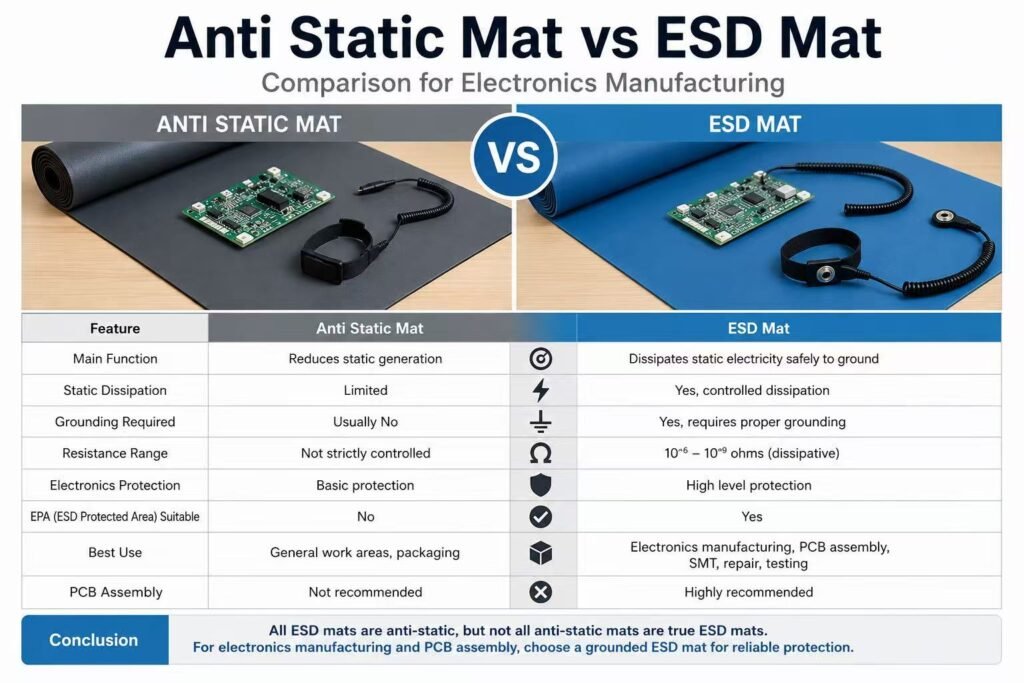
 ESD Mat vs Anti Static Mat

This is one of the most searched and most misunderstood topics.

Many buyers use the terms ESD mat and anti static mat as if they mean the same thing. In casual conversation, that happens a lot. But in practical use, there can be an important difference.

 Anti static mat

An anti static mat usually refers to a surface designed to reduce or limit static buildup. It may help lower the chance of static generation, but not every anti static mat is designed for professional ESD-safe electronics work.

 ESD mat

An ESD mat is designed specifically for static control in environments where sensitive electronics are handled. It usually works as part of a grounded ESD protection system and is designed with performance targets suitable for ESD control.

Simple comparison

FeatureAnti Static MatESD Mat
Reduces static buildupYesYes
Designed for electronics protectionSometimesYes
Works with grounding systemNot alwaysUsually
Suitable for EPA workstationNot alwaysYes
Static dissipation controlBasic or limitedControlled

Bottom line

If you are handling electronics, PCB boards, chips, assemblies, or test equipment, choose an ESD mat, not just any generic anti static mat.


 Conductive vs Dissipative Mat

Another important topic for buyers is the difference between conductive and dissipative ESD mats.

Conductive mat

A conductive mat moves charge very quickly. It has lower resistance and can transfer electrical charge fast.

 Dissipative mat

A dissipative mat moves charge more slowly and in a more controlled way. This is often preferred for bench work because it reduces the chance of a sudden discharge event.

Comparison table

TypeCharge TransferTypical Use
ConductiveFasterSome flooring or specialized grounding paths
DissipativeMore controlledBench mats, workstation mats, electronics handling

For most electronics benches and packing stations, a dissipative ESD mat is often the safer and more practical choice because it balances static control with controlled discharge.

This is exactly why many high-quality ESD mats use a layered structure rather than a single plain material.


 Bench ESD Mat vs Floor ESD Mat

Not all ESD mats serve the same purpose. The right choice depends on where and how you work.

 Bench ESD mat

A bench mat is placed on a work surface where electronics are assembled, inspected, repaired, or packed.

Best for:

  • PCB assembly

  • Electronics repair

  • Lab benches

  • Packing stations

  • Inspection tables

Main priorities:

  • Smooth work surface

  • Controlled static dissipation

  • Heat and chemical resistance if needed

  • Easy grounding connection

  • Comfort for repeated workstation use

 Floor ESD mat

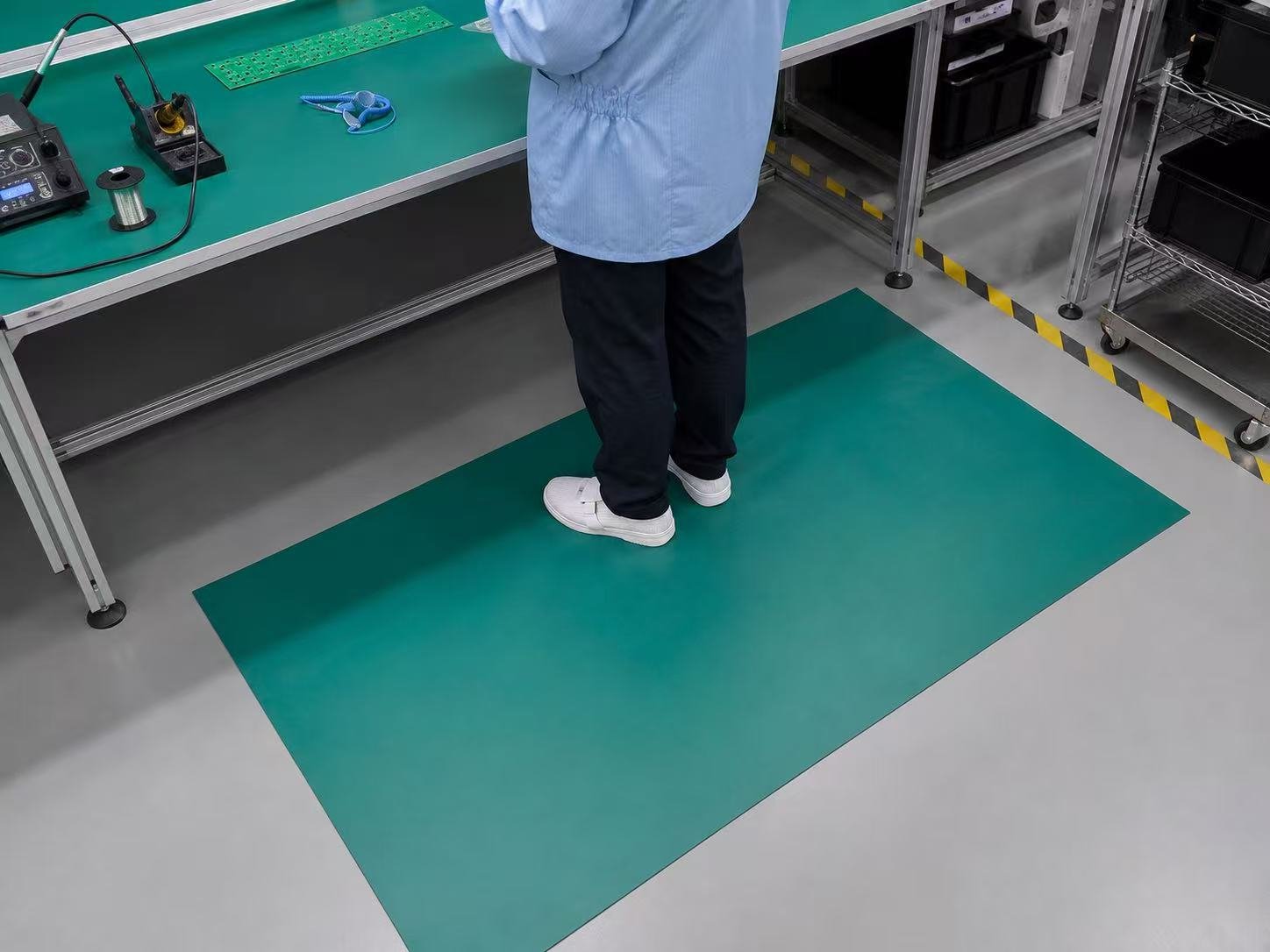
A floor mat is placed under workers, chairs, carts, or entry points to help control static from personnel movement and flooring contact.

Best for:

  • Electronics assembly lines

  • Operator standing stations

  • EPA entry areas

  • Packaging lines

  • Areas with wheeled equipment

Main priorities:

  • Durability

  • Slip resistance

  • Static control under foot traffic

  • Compatibility with ESD footwear

  • Long-term wear resistance

Which one do you need?

Many workplaces need both.

A grounded bench mat helps protect the immediate work surface. A floor mat helps control charge from personnel movement. Together with ESD footwear, wrist straps, and grounding, they create a much stronger protection system.

Internal links you should add here:

What Materials Are ESD Mats Made From?

ESD mats come in different materials, and the material affects durability, flexibility, resistance, and price.

Common ESD mat materials include:

Rubber ESD mats

Popular for industrial and workstation use. Rubber mats often provide good durability, good flatness, and reliable long-term performance.

Vinyl ESD mats

Often chosen for cost-effectiveness and lighter-duty use. Some vinyl mats are suitable for bench applications, though quality varies.

 Two-layer ESD mats

These are very common in professional electronics environments. A typical two-layer structure includes:

  • Top layer: dissipative

  • Bottom layer: conductive

This design gives controlled discharge on the surface while maintaining a path to ground underneath.

 Three-layer or specialty mats

Some premium mats are designed for special conditions such as chemical resistance, soldering environments, higher heat tolerance, or heavy-duty industrial use.

Material choice depends on:

  • Bench or floor use

  • Exposure to heat or soldering

  • Cleaning frequency

  • Traffic and abrasion

  • Required lifespan

  • Budget

For most electronics benches, a quality two-layer dissipative mat is often the most balanced choice.


 What Resistance Range Should an ESD Mat Have?

This is an important buyer question, but many product pages explain it poorly.

The goal of an ESD mat is not to be “as conductive as possible.” The goal is to create controlled dissipation.

If charge moves too slowly, static can remain on the surface too long. If it moves too quickly, discharge may be less controlled than desired. A good ESD mat is designed to fall within a suitable resistance range for static-control applications.

When comparing products, buyers usually look for:

  • Surface resistance performance

  • Consistency across the mat

  • Reliable grounding compatibility

  • Stable performance over time

On your product pages, only publish real tested values. Do not use placeholders. If you have verified test reports, show the actual performance range and match it to the exact product model.

That improves:

  • Trust

  • Conversion

  • SEO quality

  • B2B inquiry rate


How to Ground an ESD Mat Correctly

An ESD mat works best when it is integrated into a proper grounding setup.

A common bench setup includes:

  • The ESD mat

  • A grounding snap or stud

  • A grounding cord

  • A common point ground

  • A grounded wrist strap where required

Basic steps

1. Place the mat flat on the workstation

Avoid wrinkles, unstable surfaces, or loose corners.

 2. Connect the grounding snap

Use the correct grounding hardware made for the mat.

3. Attach the grounding cord

Connect the mat to a proper ground point.

4. Integrate with wrist strap if needed

In many electronics workstations, the mat and wrist strap are both connected through a common point ground.

 5. Check the workstation regularly

Test the system regularly to make sure grounding remains effective.

Common mistakes

  • Using a generic mat without grounding

  • Assuming any black rubber pad is ESD-safe

  • Failing to connect the mat properly

  • Using damaged cords or loose snaps

  • Ignoring routine verification

A grounded ESD mat is far more effective than an ungrounded one.


 How to Choose the Right ESD Mat

Choosing the right ESD mat is not just about price. The wrong mat can create performance issues, poor durability, operator complaints, or poor product protection.

Here is how to choose correctly.

1. Define the application

Is it for bench use, floor use, packaging, testing, or repair?

 2. Know the environment

Will the mat face soldering heat, chemicals, oils, heavy foot traffic, or chair wheels?

3. Decide on size and thickness

A mat should cover the real working area, not just part of it.

 4. Check the material

Rubber, vinyl, and layered construction all behave differently.

5. Review grounding options

Make sure the mat supports a reliable grounding setup.

 6. Prioritize real data

Only trust real specifications, real photos, and real testing.

7. Consider maintenance and lifespan

A cheaper mat that curls, cracks, or loses performance quickly is not cheaper in the long run.

Buyer checklist

QuestionWhy It Matters
Bench or floor?Determines structure and durability
Grounded or standalone?Affects real static-control performance
Heat resistance needed?Important for soldering stations
Heavy use?Requires stronger material
Real resistance data available?Improves trust and suitability
Easy to clean?Important for production environments

Common Problems with Low-Quality ESD Mats

Not all ESD mats are equal. Low-quality mats often create problems that hurt both usability and ESD protection.

 Curling edges

This causes workstation instability and poor appearance.

Inconsistent resistance

Performance is unreliable across the surface.

Weak snaps or grounding points

Grounding becomes unstable.

 Surface wear

Heavy use can quickly degrade cheap materials.

Poor heat resistance

The mat can deform or discolor in soldering areas.

 Misleading specifications

Some suppliers list vague claims instead of real data.

That is why serious buyers look for:

  • Stable material quality

  • Real workstation photos

  • Genuine test values

  • Durable construction

  • Clear grounding accessories


 Do You Need an ESD Mat If You Already Use Wrist Straps or Grounding?

Yes, in most cases.

A wrist strap protects the operator-body path, but it does not replace a proper static-control surface. Sensitive components are often placed directly on the workstation. Packaging materials, tools, trays, and subassemblies also contact the surface.

Without an ESD mat:

  • The work surface itself may generate or hold charge

  • Components may be placed on an unsafe surface

  • Grounding protection becomes incomplete

A strong ESD workstation usually combines:

  • ESD mat

  • Wrist strap

  • Proper grounding

  • ESD gloves where needed

  • ESD footwear or flooring

  • Ionization for insulators where needed

This is how you move from “some protection” to a real ESD control system.


ESD Mat Applications by Industry

ESD mats are used across many industries, but the buying priorities change by application.

PCB assembly

Priority: clean surface, static dissipation, bench compatibility

 Electronics repair

Priority: grounded work area, durability, daily bench comfort

 Semiconductor handling

Priority: stable ESD control, clean environment compatibility

Electronics packaging

Priority: product protection during handling and packing

 Testing and inspection

Priority: reliable surface performance and grounding

Industrial electronics manufacturing

Priority: durability, scale, consistent quality, long service life

This gives you a chance to add internal links or mini-sections later, such as:

  • ESD mat for PCB assembly

  • ESD mat for electronics repair

  • ESD floor mat for factories

  • Anti static workbench mat guide

These can become future cluster pages.


 Build a Complete ESD Workstation

An ESD mat works best when it is part of a full workstation system.

A complete ESD-safe workstation may include:

  • ESD bench mat

  • Grounding cord

  • Common point ground

  • Wrist strap

  • ESD gloves

  • ESD shoes

  • Ionizer

  • ESD-safe tools and trays

If your goal is real protection and not just a basic accessory, think in terms of systems, not isolated products.learn more how to build ess workstation

Suggested internal links:


 Final Thoughts: Why the Right ESD Mat Matters

An ESD mat is one of the simplest and most important upgrades for electronics workstations. It helps control static electricity, reduces the risk of hidden product damage, improves workstation safety, and supports a professional ESD-protected environment.

But not every mat offers the same level of protection.

The right ESD mat should match your real application, support proper grounding, use quality materials, and provide stable long-term performance. Whether you need a bench mat for PCB assembly or a floor mat for a production line, choosing the right static-control surface can protect both your products and your reputation.

If you handle sensitive electronics, an ESD mat is not just an accessory. It is a core part of your protection system.


Protect Your Workstation with the Right ESD Mat

Need a reliable ESD mat for electronics manufacturing, repair benches, packaging stations, or factory floors?

Choose a mat designed for real static control, durability, and long-term performance.

Explore professional ESD solutions:

Or contact us for bulk orders, OEM support, and factory pricing.

CTA Button Text

  • Get Factory Price

  • Ask for Bulk Order

  • Build My ESD Workstation

Protecting Workspaces from Electrostatic Discharge

Electrostatic discharge (ESD) poses a serious threat to sensitive electronic components, equipment, and cleanroom processes. One of the most effective and foundational ways to control static in an Electrostatic Protected Area (EPA) is by using ESD Mat. At HORBEST, we provide an extensive range of high-quality ESD Mats solutions designed to ground personnel, tools, and materials safely and effectively.


HORBEST’s Mat ESD Product Range

We offer a wide selection of ESD Bench mat and ESD Floor Mat to suit various industries and applications. Our collection includes:

  • Premium ESD Bench Mat – Durable, static-dissipative, and ideal for electronics assembly.

  • Mid-Range Textured Mat ESD– Balanced in performance and cost for standard workstations.

  • Smooth ESD Mat – Easy to clean, ideal for cleanroom environments.

  • Anti-Fatigue Matting –esd anti fatigue mat Combines static protection with ergonomic cushioning for all-day standing comfort.

  • Heavy-Duty Conductive ESD Mats– Robust protection in high-traffic or industrial environments.

  • ESD Rubber Floor Mat – Suitable for full-floor coverage in manufacturing or labs.

  • Tack Contamination Control ESD Mat Grounding – Designed to capture dust and particles before entering critical areas.

  • Full Workstation Kits – Includes mat, grounding cords, wrist strap, and accessories for plug-and-play ESD setup.

  • Cushion ESD Matting – Enhanced comfort and flexibility with static dissipative layers.

  • Vinyl Bench ESD Workbench Mat – Economical option for general static control in light-duty workstations.


ESD Mats and Equipment

To work effectively, ESD mats must be paired with proper accessories such as:

  • Grounding cords and earth leads

  • Common point ground connectors

  • Wrist straps

  • Monitoring equipment

Together, these create a safe discharge path for static electricity away from personnel and equipment.


ESD Matting in an EPA

In an Electrostatic Protected Area, ESD matting plays a vital role. It creates a uniform surface resistance that safely channels static charge from personnel or tools to a grounding point, preventing accidental discharges that could damage components.

Proper ESD matting is required by international standards, including IEC 61340-5-1, to establish and maintain safe EPA zones.


Importance of Antistatic Mats &esd earthing mat

Without proper matting, static generated from walking, clothing, or equipment can reach thousands of volts. Even low-level discharges invisible to humans can permanently damage sensitive electronics or cause system malfunctions.

Mat ESD:

  • Provide a controlled resistance path for electrostatic charge

  • Minimize dust accumulation due to static

  • Improve safety and compliance in the workplace

  • Enhance longevity of tools and components


How ESD Mats work?

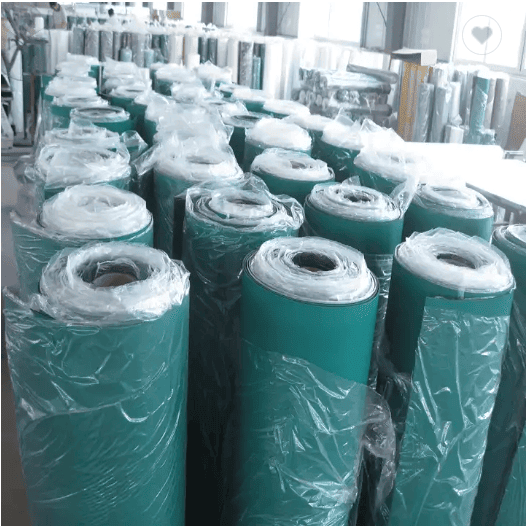
ESD mats (esd mat roll) are made from conductive or dissipative materials. They draw static charges from personnel or equipment and channel them through the mat’s surface and core to a grounding point. This prevents the charge from building up and discharging unexpectedly.


How Are ESD Mats Used?

  • Bench Mats: Placed on worktops in EPAs to protect products and tools

  • Floor Mats: Used in front of benches or in full-floor coverage to protect mobile personnel

  • Entryway Mats: Sticky or tacky mats reduce particle contamination and static at entrances

  • Kits: Include grounding and monitoring accessories to create a complete ESD-safe workstation


Common Environments Where ESD Mats Are Used ?

  • Electronics assembly plants

  • Semiconductor manufacturing

  • Aerospace and defense labs

  • PCB handling stations

  • Cleanrooms and medical device facilities

  • Data centers and telecoms

  • Repair & field service benches


Types of ESD Mats

  1. 2-Layer Matting: Static dissipative top with conductive backing

  2. 3-Layer Matting: Adds an insulative foam base for cushioning and durability

  3. Single-Layer Matting: Economical option for low-risk applications

  4. Vinyl Matting: Flexible and cost-effective

  5. Rubber Matting: Long-lasting and chemical resistant


ESD Matting Materials

Most ESD mats are made from:

  • PVC (Vinyl) – Lightweight, affordable, suitable for general workspaces

  • Rubber – High durability, chemical and heat resistance

  • Foam-Backed Materials – Provide ergonomic comfort and insulation

  • Tacky Polymers – Used in contamination control mats

Each material is chosen based on the application, environment, and durability needs.


How Is ESD Matting Measured?

Key performance criteria:

  • Surface Resistivity (usually 10⁶ to 10⁹ ohms)

  • Charge Decay Time (time to discharge static safely)

  • Point-to-point resistance

  • Resistance to ground (RTG)

Use ESD testers such as surface resistance meters to check mat performance regularly.


Field Service Work

For mobile engineers or field service staff, portable ESD mats are essential. These are compact, foldable, and provide a safe workspace in customer locations or repair benches.


How to Maintain an ESD Mat?

To ensure long-term performance:

  • Clean regularly using ESD-safe cleaners (avoid alcohol-based agents)

  • Test grounding and resistance monthly

  • Inspect for wear, cuts, or burns

  • Avoid placing sharp or heavy metal tools directly on the mat without protection


Matting Supplier You Can Trust – HORBEST

With over 29 years of experience, HORBEST is one of China’s leading manufacturers and suppliers of ESD-safe matting solutions. Whether you need a single workstation kit or full EPA floor coverage, our team can provide expert guidance and fast delivery.


📞 Contact Us Today

Need help selecting the right ESD matting for your facility? Our experts are here to help.

 Email: sales2@esdbest.com
📞 Whatsapp & Call: +86 137 1427 2599

PAA / FAQ Section


 Frequently Asked Questions About ESD Mats

 What is an ESD mat used for?

An ESD mat is used to control static electricity on benches, tables, and floors where sensitive electronics are handled. It helps reduce electrostatic discharge risk and protects components from damage.

What is the difference between an ESD mat and an anti static mat?

An anti static mat generally reduces static buildup, while an ESD mat is designed for controlled static dissipation in electronics-safe environments. ESD mats are usually better suited for grounded workstations and ESD protection systems.

Do I need to ground an ESD mat?

Yes, in most professional electronics applications, grounding an ESD mat is strongly recommended. A grounded mat provides a controlled path for static dissipation and improves overall workstation protection.

Can I use an ESD mat without a wrist strap?

You can use an ESD mat alone, but it does not provide the same level of protection as a complete workstation setup. For many electronics tasks, using both an ESD mat and a wrist strap is the better solution.

What is the best material for an ESD mat?

The best material depends on the application. Rubber and two-layer dissipative mats are popular for electronics benches because they offer good durability and controlled static dissipation.

What size ESD mat should I choose?

Choose a size that covers the actual work area where parts, tools, and packaging will be placed. A mat that is too small may leave critical areas unprotected.

Are ESD floor mats and bench mats the same?

No. Bench mats are made for work surfaces, while floor mats are designed for foot traffic, standing stations, and movement control. They serve different roles in an ESD-safe environment.

 How long does an ESD mat last?

The lifespan depends on material quality, daily use, grounding condition, cleaning practices, and exposure to heat or chemicals. A high-quality mat usually lasts much longer than a low-cost generic alternative.

{ "@context": "https://schema.org", "@type": "FAQPage", "mainEntity": [ { "@type": "Question", "name": "What is an ESD mat used for?", "acceptedAnswer": { "@type": "Answer", "text": "An ESD mat is used to control static electricity on benches, tables, and floors where sensitive electronics are handled. It helps reduce electrostatic discharge risk and protects components from damage." } }, { "@type": "Question", "name": "What is the difference between an ESD mat and an anti static mat?", "acceptedAnswer": { "@type": "Answer", "text": "An anti static mat generally reduces static buildup, while an ESD mat is designed for controlled static dissipation in electronics-safe environments. ESD mats are usually better suited for grounded workstations and ESD protection systems." } }, { "@type": "Question", "name": "Do I need to ground an ESD mat?", "acceptedAnswer": { "@type": "Answer", "text": "Yes, in most professional electronics applications, grounding an ESD mat is strongly recommended. A grounded mat provides a controlled path for static dissipation and improves overall workstation protection." } }, { "@type": "Question", "name": "Can I use an ESD mat without a wrist strap?", "acceptedAnswer": { "@type": "Answer", "text": "You can use an ESD mat alone, but it does not provide the same level of protection as a complete workstation setup. For many electronics tasks, using both an ESD mat and a wrist strap is the better solution." } }, { "@type": "Question", "name": "What is the best material for an ESD mat?", "acceptedAnswer": { "@type": "Answer", "text": "The best material depends on the application. Rubber and two-layer dissipative mats are popular for electronics benches because they offer good durability and controlled static dissipation." } }, { "@type": "Question", "name": "What size ESD mat should I choose?", "acceptedAnswer": { "@type": "Answer", "text": "Choose a size that covers the actual work area where parts, tools, and packaging will be placed. A mat that is too small may leave critical areas unprotected." } }, { "@type": "Question", "name": "Are ESD floor mats and bench mats the same?", "acceptedAnswer": { "@type": "Answer", "text": "No. Bench mats are made for work surfaces, while floor mats are designed for foot traffic, standing stations, and movement control. They serve different roles in an ESD-safe environment." } }, { "@type": "Question", "name": "How long does an ESD mat last?", "acceptedAnswer": { "@type": "Answer", "text": "The lifespan depends on material quality, daily use, grounding condition, cleaning practices, and exposure to heat or chemicals. A high-quality mat usually lasts much longer than a low-cost generic alternative." } } ] }