Anti-Static Wrist Strap: How It Works, How to Use It and How to Test It
By Rachel Zhong, ESD engineer at ESDBEST, 29 years in static control · Updated 9 November 2026
An anti-static wrist strap, also called an ESD wrist strap, grounding wrist strap or wrist earth strap, connects your skin to ground. Static charge on your body drains away through it continuously, so it cannot jump into a circuit board or component when you touch one. It is the cheapest piece of ESD equipment on a bench, and the one we most often find worn wrong, tested wrong or plugged into the wrong place.
This guide covers how the strap works, why it has a 1 megohm resistor, how to wear and connect it, what the ANSI/ESD standards require, how to test it and why straps fail. It also covers using one at home when you build or repair a PC.
- What it does: keeps you at ground potential, so charge drains from your body continuously.
- Strap resistance (band + cord): 1 MΩ ±20% (ANSI/ESD S1.1).
- Limit for the whole system with a person wearing it: less than 3.5 × 10⁷ Ω (35 MΩ) under ANSI/ESD S20.20.
- Who must wear one: every operator who is seated at an ESD workstation (ANSI/ESD S20.20).
- How often to test: daily before work, unless a continuous monitor is used.
- What is an anti-static wrist strap?
- How does it work?
- Why the 1 MΩ resistor?
- Types of wrist straps
- How to use an anti-static wrist strap
- Where to clip it
- Wrist strap for PC building
- What the standards require
- How to test it
- Why wrist straps fail
- Care and replacement
- Wrist strap, heel strap, shoes or ionizer
- FAQ
What is an anti-static wrist strap?
ANSI/ESD S1.1, the wrist strap standard, defines it as an assembled device made of a wrist cuff and a ground cord that electrically connects a person's skin to ground. It has three parts:
| Part | What it does | What to look for |
|---|---|---|
| Band (cuff) | Holds a conductive surface against bare skin | Conductive inside, insulating outside; adjustable; snug fit |
| Ground cord | Carries charge from the band to ground. It is coiled so you can move your arm | 1 MΩ resistor built in; secure snap; strain relief at both ends |
| Ground connection | Connects the cord to the workstation ground | Banana plug into a common point ground or ground socket, or an alligator clip onto a known grounded point |
When someone wears the strap, S1.1 calls the combination a wrist strap system: the electrical path runs through the person, the band and the cord. The strap and the system have different limits, which matters when you test.

Why static on people damages electronics
People charge up all the time: walking across a floor, standing up from a chair, peeling tape or handling plastic bags. You can carry a charge high enough to damage a sensitive device long before you can feel a spark. When your finger or a tool touches a component pin, that charge discharges through the part in a few nanoseconds.
The damage comes in two forms:
- Catastrophic failure. The device stops working and is caught at test.
- Latent damage. The device passes test but has been weakened and fails later in the field. This is the expensive kind, because it comes back as a customer return.
A wrist strap removes the charge on the operator. It does not ground the work surface or deal with plastic insulators on the bench, so it works as one part of a grounded workstation together with an ESD mat and a common point ground. See how to ground and verify an ESD workbench.
How does an anti-static wrist strap work?
The band keeps a conductive surface pressed against your skin. Charge generated on your body flows into the band, along the cord, through the resistor and into ground. Because the path is always connected, charge drains as fast as it is generated and never builds up to a level that could discharge into a part.
The key word is continuous. A strap that is connected only some of the time, or that touches skin only when you press your wrist down, gives a false sense of safety. This is also the difference from a cordless band, which discharges you only at the moment you touch it to a grounded object (see the FAQ).
Why is there a 1 megohm resistor in the cord?
ANSI/ESD S1.1 calls it the current-limiting resistance. It is there to protect the operator. If your hand touches a live conductor while you are strapped to ground, the resistor limits the current that can flow through your body. It does not slow the drain of static charge in any way that matters: through 1 MΩ, a person's charge is gone in a fraction of a second.
S1.1 sets the strap value at 1 MΩ ±20% (0.8 to 1.2 MΩ) unless the user defines another value. The resistor is not a substitute for electrical safety, and S1.1 recommends ground fault circuit interrupters (GFCI) wherever operators may touch power sources.
Types of ESD wrist straps
| Type | Advantages | Watch out for | Typical use |
|---|---|---|---|
| Fabric (elastic) band with conductive yarn | Light, comfortable all day, adjustable | Skin oil and dirt build up in the yarn over time; wash and retest | General assembly, inspection, repair |
| Metal expansion band | No buckle, fits most wrists, wipes clean | Can pull hair; some people react to metal | Shared stations, users with dry skin |
| Silicone band | Easy to wipe clean, no loose fibres | Check fit, since silicone does not stretch like fabric | Clean areas |
| Single-wire cord | Simple and low cost | Test daily | Most workstations |
| Dual-wire cord | Two conductors, so a monitor can check the path all the time | Needs a compatible monitor | High-value or high-sensitivity lines |
| Cordless band | No cord to snag | Grounds you only when you touch it to a grounded object | Short jobs at home, in the office or on site |
Products: ESD wrist straps (fabric, silicone, dual-wire and metal, 1.8 / 2.5 / 3.0 m cords) · continuous wrist strap monitor · cordless wrist band
How to use an anti-static wrist strap (5 steps)
- Put the band on bare skin. Not over a sleeve, glove or watch strap. Any fabric between the band and your skin breaks the path.
- Adjust it snug. It should not slide when you move your arm, but you should still be able to slip one finger under it. A loose band is the most common cause of a failed test.
- Snap the cord onto the band and check that it clicks home. The snap is meant to pull apart if you walk away while still connected. S1.1 sets the breakaway force between 0.45 and 2.3 kg (1 to 5 lb).
- Plug the other end into the workstation ground: the common point ground, the bench ground socket or the wrist strap socket on a grounded mat snap. Do not clip it onto a painted frame, a plastic part or a power cord.
- Test it before you start and keep it on for as long as you handle unprotected parts. When you leave the bench, disconnect at the plug or the snap, and reconnect when you sit back down.

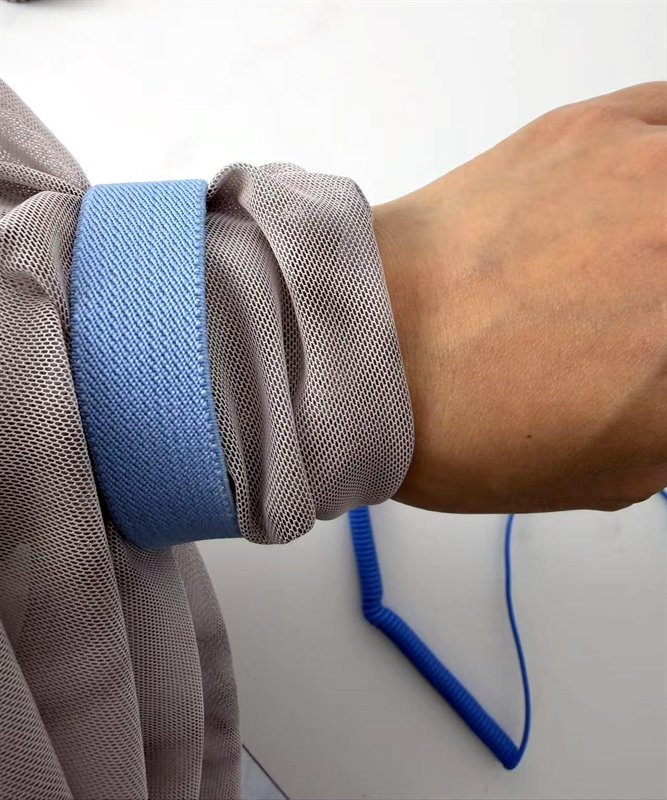
Do not route the strap through the mat material. S1.1 says a dissipative mat should not be placed in series with the wrist strap path. A mat snap with a separate wrist strap socket is fine, because the strap connects to the ground cord, not to the mat surface.
Where to clip an anti-static wrist strap
| Situation | Connect to |
|---|---|
| ESD workstation | Banana plug into the common point ground or the bench / mat wrist strap socket |
| Equipment repair on a bench | Alligator clip onto bare, unpainted metal of a grounded equipment frame |
| Inside a computer | Alligator clip onto bare, unpainted metal of the case (see the next section) |
| Never | Painted or anodised surfaces, plastic, power cords, live parts, or anything you are not sure is connected |

Using an anti-static wrist strap for PC building
At home there is usually no common point ground. What matters is that you, the case and the parts stay at the same potential while you work, so no charge passes through a component when you touch it.
- Shut down, switch off the power supply and unplug the mains cable before you open the case.
- Put the strap on bare skin and clip the alligator clip to bare, unpainted metal on the case, such as the frame or a slot bracket.
- Keep memory, graphics cards and drives in their anti-static bags until you install them, and handle boards by their edges.
- Stay clipped on until the case is closed.
The 1 MΩ resistor in a proper strap matters here too. Do not substitute a plain wire. For an occasional quick job, a cordless band that you touch to the case before handling each part is a simpler option.
What the ESD standards require
| Requirement | Limit | Source |
|---|---|---|
| Wrist strap resistance (band + cord, no person) | 1 MΩ ±20%, or user-defined | ANSI/ESD S1.1 |
| Band inside surface resistance | ≤ 100 kΩ | ANSI/ESD S1.1 |
| Band outside surface resistance | ≥ 10 MΩ | ANSI/ESD S1.1 |
| Breakaway force, cord from band | 0.45 to 2.3 kg (1 to 5 lb) | ANSI/ESD S1.1 |
| Cord bending life | ≥ 16,000 cycles | ANSI/ESD S1.1 |
| Functional test, person wearing the strap | "Pass", or ≤ 10 MΩ, or user-defined | ANSI/ESD S1.1 |
| Wrist strap system, ESD program limit | < 3.5 × 10⁷ Ω (35 MΩ) | ANSI/ESD S20.20-2014, Table 2 |
| Who must wear one | All operators seated at ESD workstations. Standing operators may use a wrist strap or a footwear / flooring system | ANSI/ESD S20.20-2014, §8.2 |
Why two numbers for the system, 10 MΩ and 35 MΩ? S1.1 is the product standard, and its functional check uses about 10 MΩ as a nominal upper reading. S20.20 is the program standard and sets the most the program can accept at 35 MΩ. Many sites set their checker to the S20.20 limit or to a tighter window of their own. Whatever you choose, write it into your ESD control plan and set the checker to match.
Limits are quoted from our copies of ANSI/ESD S1.1-2006 and ANSI/ESD S20.20-2014. If your program follows a later edition or IEC 61340-5-1, check the limits in that document.
How to test an anti-static wrist strap
There are two tests, and they answer different questions.
1. Daily system test, with the person wearing the strap. Put the band on, plug the cord into a wrist strap checker and press the touch plate firmly. The checker measures the whole path: skin, band, cord and resistor. Record pass or fail. Every operator does this at the start of the shift.
2. Strap-only test, for incoming goods or troubleshooting. With a meter, measure from the inside of the band to the plug. You should read about 1 MΩ. This tells you whether the cord and resistor are good, whoever wears the strap.
Our own measurements
We measured our corded straps with an ACL Model 800 megohmmeter (serial no. R01172234, calibrated 19 August 2026) on 28 October 2026:
| Test | Strap | How | Result | Conditions |
|---|---|---|---|---|
| System | Fabric band, 1 MΩ coil cord | Worn on bare skin, operator gripping a weighted electrode | 9.55 × 10⁶ Ω | 55.8 %RH, 29.2 °C |
| Strap only | Metal expansion band, 2.5 m cord | Band on a foil-wrapped cylinder, measured to the plug | 9.58 × 10⁵ Ω | 57.8 %RH, 29.0 °C |
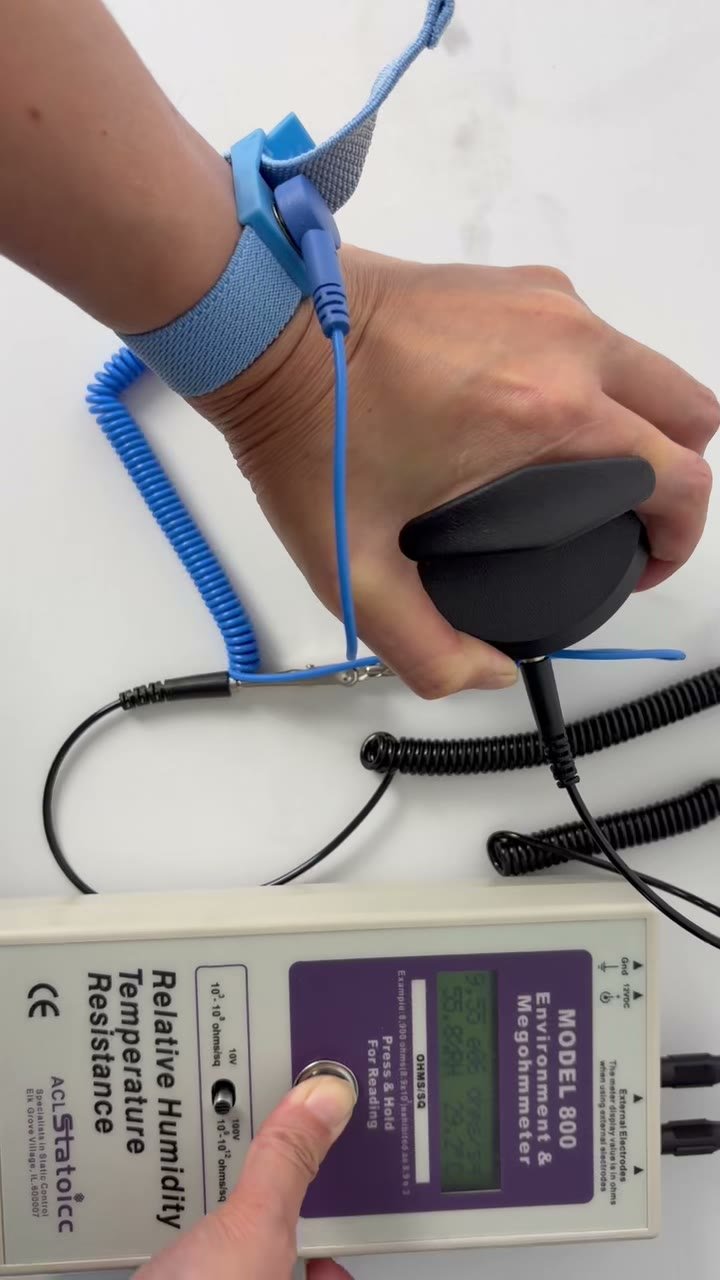

What we learned: our first system readings were far higher, between about 4 × 10⁸ and 10⁹ Ω, because the operator's palm was resting flat and loosely on the electrode. On the retest the operator gripped the electrode firmly, and the reading was 9.55 × 10⁶ Ω. If a checker fails a strap, check how the operator is touching the plate before you throw the strap away.
Step-by-step instructions, including how to read a checker: how to test an ESD wrist strap · Equipment: ESD wrist strap tester
How often to test
ANSI/ESD S1.1 recommends testing the wrist strap system daily. You can skip daily testing where a continuous monitor checks the strap all the time, which is why dual-wire straps and monitors are common on high-value lines. Under S20.20, your own compliance verification plan sets how often you check. Keep the records.
Why anti-static wrist straps fail, and what to do
| Symptom | Likely cause | Fix |
|---|---|---|
| Fails high, passes when pressed tight | Loose band | Tighten the band and retest |
| Fails for everyone | Broken cord or resistor | Replace the cord and retest; if it still fails, replace the band |
| Passes and fails while you move | Cord damaged near the snap or plug | Replace the cord |
| Fails for one person only | Dry skin | Try a metal expansion band, or a dissipative hand lotion approved for ESD areas |
| Fabric band reading rises over weeks | Skin oil and dirt in the conductive yarn | Wash as the supplier instructs, dry and retest |
| Passes at the checker, but the operator is not grounded at the bench | Bench ground socket not connected | Check the workstation ground path |
Mistakes we see on audits:
- Band worn over a sleeve or a glove cuff
- Strap on, cord not plugged in, or plugged into the mat surface
- Cord clipped onto a painted frame or an unchecked "metal" part
- Daily test skipped, or done once at the start of the week
- Strap taken off "just for a minute" while still handling boards
- Cords used long after the coil has lost its spring or the jacket has cracked
Care and replacement
- Inspect when you test: band fit, snap, cord jacket, plug.
- Wash fabric bands now and then to remove skin oil. Too much washing shortens their life. Always retest after washing and drying.
- Replace the cord when the coil no longer springs back, the jacket is cracked or results start to come and go.
- Replace the band when the elastic has stretched or the conductive yarn is visibly worn.
- Keep spare straps at the line, so a failed strap is replaced straight away instead of "used carefully".
Replace on condition and on test results, not by the calendar. A strap that passes its daily test and shows no damage is still doing its job.
Wrist strap, heel strap, ESD shoes or ionizer: which do you need?
| Method | Best for | Note |
|---|---|---|
| Wrist strap | Seated work at a bench | Required for seated operators under S20.20 |
| Heel or shoe straps | Operators who stand or move around on an ESD floor | Only work on a conductive or dissipative floor. See ESD heel straps |
| ESD shoes | Grounding people across a whole area | The footwear and floor together must meet the limits. See ESD shoes |
| Ionizer | Plastic parts and other items that cannot be grounded | Does not replace grounding people. See wrist strap vs ionizer |
Anti-static wrist strap FAQ
Do anti-static wrist straps actually work?
Yes, when the band is on bare skin, the cord is connected to a real ground and the system passes its daily test. A strap that is not plugged in, or is worn over a sleeve, does nothing.
Do anti-static bracelets work?
It depends on what is sold as a "bracelet". A wrist band with a cord to ground drains charge continuously. A band with no cord can only discharge you when you touch it to a grounded object. Bracelets sold for cars or for wellness have no path to ground at all, so they cannot drain static from you.
What resistance should an ESD wrist strap have?
The strap itself, band plus cord, should measure 1 MΩ ±20% under ANSI/ESD S1.1. With a person wearing it, the system must be below 35 MΩ (3.5 × 10⁷ Ω) under ANSI/ESD S20.20.
Do I need a wrist strap if I already have an ESD mat?
Yes. The mat grounds the parts you put down, and the strap grounds you. They are separate paths, and the strap should not run through the mat material.
How tight should an anti-static wrist strap be?
Tight enough that it does not slide when you move your arm, loose enough to slip one finger under.
How often should I test my wrist strap?
Daily before work, unless you use a continuous monitor.
Are wireless (cordless) wrist straps effective?
A cordless band removes the charge on your body each time you touch its housing to a grounded object. Between touches you are not connected to ground. That suits short jobs at home, in the office or on site where there is nowhere to plug a cord in. For continuous seated work at an ESD workstation, use a corded strap. See our cordless wrist band.
What is the difference between a wrist strap tester and a checker?
Both test the system path. A checker gives pass or fail at preset limits. A tester or meter shows the actual resistance, which helps with troubleshooting.
Can I make a DIY anti-static wrist strap?
We don't recommend it. Without a known 1 MΩ current-limiting resistor and a ground point you have checked, a home-made strap can be useless or unsafe.
Related guides: How to test an ESD wrist strap · How to ground an ESD workbench · Wrist strap vs ionizer · ESD heel straps