Wrist Strap vs Ionizer ⚡ Which One Do You Need?
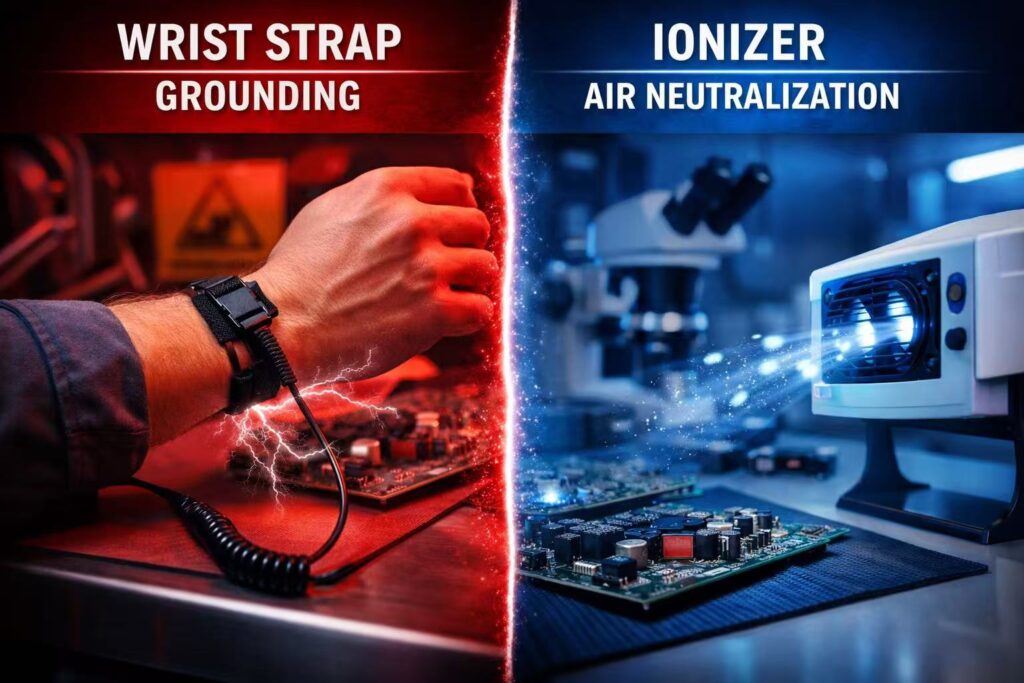
ESD Wrist Strap vs Ionizer: Which ESD Control Method Do You Need?
Quick Answer:
Wrist straps ground the human body, while ionizers neutralize airborne static. For full ESD protection, most static electricity environments require both.
👉 Learn ESD Protection
👉 Request Quote
| Feature | Wrist Strap | Ionizer |
|---|---|---|
| Controls | Human body | Air / insulators |
| Function | Grounding | Neutralization |
| Speed | Direct discharge | Controlled ion flow |
| Use case | Seated operator | Insulators / cleanroom |
If you work with sensitive electronics, one question comes up again and again: Should you use an ionizer, an ESD wrist strap, or both?
The short answer is simple: an ESD wrist strap grounds the person, while an ionizer neutralizes charge on insulators and isolated conductors in the work area. A wrist strap is usually the first choice for seated operators, but ionization is needed when items in the process cannot be grounded directly. In many real electronics workstations, the best answer is not “either/or” but both together.
That distinction matters because grounding and ionization solve different ESD problems.
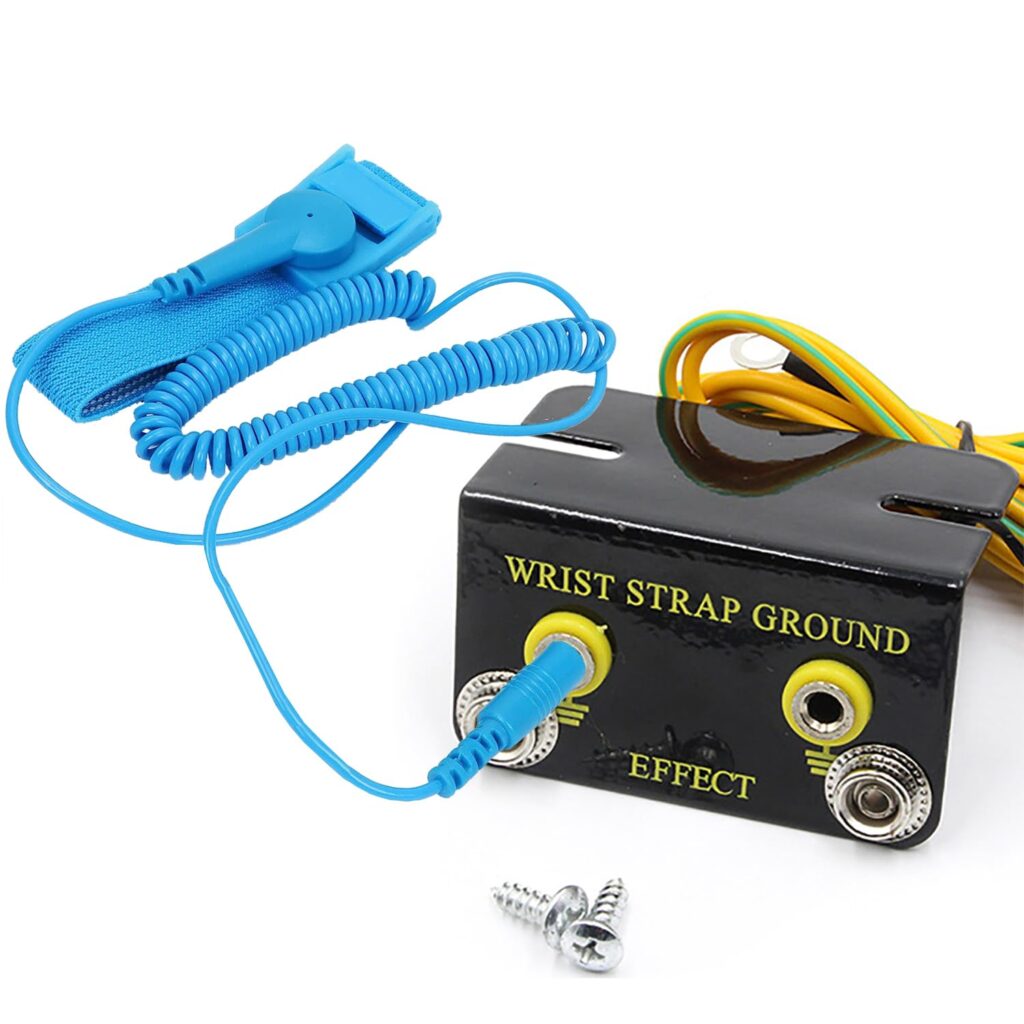
A wrist strap gives static electricity on the human body a controlled path to ground. Bondline describes the basic mechanism clearly: the conductive portion of the band contacts the skin and creates a path for charge to flow to ground. That is why the strap must be worn correctly and connected properly.
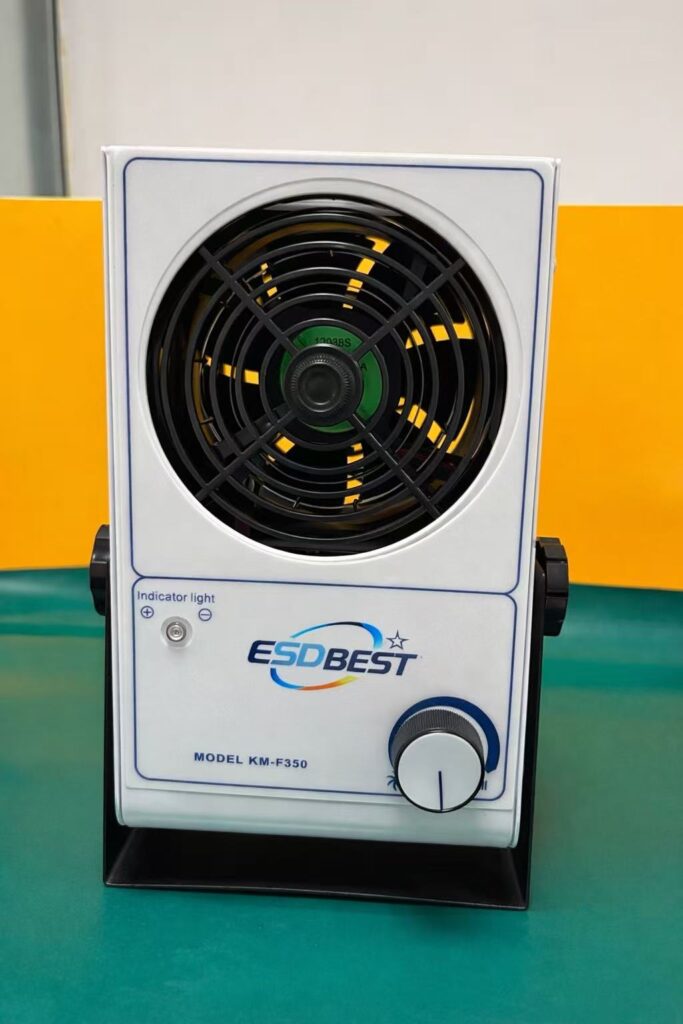
An ionizer does something a strap cannot do. It generates positive and negative ions in the air to neutralize charge on process-essential insulators and isolated conductors that cannot be grounded directly. The EOS/ESD Association explicitly says air ionization is not a replacement for grounding, but one part of a complete ESD control program and a backup when everything cannot be grounded.
So if your page only explains “how an anti-static wristband works,” it is incomplete for modern manufacturing. The better page answers the real buyer question:
When is an esd grounding wrist strap enough, and when do you also need an ionizer?
What Is an ESD Wrist Strap?
An ESD wrist strap is a personnel grounding device designed to provide an electrical connection from a person’s skin to ground through a band and ground cord. IEC 61340-4-6:2025 specifically defines a wrist strap as an assembled device consisting of a band and ground cord designed to connect a person’s skin to ground, and the standard covers electrical and mechanical test methods, performance limits, acceptance, and periodic verification of wrist straps and wrist strap systems.
In practical terms, an esd wrist strap usually includes:
-
a wrist band, often fabric or metal expansion style
-
a grounding cord
-
a resistor in the cord for operator safety
-
a common ground point or approved grounding connection
The purpose is not to “block” static. The purpose is to drain it safely and continuously so the operator stays at the same electrical potential as the grounded workstation. Bondline and Q Source both describe the strap as a way to ground the body and reduce the risk of charge flowing from the person into sensitive components.
For seated work, wrist straps are especially important. Bondline’s ESD workspace guide says anti-static bench mats should be grounded and used with ESD wrist straps, and notes that bench mats may be sufficient for seated work, while moving or standing staff may need additional flooring and footwear controls.
What Does an Ionizer Do?
An ionizer solves a different problem.
Grounding works very well for people, tools, and surfaces that can be intentionally bonded. But many items in electronics manufacturing are insulators or isolated conductors. These cannot always be grounded directly. That is where ionization becomes necessary. The EOS/ESD Association states that ionizers are used when it is not possible to properly ground everything and as backup to other static control methods. In cleanrooms, ionization may be one of the few practical control methods available.
Ionizers neutralize electrostatic charges on process-essential insulators and isolated conductors by charging air molecules and delivering them into the workspace.
That means an ionizer is especially useful when you have:
-
plastic trays, reels, covers, or fixtures
-
process-essential packaging near the work area
-
isolated tools or parts that cannot be grounded
-
cleanroom processes with limited direct grounding options
-
highly sensitive assemblies where airborne charge control matters
So the key point is this:
A wrist strap controls the person. An ionizer controls the environment.
Wrist Strap vs Ionizer: The Real Difference
The easiest way to understand the comparison is by asking what each method controls.
1. What the wrist strap controls
A wrist strap controls body charge. It keeps the operator near ground potential by giving charge a path away from the skin through the band and cord. That is why proper skin contact matters so much. ESD Systems notes that if a person “fails” a strap test, high skin resistance may be the cause, and expandable metal cuffs or dissipative lotion/gel can improve contact resistance.
2. What the ionizer controls
An ionizer controls charge in the air and on otherwise ungroundable items. It does not replace a strap, because it does not directly bond the person to ground. Instead, it reduces charges on insulators and isolated conductors by neutralizing them with ions.
3. Why many workstations need both
If you only use a wrist strap, you reduce body-generated ESD risk, but you may still have charged insulators, floating items, or airborne charge problems near the product. If you only use an ionizer, you are not directly grounding the operator, so the human body can still be a charge source. That is why industry guidance repeatedly frames ionization as supplemental, not a substitute for grounding.
When an ESD Wrist Strap Is the Better First Choice
For most seated electronics assembly, repair, inspection, and test work, an esd grounding wrist strap is the first line of defense. Q Source explains that anti-static wrist straps ground the body, while mats protect the work surface; together they create a safer electronics workstation. Bondline similarly recommends a grounded anti-static bench mat with ESD wrist straps for workstation setup.
Use a wrist strap first when:
-
the operator is seated
-
the main ESD source is the human body
-
the product is handled directly on a bench
-
you can connect to an approved common ground point
-
your setup includes an esd mat and wrist strap working together
This last point matters for SEO and for real users. Many buyers search esd mat and wrist strap because they are building or upgrading a complete bench. That is also the correct practical approach: the mat controls the surface, and the wrist strap controls the person.
When an Ionizer Becomes Necessary
An ionizer becomes important when your process involves materials or tools that cannot simply be clipped to ground.
Use ionization when:
-
there are insulators close to ESD-sensitive items
-
isolated conductors cannot be bonded
-
you work in cleanrooms
-
parts are moving through plastic-heavy or high-insulator processes
-
you need backup control beyond basic grounding
Desco’s ionization guidance states that if an insulator cannot be removed, substituted with an ESD-safe alternative, or controlled with a topical antistat, ionization must be used. operations like semiconductor packaging, plastic fixture handling, optics, high-mix assembly, and cleanroom manufacturing.
Why “You Need Both” Is Usually the Best Answer
For SEO, many pages stop at “wrist strap vs ionizer.” For conversions, that is not enough. The higher-value answer is:
Use a wrist strap to control the operator and use an ionizer to control the air and ungroundable items.
That aligns with the EOS/ESD Association’s position that ionization is one part of a complete control program rather than a grounding replacement. It also aligns with how real ESD-protected workstations are built: grounded work surface, personnel grounding, and additional controls for insulators and isolated conductors.
In other words:
-
Wrist strap only = good, but not complete
-
Ionizer only = useful, but incomplete
-
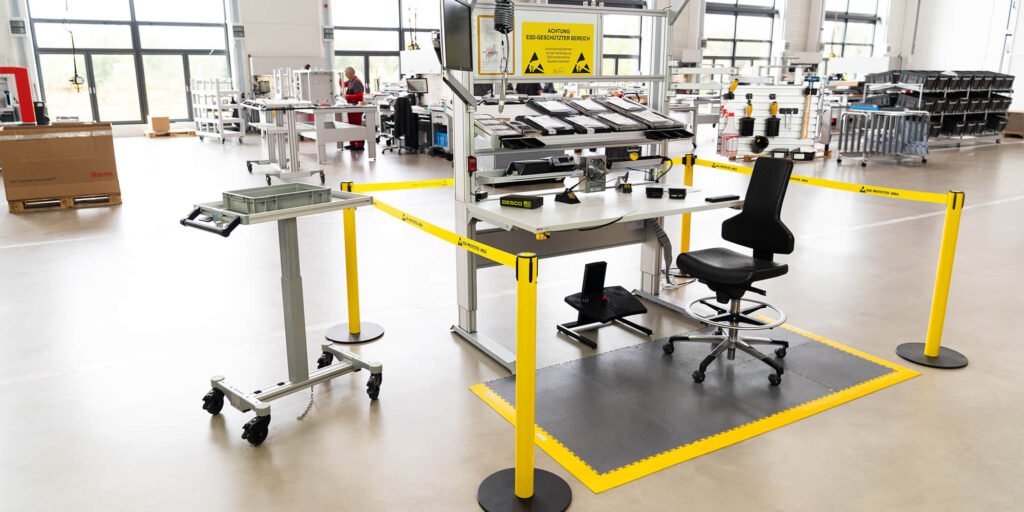
Wrist strap + mat + grounding + ionizer = strongest setup
- The best way is making a ESD workbench,learn more how to make
How to Use an ESD Wrist Strap Correctly
A lot of buyers search esd wrist straps but still use them incorrectly. That leads to false confidence.
Here is the correct setup:
-
Put the band directly against the skin, snug but comfortable.
-
Make sure the conductive portion has reliable skin contact.
-
Connect the cord to an approved grounding point or common point ground.
-
Use the strap at a grounded workstation, ideally with an ESD bench mat.
-
Test the strap regularly.
Bondline explains the skin-contact-to-ground concept clearly, and Q Source notes that the metallic part inside the strap should touch the skin.
such as:
-
wearing the strap loosely
-
clipping to an unverified point
-
using it without a proper bench setup
-
assuming a strap controls nearby insulators
-
skipping routine testing
Also, corded straps matter. Sanken specifically warns that cordless wrist straps may leave approximately 200 V on the human body and recommends a corded wrist strap with a dedicated grounding point.
Do You Need an ESD Wrist Strap Tester?
Yes, if you want a credible ESD control program.
An esd wrist strap tester or esd wrist strap checker verifies that the wrist strap system is functioning correctly. EOS/ESD Association guidance says wrist straps used daily are typically recommended to be tested daily unless continuous monitoring is used.
ESD Systems also cites the ANSI/ESD S20.20 recommended technical requirement range for a wrist strap system as less than 35 × 10^6 ohms.
That means your content should not just sell the strap. It should also explain that a good program includes:
-
the strap
-
the cord
-
the grounding point
-
an esd wrist strap tester
-
or a continuous monitor for more critical operations
This is especially important if you want to rank for esd wrist strap tester and esd wrist strap checker instead of leaving that traffic to product-only pages.
Learn more: how to test wrist strap
Is a Black Metal ESD Wrist Strap Better?
Buyers often search black metal esd wrist strap because metal expansion bands look durable and professional. A metal strap can offer very good and consistent skin contact, which can help where skin resistance is an issue. That said, “better” depends on fit, comfort, cleanliness requirements, and compliance with your program requirements. ESD Systems notes that expandable metal cuffs can help reduce skin contact resistance in some cases.
So a black metal esd wrist strap can be a strong option for many operators, but the right choice still depends on application, operator comfort, and proper testing.
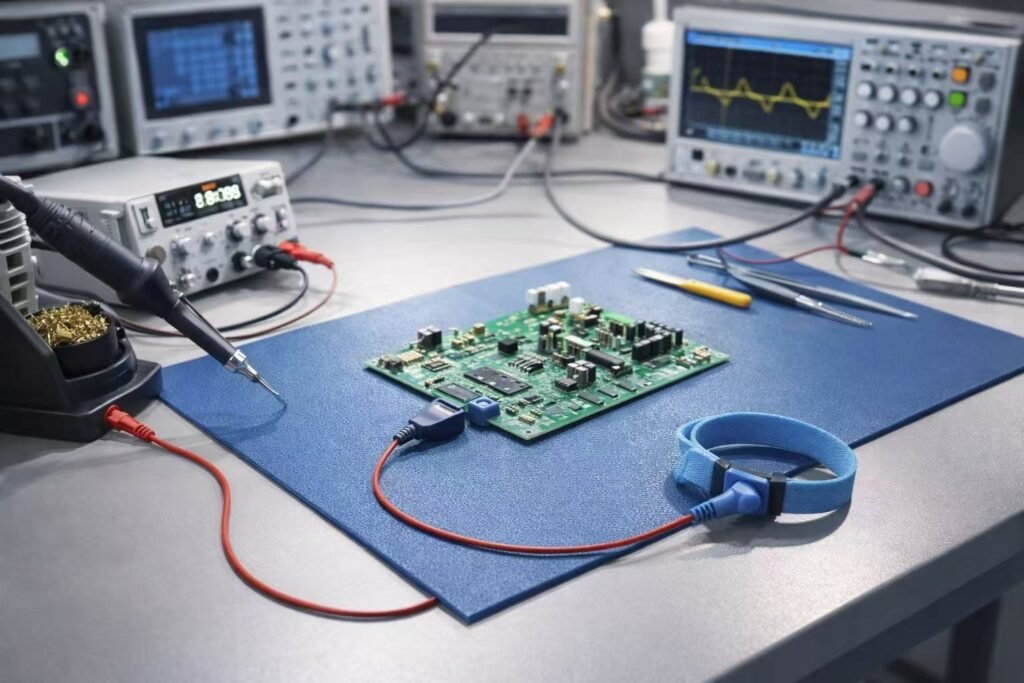
Best Setup: ESD Mat and Wrist Strap Together
One of the strongest sections for SEO and conversions is the workstation setup answer, because it naturally captures esd mat and wrist strap intent.
A simple, effective bench setup includes:
-
a grounded ESD mat
-
an esd wrist strap
-
a common ground point
-
regular strap testing
-
ionization if insulators or isolated conductors are present nearby
Bondline’s workstation guide and Q Source’s mat-and-strap guide both support this combined approach.
So if someone asks, “Do I need an ionizer if I already use an esd wrist strap?” the best practical answer is:
If your process includes charged plastics, isolated tools, packaging, or other non-groundable items near the product, yes.
Final Verdict: Wrist Strap or Ionizer?
Choose a wrist strap when you need to control the operator.
Choose an ionizer when you need to neutralize charge on insulators and isolated conductors.
Choose both when you want a serious ESD-safe workstation for electronics manufacturing, repair, test, or cleanroom work. That is the most accurate answer technically and the most useful answer commercially.
If your goal is to protect sensitive electronics, don’t ask which tool is “better” in the abstract. Ask which source of charge you are trying to control.
That is the difference between surface-level ESD advice and a real ESD control program.
Applications of ESD Protection
PCB Assembly
Prevent electrostatic discharge when handling sensitive circuit boards and components.
Semiconductor Manufacturing
Protect highly sensitive chips and wafers from invisible ESD damage.
Electronics Repair
Avoid hidden failures when repairing or testing electronic devices.
Cleanroom Environments
Control static where grounding alone is not enough and ionization is required.
Build Your Complete ESD System
Don’t rely on partial protection. Use a complete ESD setup including wrist straps, mats, and ionizers.
FAQ
1. Is an esd wrist strap enough on its own?
For many seated workstations, it is the essential starting point, but it is not always enough. If your process includes insulators or isolated conductors near sensitive electronics, ionization may also be required.
2. Do esd wrist straps need to be tested?
Yes. Typical guidance recommends daily testing for wrist straps used daily, unless continuous monitoring is used instead.
3. What does an esd wrist strap tester check?
It checks whether the wrist strap system is functioning within the required resistance range and whether the operator has a proper path to ground.
4. What is the difference between an esd wrist strap and an ionizer?
A wrist strap grounds the person. An ionizer neutralizes charge in the air and on non-groundable items. They solve different ESD risks.
5. Should I use an esd mat and wrist strap together?
Yes, that is one of the most common and effective workstation combinations for seated electronics work.
6. Are cordless wrist straps good enough?
For sensitive electronics work, corded straps are the safer recommendation. Sanken notes cordless straps may leave about 200 V on the body.
📞 Contact Us Today
For bulk orders, quotes, or product guidance, get in touch with our expert team:
Email: sales2@esdbest.com
Phone: +86 137 1427 2599