ESD Boots: How They Work, Standards, and Common Failure Scenarios
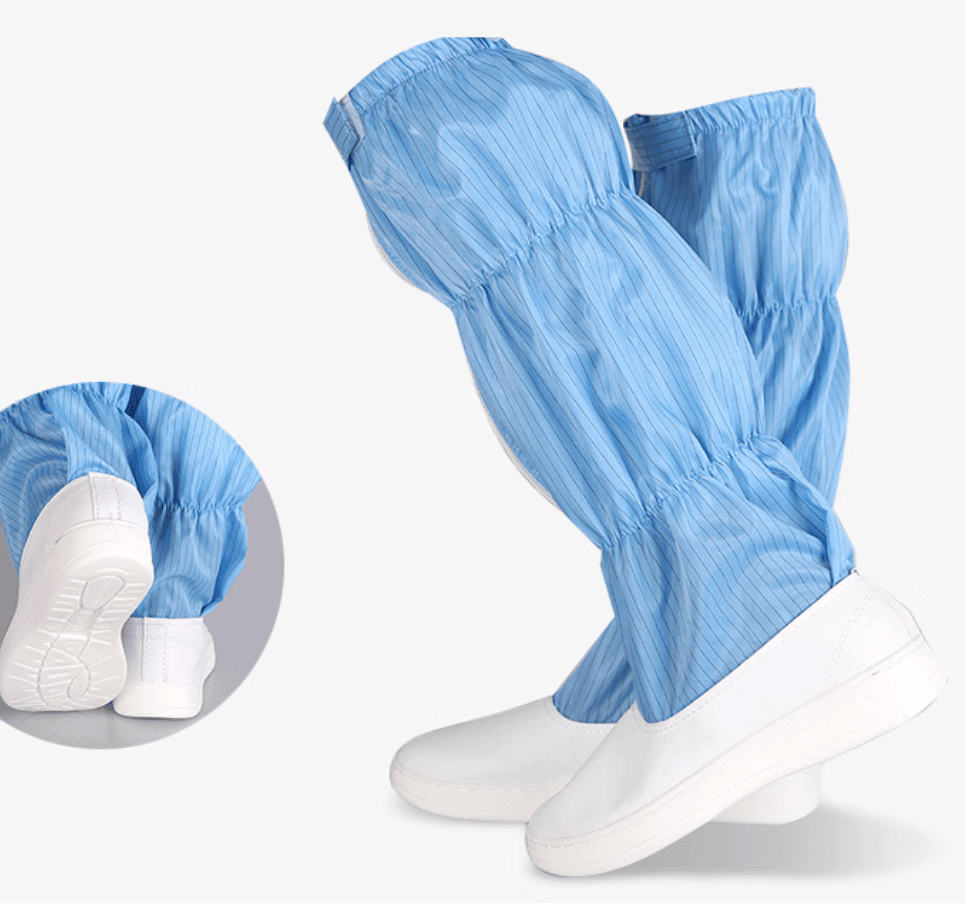
| Type | ESD Boots |
| Upper Material | PU Leather + Antistatic Fabric |
| Insole Material | 5mm Stripe Antistatic Fabric |
| Outer Sole Material | PVC/ PU |
| Color | white, blue, pink,yellow,etc. |
| Size | PU Outsole: #34-#46,48,50 PVC Outsole: #34-#46,48 |
| ESD Resistance | 10^6-10^9Ω |
Introduction
ESD boots are often treated as simple safety footwear.
In reality, they are a functional component of an electrostatic discharge control system.
Many products are labeled “ESD compliant,” yet fail to control static charge in real production environments.
The reason is not always the boot itself — it is the system design and verification.
This page explains what ESD boots actually do, how standards define their performance, and why system-level understanding matters more than marketing claims.
⸻
What Are ESD Boots?
ESD boots are safety footwear designed to control and dissipate electrostatic charge from the human body to ground.
They are not insulators, and they are not meant to eliminate static instantly.
Their role is to provide a controlled resistance path that prevents sudden discharge while avoiding charge accumulation.
Typical resistance range:
•10⁵ – 10⁹ ohms (depending on standards and application)
ESD boots function only when used as part of a footwear–flooring–grounding system.
In diverse manufacturing environments, ESD work boots are specifically selected for controlling human body voltage in production lines.
How ESD Boots Work (The System Logic)
ESD boots do not work alone.
A compliant ESD system requires:
•ESD boots (controlled resistance sole)
•Dissipative or conductive flooring
•A verified grounding path
Electrostatic charge flows:
Human body → ESD boot sole → ESD floor → Ground
If any element is missing or incorrect, charge remains uncontrolled.
ESD boots function only when paired with a compatible flooring system and a verified grounding path. The discharge route is:
Human Body → ESD Boots Sole → ESD Flooring → Ground. Without any of these components, ESD control fails.
Human Body → ESD Boots Sole → ESD Flooring → Ground. Without any of these components, ESD control fails.
This is why ESD standards never evaluate boots in isolation — they evaluate system performance, including body voltage reduction.
In manufacturing environments, ESD work boots are specifically selected to control body voltage during movement and daily production activities.
⸻
ESD Boots vs Regular Safety Boots
Regular safety boots are designed for:
•Impact protection
•Slip resistance
•Mechanical safety
They are typically electrically insulating.
ESD boots, by contrast:
•Use specially formulated sole materials
•Maintain controlled resistance
•Allow safe, gradual charge dissipation
Wearing regular safety boots in an ESD-protected area can increase electrostatic risk, even if other controls are in place.
Unlike ordinary PPE, ESD safety boots are designed to provide mechanical protection while still maintaining controlled electrostatic discharge performance.
⸻
Relevant ESD Standards for Boots
ESD boots are evaluated as part of a system under international standards such as
IEC 61340-5-1 and ANSI/ESD S20.20, which define acceptable resistance ranges,
testing protocols, and body voltage limits. Compliance means measurable performance, not just product labeling.
IEC 61340-5-1 and ANSI/ESD S20.20, which define acceptable resistance ranges,
testing protocols, and body voltage limits. Compliance means measurable performance, not just product labeling.
ESD boots are governed by system-level standards, not standalone product claims.
Key standards include:
•IEC 61340-5-1 – Protection of electronic devices from electrostatic phenomena
•ANSI/ESD S20.20 – ESD control program requirements
These standards define:
•Acceptable resistance ranges
•Test methods
•Body voltage limits
•Footwear–floor interaction requirements
Compliance means meeting measurable performance criteria, not simply passing a material test.
👉 Reference:
🔗 https://esdbest.com/esd-boots-standards/
🔗 https://esdbest.com/esd-flooring-standards/
⸻
Why ESD Boots Fail in Real Factories
Common failure scenarios include:
•Boots used on non-dissipative floors
•Sole resistance drifting out of range over time
•No grounding verification after installation
•Assuming “ESD rated” equals “ESD effective”
•Mixing ESD boots with insulating insoles
In all cases, the system fails — not because of one product, but because integration and verification were ignored.
⸻
How to Choose ESD Boots for Manufacturing Environments
When selecting ESD boots, engineers should evaluate:
•Resistance stability across production batches
•Compatibility with existing flooring systems
•Toe cap integration (steel vs composite)
•In-house testing capability
•Documentation and traceability
For factories, consistency and control matter more than branding.
In heavy-duty production areas, ESD steel toe boots are commonly used where impact protection and stable ESD performance are both required.
In metal-free or weight-sensitive environments, ESD composite toe boots may be preferred as an alternative to traditional steel toe designs.
For applications which also require mechanical toe protection, ESD steel toe boots provide both impact resistance and static control.
In metal-free or lightweight-required environments, ESD composite toe boots may be preferred.
⸻
HORBEST Manufacturing Approach (Factory Perspective)
HORBEST manufactures ESD boots in-house, allowing direct control over:
•Sole material formulation
•Resistance range consistency
•Toe cap integration
•Batch-level ESD testing
This manufacturing control supports stable ESD performance across large production volumes — a key requirement for electronics and industrial customers.
⸻
Conclusion
ESD boots are not accessories.
They are functional grounding components.
Evaluating ESD boots by labels, appearance, or resistance numbers alone leads to false confidence.
True ESD protection is systemic, measurable, and verified.
Understanding how ESD boots work within the full system is the foundation of effective static control.
📞 Contact Us Today
For bulk orders, quotes, or product guidance, get in touch with our expert team:
Email: sales2@esdbest.com
Phone: +86 137 1427 2599
To ensure performance under real factory conditions, proper ESD footwear testing</a > is essential — verifying resistance and body-voltage behavior in situ.
For applications which also require mechanical toe protection, ESD steel toe boots</a > provide both impact resistance and static control.
</p >
In metal-free or lightweight-required environments, ESD composite toe boots</a > may be preferred.
</p >
In diverse manufacturing environments, ESD work boots</a > are specifically selected for controlling human body voltage in production lines.
</p >
FAQ
Are ESD boots the same as anti-static boots?
No. Anti-static boots only reduce charge buildup, while ESD boots are engineered to dissipate charge through a controlled path.
Can ESD boots work without ESD flooring?
No. ESD boots require compatible dissipative or conductive flooring to provide a discharge path to ground.
What resistance range is typical for ESD boots?
Commonly between 10⁵–10⁹ ohms depending on system requirements.
Why do some ESD boots fail in real use?
Failure usually occurs when the ESD system is incomplete — such as improper flooring, missing grounding, or lack of testing.
Which standards define ESD boot performance?
Standards include IEC 61340-5-1 and ANSI/ESD S20.20.
No. Anti-static boots only reduce charge buildup, while ESD boots are designed to dissipate electrostatic charge as part of a controlled grounding system.
No. ESD boots require compatible dissipative or conductive flooring to create a continuous discharge path to ground.
Most ESD boots fall within 10⁵–10⁹ ohms, depending on system requirements and applicable standards.
Failures usually occur due to improper flooring, missing grounding, or lack of system-level testing—not because the boots are defective.
ESD boots are evaluated under system standards such as IEC 61340-5-1 and ANSI/ESD S20.20.