ESD Gloves vs Anti-Static Gloves
Short Answer
In commercial use they are the same product.
"ESD gloves," "anti-static gloves," "antistatic gloves," "electrostatic discharge gloves," "static dissipative gloves" and "static control gloves" all appear in supplier catalogues describing gloves intended for an Electrostatic Protected Area. No standard assigns them different meanings, and no supplier uses them consistently.
If you are comparing two quotations and one says "ESD gloves" while the other says "anti-static gloves," that tells you nothing about the difference between them.
Where the Terms Actually Differ
In strict materials language the words are not interchangeable. They describe different things:
| Term | What it describes | Resistance |
|---|---|---|
| Conductive | Charge moves freely across the surface | < 1 × 10⁴ Ω |
| Dissipative | Charge moves in a controlled, slowed way | 1 × 10⁶ – 1 × 10⁹ Ω |
| Anti-static | Resists generating charge by friction | No fixed range |
| Insulative | Charge does not move | ≥ 1 × 10¹¹ Ω |
Strictly, anti-static describes low charge generation — a triboelectric property. Dissipative describes a measured resistance range.
Almost every glove sold as "anti-static" is in fact a dissipative product. The distinction matters when you are writing a specification document. It rarely matters on a purchase order.
ESD Gloves vs Normal Gloves — The Difference That Does Matter
The useful comparison is not between two labels. It is between a glove that has been measured and one that has not.
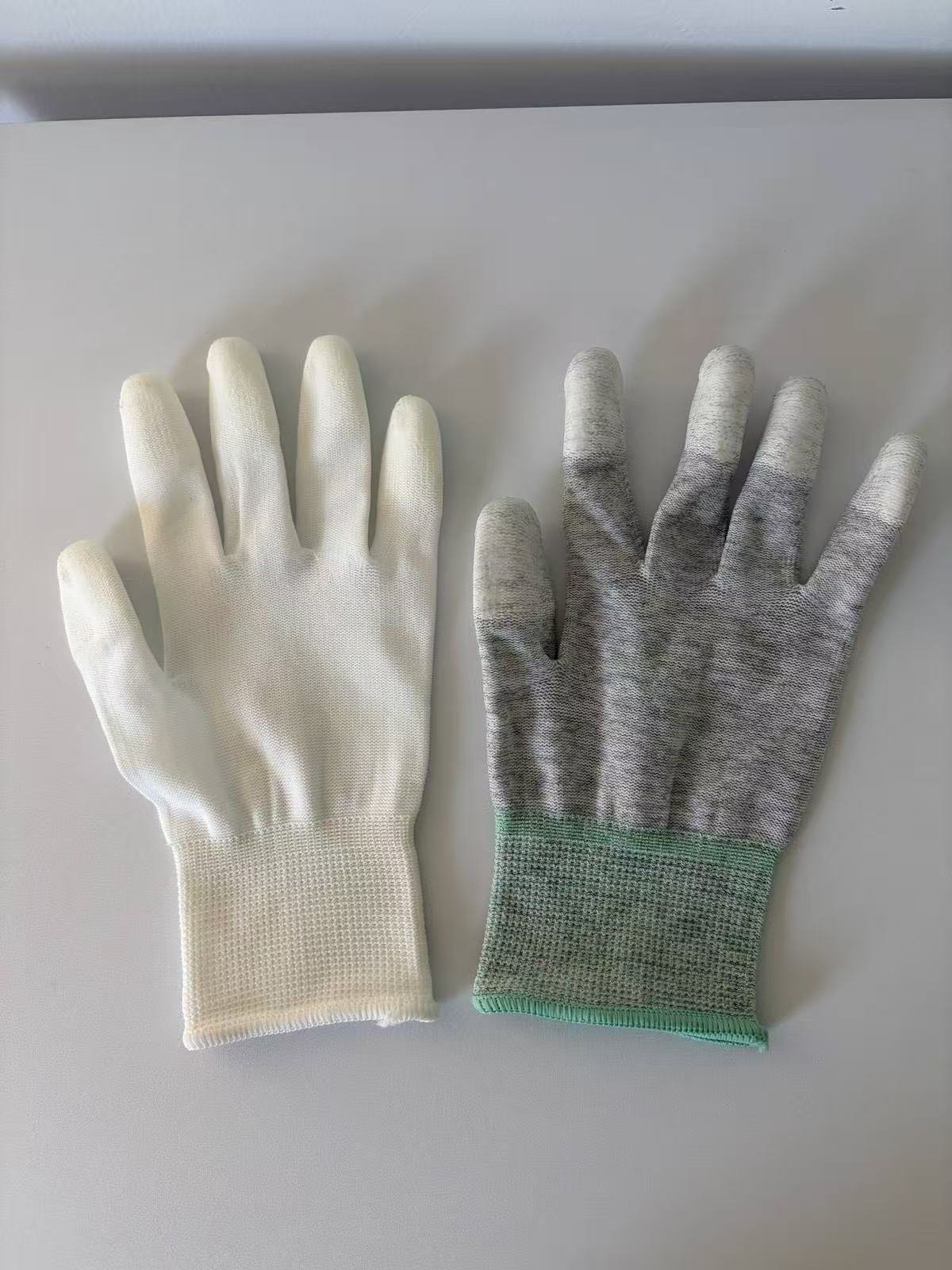
We tested two gloves with the same knitted construction and the same white PU fingertip coating. One has carbon fibre in the yarn; the other does not.
| Carbon fibre glove | Plain knitted glove | |
|---|---|---|
| Measured resistance | 2.52 × 10⁶ – 2.01 × 10⁷ Ω/sq | 6.47 × 10¹⁰ – 8.16 × 10¹⁰ Ω/sq |
| Classification | Static-dissipative | Outside the ESD glove range |
| Visual difference | None | None |
Conditions: 60–65% RH, 30 °C. ACL Staticide Model 800, serial R01172234, calibrated 19 August 2026.
The plain glove is not strictly insulative — at 1010 it sits below the 1 × 10¹¹ Ω threshold. But it is three to four decades above the range specified for ESD gloves, and is not suitable for EPA use.
Neither the label on the bag nor the appearance of the glove would have told you that.
What to Ask Instead
Rather than asking which term a supplier uses, ask:
- What is the measured surface resistance? Not a claimed range — a measured value.
- At what temperature and relative humidity? A figure without conditions cannot be compared to anything.
- On what instrument, and when was it last calibrated?
We publish all three for every glove we sell.
Our carbon fibre gloves measured 2.52 × 10⁶ – 2.01 × 10⁷ Ω/sq. Our nitrile gloves measured 3.72 – 4.28 × 10⁸ Ω/sq. Both at 60–65% RH and 30 °C, on an instrument calibrated on 19 August 2026.
Download the comparative test report (PDF)