ESD Workbench Grounding: How to Ground and Verify an ESD Workbench


By Rachel Zhong, ESD Engineer, ESDBEST · 29 years in ESD control · Last updated: October 2026
ESD workbench grounding is the controlled connection of the work surface, the operator and other ESD control items at a workstation to one verified ground through a common-point ground. The goal is to keep everything at the same electrical potential and give static charge a safe, measurable path to ground.
Putting an “ESD-safe” mat on a table does not do this by itself. A workstation can look complete and still offer little protection. The usual causes are a disconnected ground cord, an outlet nobody has checked, several unrelated grounding points, or a resistance reading taken with the wrong method.
This guide covers how an ESD workbench grounding system works, the resistance limits it has to meet, how to install it step by step, and how to verify it.
Key takeaways
- Connect every ESD control item at the bench to one common-point ground (CPG). The CPG is then connected to a verified facility ground.
- Under ANSI/ESD S20.20 and IEC 61340-5-1, an installed work surface should measure less than 1 × 10⁹ Ω to ground. A wrist-strap system should measure less than 3.5 × 10⁷ Ω.
- Never use a table leg, gas pipe, water pipe or computer case as the ground point.
- A multimeter can check a ground cord. It cannot verify a dissipative work surface.
- Test at several locations, record every result, and repeat at the interval set in your ESD control plan.
What Is ESD Grounding and Why Does a Workbench Need It?
Movement, clothing, packaging and handling all generate electrostatic charge. If that charge stays on a person, a tool or a work surface, it can discharge through an electronic component the moment contact occurs.
An ESD work surface is made from static-dissipative material. Its job is not to short anything to earth. It gives charge a controlled path to drain away. That only works when the path ends at a verified ground:
Charged object → dissipative work surface → grounding snap → ground cord → common-point ground → verified ground
Without the final ground connection, a mat can spread charge across its surface but cannot reliably remove it from the workstation. Grounding is part of the ESD control system, not an optional accessory. For the difference between true ESD surfaces and generic “anti-static” products, see ESD mat vs anti-static mat.
ESD Workstation Setup Requirements at a Glance
The table below summarises the grounding and resistance limits most often applied to an ESD workbench. Your own ESD control plan, customer contracts and the edition of the standard you follow take priority.
| Item | Typical requirement | Reference |
|---|---|---|
| Work surface, resistance to ground (installed) | < 1 × 10⁹ Ω | ANSI/ESD S20.20; IEC 61340-5-1 |
| Work surface, point-to-point (product qualification) | < 1 × 10⁹ Ω | ANSI/ESD S20.20, test method ANSI/ESD STM4.1 |
| Wrist strap system (operator + strap + cord to ground) | < 3.5 × 10⁷ Ω | ANSI/ESD S20.20; IEC 61340-5-1 |
| Equipment grounding conductor (AC protective earth) | < 1.0 Ω impedance | ANSI/ESD S20.20; ANSI/ESD S6.1 |
| Auxiliary ground to equipment ground | < 25 Ω | ANSI/ESD S20.20; ANSI/ESD S6.1 |
| Test voltage | 10 V for readings below 1 × 10⁶ Ω; 100 V for higher readings | ANSI/ESD STM4.1; ESD TR53 |
A lower limit, such as 1 × 10⁶ Ω, is not required by S20.20 for work surfaces. Many facilities still specify one, because a very conductive surface can cause a fast, damaging discharge from a charged device. If your plan sets a lower limit, test against it as well.
Components of an ESD Workbench Grounding System
| Component | Primary function |
|---|---|
| Static-dissipative work surface (mat or ESD laminate top) | Provides a controlled surface for handling ESD-sensitive items |
| Grounding snap or connection point | Creates the electrical connection to the mat |
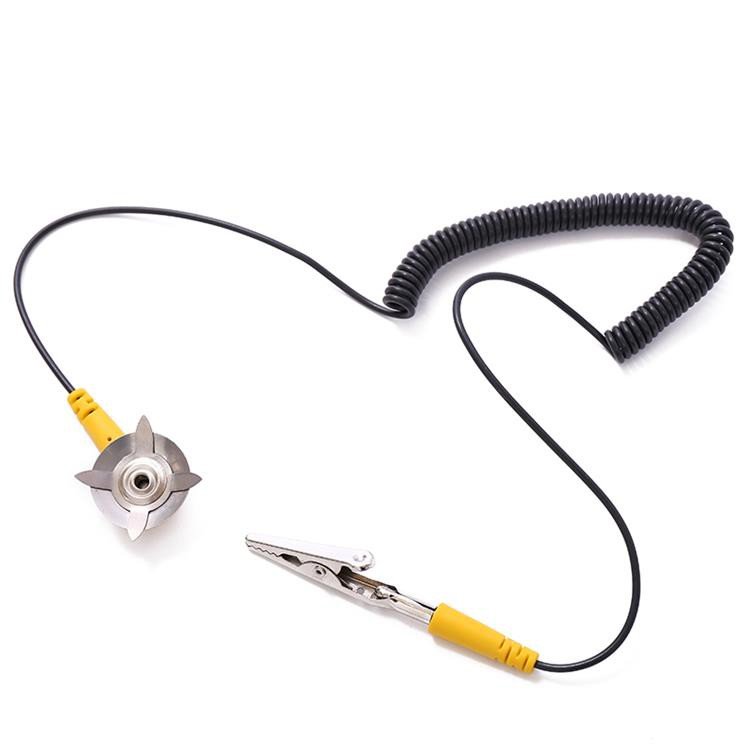
| Mat ground cord | Connects the work surface to the common-point ground |
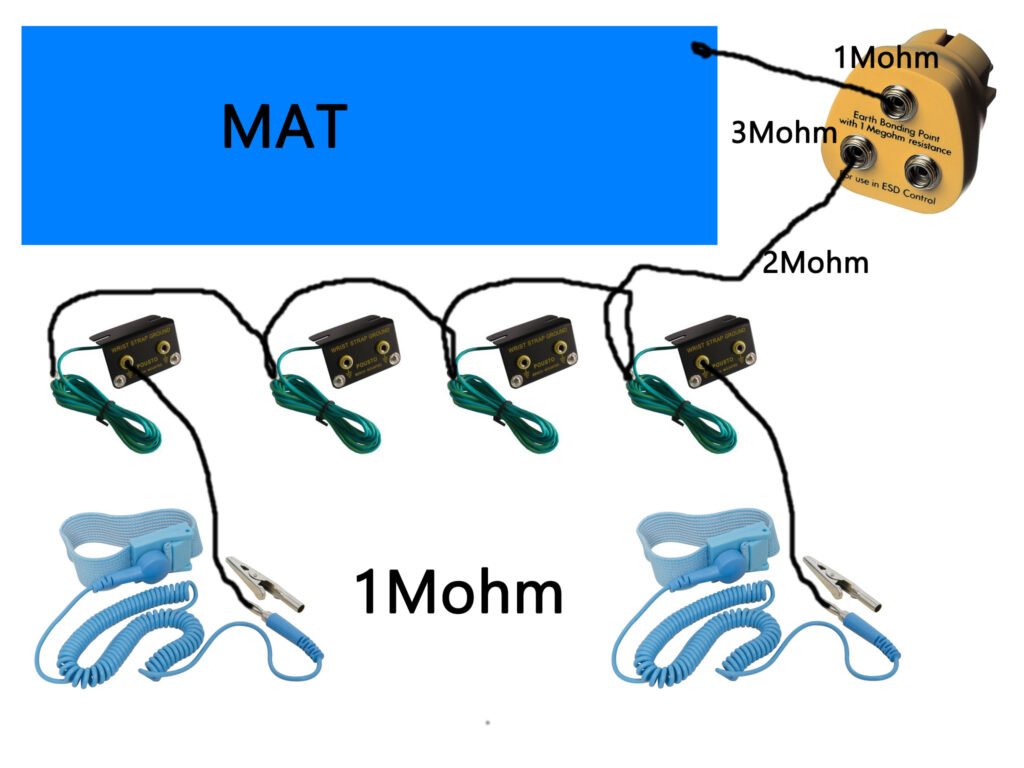
| Common-point ground / earth bonding point | Gives all ESD control items one shared connection to ground |
| ESD grounding plug | Connects the CPG to the protective-earth pin of a verified outlet |
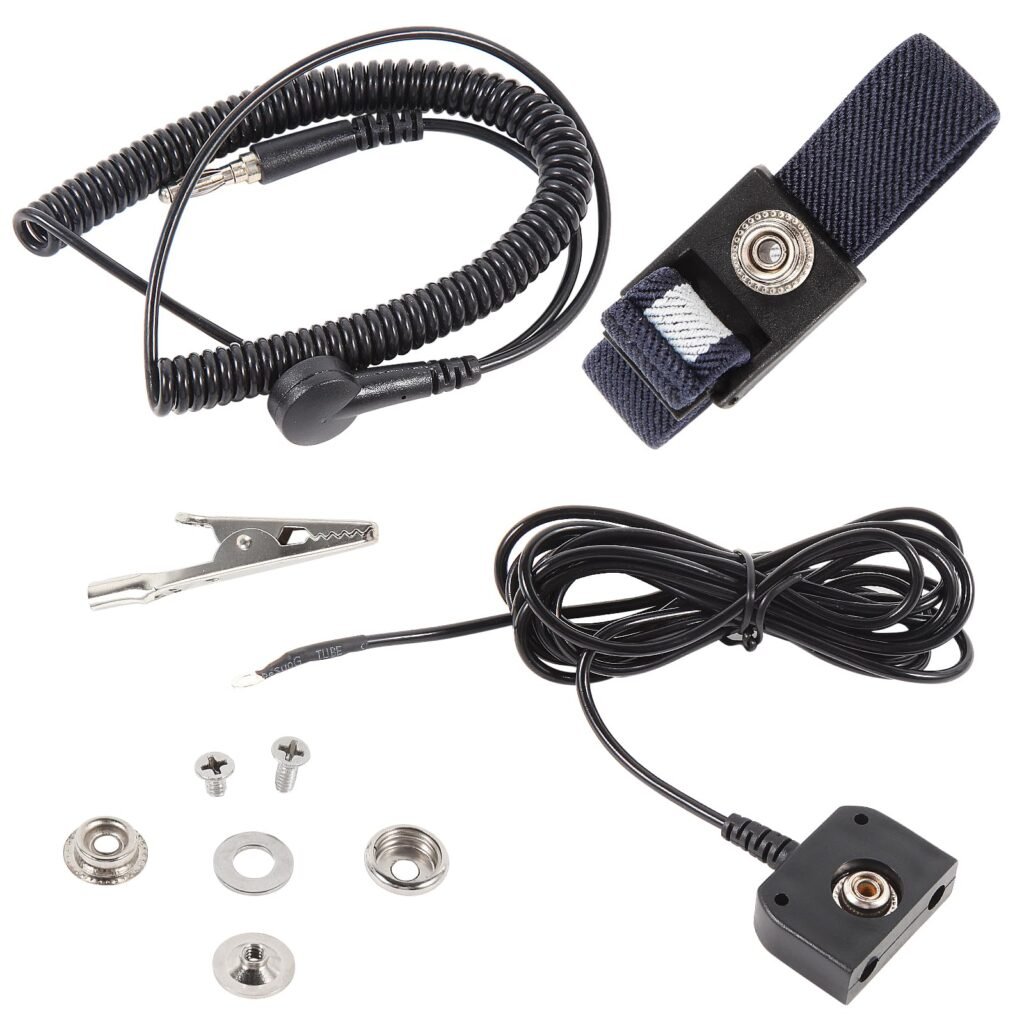
| Wrist strap and coil cord | Connect a seated operator to the grounding system |
| Heel straps or ESD footwear | Ground standing or moving operators through an ESD floor |
| Resistance meter and wrist strap tester | Verify the resistance of the installed system |
ANSI/ESD S6.1 covers selecting, establishing, verifying and maintaining an ESD grounding system within an ESD protected area (EPA). IEC 61340-5-1:2024 sets the broader administrative and technical requirements for an ESD control program.
What Is the Preferred Grounding Point for ESD Workstations?
The preferred grounding point is a common-point ground (CPG), also sold as an earth bonding point (EBP). It is a single, labelled terminal where the work surface, wrist strap and other ESD control items at one bench terminate. The CPG is then connected to the equipment grounding conductor (protective earth) of the facility electrical system, or to another ground approved in your ESD control plan.
A CPG keeps the work surface and the operator at roughly the same potential. It also makes the workstation easy to inspect, because every connection is in one place.
What not to use as a grounding point
- Table legs or bench frames. Paint, plastic feet and bolted joints can isolate them.
- Gas pipes. Never use them.
- Water pipes, radiators and building steel. Use these only if they have been evaluated and approved as part of the grounding system.
- A computer case or instrument chassis. Its ground depends on its power cord and outlet. It may also carry fault or leakage current.
- Any unidentified metal object. A conductive object is not necessarily a verified ground.
If a facility has two grounding systems, such as electrical earth and a separate ESD ground bus, they must be bonded according to the applicable electrical and ESD requirements. Unplanned independent ground paths create potential differences, and those potential differences are what the workstation is meant to remove.
How to Ground an ESD Workbench: 6 Steps
Step 1: Identify a verified ground reference
Identify the ground reference approved for the facility before you install anything. Depending on the installation, it may be:
- The equipment grounding conductor of a correctly wired electrical system
- A facility ESD grounding bus
- A verified grounding terminal installed for the protected area
- Another point approved by a qualified electrical or ESD professional
A three-pin receptacle does not prove that an outlet is correctly grounded. A qualified person should check outlet wiring and protective-earth continuity with suitable equipment.
ESD grounding is not a substitute for protective electrical earthing. The facility’s electrical safety requirements always come first.
Step 2: Bond the bench structure and work surface
A complete ESD workbench is more than a mat on a table. Check how each part of the bench is bonded:
- Steel frames. A metal frame does not need to be part of the ESD path, but it must not create an isolated conductor next to sensitive parts. If the bench design calls for frame bonding, use the manufacturer’s bonding point, not a painted bolt.
- ESD laminate tops. These need their own grounding point and cord, just like a mat. The laminate’s dissipative layer must be connected. Connecting only the frame underneath is not enough.
- Shelves, drawers and bins. If ESD-sensitive items are placed on shelves, the shelf surfaces need a dissipative top connected to the CPG.
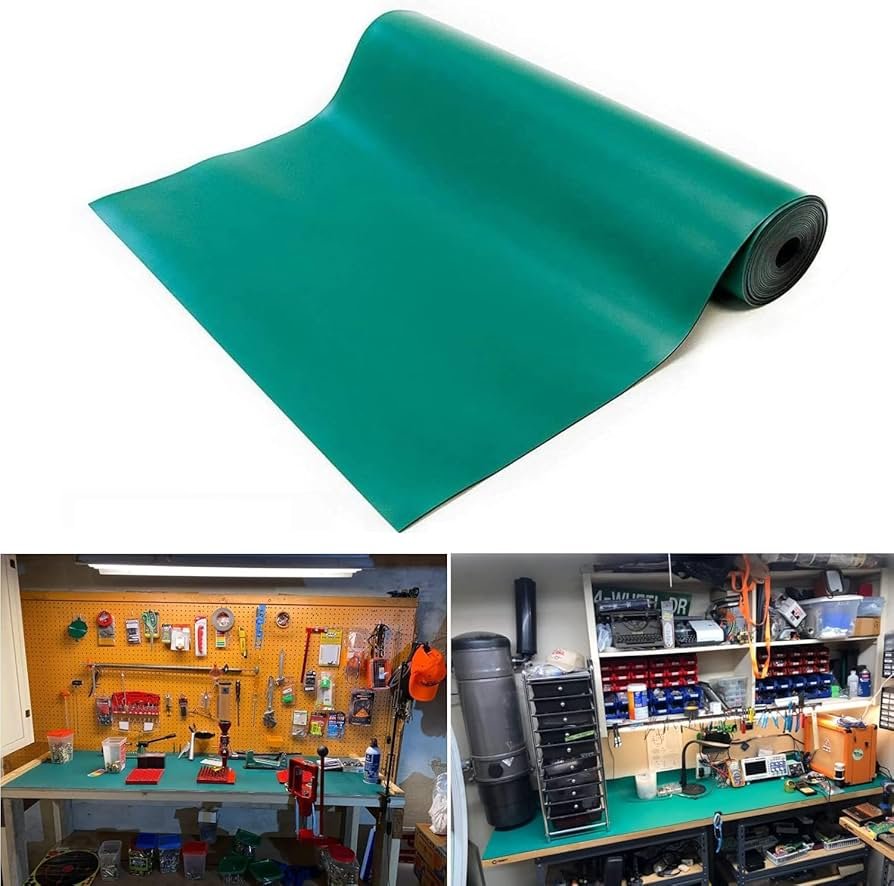
- Mats on existing benches. If you are adding a mat to a standard bench, the bench itself can stay as it is. The mat becomes the controlled work surface.
Step 3: Install the work surface and connect it to the CPG
Lay the mat flat on a clean, dry, stable bench. Keep insulators away from the working area, including untreated plastic sheets, foam, ordinary document folders and adhesive films.
Fit the grounding snap where the mat manufacturer recommends. This is usually near the rear or side, where the cord stays out of the way. The snap must contact the correct dissipative or conductive layer. A snap attached only to an insulating top layer will not provide a working ground path.
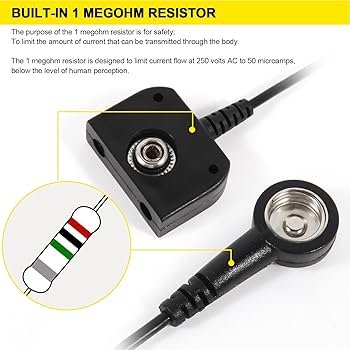
Attach the mat ground cord to the snap and connect the other end to the CPG. Some mat cords include a series resistor and some do not. A 1 MΩ resistor is standard in wrist strap cords to limit current to the operator. For work surfaces, follow the workstation design and the manufacturer’s instructions. Do not add or remove resistors because a value is commonly quoted online, because doing so changes the measured resistance of the whole path. For the full mat installation sequence, see how to ground an ESD mat, and for cord and resistor details see ESD mat grounding and the 1 MΩ resistor.
Before moving on, check that:
- The snap is mechanically secure
- The cord is not cut, crushed or stretched
- All connectors are fully engaged
- The ground lead does not create a trip hazard
- The CPG is clearly marked
Step 4: Connect the operator
For seated personnel handling exposed ESD-sensitive parts, a grounding wrist strap is the primary grounding method. The band should fit snugly against the skin. The coil cord connects to the wrist-strap terminal on the CPG or a continuous monitor, never to a random screw, the table frame or an unverified conductor.
Standing or moving operators are normally grounded through ESD footwear or heel straps on a grounded ESD floor. In that case, the floor is also part of the grounding system and must be tested.
The work-surface test and the wrist-strap test answer different questions. A passing mat reading does not prove that the operator’s wrist strap works. See how to test an ESD wrist strap.
Step 5: Connect other ESD control items
Any other item at the bench that is part of your ESD control plan should connect to the same grounding architecture. This includes grounded tool holders, shelf tops and equipment requiring a ground connection. Soldering irons are grounded through their own power cord and are verified with their own method, such as ANSI/ESD STM13.1. Do not daisy-chain one mat through another. Each item should have a defined, testable path to the CPG.
Step 6: Verify the installed workstation
Installation is not complete until the installed system has been measured and the results recorded. The next section explains how.
How to Verify ESD Workbench Grounding
A resistance-to-ground (RTG) test measures the path from the work surface to its ground reference. It uses a resistance meter and a standard 5 lb (2.27 kg) cylindrical electrode placed on the mat. The second test lead connects to the ground reference defined in the procedure, usually the CPG or the ground pin of the grounding plug.
- Remove loose items from the test area.
- Inspect the surface for dirt, oil, flux or moisture.
- Confirm that the mat ground cord is connected to the CPG.
- Place the electrode at the first test location.
- Connect the ground lead to the specified ground reference.
- Start at 10 V. If the reading is above 1 × 10⁶ Ω, retest at 100 V.
- Let the reading stabilise.
- Record the resistance, test location, temperature, relative humidity and instrument ID.
- Repeat at every location defined in your compliance plan.
ANSI/ESD STM4.1 covers qualification test methods for work surfaces. ESD TR53 and IEC TS 61340-5-4 describe compliance verification for installed items. Your ESD control plan should define the acceptance limits, instruments, electrode setup and test frequency.
Test more than one location
A single reading beside the snap does not represent the whole surface. A practical plan tests:
- The center of the working area
- The front-left and front-right working positions
- A rear working position
- The point farthest from the grounding snap
Testing several locations can reveal contamination, wear, cuts, delamination or poor contact between mat layers. Record every result, not just the best one.
Resistance to ground vs point-to-point testing
| Test | Measurement path | What it tells you |
|---|---|---|
| Resistance to ground | Surface electrode to ground reference | The installed work surface has a working ground path |
| Point-to-point | One surface electrode to another | Resistance across the material itself |
| Ground continuity | Connection point to grounding system | Integrity of a cord or bonding conductor |
| Wrist strap system | Operator through strap and cord to ground | Personnel grounding performance |
A mat can pass point-to-point and still fail resistance to ground if its snap, cord or ground connection is faulty. Material data from a datasheet does not replace a test of the installed workstation. For mat-specific test methods, see how to test an ESD mat with a resistance meter.
📞 Contact Us Today
For bulk orders, quotes, or product guidance, get in touch with our expert team:
Email: sales2@esdbest.com
Phone: +86 137 1427 2599
Can You Check ESD Grounding With a Multimeter?
Partly. A standard multimeter on its ohms range can confirm that a ground cord is continuous and that its resistor is roughly the expected value (about 1 MΩ, if fitted). It can also check that the CPG is connected to the grounding plug.
It cannot verify a dissipative work surface. Most multimeters test at low voltage and cannot read reliably into the 106–109 Ω range. They also do not use the standard electrode. A reading of “OL” on a mat does not mean the mat has failed, and a low reading does not mean it passes. Use a resistance meter that meets the test method for work-surface verification.
Never use a multimeter or continuity tester on mains wiring unless you are qualified to do so. Outlet checks are a job for an electrician with the right equipment.
Common ESD Bench Grounding Mistakes
Grounding to an unverified metal object. A table leg or metal shelf may look conductive but can be isolated by paint, plastic feet or joints.
Using separate, unrelated grounds. If the mat and the operator go to different ground points, a potential difference can develop between them. Bring both to the same CPG.
Daisy-chaining work surfaces. Grounding one mat through another adds uncertain connections and makes faults hard to find.
Ignoring contamination. Flux residue, oil, dust and the wrong cleaner can all change surface resistance. Clean only with a product compatible with the mat material.
Testing only at installation. Cords loosen, snaps corrode and surfaces wear. Re-test at the interval set in your ESD control plan.
Treating every “anti-static” mat as an ESD work surface. Some anti-static materials only reduce charge generation and have no defined path to ground. You need both product resistance data and installed-system measurements.
Troubleshooting a Failed Reading
If resistance to ground is unstable or above your limit, work through the system in order:
- Confirm the meter, leads and electrode are working.
- Check the connection between the meter and the ground reference.
- Inspect the mat ground cord for damage.
- Check the snap-to-mat connection.
- Clean the test area with the approved cleaner.
- Repeat the test at several locations.
- Compare with previous records.
- Replace one suspected component at a time.
- Record the corrective action and the final result.
If every location fails by a similar amount, check the ground cord and ground reference first. If only one area fails, local contamination or mat damage is more likely.
Build Grounding Into Your ESD Control Plan
A reliable ESD workstation needs a defined grounding design, approved components, documented test methods and repeatable verification. At minimum, the compliance plan should state:
- Approved grounding references
- Work-surface resistance requirements
- Personnel grounding methods
- Test instruments and electrodes
- Test voltage and procedure
- Verification frequency
- Environmental conditions to record
- Corrective-action process
- Who is responsible for testing
- How long records are kept
Neither ANSI/ESD S20.20 nor IEC 61340-5-1 fixes a single test interval. Each facility sets its own based on use and risk. As a common practice, wrist straps are checked at the start of each shift, or monitored continuously, and installed work surfaces are verified on a periodic schedule, often monthly to quarterly.
ESD Workbench Grounding Checklist
Before releasing an ESD workbench for production, confirm that:
- The ground reference has been verified
- The work surface is properly installed
- The grounding snap makes reliable contact
- The mat cord is connected to the approved CPG
- The wrist-strap system is connected and tested
- Resistance to ground is below 1 × 10⁹ Ω at every tested location
- Environmental and measurement data have been recorded
- Operators understand the workstation requirements
- A periodic verification schedule is in place
A mat becomes a protective work surface only when it is correctly connected, tested and maintained as part of a complete ESD control system.
FAQ
Do ESD mats need to be grounded?
Yes. A static-dissipative mat can only remove charge if it is connected to ground, usually through a ground cord to a common-point ground. An ungrounded mat may spread charge across its surface, but it cannot drain it away, so it gives little real protection.
What is the preferred grounding point for ESD workstations?
A common-point ground (CPG), also called an earth bonding point. The work surface, wrist strap and other ESD items at the bench connect to it, and it connects to the facility’s verified equipment ground. This keeps everything at the same potential and makes testing simple.
Can I ground an ESD mat to a table leg or computer case?
No. Table legs are often isolated by paint, plastic feet or joints. A computer case is grounded only through its own power cord and outlet, which have not been verified. It may also carry leakage current. Use a CPG connected to a verified ground.
What resistance should an ESD workbench have to ground?
Under ANSI/ESD S20.20 and IEC 61340-5-1, an installed work surface should measure less than 1 × 10⁹ Ω to ground. Many facilities also set a lower limit, often 1 × 10⁶ Ω. Your ESD control plan defines the exact limits.
How do I check ESD grounding?
Use a resistance meter with a 5 lb electrode. Place the electrode on the work surface, connect the other lead to the ground reference, test at 10 V (or 100 V for higher readings), and record the result at several locations. Test wrist straps separately with a wrist strap tester.
Is ESD ground the same as electrical ground?
Not exactly. ESD grounding is usually connected to the electrical equipment ground (protective earth), but it serves a different purpose and is not a substitute for it. Electrical safety requirements always take priority.
About the Author
Rachel Zhong is an ESD engineer at ESDBEST with 29 years of experience in electrostatic discharge control, covering ESD work surfaces, grounding hardware and compliance testing for electronics manufacturers.
Need grounding hardware for your ESD workbenches? ESDBEST manufactures common point grounds and earth bonding plugs, wrist straps, mat ground cords and ESD testers for electronics production. Contact us for samples or a quote.
References
- ANSI/ESD S20.20-2021, Protection of Electrical and Electronic Parts, Assemblies and Equipment
- IEC 61340-5-1:2024, Electrostatics – Protection of Electronic Devices from Electrostatic Phenomena – General Requirements
- ANSI/ESD S6.1, Grounding
- ANSI/ESD STM4.1, Worksurfaces – Resistance Measurements
- ESD TR53, Compliance Verification of ESD Protective Equipment and Materials
- IEC TS 61340-5-4, Compliance Verification