Ionizing Blower for Large-Area Static Control
Industrial Ionization Solutions for Packaging & Production Lines

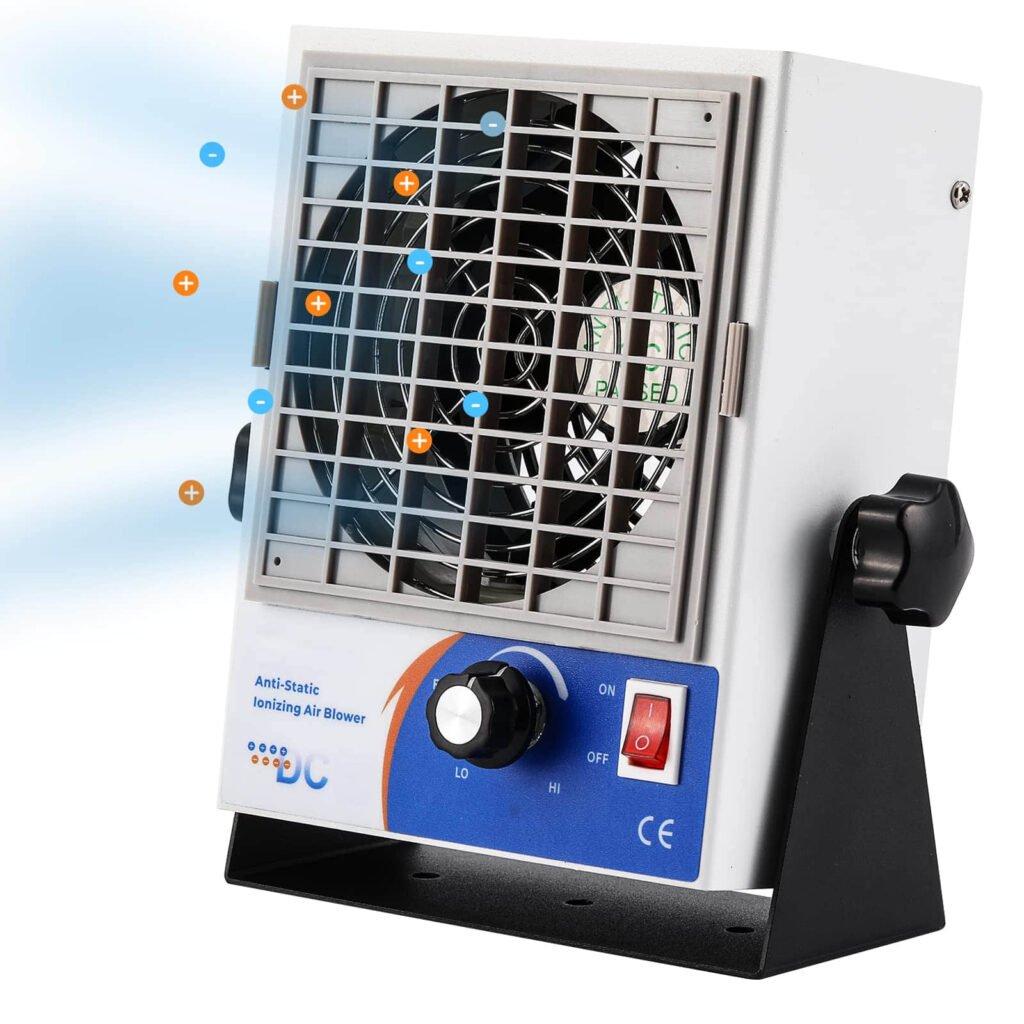
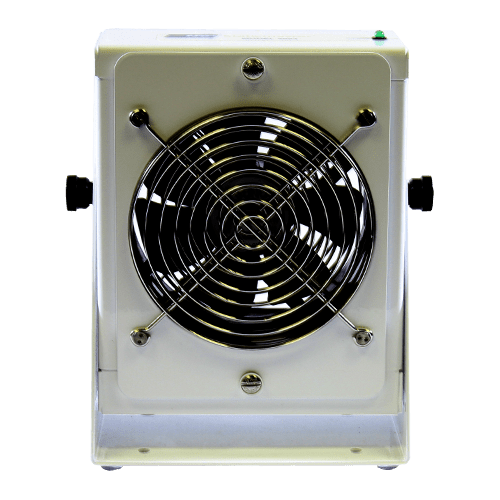
Ionizing Fan Guides
Choosing the right ionizing fan requires more than just airflow or size. Understanding technical specifications and performance testing methods is critical for effective static control in EPA environments.
- Ionizing Fan Guide: How Ionizers Work & When to Use Them – A complete overview of ionizing fan principles, applications, and selection basics.
- Ionizing Fan Specifications Explained – Key parameters such as ion balance, decay time, airflow coverage, and compliance standards.
- Ionizing Fan Testing & Performance Verification – How ionizing fans are tested using charged plate monitors and decay time measurements.
These guides help ensure the ionizers selected from this category meet real-world ESD control requirements and industry standards.
- Ionizing Fan Guide: How Ionizers Work & When to Use Them – A complete overview of ionizing fan principles, applications, and selection basics.
- Ionizing Fan Specifications Explained – Key parameters such as ion balance, decay time, airflow coverage, and compliance standards.
- Ionizing Fan Testing & Performance Verification – How ionizing fans are tested using charged plate monitors and decay time measurements.
An ionizing blower is designed for large-area static neutralization where controlled airflow and high ion output are required.
Unlike ionizing fans used at workstations, ionizing blowers deliver high air volume to neutralize static charges across wide zones, moving materials, and production environments.
This guide explains how ionizing blowers work, where they are used, key performance specifications, and how to choose the right air ionizing blower for industrial static control.
What Is an Ionizing Blower?
An ionizing blower (also called an ionizer blower or air ionizing blower) is an active static elimination device that generates balanced positive and negative ions and projects them using high-volume airflow.
Ionizing blowers are typically used where:
Static is generated continuously
Materials are moving
Large areas must be neutralized evenly
Precision directional airflow is less critical than coverage
For localized, precision control at ESD workstations, refer instead to an ionizing fan solution:
Ionizing Fan Selection Guide → https://esdbest.com/ionizing-fan/
When Do You Need an Ionizing Blower?
An ionizing blower is the correct choice when static control must cover large zones or production lines.
Common applications include:
Packaging and labeling lines
Plastic film and sheet handling
Injection molding operations
Printing and converting processes
Conveyor-based assembly
Material handling and storage areas
If static persists across a wide area or on moving materials, a blower-based ionization system is often more effective than workstation-level fans.
How an Air Ionizing Blower Works
Emitters generate positive and negative ions
A high-volume blower projects ions into the target zone
Ions attach to charged surfaces and materials
Static charges are neutralized continuously during movement
Because airflow volume is high, ionizing blowers are well suited for dynamic processes, but require careful layout planning.
Ionizing Blower vs Ionizing Fan (Quick Overview)
| Feature | Ionizing Blower | Ionizing Fan |
|---|---|---|
| Coverage Area | Large / wide zones | Localized / workstation |
| Air Volume | High | Moderate |
| Precision | Medium | High |
| Typical Use | Packaging, molding, conveyors | Electronics assembly |
| Installation | Floor, wall, duct | Benchtop, overhead |
If you are unsure which solution fits your process, use the detailed comparison:
Ionizing Blower vs Ionizing Fan
Key Ionizing Blower Specifications That Matter
When selecting an ionizing blower, airflow alone is not enough. Focus on these parameters:
| Specification | Why It Matters |
|---|---|
| Ion Balance | Ensures neutral output without charge offset |
| Decay Performance | Determines neutralization speed across distance |
| Air Volume | Drives ion delivery across wide areas |
| Coverage Distance | Defines effective neutralization zone |
| Noise Level | Operator comfort in production areas |
| Ozone Emission | Environmental and safety compliance |
| Maintenance Method | Performance stability over time |
For engineering target values and a comparison checklist, see:
Ionizing Blower Specifications Explained → https://esdbest.com/ionizing-fan-specifications/
Coverage & Layout Planning (Critical for Blowers)
Ionizing blowers are most effective when layout matches process flow.
Practical layout considerations:
Position blowers to follow material movement
Avoid dead zones caused by obstructions
Use multiple blowers instead of one oversized unit when coverage is uneven
Validate neutralization at real working distances
For layout planning examples and coverage strategies:
Ionizing Blower Coverage & Layout Guide →Spec
Testing & Verification of Ionizing Blowers
Because ionizing blowers often operate continuously, performance drift can go unnoticed.
Routine verification should include:
Ion balance checks at multiple points
Decay performance measurements
Airflow consistency checks
Testing workflow reference:
How to Test an Ionizing Blower → test
Maintenance & Long-Term Performance
Industrial environments introduce dust, fibers, and residues that can affect emitter performance.
Best practices:
Establish regular cleaning intervals
Verify performance after maintenance
Monitor for changes in decay or balance
Document verification results
Maintenance checklist:
Ionizing Blower Maintenance Guide
Typical Ionizing Blower Use Scenarios
| Industry | Common Use |
|---|---|
| Packaging | Film neutralization before sealing |
| Plastics | Static removal after molding |
| Printing | Sheet and web handling |
| Logistics | Static reduction on conveyors |
| Manufacturing | Large-area material flow |
For a broader view of static control technologies, see:
Static Eliminator Overview → /https://esdbest.com/static-eliminator/
Frequently Asked Questions (FAQ)
What is the difference between an ionizing blower and an ionizing fan?
An ionizing blower provides high air volume for large-area neutralization, while an ionizing fan offers controlled, localized airflow for workstations.
Is an ionizer blower suitable for electronics assembly?
Usually no. Electronics assembly typically requires the precision of an ionizing fan rather than a blower.
How far can an air ionizing blower neutralize static?
Depending on airflow and layout, ionizing blowers can cover several meters, but validation at real working distances is essential.
Do ionizing blowers produce ozone?
Quality systems are designed to keep ozone well below accepted safety limits.
How often should an ionizing blower be tested?
Many facilities verify performance quarterly or monthly, depending on process sensitivity and uptime requirements.
Ionizing Blower for Industrial Static Elimination
An ionizing blower is a powerful static elimination solution for large-area, high-throughput environments.
By understanding coverage requirements, key specifications, and verification practices, you can select an air ionizing blower that delivers reliable, long-term static control without unnecessary airflow or maintenance issues.
🔗 Internal Link Anchor Text Table (This Page → Targets)
| Placement | Anchor Text | Target |
|---|---|---|
| Intro section | Ionizing Fan Selection Guide | /https://esdbest.com/ionizing-fan/ |
| Comparison section | Ionizing Blower vs Ionizing Fan | https://esdbest.com/ionizing-fan-vs-ionizing-blower/ |
| Specs section | Ionizing Blower Specifications Explained | https://esdbest.com/ionizing-fan-specifications/ |
| Layout section | Ionizing Blower Coverage & Layout Guide | /https://esdbest.com/ionizing-blower-coverage-layout/ |
| Testing section | How to Test an Ionizing Blower | /https://esdbest.com/how-to-test-ionizing-blower/ |
| Maintenance section | Ionizing Blower Maintenance Guide | https://esdbest.com/ionizing-fan-maintenance/ |
| Footer / related | Static Eliminator Overview | /https://esdbest.com/static-eliminator/ |
| Footer | Browse Ionizers | /https://esdbest.com/ionizers/ |
📞 Contact Us Today
For bulk orders, quotes, or product guidance, get in touch with our expert team:
Email: sales2@esdbest.com
Phone: +86 137 1427 2599