ESD Tester CE
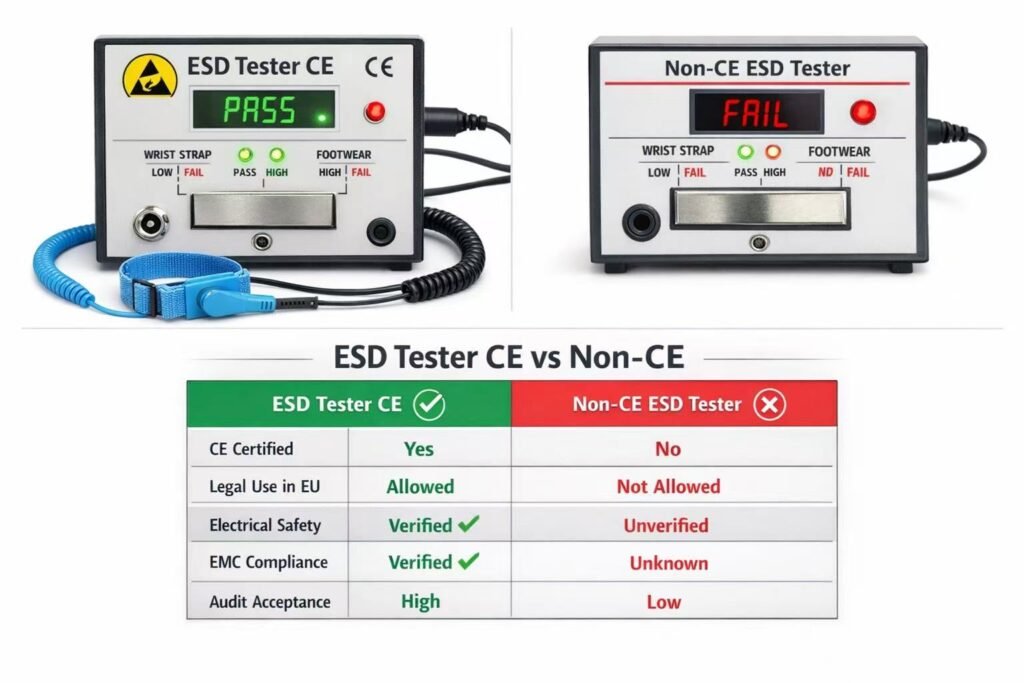
ESD Tester CE
ESD Tester CE: A Complete Guide to CE-Compliant ESD Testing for Electronics Manufacturing
In modern electronics manufacturing, electrostatic discharge (ESD) control is critical. One of the most important tools in an ESD protected area (EPA) is the ESD tester CE, which ensures operators are properly grounded and compliant with European safety regulations.
This article provides a complete, easy-to-understand overview of ESD tester CE, explaining what it is, why CE compliance matters, how it works, and how to choose the right solution for your factory.
What Is an ESD Tester CE?
An ESD tester CE is an ESD testing device that meets CE (Conformité Européenne) requirements, allowing it to be legally used and sold in the European Union.
It is typically used to test:
•ESD wrist straps
•ESD footwear or heel grounders
By verifying resistance values before operators enter an ESD protected area, an ESD tester CE helps prevent electrostatic discharge that could damage sensitive electronic components.
Why CE Certification Is Important for ESD Testers
For factories serving European customers or exporting electronics to the EU, CE certification is essential.
An ESD tester CE ensures:
•Compliance with EU electrical safety regulations
•Compliance with EMC (electromagnetic compatibility) standards
•Safe operation for devices involving human contact
•Acceptance during customer audits and factory inspections
Without CE compliance, ESD testers may be rejected by OEMs, EMS providers, or EU-based customers.
How Does an ESD Tester CE Work?
An ESD tester CE operates as part of a complete ESD control system.
Typical workflow:
1.The operator wears an ESD wrist strap or ESD footwear
2.The ESD tester CE measures resistance levels
3.The tester indicates pass or fail based on preset limits
4.Only grounded operators enter the ESD protected area
This process significantly reduces the risk of invisible ESD damage on production lines.
ESD Tester CE vs ESD Standards (EN 61340)
It is important to distinguish between CE certification and ESD performance standards.
Item ESD Tester CE
CE certification Electrical safety & EMC compliance
ESD reference standard EN 61340 / IEC 61340
Main function Verify grounding effectiveness
A professional ESD tester CE is CE-certified and designed according to EN 61340 ESD control requirements.
Where Is an ESD Tester CE Used?
ESD tester CE devices are commonly installed at:
•Electronics assembly lines
•SMT and PCBA workshops
•Semiconductor production facilities
•Cleanrooms and laboratories
•EPA entry points
They are an essential part of any ESD compliance program.
Benefits of Using an ESD Tester CE
From a B2B perspective, an ESD tester CE offers clear advantages:
•Improved ESD control and product reliability
•Reduced ESD-related defects and rework
•Easier compliance with EU regulations
•Greater confidence during audits and inspections
•Standardized grounding verification across facilities
How to Choose the Right ESD Tester CE
When selecting an ESD tester CE, consider:
1.CE certification documentation
2.Supported tests (wrist strap, footwear, or both)
3.Compatibility with EN 61340 systems
4.Ease of installation and operation
5.Reliability and manufacturer support
Working with a direct manufacturer helps ensure consistent quality, technical support, and long-term availability.
ESD Tester CE for Global Markets
Although CE certification originates in Europe, an ESD tester CE is also widely accepted by customers in:
•North America
•Southeast Asia
•Middle East
For global electronics manufacturers, CE-compliant ESD testers have become a de facto international requirement.
ESD Tester CE vs Non-CE: A Practical Comparison
ESD Tester CE vs Non-CE: A Practical Comparison
When selecting an ESD tester, many buyers ask whether CE certification really matters.
Below is a clear comparison between ESD tester CE and non-CE ESD testers.
Item ESD Tester CE Non-CE ESD Tester
CE compliance ✅ Yes ❌ No
Legal use in EU ✅ Allowed ❌ Not allowed
Electrical safety ✅ Verified ⚠️ Unverified
EMC compliance ✅ Verified ⚠️ Unknown
Audit acceptance ✅ High ❌ Low
Suitable for OEM/EMS ✅ Yes ❌ Risky
Buyer confidence ✅ High ❌ Low
Why European Buyers Prefer ESD Tester CE
For European electronics manufacturers and EMS providers, CE compliance is often a mandatory requirement, not a preference.
Using a non-CE ESD tester may result in:
•Audit failure
•Customer rejection
•Safety concerns
•Replacement costs
That’s why most professional factories choose ESD tester CE solutions.
When Is a Non-CE ESD Tester Still Used?
Non-CE ESD testers may appear in:
•Internal testing environments
•Non-export production
•Price-driven applications
However, for any factory serving EU or international customers, an ESD tester CE is the safer and more sustainable choice.
Final Thoughts
Electrostatic discharge damage is often invisible but costly.
Using an ESD tester CE helps electronics manufacturers maintain compliance, protect sensitive components, and ensure stable production quality.
For any factory operating under international ESD standards, an ESD tester CE is a critical and practical investment.
📞 Contact Us Today
For bulk orders, quotes, or product guidance, get in touch with our expert team:
Email: sales2@esdbest.com
Phone: +86 137 1427 2599
Is CE certification mandatory for ESD testers in Europe?
Yes. For use and sale in the European Union, ESD testers must comply with CE regulations. Most electronics factories and OEM customers require CE-certified equipment for audits and compliance.
Does CE certification guarantee ESD performance accuracy?
No. CE certification focuses on electrical safety and electromagnetic compatibility. ESD performance is usually designed according to standards such as EN 61340 or IEC 61340.
Can an ESD tester CE be used outside Europe?
Yes. ESD tester CE products are widely accepted in North America, Southeast Asia, and the Middle East as a trusted compliance standard.
What is the difference between an ESD tester CE and a non-CE ESD tester?
An ESD tester CE meets EU legal and safety requirements, while a non-CE tester may not be accepted in European factories or during audits.