
ESD Gloves and Anti-Static Gloves
Most suppliers describe their gloves as anti-static and stop there. We publish the measurements.
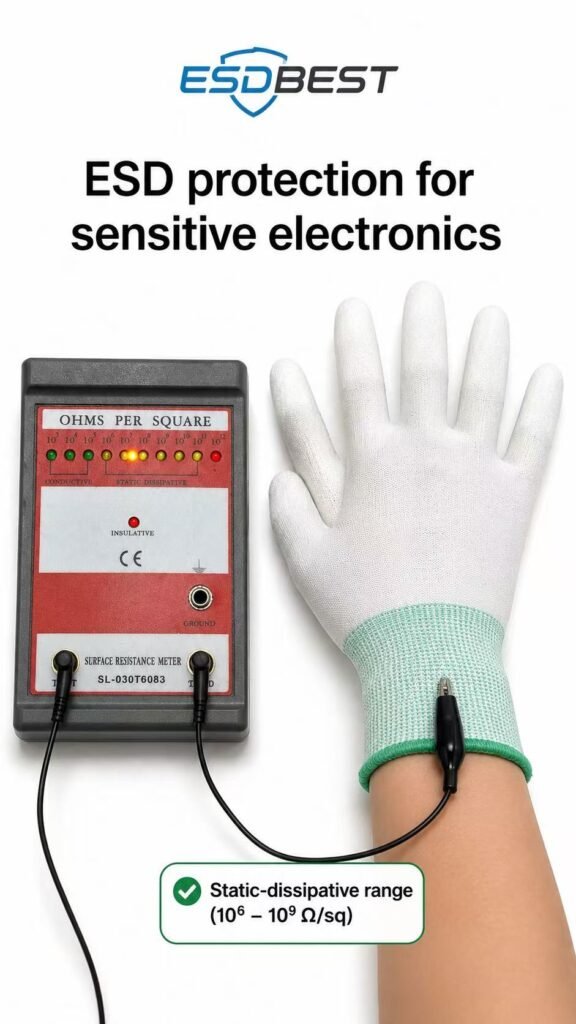
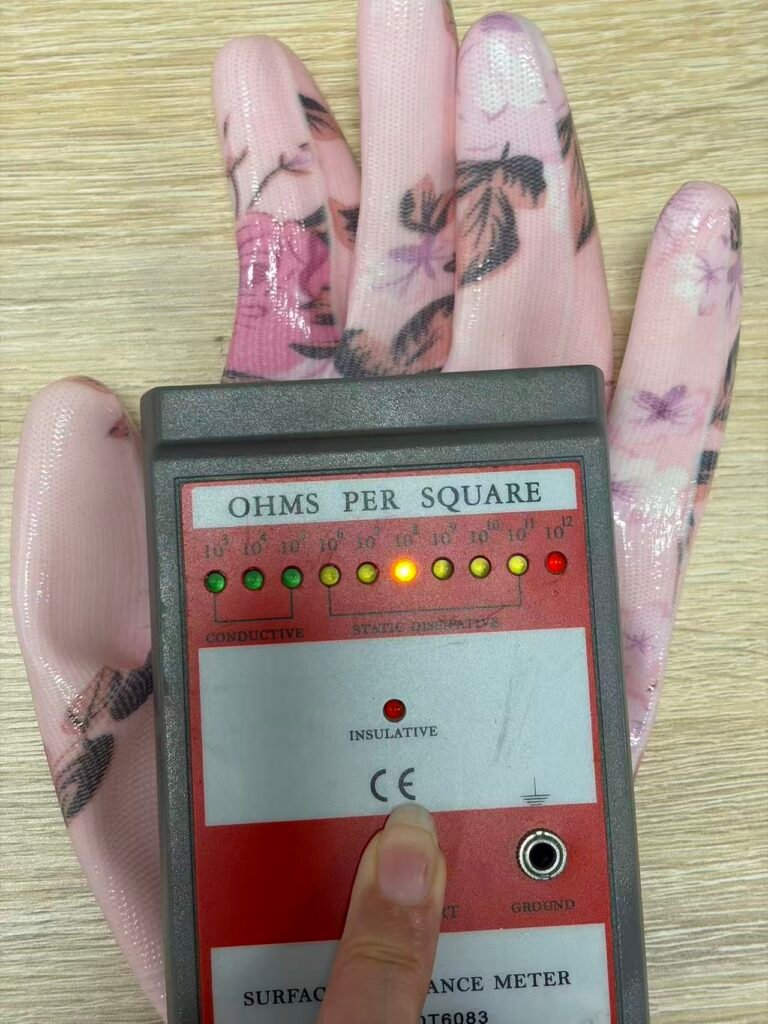
The table below shows surface resistance readings taken in our own laboratory on a calibrated ACL Staticide Model 800 megohmmeter, with temperature and humidity recorded for every reading.
| Glove type | Measured surface resistance | Result |
|---|---|---|
| Carbon fibre knitted, PU fingertip | 2.52 × 10⁶ – 2.01 × 10⁷ Ω/sq | Static-dissipative |
| ESD nitrile, powder-free | 3.72 × 10⁸ – 4.28 × 10⁸ Ω/sq | Static-dissipative |
| Plain knitted glove (reference) | 6.47 × 10¹⁰ – 8.16 × 10¹⁰ Ω/sq | Outside ESD glove range |
Conditions: 60.4–64.8% RH, 30.1–30.7 °C. Instrument serial R01172234, calibrated 19 August 2026, next due 18 August 2027.
Download the full comparative test report (PDF)What Are ESD Gloves?
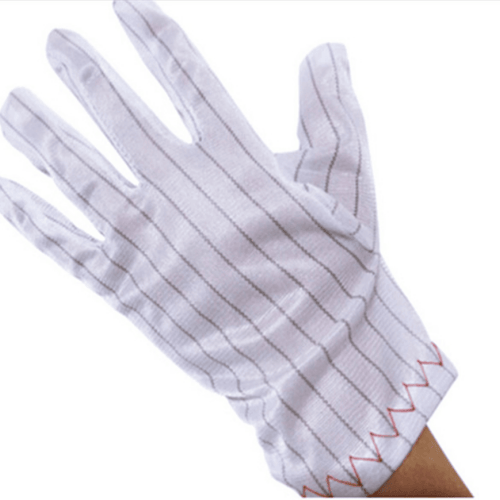
ESD gloves are hand protection designed for use inside an Electrostatic Protected Area. They limit charge transfer between an operator's hands and the components being handled, while acting as a barrier against skin oils, sweat and particulate contamination.
Anti-static gloves, antistatic gloves, electrostatic discharge gloves, static dissipative gloves and static control gloves all describe the same category. No standard assigns them different meanings, and suppliers use them interchangeably. See our page on ESD gloves vs anti-static gloves for where the terminology does and does not matter.
What defines an ESD glove is not the name on the bag. It is the measured surface resistance.
How Do ESD Gloves Work?
A glove reduces static risk in two ways.
It provides a controlled resistance path. Charge generated on the hand, or picked up from a component, moves across the glove surface rather than accumulating at one point. A material in the static-dissipative range — 1 × 10⁶ to 1 × 10⁹ Ω — bleeds charge away slowly enough to avoid a rapid discharge event, but fast enough that it does not build up.
It acts as a barrier. Bare skin transfers oils and moisture to boards and connectors. A glove prevents that, which matters as much for yield as static does.
In carbon fibre gloves the conductive path is the fibre itself, spun into the yarn. In nitrile gloves the behaviour comes from the material surface. Both measured inside the dissipative range in our tests.
Do Anti-Static Gloves Actually Work?
They work for what they are designed to do, and not for what they are sometimes assumed to do.
What a glove does
- Limits charge transfer at the point of contact
- Keeps skin oils, sweat and particulates off the product
- Provides grip and handling control
What a glove does not do
- Ground the operator
A glove is not a grounding path to earth. Personnel grounding requires a wrist strap connected to a common point ground, or ESD footwear used with a dissipative floor. A glove supplements those; it does not replace them.
This is the most common mistake we see in the field: an operator wearing ESD gloves but no wrist strap, on the assumption that the gloves are enough.
ESD Gloves vs Normal Gloves — What We Measured
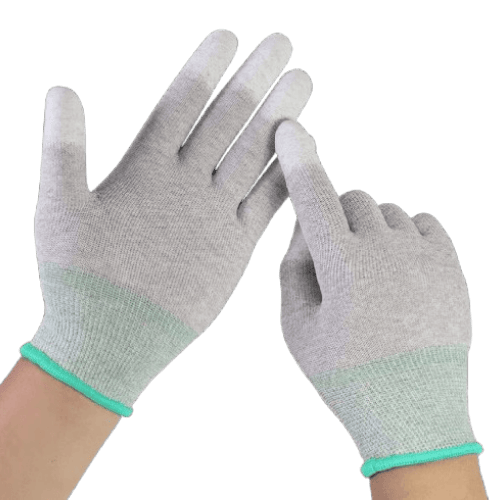
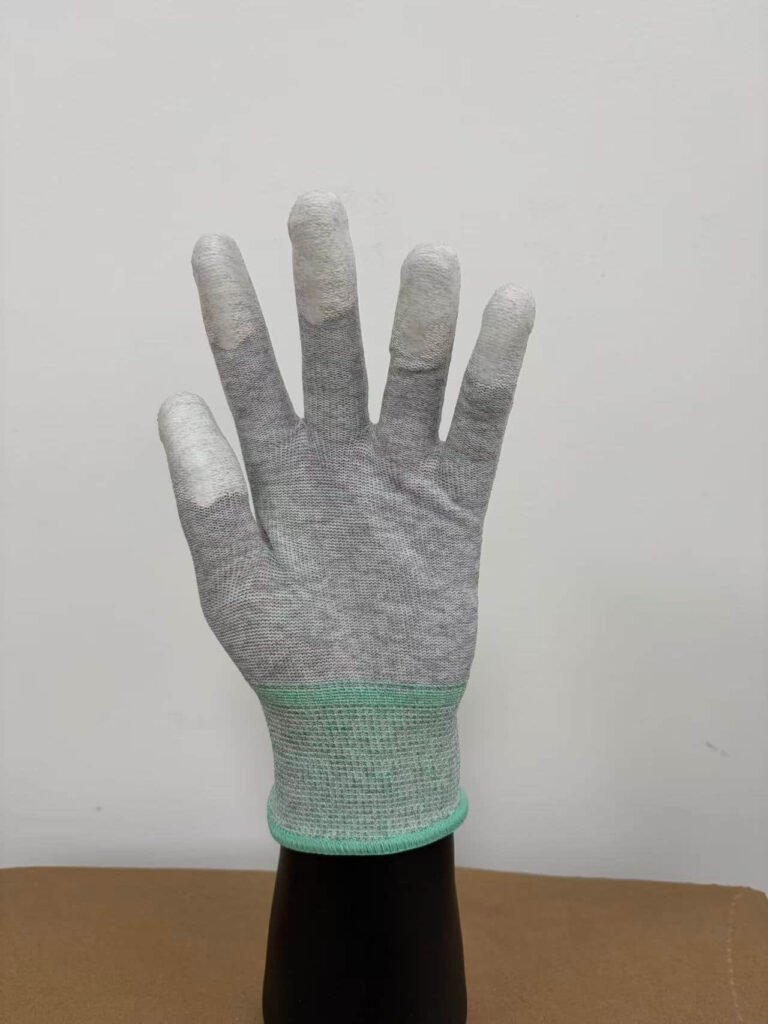
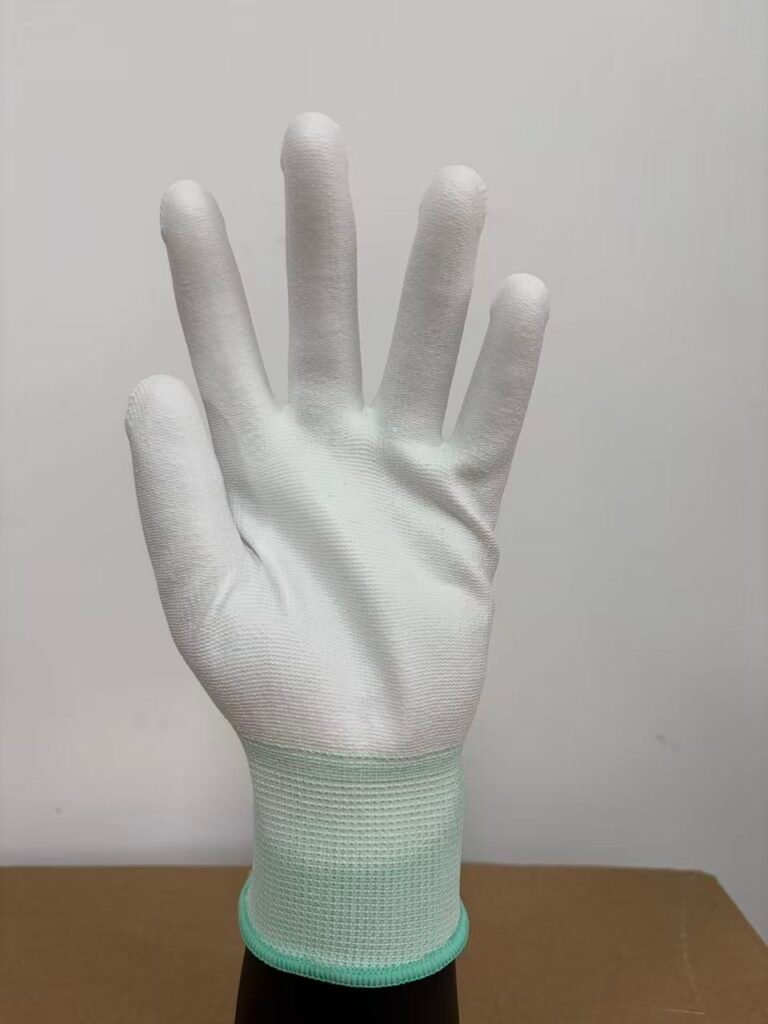
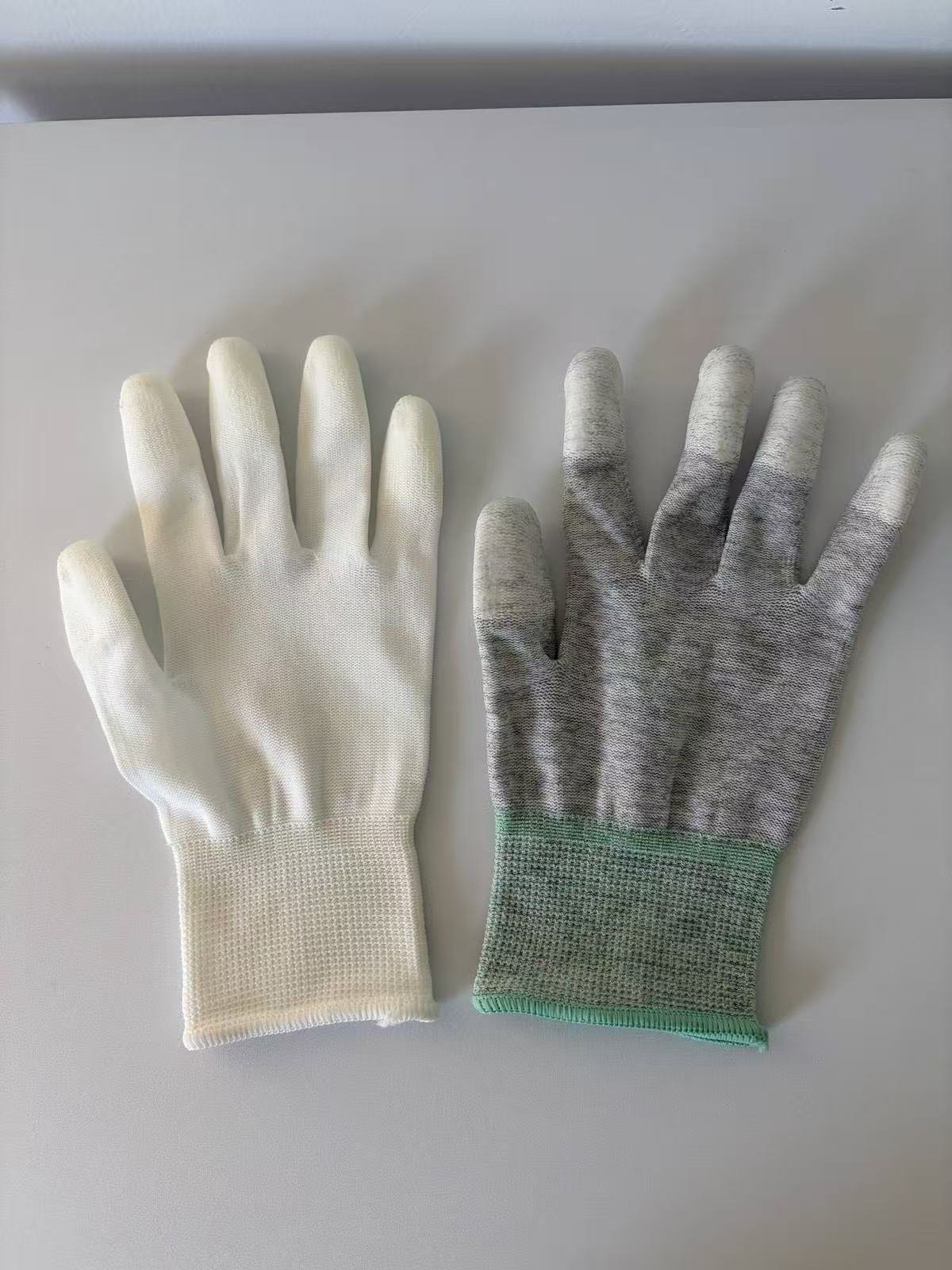
We tested two gloves of the same knitted construction, with the same white PU fingertip coating. One has carbon fibre in the yarn. The other does not.
| Carbon fibre glove | Plain knitted glove | |
|---|---|---|
| Measurement 1 | 2.52 × 10⁶ Ω/sq | 6.47 × 10¹⁰ Ω/sq |
| Measurement 2 | 4.24 × 10⁶ Ω/sq | 6.91 × 10¹⁰ Ω/sq |
| Measurement 3 | 5.60 × 10⁶ Ω/sq | 7.78 × 10¹⁰ Ω/sq |
| Measurement 4 | 7.87 × 10⁶ Ω/sq | 8.16 × 10¹⁰ Ω/sq |
| Measurement 5 | 9.23 × 10⁶ Ω/sq | — |
| Measurement 6 | 2.01 × 10⁷ Ω/sq | — |
| Range | 2.52 × 10⁶ – 2.01 × 10⁷ | 6.47 × 10¹⁰ – 8.16 × 10¹⁰ |
The difference is roughly four orders of magnitude — a factor of about 10,000.
The plain glove is not strictly insulative; at 1010 it sits below the 1 × 10¹¹ Ω threshold. But it is three to four decades above the 106–109 range specified for ESD gloves, and is not suitable for EPA personnel handling.
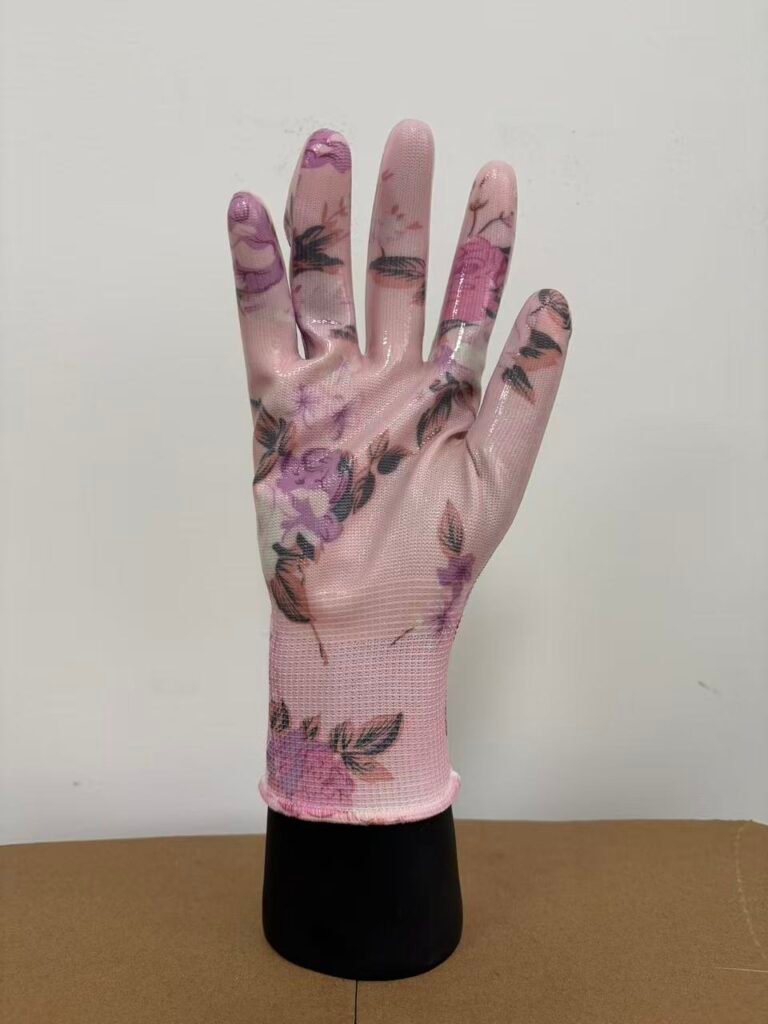
Put the two gloves side by side and you cannot tell them apart. Same knit, same coating, same weight in the hand. Only measurement distinguishes them.
This is why a resistance figure with documented conditions matters more than any product description.
Our ESD Glove Range
Carbon fibre knitted gloves — Top Fit, Palm Fit, Dotted
Measured 2.52 × 10⁶ – 2.01 × 10⁷ Ω/sq. Reusable and washable. The conductive path is built into the yarn. PU fingertip, PU palm and PVC dotted coating options. The specification for all-shift wear in general assembly and inspection.
ESD nitrile gloves
Measured 3.72 × 10⁸ – 4.28 × 10⁸ Ω/sq. Powder-free, disposable, latex-free. 6 mil and 8 mil. Barrier against oils, flux residue and contamination. Black, purple and blue.
ESD glove types and selection guide
Which construction suits which process.
Bulk, OEM and private label supply
Pricing, MOQ, custom colours and branding.
ESD Gloves for Electronics Assembly and Repair
| Application | Recommended |
|---|---|
| PCB and PCBA assembly | Carbon fibre knitted |
| SMT line operation | Carbon fibre knitted |
| Semiconductor device handling | Carbon fibre knitted or nitrile |
| Electronics repair and rework | Carbon fibre, PU fingertip for grip |
| Cleanroom operation | Nitrile, powder-free |
| Inspection and QC | Carbon fibre knitted |
| Handling with flux or solvent exposure | Nitrile |
| Handling sharp-edged assemblies | Carbon fibre, PU palm |
How to Use ESD Gloves Correctly
Gloves fail in service more often than they fail on the test bench. The four causes we see most:
1. Worn as a substitute for grounding. Gloves are not a grounding path. Wrist strap or ESD footwear is still required.
2. Contaminated. Hand cream, flux residue and solvents change surface behaviour. Replace gloves that are visibly soiled rather than cleaning them with solvent.
3. Washed incorrectly. Carbon fibre gloves are washable and retain their dissipative performance, because the conductive path is in the yarn. Fabric softener coats the fibre and should not be used.
4. Never verified. A glove that arrived in an ESD bag two years ago has not been measured since. Spot-check incoming batches with a surface resistance meter.
Do cotton gloves prevent ESD? No. Plain cotton and polyester gloves have no conductive path. Our test of a plain knitted glove, which looked identical to an ESD glove, measured in the 1010 range.
ESD Glove Standards
Our gloves conform to the static-dissipative range defined in ANSI/ESD S20.20 and IEC 61340-5-1 under the test conditions documented in our test report.
The relevant resistance bands:
| Classification | Surface resistance |
|---|---|
| Conductive | < 1 × 10⁴ Ω |
| Dissipative | 1 × 10⁶ – 1 × 10⁹ Ω |
| Insulative | ≥ 1 × 10¹¹ Ω |
HORBEST Tech Co., Ltd is ISO 9001 certified. SGS RoHS and REACH documentation is available on request.
How to Verify an ESD Glove
- Ask the supplier for a measured surface resistance value, not a claimed range.
- Ask at what temperature and relative humidity the measurement was taken. A figure without conditions cannot be compared to anything.
- Ask which instrument was used and when it was last calibrated.
- Check that the value sits between 1 × 10⁶ and 1 × 10⁹ Ω/sq.
We publish all four for every glove on this site.
ESD Glove Supplier
HORBEST Tech Co., Ltd, trading as ESDBEST, has manufactured ESD control products in Shenzhen, China since 1996, across nine production lines. We supply electronics manufacturers, EMS providers and distributors in Europe, North America, Japan and Southeast Asia.
Samples, the full test report and the instrument calibration certificate are available on request.
Request a QuoteFAQ
What is the resistance range for ESD gloves?
1 × 10⁶ to 1 × 10⁹ Ω/sq is the static-dissipative range. Our carbon fibre gloves measured 106–107 and our nitrile gloves measured 108.
Are anti-static gloves and ESD gloves the same thing?
In commercial use, yes. Both describe gloves intended for an EPA. What matters is the measured value, not the label.
Can I use ESD gloves instead of a wrist strap?
No. Gloves limit charge transfer at the point of contact. They do not ground the operator.
How can I tell an ESD glove from an ordinary glove?
You cannot, by eye. We tested two gloves of identical knit and coating; one measured 106 and the other 1010.
Do ESD gloves wear out?
Carbon fibre gloves retain their dissipative performance through washing because the conductive path is in the yarn. Contamination and physical damage are the usual reasons for replacement, not electrical degradation.
Are disposable gloves ESD safe?
Our nitrile gloves measured 3.72–4.28 × 10⁸ Ω/sq, inside the dissipative range. But "disposable" says nothing about electrical performance — see ESD nitrile gloves for the measured data.
Do you supply gloves in bulk?
Yes. See bulk and OEM supply.