What’s the Difference and Which One Do You Need?
ESD Floor Mats vs Bench Mats
Quick Answer
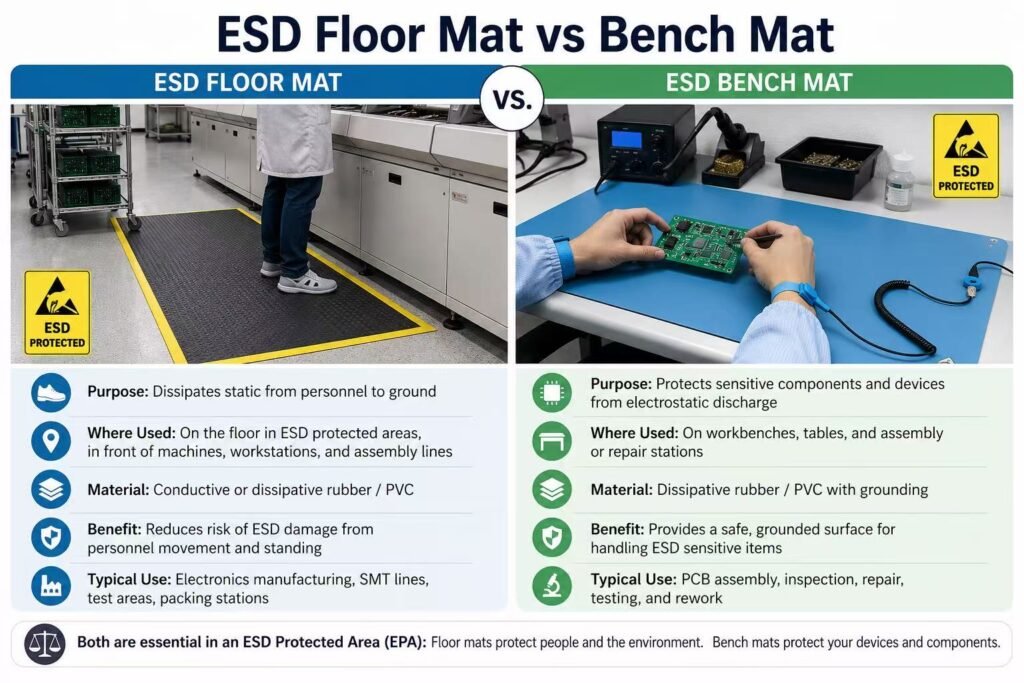
An ESD floor mat is used on the floor to reduce static electricity generated by walking personnel, while an ESD bench mat is used on the workbench to protect PCBs, electronic components, and tools during assembly or repair.
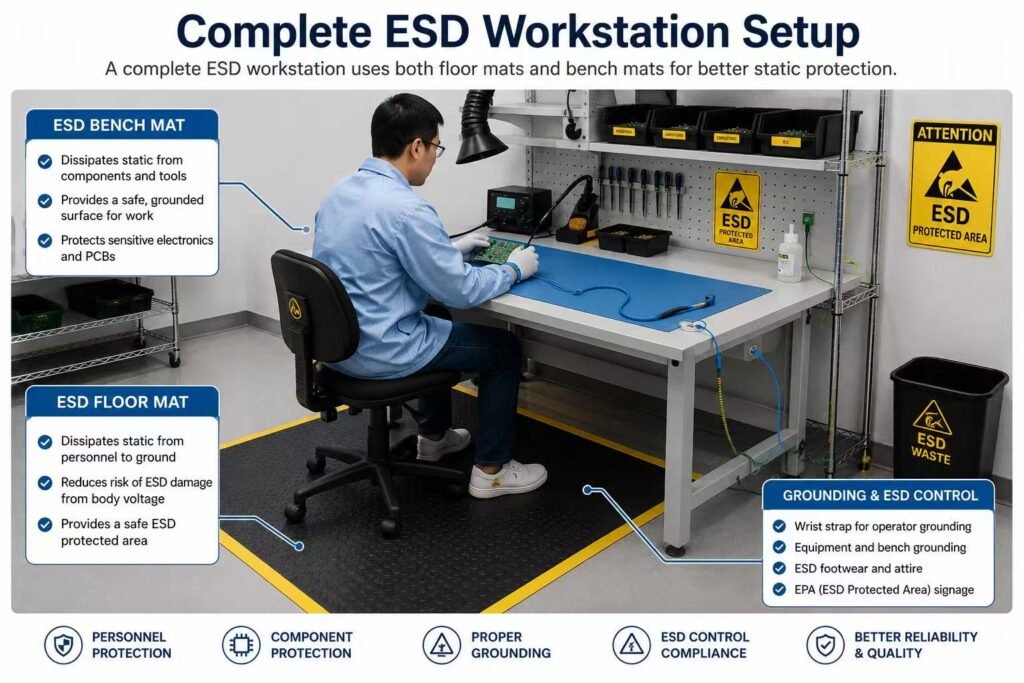
For a complete ESD workstation, the best solution is usually to use both an ESD floor mat and an ESD bench mat.
ESD Floor Mat vs Bench Mat Comparison
| Item | ESD Floor Mat | ESD Bench Mat |
|---|---|---|
| Main Location | Floor | Workbench |
| Main Purpose | Controls static from walking | Protects PCBs and components |
| Contact Area | Shoes / personnel | PCB / tools / hands |
| Common Use | EPA area, production line, standing area | PCB assembly, repair, testing |
| Grounding | Ground cord to earth ground | Ground cord / common point ground |
| Resistance Range | Usually 10⁶–10⁹ Ω | Usually 10⁶–10⁹ Ω |
| Best For | Personnel grounding | Component protection |
| Can Replace the Other? | No | No |

What Is an ESD Floor Mat?
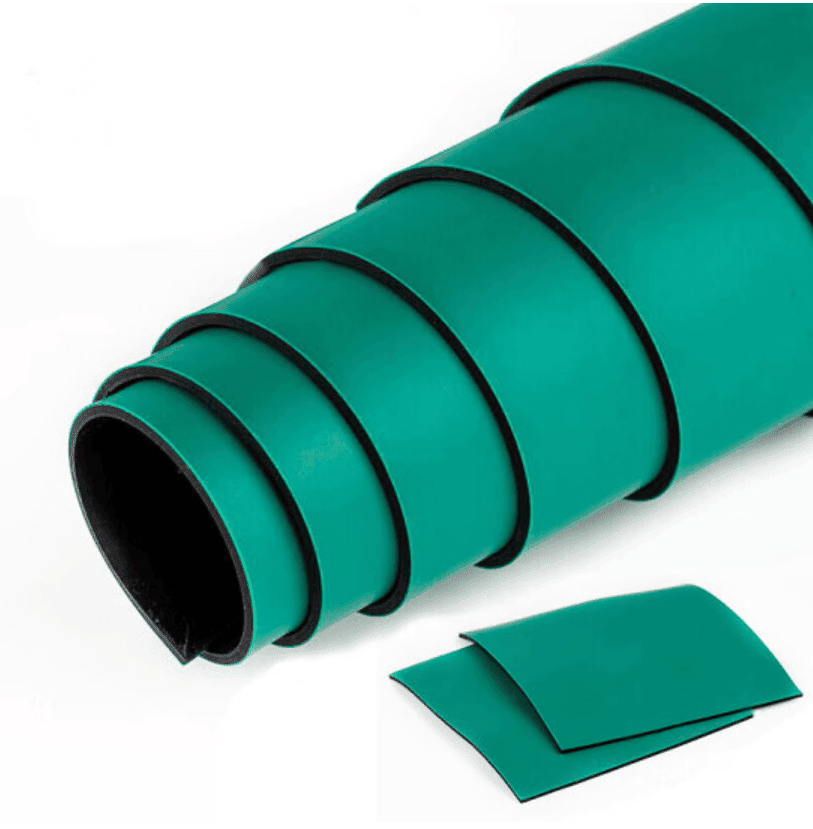
An ESD floor mat is a static control mat placed on the floor in an ESD protected area. It helps safely dissipate static electricity generated by operators walking, standing, or moving around the workstation.
ESD floor mats are commonly used in:
- Electronics manufacturing
- PCB assembly areas
- SMT production lines
- Repair workshops
- Testing rooms
- ESD protected areas
The main purpose of an ESD floor mat is to reduce the risk of static buildup from human movement.
Internal link:
What Is an ESD Bench Mat?
An ESD bench mat is placed on the workbench surface to protect sensitive electronics during handling, assembly, repair, and testing.
It creates a controlled dissipative surface where PCBs, ICs, tools, and electronic components can be safely placed.
ESD bench mats are commonly used for:
- PCB assembly
- Electronics repair
- Soldering work
- Testing stations
- SMT inspection
- Component handling
Internal link:
Main Difference Between ESD Floor Mat and Bench Mat
The main difference is where they protect.
An ESD floor mat protects the working area from static generated by people walking or standing.
An ESD bench mat protects electronic components directly on the workbench.
In simple words:
Do You Need an ESD Floor Mat or Bench Mat?
Choose an ESD floor mat if:
- Operators stand for long hours
- Workers walk around an ESD area
- You need personnel grounding
- You are building an EPA floor area
- You want to reduce static from shoes and movement
Choose an ESD bench mat if:
- You handle PCBs directly
- You assemble or repair electronics
- You solder electronic components
- You need a safe surface for ICs and PCBs
- You build ESD-safe workstations
Use both if:
- You run electronics manufacturing
- You operate SMT lines
- You build PCB assembly workstations
- You need complete ESD control
- You want professional EPA protection
Can an ESD Floor Mat Replace a Bench Mat?
No.
An ESD floor mat cannot replace an ESD bench mat because it does not protect components placed on the workbench.
Even if the floor is ESD-safe, a PCB can still be damaged if it is placed on a normal table, wood desk, plastic surface, or ordinary rubber mat.
For PCB assembly, an ESD bench mat is still necessary.
Can an ESD Bench Mat Replace a Floor Mat?
No.
An ESD bench mat protects the work surface, but it cannot control static generated by walking, shoes, clothing, or movement around the production area.
If workers move frequently around the workstation, an ESD floor mat or ESD flooring system is still recommended.
Best Setup: Floor Mat + Bench Mat + Grounding
The best ESD workstation setup usually includes:
- ESD bench mat
- ESD floor mat
- ESD wrist strap
- ESD grounding cord
- Common point ground
- ESD shoes or heel grounders
- Verified earth ground
Internal links:
ESD Floor Mat vs Bench Mat: Which Is More Important?
For PCB assembly, the ESD bench mat is more important because PCBs and components directly touch the bench surface.
For production lines and standing work areas, the ESD floor mat is also important because personnel movement can generate static electricity.
Best answer:
Recommended Resistance Range
Most ESD mats are designed with dissipative resistance, commonly around:
10⁶ Ω to 10⁹ Ω
This allows static charge to dissipate safely instead of discharging suddenly into sensitive electronic components.
Common Mistakes
Mistake 1: Using a normal rubber mat
Normal rubber mats may look similar, but they are not designed for controlled static dissipation.
Mistake 2: Using an ESD mat without grounding
An ESD mat must be connected to a verified ground. Without grounding, it may not provide reliable static protection.
Mistake 3: Only using floor mats
Floor protection is not enough if PCBs are placed on a non-ESD workbench.
Mistake 4: Only using bench mats in large production areas
If workers move around frequently, floor-level static control is also important.
Buyer Guide
For PCB repair shops
Recommended:
ESD bench mat + wrist strap + grounding cord
For electronics factories
Recommended:
ESD floor mat + ESD bench mat + ESD shoes + grounding system
For SMT lines
Recommended:
ESD bench mat for workstations
ESD floor mat for standing and walking areas
For laboratories
Recommended:
ESD bench mat + ESD floor mat + common point ground
Product CTA
Need ESD Floor Mats or Bench Mats for Your Factory?
ESDBEST supplies ESD floor mats, ESD bench mats, grounding cords, wrist straps, and complete ESD workstation solutions for electronics manufacturing and PCB assembly.
Contact us for bulk orders, samples, or custom ESD mat solutions.
📞 Contact Us Today
For bulk orders, quotes, or product guidance, get in touch with our expert team:
Email: sales2@esdbest.com
Whatsapp: +86 137 1427 2599
FAQ
What is the difference between an ESD floor mat and an ESD bench mat?
An ESD floor mat is used on the floor to control static from walking or standing, while an ESD bench mat is used on the workbench to protect PCBs and electronic components.
Do I need both an ESD floor mat and bench mat?
Yes, if you want complete ESD protection. The floor mat controls personnel-generated static, while the bench mat protects components directly.
Which mat is better for PCB assembly?
An ESD bench mat is better for PCB assembly because PCBs and electronic components directly touch the bench surface.
Can I use a floor mat on a workbench?
It is not recommended. Floor mats and bench mats are designed for different applications, thickness, surface texture, and working conditions.
Can I use a bench mat on the floor?
No. Bench mats are not designed for walking, standing, or heavy foot traffic.
Do ESD mats need grounding?
Yes. Both ESD floor mats and ESD bench mats should be connected to a verified ground for reliable static dissipation.
What resistance should an ESD mat have?
Most ESD mats are commonly designed in the dissipative range of 10⁶ Ω to 10⁹ Ω.
What is the best ESD mat setup?
The best setup is an ESD bench mat, ESD floor mat, grounding cord, wrist strap, and verified earth ground.