Introduction
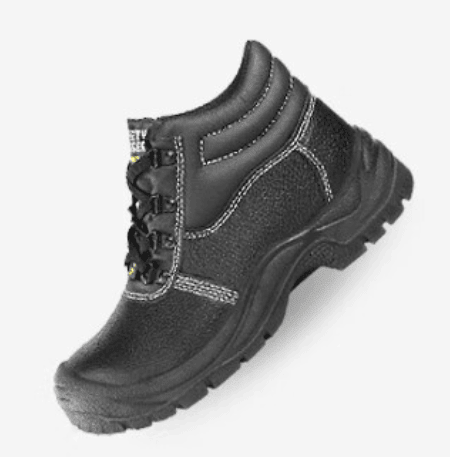
ESD composite toe boots are designed for environments that require both toe protection and effective electrostatic discharge control, without the use of metal components.
In electronics manufacturing and ESD-protected areas, footwear is not evaluated as an isolated product.
Within a complete ESD control program, ESD boots are treated as grounding components that help control body voltage as part of a footwear–flooring system.
Composite toe designs are increasingly selected in applications where metal-free construction, lighter weight, and consistent ESD performance are required.
⸻
What Are ESD Composite Toe Boots?
ESD composite toe boots are safety boots that use non-metallic materials—such as composite polymers or fiber-reinforced components—to provide toe protection while maintaining controlled electrical resistance.
Unlike ordinary safety boots, these boots are engineered to:
•Control electrostatic charge rather than block it
•Maintain defined resistance ranges
•Work together with ESD flooring and grounding systems
The absence of metal does not reduce ESD effectiveness.
Static control depends on sole formulation and system integration, not on toe cap material.
⸻
Why Choose Composite Toe Designs in ESD Environments?
Composite toe
ESD boots are commonly used in:
•Electronics and semiconductor manufacturing
•Assembly lines with metal-sensitive equipment
•Facilities requiring metal-free footwear
•Long-shift environments where weight reduction matters
Because they do not contain metal, composite toe boots avoid interference with sensitive processes and are often preferred in controlled production areas.
⸻
ESD Composite Toe Boots vs Steel Toe ESD Boots
Both composite toe and steel toe designs can be ESD compliant when properly engineered and tested.
•Metal-free construction
•Reduced weight for operator comfort
•No impact on ESD discharge paths
Steel toe designs, on the other hand, are typically selected when higher impact resistance is required.
The correct choice depends on application requirements—not on marketing labels.
⸻
How ESD Performance Is Maintained
The ESD performance of composite toe boots is determined by:
•Sole compound formulation
•Resistance stability over time
•Compatibility with ESD flooring
•Proper system grounding
Toe cap material does not define ESD behavior.
Instead, performance depends on how the footwear functions within the complete ESD system.
⸻
Verifying Performance Through Testing
Consistent performance of composite toe designs can only be confirmed through proper ESD footwear testing.
System-level testing verifies:
•Footwear-to-floor resistance
•Stability of resistance values over time
•Effective control of body voltage during movement
Without verification, ESD compliance remains an assumption rather than a measured result.
⸻
Applications of ESD Composite Toe Boots
ESD composite toe boots are widely used in:
•EPA (ESD Protected Areas)
•Electronics assembly facilities
•Clean manufacturing environments
•Operations requiring metal-free PPE
Their combination of protection, comfort, and static control makes them suitable for long-term industrial use.
⸻
Conclusion
ESD composite toe boots provide reliable toe protection and static control without relying on metal components.
When properly engineered, tested, and integrated into an ESD system, they perform just as effectively as steel toe alternatives—while offering advantages in weight and metal-free environments.
As with all ESD footwear, true performance depends on system-level understanding, not on product labels alone.
📞 Contact Us Today
For bulk orders, quotes, or product guidance, get in touch with our expert team:
Email: sales2@esdbest.com
Phone: +86 137 1427 2599