Differences, Resistance, and Best Uses
Conductive vs Dissipative Mats: What’s the Difference?
Intro
In electronics manufacturing, static control is not optional. A small electrostatic discharge can damage microchips, printed circuit boards, sensors, and other sensitive devices long before the damage becomes visible. That is why ESD control programs rely on properly selected work surfaces, flooring, grounding systems, wrist straps, footwear, and ionization equipment.
One of the most common questions in static control is the difference between conductive vs dissipative mats. Both are used in ESD-protected environments, and both help manage static electricity, but they do not behave in the same way. Their resistance ranges, discharge behavior, and best-use cases are different.
If you are selecting a mat for a workstation, repair bench, production line, laboratory, or ESD protected area, understanding the difference matters. The wrong choice can affect product safety, grounding performance, and operator protection.
In this guide, you will learn:
-
what conductive mats are
-
what dissipative mats are
-
how they differ in resistance and discharge speed
-
where each type is used
-
which type is usually better for electronics workstations
-
how to choose the right ESD mat for your application
What Is the Difference Between Conductive and Dissipative Mats?
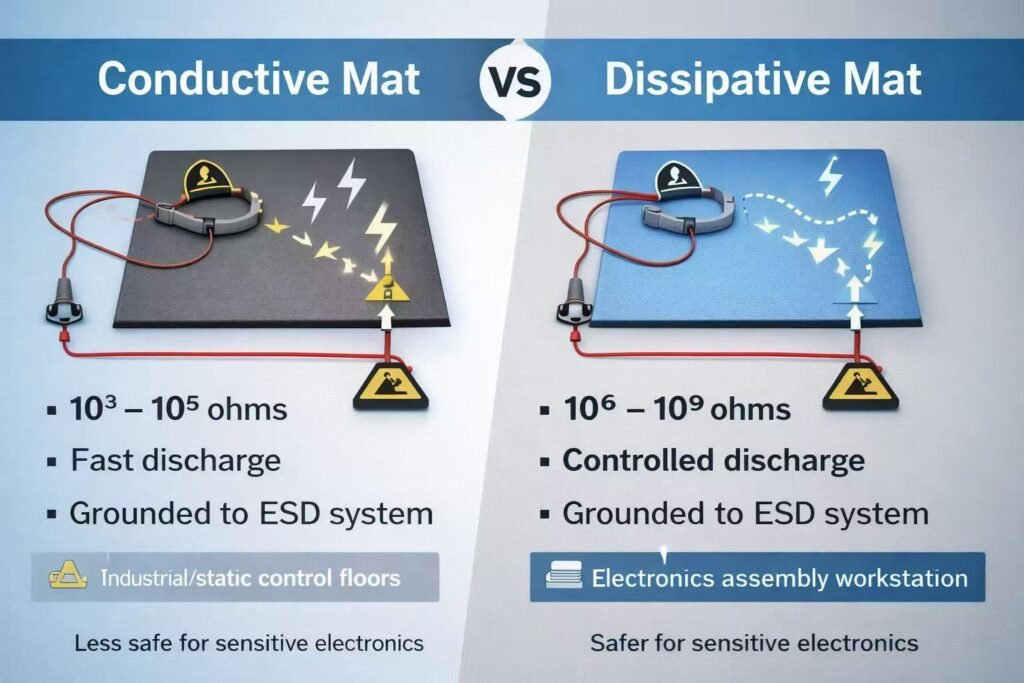
Conductive mats have very low electrical resistance and allow static electricity to flow quickly to ground. Dissipative mats have higher resistance and discharge static electricity more slowly in a controlled manner. In electronics workstations, dissipative mats are often preferred because they reduce the risk of fast discharge that could damage sensitive components.
What Is a Conductive Mat?
A conductive mat is an ESD control surface designed to move electrical charge quickly across the material and into ground. Conductive mats typically have a very low resistance range and are used where a fast grounding path is needed.
In general, conductive materials are designed to provide minimal resistance to the movement of electricity. In static control, this means the mat can transfer charge efficiently. This may sound ideal at first, but in electronics environments, faster is not always better. A discharge that is too fast may not be the safest option for highly sensitive components.
Conductive mats are commonly associated with applications such as:
-
conductive flooring systems
-
grounding-heavy industrial areas
-
specific static control zones requiring rapid charge transfer
-
some shelving or storage applications
-
specialized environments where surface charge must be removed quickly
Typical conductive mat resistance ranges are often in the area of:
-
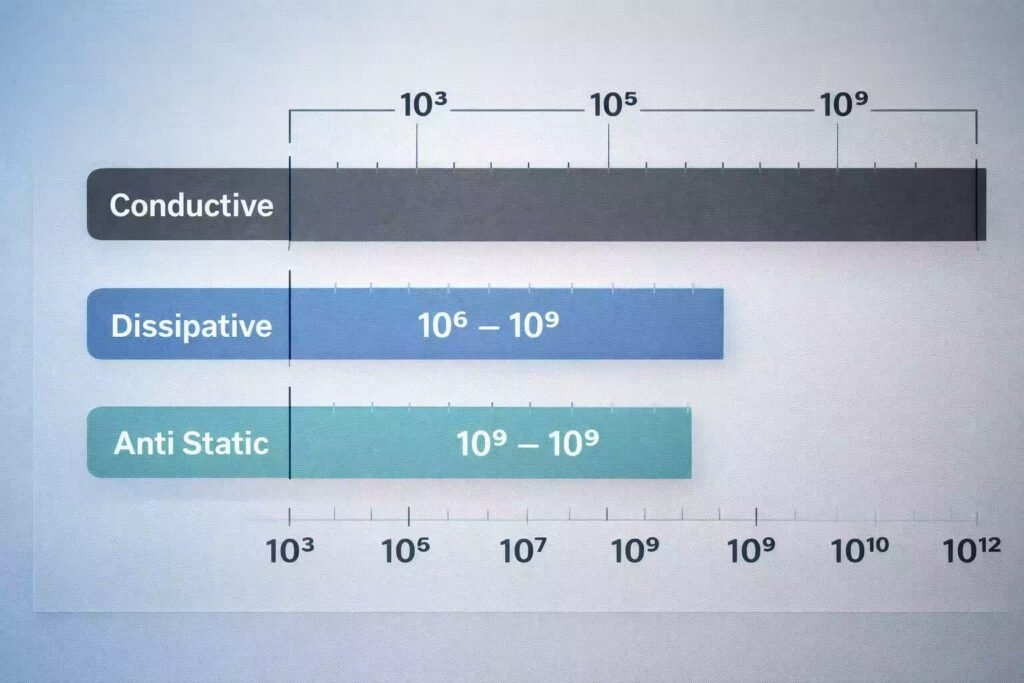
10³ to 10⁵ ohms
The exact range depends on the product design, material construction, test method, and manufacturer specification.
What Is a Dissipative Mat?
A dissipative mat is a static control mat designed to discharge electricity in a slower, controlled manner. Instead of moving charge as quickly as possible, a dissipative surface regulates the flow of electricity to reduce the chance of sudden electrostatic events.
This is why dissipative mats are widely used in:
-
electronics assembly
-
PCB workstations
-
semiconductor handling areas
-
repair benches
-
testing laboratories
-
ESD-protected work surfaces
Dissipative mats are often considered the standard choice for bench-top electronics work because they balance static control and component safety.
Typical static dissipative resistance ranges are usually around:
-
10⁶ to 10⁹ ohms
Again, exact ranges vary by product and test standard, but this range is commonly used as the practical working definition for dissipative materials in ESD control discussions.
Which Is Better for Electronics Workstations: Conductive or Dissipative Mats?
For most electronics workstations, dissipative mats are the better choice. They allow static electricity to discharge in a controlled manner, reducing the chance of sudden charge transfer that could harm sensitive electronic components. Conductive mats are faster, but they are not always the best fit for delicate electronics assembly.
Conductive vs Dissipative Mats: The Key Difference
The main difference between conductive vs dissipative ESD mats is resistance and discharge behavior.
| Feature | Conductive Mat | Dissipative Mat |
|---|---|---|
| Typical resistance | 10³–10⁵ ohms | 10⁶–10⁹ ohms |
| Charge movement | Faster | More controlled |
| Common use | Flooring, industrial static control | Electronics benches, assembly |
| Sensitivity suitability | Lower for delicate bench work | Better for sensitive electronics |
| Grounding behavior | Rapid path to ground | Controlled path to ground |
A conductive mat provides a more aggressive path for charge transfer. A dissipative mat slows the movement of electricity enough to control static without creating an unnecessarily fast discharge event.
That is why many ESD workstations use dissipative mats rather than conductive mats.
Why Resistance Matters in ESD Mats
Resistance is one of the most important performance characteristics in any ESD control surface.
If resistance is too high, static electricity may not move effectively to ground.
If resistance is too low, discharge may happen too quickly for some sensitive applications.
A properly chosen ESD mat is not just about “being anti-static.” It is about controlling electrical charge at a safe and effective rate.
For this reason, when comparing conductive vs dissipative mats, you should always review:
-
surface resistance
-
point-to-point resistance
-
resistance-to-ground performance
-
compatibility with the full grounding system
-
application environment
This is also why professional buyers do not choose mats based only on color, thickness, or price. Performance data matters.
How Conductive Mats Work
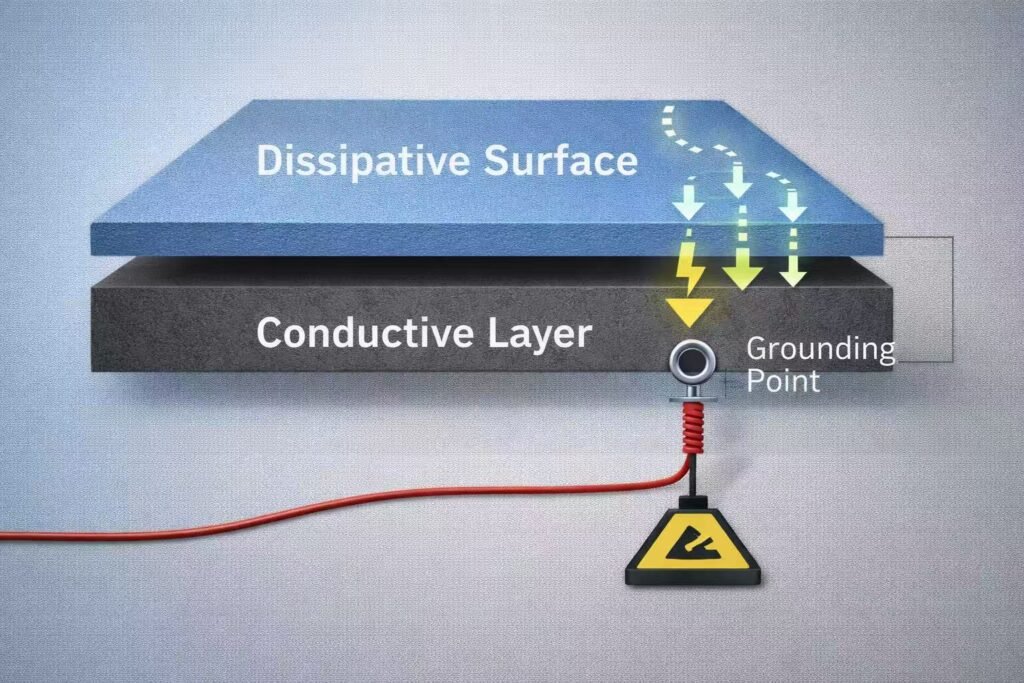
A conductive mat works by offering a low-resistance path that allows electrical charge to travel quickly through the material.
When a charged object, tool, cart, or person interacts with the surface, charge can move across the conductive layer and into ground through the installed grounding system.
This fast charge movement can be useful in certain industrial environments, especially where:
-
fast drainage of charge is required
-
the risk profile is different from bench electronics assembly
-
flooring or larger grounding zones are involved
However, in highly sensitive electronics work, this fast response may be less desirable than a controlled dissipative path.
Know more about ESD vs Anti-Static Mats
How Dissipative Mats Work
A dissipative mat still allows static charge to move to ground, but it does so more gradually. Instead of dumping charge as quickly as possible, it controls the rate of discharge.
This is especially important in electronics workstations where components may be extremely sensitive to electrostatic events.
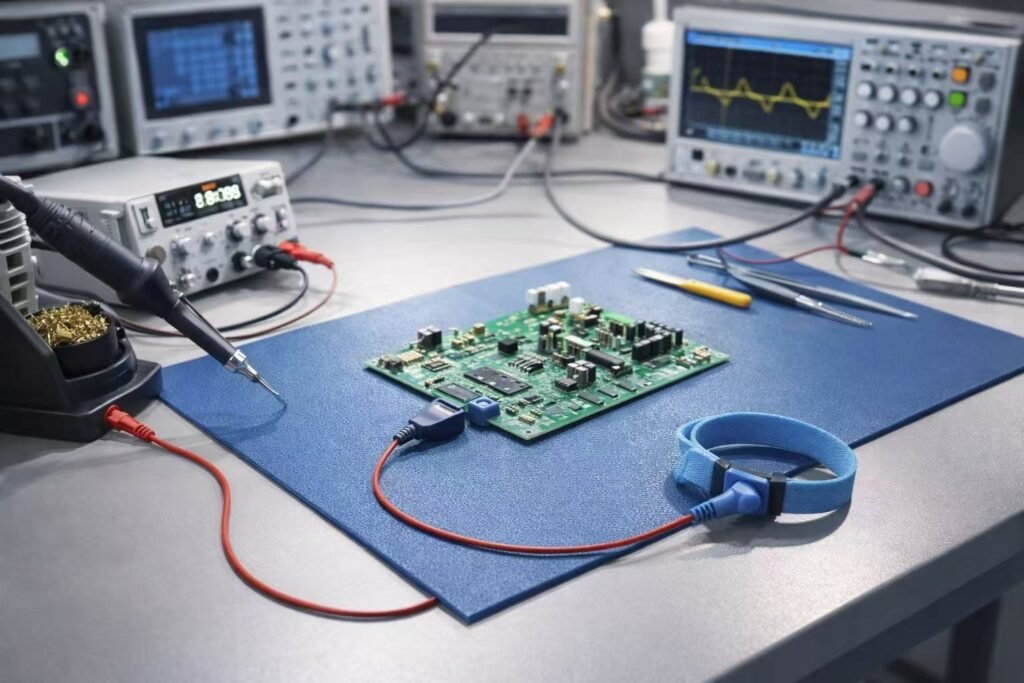
A dissipative mat typically works as part of a complete workstation system that may include:
-
a grounding cord
-
a common point ground
-
an ESD wrist strap
-
ESD footwear or floor grounding
-
ionization for insulators when required
This is why a dissipative mat is often recommended for PCB assembly, electronics repair, and precision handling environments.
What Resistance Should an ESD Workstation Mat Have?
Many ESD workstation mats are static dissipative, typically falling in the range of 10⁶ to 10⁹ ohms. This controlled resistance helps safely move static charge to ground without allowing an overly fast discharge that could increase risk to sensitive electronic components.
When to Use Conductive Mats
Conductive mats are commonly used where rapid charge transfer is acceptable or desirable. Depending on the environment, they may be suitable for:
-
conductive floor systems
-
certain grounding zones in industrial plants
-
static control pathways
-
specialized material handling areas
-
applications where the overall system is designed around conductive surfaces
Conductive mats are not automatically “better.” They are simply a different category of material with different electrical behavior.
If your main concern is delicate electronics assembly at a bench, a conductive mat may not be the first choice.
When to Use Dissipative Mats
Dissipative mats are usually the preferred choice for:
-
electronics workstations
-
repair benches
-
component inspection areas
-
assembly lines
-
laboratories
-
ESD benches in manufacturing and service environments
They are especially appropriate when the work involves:
-
integrated circuits
-
semiconductors
-
sensors
-
communication boards
-
high-value electronic assemblies
For these applications, the controlled discharge behavior of dissipative mats is generally more suitable.
Conductive vs Dissipative Mats in Floor Applications
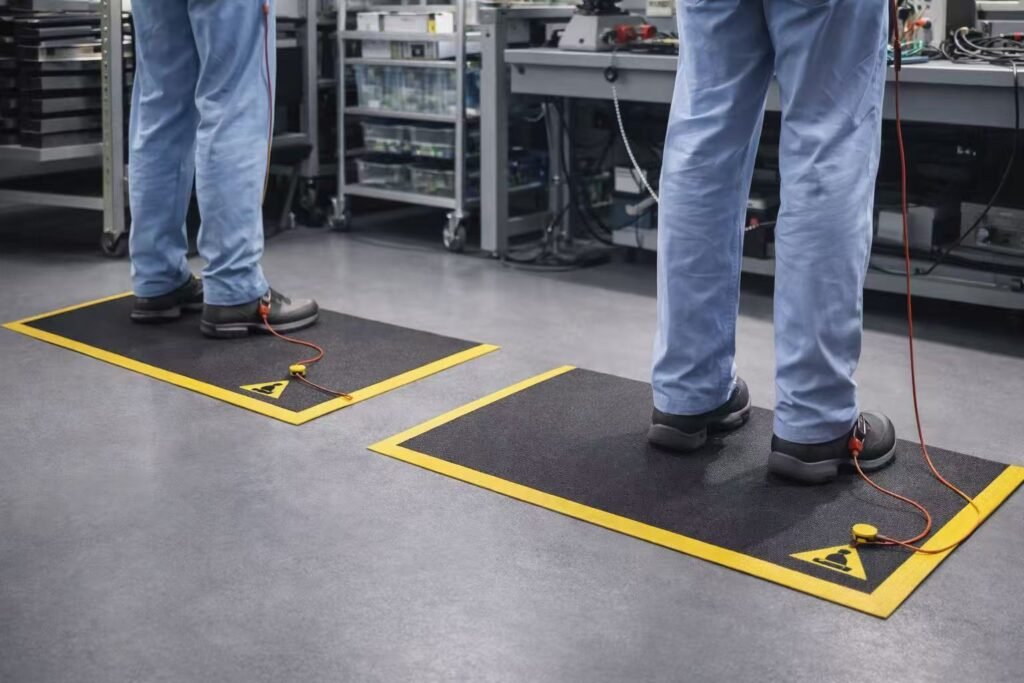
The answer can be different when discussing floor systems rather than bench mats.
In flooring, the overall ESD control strategy may involve:
-
conductive or dissipative flooring materials
-
footwear or heel grounders
-
traffic levels
-
cleaning procedures
-
environmental humidity
-
resistance-to-ground targets
In some floor applications, conductive materials may be used as part of a broader grounding design. In others, dissipative floor mats are preferred because they provide more balanced control.
This is why “best” depends on the application, not just the category name.
Common Misunderstandings
1. Conductive always means better
Not true. Faster electrical transfer is not automatically better for all electronics applications.
2. Dissipative means weak protection
Also not true. Dissipative mats are often the preferred bench solution in electronics manufacturing.
3. Any anti-static mat is good enough
No. General anti-static mats and ESD mats are not always the same. Static reduction alone does not guarantee proper grounding performance.
4. A mat works by itself
Not completely. Real ESD control depends on the entire system, including grounding, personnel grounding, footwear, floor interaction, and handling procedures.
How to Choose Between Conductive and Dissipative Mats
When choosing between conductive vs dissipative mats, ask these questions:
What kind of products are being handled?
If the workstation handles sensitive electronics, dissipative mats are usually the safer choice.
Is this a bench or a floor application?
Bench-top electronics work often favors dissipative mats. Floor systems may vary depending on the ESD program design.
How important is controlled discharge?
For delicate assemblies, controlled discharge is very important.
Is the mat part of a full ESD system?
A mat should match the rest of the grounding setup, including wrist straps, cords, flooring, and work process.
What do the specifications show?
Always review technical data, not just product labels.
PAA Section
Are conductive mats better than dissipative mats?
Not necessarily. Conductive mats move charge faster, but dissipative mats provide a more controlled discharge. For electronics workstations, dissipative mats are often preferred.
Why are dissipative mats used for electronics assembly?
Dissipative mats help control static electricity without allowing an unnecessarily fast discharge. This makes them suitable for handling sensitive components.
Can conductive mats damage electronics?
A conductive mat itself is not “bad,” but in some sensitive electronics environments, a more controlled dissipative surface is often the better choice.
What is the resistance range of a conductive mat?
Conductive mats are commonly associated with resistance ranges around 10³ to 10⁵ ohms.
What is the resistance range of a dissipative mat?
Dissipative mats are commonly associated with resistance ranges around 10⁶ to 10⁹ ohms.
Best Choice for Most Electronics Benches
For most electronics manufacturing, repair, and inspection benches, the best practical choice is usually a dissipative ESD mat.
Why?
-
it controls static safely
-
it suits sensitive components
-
it integrates well with wrist strap grounding systems
-
it is widely used in workstation ESD programs
That does not mean conductive mats have no place. It simply means their role is different.
Conclusion
The debate around conductive vs dissipative mats is really about choosing the correct electrical behavior for the application.
Conductive mats provide a low-resistance path and move charge quickly. Dissipative mats regulate charge transfer more slowly and are often preferred for electronics workstations.
If your application involves sensitive components, PCB assembly, electronics repair, or precision testing, a dissipative mat is usually the better option.
If your application involves flooring or other industrial static control scenarios, conductive materials may be appropriate depending on the system design.
The right decision always depends on:
-
the type of work
-
component sensitivity
-
full grounding design
-
actual electrical specifications
For most bench-top electronics environments, dissipative mats remain the most practical and widely recommended solution.
📞 Contact Us Today
For bulk orders, quotes, or product guidance, get in touch with our expert team:
Email: sales2@esdbest.com
Phone: +86 137 1427 2599
FAQ
1. What is the main difference between conductive and dissipative mats?
Conductive mats have lower resistance and move charge faster, while dissipative mats discharge static in a more controlled way.
2. Which is better for electronics assembly?
Dissipative mats are usually better for electronics assembly.
3. What is a conductive ESD mat?
A conductive ESD mat is a low-resistance static control mat designed to transfer electrical charge quickly to ground.
4. What is a dissipative ESD mat?
A dissipative ESD mat is a static control mat that allows charge to move to ground at a controlled rate.
5. Are conductive mats used on workbenches?
They can be, but dissipative mats are more commonly used for sensitive electronics benches.
6. Are dissipative mats grounded?
Yes, when properly installed as part of an ESD grounding system.
7. What resistance should an ESD mat have?
It depends on the application, but many workstation mats are static dissipative in the 10⁶ to 10⁹ ohm range.
8. Can I use a regular anti-static mat instead of an ESD mat?
Not for sensitive electronics work. General anti-static products may not provide the grounding performance needed.
9. Are conductive mats safer than dissipative mats?
Not in every case. Safety and suitability depend on the application.
10. Which mat is used in PCB assembly?
Dissipative mats are commonly used in PCB assembly.
11. Do conductive mats discharge faster?
Yes, conductive mats usually discharge faster because of lower resistance.
12. Why are dissipative mats more common in electronics manufacturing?
Because they offer controlled discharge that better suits sensitive components.
13. Can a dissipative mat be used with a wrist strap?
Yes. That is a common workstation setup.
14. Are conductive and dissipative mats both ESD mats?
Yes, both can be part of ESD control, but they perform differently.
15. How do I choose the right ESD mat?
Match the mat type to the application, grounding system, and sensitivity of the products being handled.
📞 Contact Us Today
For bulk orders, quotes, or product guidance, get in touch with our expert team:
Email: sales2@esdbest.com
Phone: +86 137 1427 2599