Earth Bonding Point (EBP) for ESD Benches — Also Known as a Common Point Ground
An earth bonding plug gives an ESD workstation a single, verifiable connection to protective earth. Wrist strap cords and bench mat ground cords both terminate at the same point, so one connection can be checked instead of several. ESDBEST supplies UK and EU plug styles, bench-mounted ground blocks, and the cords, snaps and hardware that connect to them.
What Is an Earth Bonding Point?
An earth bonding point is a plug or block that connects the grounded items at an ESD workstation to the protective earth conductor of the building’s mains supply. It presents one or more sockets or studs on its face. A wrist strap coil cord plugs into one; a bench mat ground cord snaps onto another. Everything at that station then shares a single reference potential.
The purpose is not only to drain charge. It is to make the grounding path checkable. When every item at a bench routes through one point, a technician verifies one connection at the start of a shift rather than tracing three separate cords under a worktop.
Earth Bonding Point vs Common Point Ground — Same Device, Two Markets
These are two names for the same thing. UK and European ESD practice says earth bonding point, usually shortened to EBP, and the plug version is called an earth bonding plug. North American practice says common point ground, shortened to CPG. Documentation from a US customer and documentation from a UK customer can describe the identical part in completely different words.
The physical difference is the mains interface, not the function. A UK earth bonding plug has a BS 1363 three-pin body where the live and neutral pins are insulated and act only as locating pins — only the earth pin conducts. A European version uses a CEE 7/4 Schuko body.
Not to Be Confused With Electrical Equipotential Bonding
In UK building services, “earth bonding” also refers to equipotential bonding of gas pipes, water pipes and structural metalwork under BS 7671. That is a different discipline with different cable sizing rules and different inspection requirements. An ESD earth bonding point is a low-current static control device and is not a substitute for, or a part of, an electrical installation’s bonding scheme. If you arrived here looking for pipework bonding, this is not the right product.
The 1 MΩ Resistor — Where It Sits and Why
Most earth bonding plugs contain a 1 megohm current-limiting resistor in series with the earth path. Its job is to slow a discharge rather than to block it. A charged surface connected directly to earth through zero resistance discharges almost instantaneously; the resulting current spike is itself an ESD event and can couple into nearby components. One megohm stretches that discharge over a longer interval so the energy dissipates gradually.
The resistor also limits the current a person could draw if a grounded item became live through a fault. This is a secondary safety function, not a substitute for correct electrical installation.
When you want the resistor: personnel grounding. Wrist straps and anything a person touches.
When you may not want it: some worksurface and equipment grounding schemes call for a hard ground with no series resistance. This is why no-resistor variants exist and why the two must be ordered separately — fitting the wrong one can put a worksurface outside its specified resistance-to-ground range.
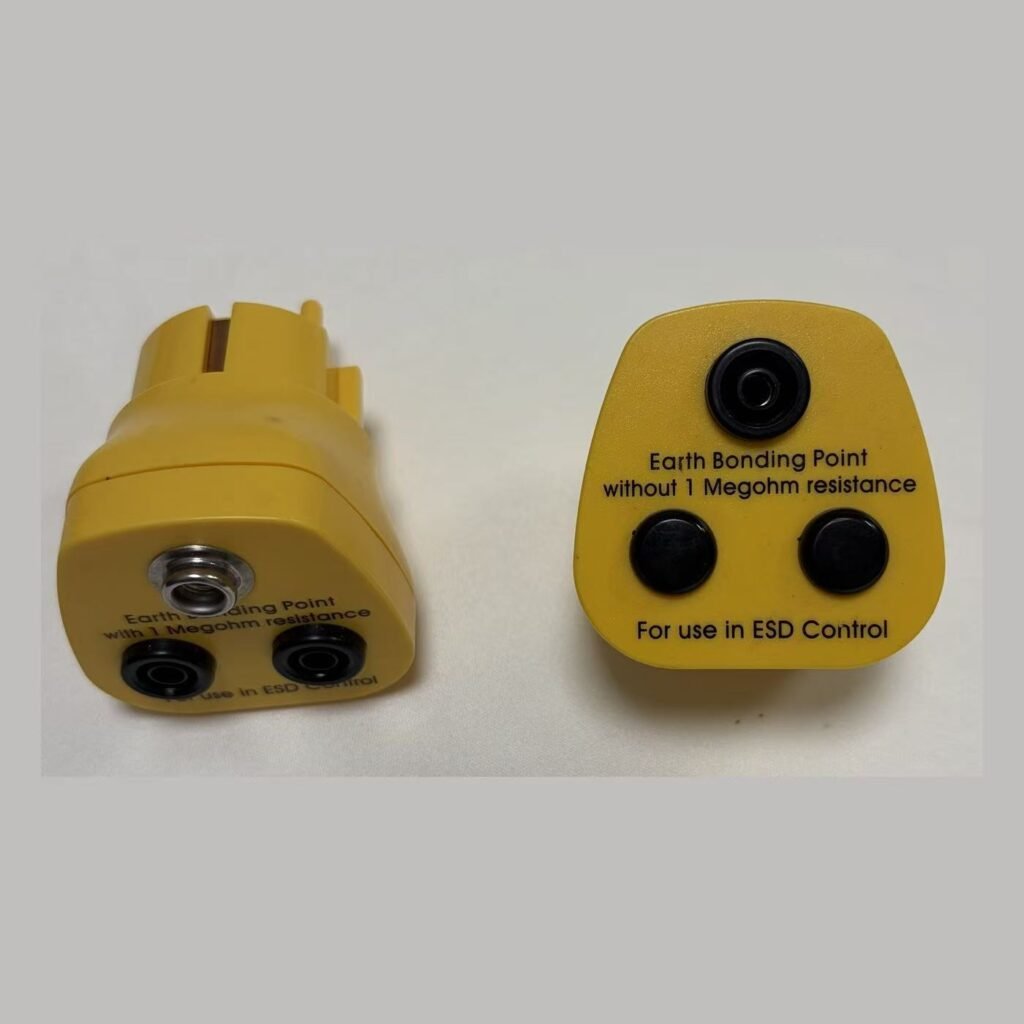
Earth Bonding Plugs and Ground Points
UK Earth Bonding Plug — BS 1363, 3-Pin
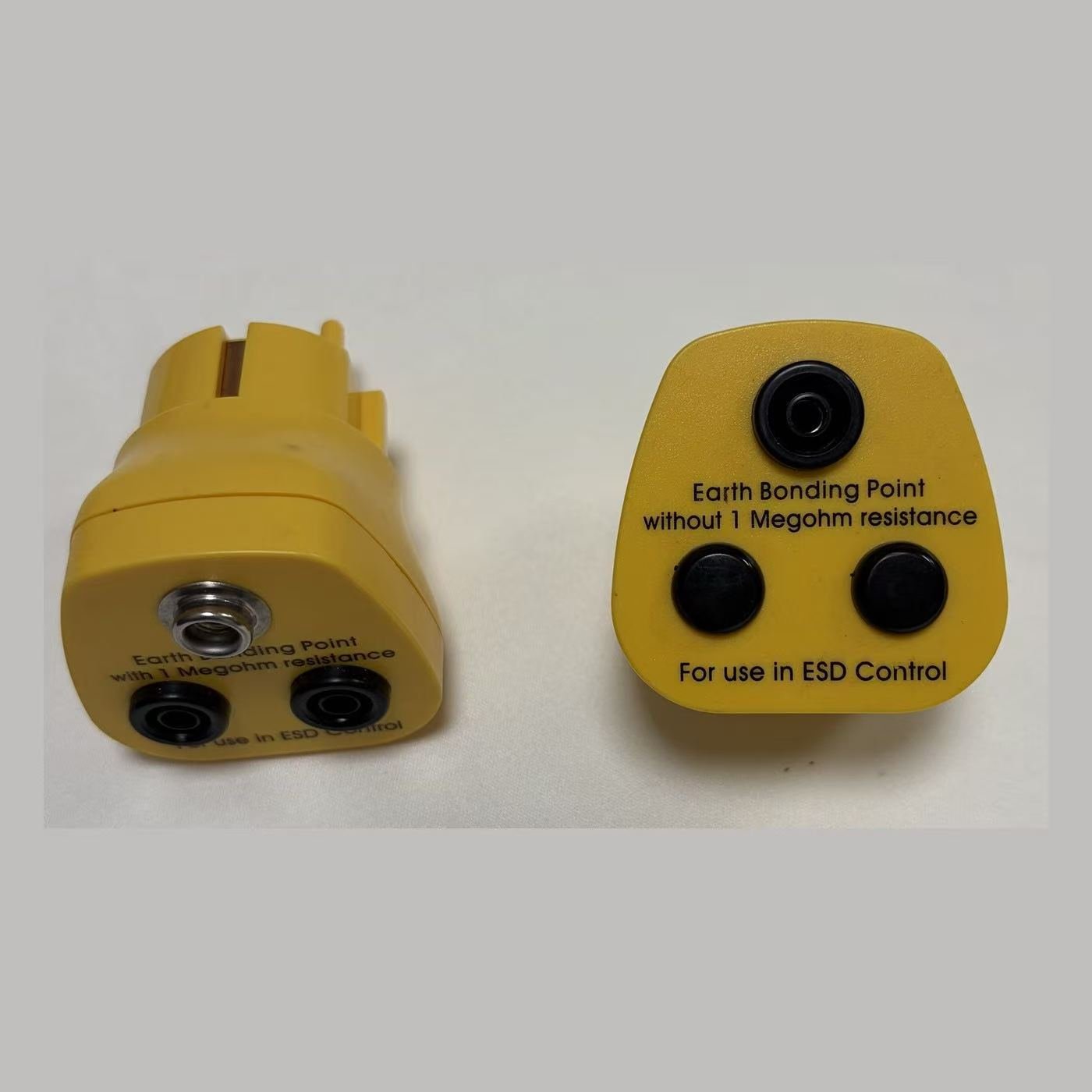
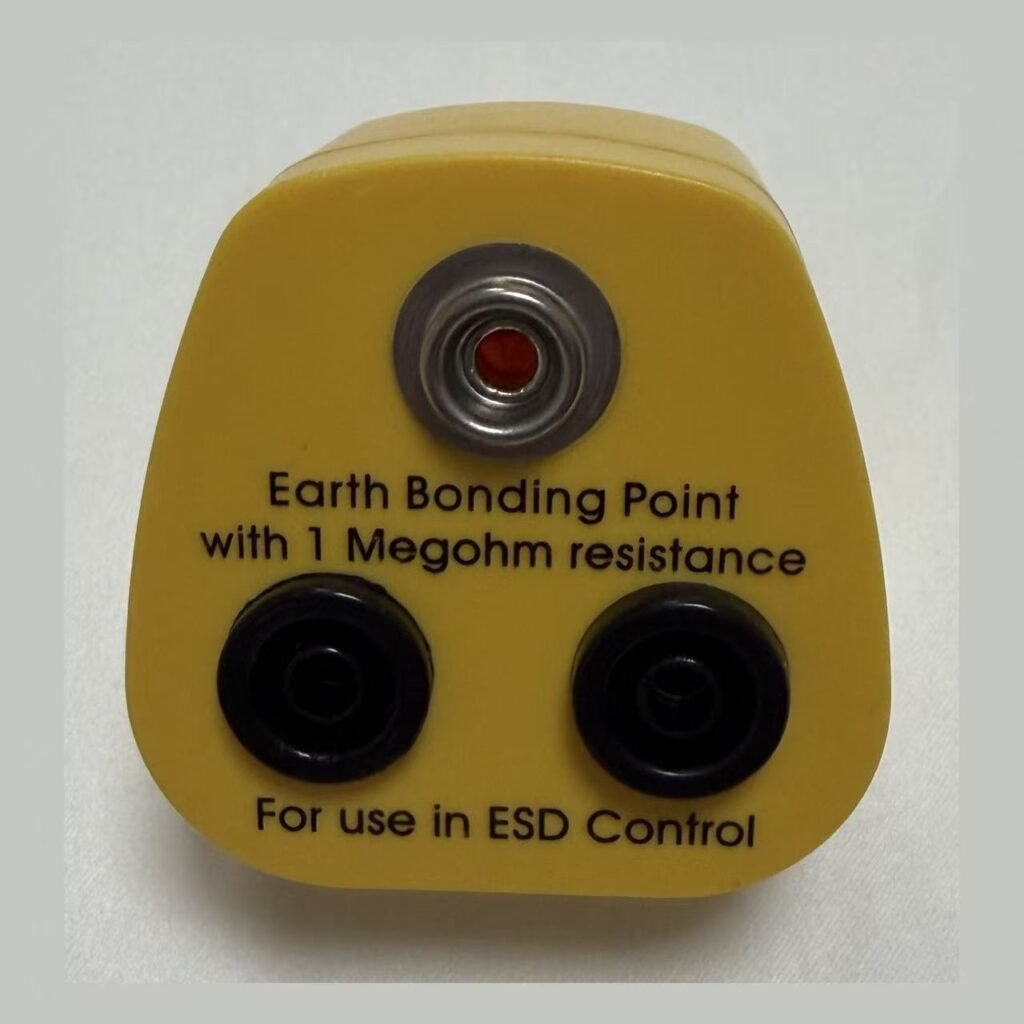
Moulded three-pin body for standard UK mains outlets. Live and neutral pins are insulated and serve only to locate and retain the plug; only the earth pin is conductive. Available with 1 MΩ resistor or as a hard-ground version with no resistor.
Face configurations: 1 × 10 mm stud with 2 × 4 mm sockets · 3 × 4 mm sockets
Model: EBP-001 · Colour: Yellow · MOQ: 100 pcs
EU Earth Bonding Plug — Schuko
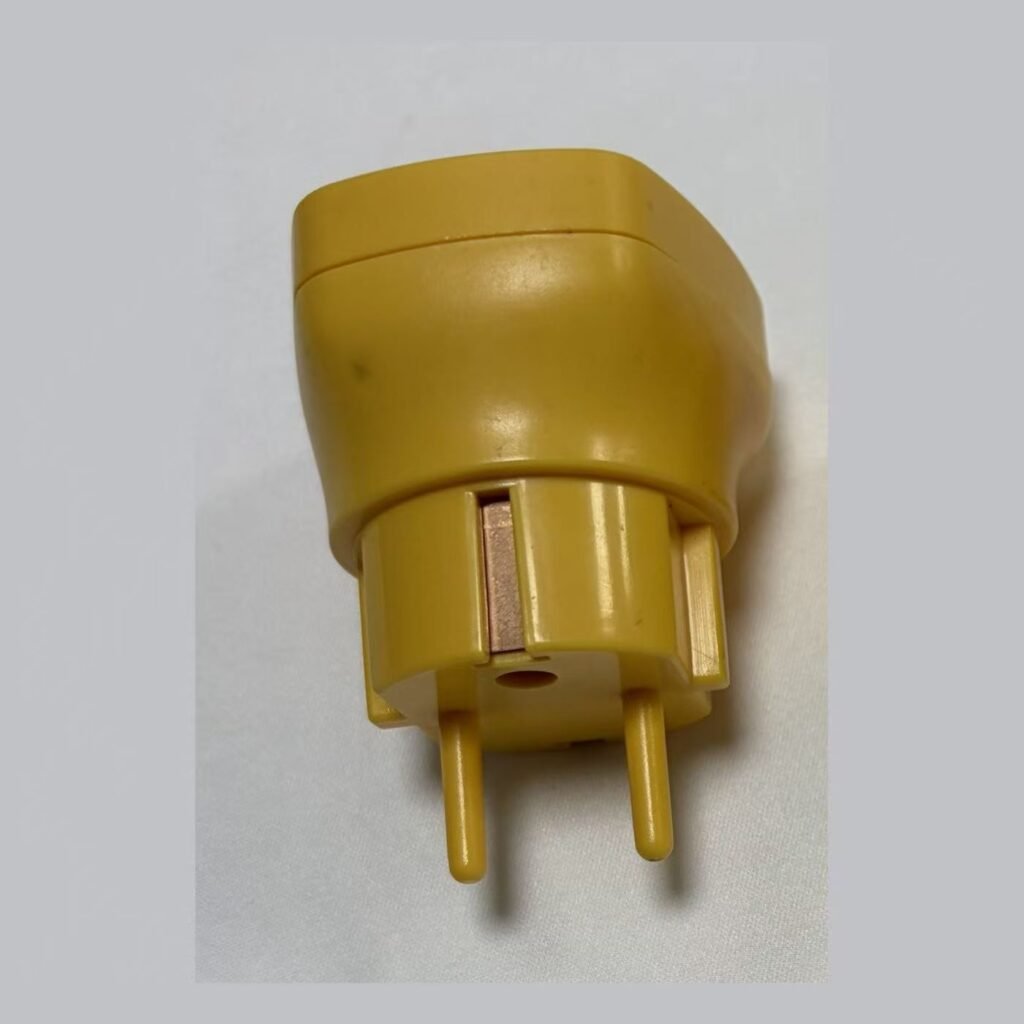
CEE 7/4 Schuko body for continental European outlets, with round pins and earth clips on both sides of the body.
Model: EBP-002 · Colour: Yellow · MOQ: 100 pcs
Bench-Mount Ground Block
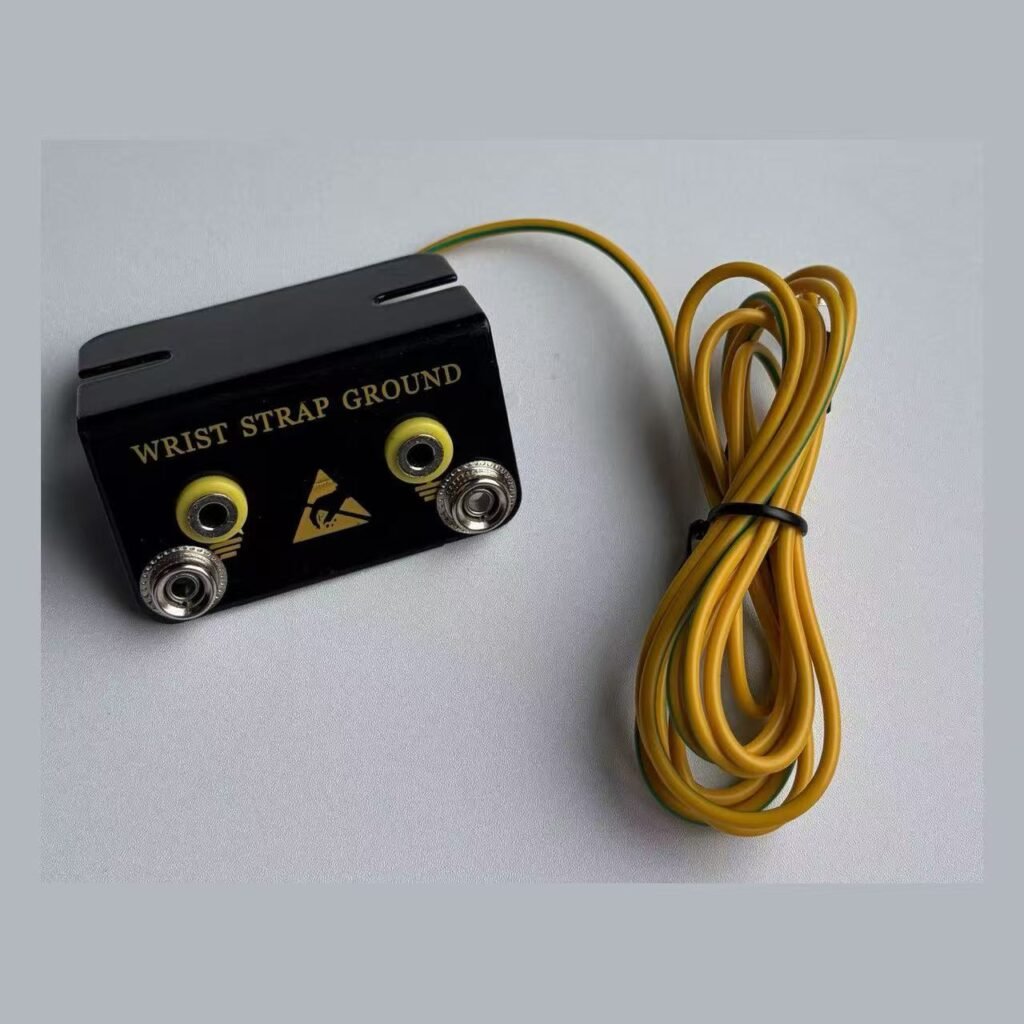
L-shaped block that screws to the underside or edge of a workbench, presenting multiple banana jacks so more than one operator can work at a single station. Available in 2, 3, 4, 5 and 7 jack configurations.
Model: EBP-003 · Body material: Plastic · MOQ: 100 pcs
Ground Cords, Snaps and Grounding Hardware
The bonding point is one part. What connects to it matters just as much, and a mismatched cord or a badly installed snap is the most common reason a workstation measures out of specification while appearing to be correctly assembled.
Bench Mat Ground Cord
Connects the worksurface to the bonding point. One end carries a 10 mm female snap that presses onto the socket fitted at the corner of the mat; the other end terminates in a banana plug, a 10 mm snap or a #10 ring terminal depending on what it is connecting to.
Two construction types are in common use. A straight cord runs flat and is usually routed along the back edge of the bench. A low-profile cord uses a flattened moulding at the mat end so the cord can pass under the mat without creating a bump under the work area.
Cords are supplied with or without a 1 MΩ resistor moulded into the connector. A worksurface cord and a wrist strap cord are not interchangeable — check which one your ESD control programme calls for before ordering.
Lengths available: 1 m · 2 m · 3 m or customised · Conductor: customised · MOQ: 100 pcs
Wrist Strap Coil Cord
Connects the wrist band to the bonding point. Terminates in a 4 mm banana plug at the bonding point end and a 4 mm or 10 mm snap at the wrist band end. Contains a 1 MΩ resistor as standard. Coil cords are rated by flex life — a typical figure quoted in the industry is around 50,000 flexes — because the coil is the part that fails first in daily use.
Lengths available: 1m;2m;3m or customized · Resistor: 1 MΩ · MOQ: 100pcs
10 mm Snap Kits and Snap Sockets
A snap kit installs a 10 mm socket into a bench mat that did not ship with one, or replaces a socket that has pulled through. The kit contains the socket, the stud, the backing washer and the screw. Installation needs a punch or a small screwdriver to make the hole and a snap tool or a firm press to seat the two halves.
Sockets are supplied in socket form (female, accepts the male snap on a cord) and stud form (male, accepts a female snap). Confirm which your cords use before ordering — mixing the two is the single most common ordering error in this category.
MOQ: 100 pcs
Alligator Clips and Adapters
Supplied for temporary and field use. An alligator clip is appropriate for clipping onto a chassis, a rack frame or a known earth stud. It is not appropriate for grounding a mat — see the warning under Installation below.
Grounding Hardware Reference
| Item | Connects | Interface | Resistor |
|---|---|---|---|
| Earth bonding plug | Mains earth → workstation | BS 1363 / CEE 7/4 Schuko | 1 MΩ or none |
| Bench mat ground cord | Bench mat → bonding point | 10 mm snap ↔ banana / ring | 1 MΩ or none |
| Low-profile ground cord | Bench mat → bonding point | Flat 10 mm ↔ banana | 1 MΩ or none |
| Wrist strap coil cord | Wrist band → bonding point | 4 mm snap ↔ 4 mm banana | 1 MΩ |
| Bench-mount ground block | Multiple operators → earth | 2–7 × banana jack | Per cord |
| 10 mm snap kit | Fits socket into a mat | 10 mm socket + stud | — |
Specifications
| Parameter | Specification |
|---|---|
| Series resistance | 1 MΩ ±5% (resistor version) / no series resistance (hard-ground version) |
| Mains body | BS 1363 (UK) · CEE 7/4 Schuko (EU) |
| Stud and socket sizes | 10 mm · 4 mm · M5 |
| Housing material | Plastic + metal |
| Operating temperature | -50 – 40 °C |
| Applicable standards | ANSI/ESD S20.20 · IEC 61340-5-1 |
Installation
- Confirm the outlet’s earth terminal is intact and correctly wired. An earth bonding plug is only as good as the earth it connects to. If the outlet’s earth is not verified, the whole station is ungrounded and the worksurface gives no protection.
- Insert the plug into the outlet. Do not use an extension lead with a switched or unearthed socket.
- Snap the bench mat ground cord onto the 10 mm stud, or plug the banana plug into the socket.
- Connect the wrist strap coil cord to a second stud or socket on the same face.
- Measure resistance to ground from the worksurface to a known earth. Record the reading. Repeat at intervals set by your ESD control programme.
Do not use an alligator clip on a mat surface as a substitute for a proper snap connection. The contact area is small and the added contact resistance can push the system beyond its specified limit while appearing to be connected. Use the installed 10 mm socket and a matching cord.
Where This Fits in a Workstation
The bonding point is one of three grounded elements at an ESD bench. It works with a two-layer rubber ESD bench mat on the worksurface and a wrist strap on the operator. For the wider product range see our ESD mat pages.
OEM and Private Label
ESDBEST has manufactured ESD control products since 1996, across nine production lines, with OEM programmes running in Europe, North America, Japan and Southeast Asia. Flexible MOQ, 10-day lead time. Custom colours, face configurations and packaging available.
Frequently Asked Questions
Is an earth bonding point the same as a common point ground?
Yes. The terms describe the same device. Earth bonding point (EBP) is the UK and European term; common point ground (CPG) is the North American term. The difference is the mains connector, not the function.
Do I need the 1 MΩ resistor version?
For anything a person connects to — wrist straps, coil cords — yes. For some worksurface and equipment grounding schemes a hard ground with no series resistance is specified instead. Check the requirement in your ESD control programme before ordering.
Can one earth bonding plug ground both a bench mat and a wrist strap?
Yes, provided it has two or more studs or sockets. That is the reason the device exists: both connections share a single verifiable point rather than being grounded separately.
What length of ground cord should I order?
Measure from the corner of the worksurface where the snap is fitted to the outlet the plug will occupy, then add slack for the cord to be routed rather than stretched. A stretched cord pulls on the snap and eventually tears it out of the mat.
Why are the live and neutral pins insulated?
They carry no current. They exist only to locate and retain the plug in the outlet so that the earth pin makes and holds contact. Only the earth pin is conductive.
What is the difference between a 10 mm stud and a 4 mm socket?
A 10 mm stud accepts the female snap fitted to worksurface ground cords. A 4 mm socket accepts a banana plug, which is what most wrist strap coil cords terminate in. Many plugs carry both so one part serves both connection types.