Coverage, Layout & Use Cases
Overhead Ionizing Fan: Coverage-First Ionization for Larger
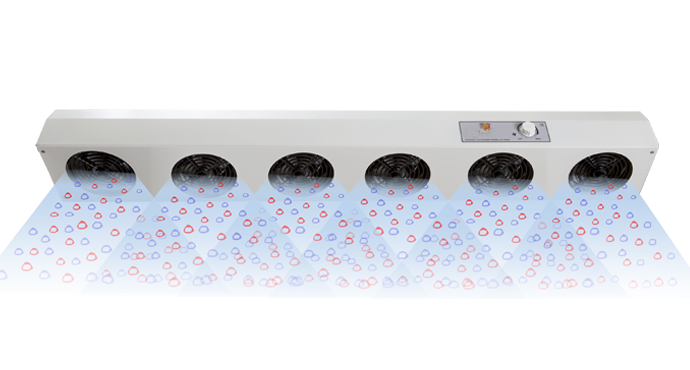
An overhead ionizing fan (often installed as a suspended ionizer fan) is designed to neutralize static across a larger workstation zone or production area where a benchtop unit can’t cover consistently.
This guide focuses on coverage planning, layout, and distance reality—the three factors that decide whether overhead ionization works in practice.
When Overhead Ionization Makes Sense
Choose an overhead setup when:
-
Multiple operators share a large bench
-
You need coverage across a line segment
-
Bench space is limited
-
Static appears on insulators moving through the work area
For the core selection logic (fan type, specs, verification), reference the main guide:
Ionizing fan selection guide → /https://esdbest.com/ionizing-fan/
Coverage Planning: One Big Fan vs Multiple Fans
Coverage depends on airflow distribution and distance. Many real setups perform better with multiple smaller fans rather than one large unit blasting air.
Practical Layout Table
| Area Type | Typical Recommendation |
|---|---|
| Single ESD workstation | Benchtop fan (most stable) |
| Wide bench / dual operators | Overhead fan (balanced coverage) |
| Production segment | Multi-fan suspended layout |
| Large open zone | Consider blower strategy |
If you’re deciding fan vs blower, use:
Ionizing fan vs ionizing blower → /https://esdbest.com/ionizing-fan-vs-ionizing-blower/
Distance Guidelines (What Most Installations Get Wrong)
Overhead fans lose neutralization performance if the working surface is too far away or airflow is blocked.
Checklist
-
Keep airflow unobstructed (lights, racks, tall bins)
-
Match distance to real decay requirements
-
Validate performance at the actual working point
Use targets and spec definitions here:
Ionizing fan specifications and engineering targets → /https://esdbest.com/ionizing-fan-specifications/
Maintenance and Verification for Suspended Systems
Overhead systems often fail quietly because emitters get dirty and no one notices until ESD defects appear.
Build a routine:
-
emitter cleaning schedule
-
periodic ion balance checks
-
decay performance spot checks
|
Input voltage |
DC 24V(RJ45 interface)/3 in 1 socket (220VAC 50/60Hz) |
|
Input Current |
< 0.21A AC |
|
Output voltage |
DC±4KV → ±7KV |
|
Power |
< 77W |
|
Ion emission |
DC |
|
Emitter electrode |
Tungsten |
|
Discharge range |
750*1550mm(L*W) |
|
Air volume |
≤ 135CFM*6 |
|
Noise |
Single air outlet ≤ 58dBA(1000mm away from the air outlet) |
|
Ozone thickness |
≤ 0.05ppm(150mm away from the air outlet) |
|
Ion banlance |
≤ |±15V| |
|
Discharge speed |
≤ 2.0s(450mm away from the air outlet) |
|
Status indicator
|
Power on/clean operation—blue light flashes |
|
Normal work—green light (always under monitoring status) |
|
|
|
|
|
Fan alarm—red light always on |
|
|
High voltage abnormality—red light flashes |
|
|
Infrared debugging/cleaning prompt – Blue light flashing |
|
|
Communication mode |
HB003 |
|
Working temperature |
0℃ -50℃ |
|
Working humidity |
< 70%RH |
|
Dimensions(L*W*H) |
1500*67*154mm(Ionizing Air Blower body size) |
|
Shell material |
Aluminum powder spraying |
|
Installation accessories |
1 pair of L-shape iron powder spray mounting bracket , |
|
1 pair of ABS screw handles(M6×12) |
|
|
|
|
|
Power adapter |
INPUT:AC100—240V 50/60Hz |
|
|
|
|
OUTPUT:DC24V 2A(Dual RJ45 interface) |
Testing steps:
How to test an ionizer fan (ion balance & decay time) → /https://esdbest.com/how-to-test-ionizer-fan/
FAQ
Is an overhead ionizer air fan better than a benchtop fan?
Not always. Overhead is better for coverage, benchtop is better for precision at a defined workpoint.
How do I know if I need a suspended multi-fan layout?
If one fan cannot cover the whole area consistently, split coverage with multiple fans and validate.
Can overhead ionization work in a cleanroom?
Yes—choose low-ozone, stable balance units and follow strict maintenance/verification routines.
Internal Link Anchor Text Table
| Where to place the link | Anchor text | Target URL |
|---|---|---|
| Intro paragraph | Ionizing fan selection guide | /https://esdbest.com/ionizing-fan/ |
| Layout section | Ionizing fan vs ionizing blower | /https://esdbest.com/ionizing-fan-vs-ionizing-blower/ |
| Distance section | Ionizing fan specifications and engineering targets | /https://esdbest.com/ionizing-fan-specifications/ |
| Maintenance section | How to test an ionizer fan (ion balance & decay time) | /https://esdbest.com/how-to-test-ionizer-fan/ |
| Footer | view ionizer options | https://esdbest.com/ionizers/ |
Contact Us Today
For bulk orders, quotes, or product guidance, get in touch with our expert team:
Email: sales2@esdbest.com
Phone: +86 137 1427 2599